Sunday, August 29, 2021

Over 30,000 civil servants didn’t register for vaccines


Over 30,000 civil servants didn’t register for vaccines, says JPA


So far, 74% of civil servants have been fully vaccinated while 17.8% have received one dose, JPA director-general Mohd Khairul Adib Abd Rahman said.

PORT DICKSON: As of Aug 19, 2.2% or more than 30,000 of the 1.6 million civil servants in Malaysia, were found to have not registered for Covid-19 vaccination on the MySejahtera application.

Public Services Department (JPA) director-general Mohd Khairul Adib Abd Rahman said as a follow-up, JPA would submit the names of the employees to their respective department heads to determine the reasons for the non-registration, and consider further action.

“After we matched the data in the MySejahtera application with the data of civil servants, we found that out of the more than a million civil servants, 2.2% did not register on MySejahtera for the vaccination.

“So we will look into it and try to increase the percentage (of vaccination of civil servants). This is because when more service sectors are opened, they have to go to the office, as attendance at the office is mandatory even though vaccination is not yet mandatory so far,” he said.

He told this to reporters after checking on the Community Vaccination Mobilisation Program (Movak) organised by the national unity ministry, and the housing and local government ministry for about 400 people among the Indian community here today.

Commenting further, Khairul said that as of Aug 19, 74% of civil servants in the country had completed their Covid-19 vaccine injections while 17.8% had received one dose.

He said that JPA had also asked the health ministry to expedite the vaccination of 30,000 civil servants who still did not have an appointment date to be vaccinated before the opening of all economic sectors in the country.

“This is because if we want to open the economic sectors, government services need to be opened first, so we hope those who do not have an appointment date will be vaccinated without delay,” he said.

In the meantime, he also called for civil servants who have not registered under the National Covid-19 Immunisation Program (PICK) to do so to ensure that the country achieves herd immunity quickly.

Khairul said all civil servants were now ready to return to office and continue to provide the best service to the public, and help restore the country’s economy.

M’sians involved in Kabul attack? Silence is not an option, academic tells PM


M’sians involved in Kabul attack? Silence is not an option, academic tells PM


WITH two Malaysians seemingly implicated in the deadly attack at the Kabul airport, an expert urged Prime Minister Datuk Seri Ismail Sabri Yaakob to make a firm stand that Malaysia neither supports nor condone any terror groups.

“The prime minister must make our stand clear that we don’t support any terror groups. I’m just upset that our Government is still keeping mum about this.

“Bear in mind that Taliban’s success in retaking Afghanistan, the withdrawal of US troops and deadly attack by Islamic State Khorasan (ISIS-K) is being used as propaganda by terror groups across the globe to launch attacks in their respective countries,” HELP University Faculty of Business, Economics and Accounting and Institute Crime and Criminology senior lecturer R Paneir Selvam told FocusM.


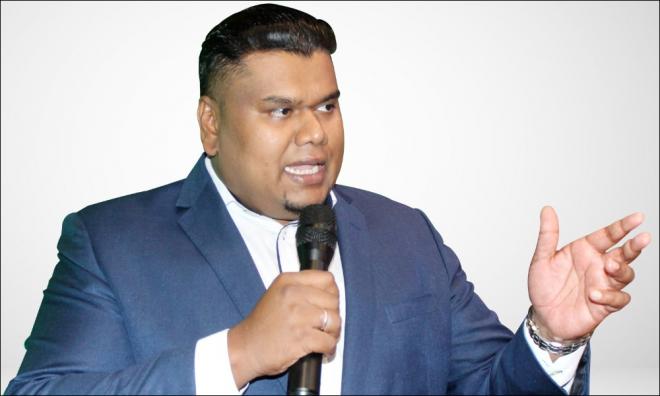
R Paneir Selvam

Yesterday, the UK Times quoted Taliban intelligence chief Maulawi Saifullah Mohammed as saying that they have captured six members of the ISIS-K involved in the deadly attack at the Kabul airport last week, with two of them being Malaysians.

Following the expose, Malaysiakini reported Inspector-General of Police (IGP) Datuk Seri Acryl Sani Abdullah Sani as saying that they were in the midst of authenticating the allegation.

Last Thursday, ISIS-K, a rival of Taliban, launched a deadly attack at the Kabul airport, leaving 200 people dead including 13 US soldiers.

US President Joe Biden subsequently retaliated by ordering a drone strike against those involved in the bombing.

On the supposed Malaysians’ involvement with ISIS-K, Paneir Selvam said that he was not surprised by the matter.

He added that in the past, there were many Malaysians who got caught for being part of terror groups, such as Noordin Mohammad Top and Azahari Husin.

“The Taliban actually has a good impression over Malaysia as we provided much humanitarian aid to the Palestinians and Rohingyas. So, I believe they wouldn’t simply implicate Malaysia’s name unless they have proof,” he opined.


People try to get into Hamid Karzai International Airport in Kabul, Afghanistan August 16, 2021 (Reuters)

Once a terrorist, always a terrorist

Touching on terrorism in general, Paneir Selvam said that after ISIS was defeated by the US forces and its allies, many of its former members wanted to return to their home countries.

While other countries refused to accept former ISIS members back, Malaysia took a different approach by allowing them to return home.

“Of course, our security experts assessed them first before allowing them back in. Once they were in Malaysia, I believe they were put under rehabilitation programmes before letting them back into our society.

“But in my personal view, a terrorist will always remain a terrorist. Why do I say this? It’s because we are dealing with someone who has been brainwashed by a certain ideology.

“As for ISIS and other terror groups, we are dealing with a religion-based ideology which makes it even more difficult to rehabilitate them,” he opined.


Photo credit: iStock

Citing former detainee Yazid Sufaat as an example, Paneir Selvam said that the former repeated his terror related offences despite being jailed and undergoing rehabilitation multiple times.

“It’s like dealing with hardcore criminals. No amount of jail time or rehabilitation programme will work on them. In my view, we have to isolate these people from the society,” Panier Selvam stressed.

With an economic downturn and rising unemployment due to COVID-19, he urged the Malaysian security team to beef up their monitoring system as terror groups would use the opportunity to radicalise the vulnerable.

“No doubt, our Special Branch has been doing a good job but we need to step up efforts given the economic situation and the rise of Taliban,” he noted.

On related matter, Paneir Selvam criticised several Government leaders for backing the Taliban without going through international norms and practices in recognising a regime change.

“As political leaders, these people must understand that there are certain protocols that needs to be adhered to before recognising the legitimacy of a foreign Government.

“I urge these so-called leaders not to jump the gun as it may jeopardise Malaysia’s image globally by sending a wrong message to the international community. Do bear in mind that we share a good relationship with the US and other major powers,” he remarked. – Aug 29, 2021.


M’sian duo held at Gitmo over 2002 Bali bombings to face charges tomorrow

theVibes.com:

M’sian duo held at Gitmo over 2002 Bali bombings to face charges tomorrow

Mohammed Nazir Lep, Mohammed Farik Amin detained since 2006, along with alleged attack mastermind Hambali of Indonesia


The November 2002 Bali bombings claimed 202 lives. – AFP pic, August 29, 2021

KUALA LUMPUR – After 15 years at the Guantanamo Bay detention camp, suspects in the November 2002 Bali bombings, including two Malaysians, are getting their day in court tomorrow.

Malaysian duo Mohammed Nazir Lep and Mohammed Farik Amin have been detained at the United States prison in Cuba since 2006, alongside Indonesian Encep Nurjaman, also known as Hambali and “the Osama of Southeast Asia”, who is said to be the attack mastermind, reported BenarNews.

All three are to be indicted at the US naval station at Guantanamo on charges linked to the blasts that killed 202 people, as well as the August 2003 assault on the JW Marriott Hotel in Jakarta that claimed 12 lives.

A charge sheet uploaded by the US Office of Military Commissions showed that the Malaysians face nine charges, and Hambali, eight, in relation to their alleged roles in the terrorist attacks.

All three will be charged with conspiracy, attempted murder, murder, intentionally causing serious bodily injury, terrorism, destruction of property, and attacking civilians and civilian objects.

The charges do not carry the death penalty.

The trio were arrested in Thailand in August 2003 and sent to a secret CIA prison network before being moved to Guantanamo in September 2006.

The Malaysians were also implicated in an al-Qaeda plot to crash a hijacked plane into the 73-storey US Bank Tower, also known as the Library Tower, in Los Angeles.

Hambali has been described as “an operational mastermind for Jemaah Islamiyah, a Southeast Asian militant group affiliated with al-Qaeda”.

He was among those responsible for organising the September 11, 2001 attacks in the US. – The Vibes, August 29, 2021


MP sounds alarm over Johor’s Covid-19 situation, wants govt’s urgent action


MP sounds alarm over Johor’s Covid-19 situation, wants govt’s urgent action

Bakri MP Yeo Bee Yin has urged the government to increase the healthcare system’s capacity and ramp up the vaccination in Johor amid increasing Covid-19 cases and deaths in the state.

She pointed out that the intensive care unit (ICU) usage capacity in Johor has already reached 90 percent while the state continues to have one of the lowest full vaccination rates in the country.

“It is very worrying to see an increasing trend of positive cases and Covid-19-related deaths in Johor from mid-July until now, despite a drop in ICU cases in the past two weeks. The different trends of ICU and death numbers are probably due to more brought-in-dead cases.

“Johor's full vaccination rate is still one of the lowest in the country despite it being one of the most industrialised states outside of Klang Valley.

“There is a need to look thoroughly into Johor’s Covid-19 situation by increasing ICU capacity in locations that are running out of ICU beds.

“In addition, I call upon the government to double or even triple up the vaccination rate in Johor before it is too late,” Yeo (above) said in a statement today.

She said she has already alerted the Health Ministry, the Covid-19 Immunisation Task Force (CITF) and the Johor government about the dire state of the Covid-19 situation in the state earlier this month.

“But so far, there’s no concerted effort seen. Hopefully, the new Health Minister Khairy Jamaluddin will pay more attention to Johor’s Covid-19 situation,” Yeo said, adding that she hopes the federal government will not marginalise Johorians in the fight against the pandemic.

As of midnight Aug 27, only 31.5 percent of the total population in Johor had been fully vaccinated.

Meanwhile, Johor has seen an average of 47 deaths a day in the past seven days.


Why Afghans hate the Yanks intruders-occupier's in Afghanistan

I published the following posts 16 years ago (2005) - Methinks it's time again to reproduce them here for your convenient perusal:


Sunday, May 22, 2005

The Tragedy of an Afghan Taxi Driver

"To the country boys here, if you're a different nationality, a different race, you're sub-human. That's the way that girls like Lynndie are raised ... Tormenting Iraqis, in her mind, would be no different from shooting a turkey. Every season here you're hunting something. Over there, they're hunting Iraqis."


Colleen Kesner, a resident from hometown of Lynndie England, of the Abu Ghraib notoriety


Lynndie England

Dilawar was a taxi driver in Afghanistan. Arrested by the US military, he was beaten on his legs until he couldn’t stand anymore. This occurred at the USAF 
Bagram air base, a US interrogation centre in Afghanistan notorious for torturing prisoners.

Following a rocket attack on the base, while he was in prison, he was nevertheless hauled into the interrogation room for another session, but by then his legs were bouncing uncontrollably and his hands were numb. He had been chained by his wrists to the ceiling of his cell for much of the previous four days.

When Dilawar asked for a drink of water, a 21-year old interrogator, Specialist Joshua Claus (obviously no relation of Father Christmas) concocted a form of mental torture to deny the prisoner that, enjoying Dilawar’s agony as the water was either pouring onto the prisoner’s body or squirted into his face.

A guard tried to force Dilawar to his knees, but his legs, pummelled by US military guards for several days, could no longer bend.

After the interrogation Dilawar was sent back to his cell, and chained to the ceiling. Several hours passed before a doctor saw Dilawar. By then he was stiff dead.

And the cruellest and most sad and unjust ending to this atrocity, many months before the official investigation even eventuated - and only after persistent report of torture including the Abu Ghraib scandal - most of the interrogators at Bagram believed Dilawar was an innocent man who simply drove his taxi past the US base at the wrong time.

The report into Dilawar’s death at the USAF base at Bagram contains graphic details of widespread abuse of detainees in Afghanistan carried out by young and poorly trained soldiers, including females like Lynndie England (do read this link), except they made Lynndie England look like Mother Teresa.

The torture was not just related to extracting information, but involved punishment (whatever that means) and a la Kempeitaialleviating the US soldiers' boredom or satiating their cruelty.

Though frequently reported to US officials, the incidents of prisoner abuse at Bagram were casually dismissed by them as isolated problems that had already been thoroughly investigated. Human Rights Watch reports that nine detainees in Afghanistan have died in US custody*, including four cases already determined to be murder or manslaughter.

* kt note: This was in 2005 (16 years ago) when I published this post


The dead cannot cry out for justice; it is a duty of the living to do so for them.

- Lois McMaster Bujold


***

Thursday, July 28, 2005

Bagram Villagers: "Die America!"

The USAF air base at Bagram, Afghanistan is one of the most notorious American military torture centres. It forms an important component of the American Gulag Archipelago. In many ways, it is even more notorious than Abu Ghraib and Guantanamo Bay prisons because a few Afghans died there from American torture.

Some months back, an innocent Afghan taxi driver, who happened to be passing the air base shortly after the place was attacked by the insurgents, was dragged in by American guards, beaten and tortured until he couldn’t even bend his legs. He was deprived of water, with a young American guard deliberately tantalizing him with water placed in such a manner he couldn’t drink from. When left alone in his cell, he died from severe injuries. And the tragedy was many Americans at the base knew he was innocent.

Now, a crowd of more than 1,000 Afghans gathered outside Bagram chanting "Die America!" They threw stones at a passing convoy of US military vehicles and attempted to batter down the camp gate. The protestors also threw stones into the compound of the air base. Afghan guards had to use sticks to drive back the mob while other troops fired into the air.

The rioting was in protest against the detention of eight villagers at the base.

One of the protestors said "We have supported the Americans for years. We should be treated with dignity. They are arresting our people without the permission of the government. They are breaking into our houses and offending the people. We are very angry.”

Related posts:

The Tragedy of an Afghan Taxi Driver

The New Gulag Archipelago!

Kerbau-ish Report: Former defence official claims had intel to show Malaysian politicians receiving foreign financial and ‘moral support’, especially from the US

MM:

Report: Former defence official claims had intel to show Malaysian politicians receiving foreign financial and ‘moral support’, especially from the US


Certain Malaysian politicians had received regular funding and ‘moral’ backing from foreign organisations and individuals. — Reuters pic

KUALA LUMPUR, Aug 29 — Certain Malaysian politicians had received regular funding and “moral” backing from foreign organisations and individuals, former defence director-general (Intelligence) Lieutenant General Datuk Mohd Salleh Ismail claimed.

He claimed that when he was in office, he received defence intelligence reports of correspondence between Malaysian politicians and their foreign backers, Mingguan Malaysia — the weekend edition of Utusan Malaysia — reported today.

According to Mohd Salleh, physical assets and cold hard cash were among the forms of support given by the foreign backers to the Malaysian politicians. He further claimed that most of the foreign backers were from the US.

“We received information that several leaders in the country are strongly favoured to continue their position and strong influence in politics.

“They also provided moral support. This is clear through their actions of constantly meeting with influential parties overseas. This is the kind of information we have obtained.

“We do not have proof if the assistance was handed over directly, but based on information obtained, several organisations in the US, for example, are involved,” Mohd Salleh was quoted saying.

According to the former government official, the Defence Ministry has information on the identities of the Malaysian politicians and the exact dates and locations of when they met their foreign backers on overseas trips.

“When they [politicians] were in several countries, we were doing our monitoring. Who they met and such.

“However, we do not know what was discussed. But there were indeed meetings between several individuals who obtained this moral support from those overseas,” Mohd Salleh was quoted saying.

However, the Malay weekly did not report if Mohd Salleh disclosed the identities of the Malaysian politicians or their alleged foreign backers as no names were mentioned in the news report.

***

kt notes:

1. He is a FORMER whoever

2. He was DEFENCE Intelligence - WTF was he doing with POLITICAL intelligence

3. Intelligence chiefs, past and present, don't squeal like a kerbau

Conclusion: (a) Sheer Kerbau, (b) Preparing the ground for Police to arrest some poor bastards, (c) combination of (a) and (b)


The dangerous and treacherous new sports minister


New sports minister must use more than his noodle


Four years ago today, Malaysia’s sports minister won a gold medal while competing at the SEA Games. The third person to replace him at the ministry is now at the helm – a man known more for his bowl of mee than gold.

When the Malaysian Paralympics team left for Tokyo recently, sports minister Reezal Merican Naina Merican came to send them off. Over the last couple of years, he has overseen their preparations, and that of the able-bodied Olympians before them, providing funds and his personal touch.

It must have been a touching send-off. After all, he won’t be there when they come back, certainly with a few gold medals. Instead, the newest sports minister – Ahmad Faizal Azumu – will get to bask in reflected glory and be part of the media frenzy that will follow.

The youth and sports ministry has become a carousel of sorts, over the past decades, with the conveyor belt bringing a new minister every couple of years, and dropping the man off – yes, it has always been a man except for Azalina Othman Said in 2004 – and going on to fetch a new one.

Azalina, Muhyiddin Yassin, Hishammuddin Hussein and Khairy Jamaluddin are the only ones to have ever hung on to the position for any length of time in recent memory. The first three lasted four years and Khairy a full five.

In the 40 years since Dr Mahathir Mohamad first took power, there have been 16 sports ministers.

Is it any wonder then that we do not have any proper sports policy to speak of?


On Aug 29 four years ago, Khairy Jamaluddin won a gold medal at the SEA Games. (Bernama pic)

Khairy was the sports minister at the last SEA Games that Malaysia hosted, in 2017. He was even an athlete, taking part in the polo event and – what’s more – winning the gold medal. That was on Aug 29, 2017 – exactly four years ago today.

By the time the next edition of the Games came around in 2019, Khairy was neither minister nor athlete.

Instead, it was Syed Saddiq Syed Abdul Rahman who, in Manila, basked in the glory of Malaysia winning the second 100m gold in a row, with Haiqal Hanafi being crowned the fastest man in the region.

Before Syed Saddiq could even say “tahniah”, his tenure was over, no thanks to the Sheraton move, and Reezal Merican had the post. Now, it’s over to Faizal. And he’s got a lot on his hands.

The glory days of Malaysian sports are fading. Lee Chong Wei has hung up his racquets, and so too Nicol David, while our track and field athletes are nothing to shout about.

Chong Wei, despite his best efforts, could not bring back Olympic gold, settling for silver three times. He never got to be world champion, either. Can Lee Zii Jia do it?

Azizulhasni Awang may have been the star of the Tokyo Olympics but he is 33. There is no one breathing down his neck, not even fellow Olympic cyclist Muhammad Shah Firdaus Sahrom – who was only at the Olympics because Azizul had won two berths for Malaysia, in the sprint and keirin.

While Malaysia has been languishing, the Vietnamese and the Laotians – let’s not even talk of the Thais and Indonesians – are fast leaving us behind. Then, there’s Japan and Taiwan in world badminton.

There is a lot to do, not just for the medals but also to create a sports culture at grassroots level. We need to keep the production line of fresh young athletes running.

Faizal can breathe easy for now, ironically enough, thanks to Covid-19. The next SEA Games is due to be held in Vietnam in April or May and there is still no guarantee it will go ahead.

The Asian Games in China is only in September but Faizal will have little to do for that.

In fact, it is hoped that Faizal does not meddle just yet. The programmes are already up and running – and not much is expected of Malaysians, considering the constraints of the pandemic.

It is at the 2024 Olympics that his mettle will be tested. He has his job cut out for him. He has to roll up his sleeves and get down to work. We need a man who gets down to the field and gets his fingers dirty, not someone who watches the action while slurping on curry mee.

Is Faizal a doer? I have my fears. This is the guy who boasted that when he was part of Jasa (the government propaganda unit), all he did was to think.

“We’d go into the office, sit down and think. That’s all we did. Think,” he proudly told Parliament. If he thinks that’s how this job is going to go, I think he has another think coming.

He wasn’t exactly a great sporting success while he was Perak menteri besar and automatically the Perak FA chief. He left the team in tatters.

When he abruptly resigned in January after being ousted as menteri besar via a confidence vote, Perak players and officials had not been paid for close to three months.

The wage bill was about RM2 million a month. That meant he left behind a RM6 million hole, despite making promises to the players that they would be paid. A couple of players just quit and left.

I am told he is a likeable fellow, though, very approachable and with a penchant for hockey, especially while at his alma mater, Ipoh’s Anderson School.

His current portfolio, however, is no school. The learning curve will be steep.

There are just three years before the Paris Olympics in August 2024.

If the new government survives until the end of its term, Faizal might be the man to get the contingent prepared. But he won’t be the one to celebrate when they return.

A new government will be in place by then. And, I am guessing, a new sports minister.

***

kt notes:

When Azumu was MB Perak, and the Perak soccer team won the FA Cup (or some trophy) he confiscated land worked on by some Chinese farmers for more than 40 years. Those farmers had no licence to work the land, because for those 40 years the Perak government refused to grant them those but conveniently allowed/ignored their farming.

Azumu then gifted the confiscated land to everyone of his soccer players, without any consideration for the victimised farmers. 

Azumu can be very dangerous and callous to people he doesn't give a shit for, even like his old Pakatan Harapan colleagues, when/where in the Tanjung Piai by-election, he was "caught" badmouthing them to his supposedly-political opponents in UMNO. He is indeed very treacherous and as shown in his ouster as MB Perak, he has been immensely disliked distrusted disregarded by even his PN colleagues.


Pakatan must move on, groom next generation, analysts say

MM:

Pakatan must move on, groom next generation, analysts say


It is time for PH and the Opposition to move forward and formulate a long-term strategy in order to engage the majority of Malaysians as opposed to their traditional support in mostly urban areas. — Picture by Shafwan Zaidon

KUALA LUMPUR, Aug 29 — Pakatan Harapan (PH) and the larger Opposition’s failure to get majority support for Datuk Seri Anwar Ibrahim to be the prime minister was seen as a setback for them and their supporters.

However, it showed that PH and other Opposition parties could at least unite and support one leader as their PM candidate, avoiding the infighting that prevented the coalition from regaining control of the government in 2020.

PH accepted Datuk Seri Ismail Sabri Yaakob’s appointment as prime minister, and proposed openness for discussions and cooperation under the “big tent” concept based on its reform agenda and the people’s interests.

Several political analysts told Malay Mail that it is time for PH and the Opposition to move forward and formulate a long-term strategy in order to engage the majority of Malaysians as opposed to their traditional support in mostly urban areas.

Associate director at Vriens & Partners, Shazwan Mustafa Kamal said the “big tent” approach was not a novel idea but PH was right to plan for the future and groom leaders to replace their ageing chiefs.

“PH should focus on coming up with a consolidated shadow Cabinet comprising all Opposition reps.

“Anwar can be the PM choice, but PH should ideally be grooming a replacement leader already,” he told Malay Mail when contacted.

Shazwan also added that although PH and the other Opposition parties could unite on an ad hoc basis, they need to formulate a clear narrative in terms of policies and leadership in order to reach the people.

“The proof will be the pudding if they can align in such a way that was seen during the lead-up to GE14.

“But the difference is that PH has to be clear in what they are offering, in terms of policies and leadership, and they have to be able to narrate this in a way that can be understood by all voters, not just those within the urban areas,” he said.

Universiti Teknologi Malaysia’s geostrategist Prof Azmi Hassan said the 15th General Election (GE-15) was more important for the Opposition than the scramble for the PM’s post last week.

He said they need to build confidence for voters to choose the coalition.

“First, confidence needs to be built within the Opposition whether the big tent strategy led by Datuk Seri Anwar Ibrahim is formidable enough or more importantly acceptable by the general public.

“The problem with that is that Datuk Seri Anwar as a prime minister-designate is not acceptable within the big tent strategy especially with Warisan and a few independent lawmakers and Pejuang too and Muda. So in this case they need to rethink their big tent policy. It is a good strategy but again who is their leader that will bring them facing the GE15.

“They need to concentrate on GE15, not on trying to increase the 105 to 114 or 111 in order to retake Putrajaya via a majority method,” he told Malay Mail.

Azmi said the Opposition also must instil the confidence in the general public that they are ready to tackle the nation’s problem and ready to retake Putrajaya.


Datuk Seri Anwar as a prime minister-designate is not acceptable within the big tent strategy. — Picture by Miera Zulyana

More importantly, they also need to face GE15 under one umbrella and even ensure they have a leader that is acceptable by all of them.

“The problem with that is they gain 105 votes because of Datuk Seri Anwar, maybe that’s true, maybe it’s not but the best possible way for the Opposition to move forward is not Pakatan Harapan plus Pejuang or plus Muda.

“I don’t think they should go that way. They should go as Pakatan Harapan, period. All must be in the same boat,” he said.

On Thursday, PH made strides in this area when it announced that Sabah’s Upko has officially joined the coalition as a component party.

For senior fellow at the Singapore Institute of International Affairs Oh Ei Sun, however, PH’s latest failure to regain control of Putrajaya indicated that Anwar’s viability as the coalition’s candidate for prime minister was showing diminishing returns.

He said that the support by both Pejuang’s Tun Dr Mahathir Mohamad and Warisan’s Datuk Seri Shafie Apdal was made “at the spur of the moment” and was by then “too late” akin to their failure to unite during the Sheraton Move in February 2020.

“More or less like the Sheraton Move at the last moment also Anwar was trying to make his own bid and then at the last moment, support Mahathir instead but again it’s too late so in both cases it was too late.

“That 105 supporting Anwar cannot be taken at face value. It’s not that they all like Anwar, it’s just a desperate move,” he told Malay Mail when contacted.

Oh was also not convinced that PH and the Opposition were ready to be contenders in GE15, saying their performance in 2018 was just “lucky” as Umno and PAS contested in the same seats in Malay rural seats, which lead to split Malay votes there.

He added that in GE15, PAS would be backed up by Umno and their strategy would lead to even more of a challenge to PH which is something they need to think about more than focusing on Anwar.

“I think those days are over as Umno and PAS, even with their disagreements, are working together but now with Umno firmly in charge.

“PAS would come back to Umno and they will coordinate their seat allocations and so on and therefore it is very difficult for Pakatan to repeat what they did in 2018. I think that is more important than uniting around Anwar,” he said.

+++++++++

kt notes:

The statement "Anwar as a prime minister-designate is not acceptable within the big tent strategy" shows that some do not even know what "big tent strategy" means. I hope those people would stop mumbling big words when they know fuckall.

Secondly, it's not that Anwar doesn't have support when he has been consistently having approximately 90 behind him for quite a fair while (since 2020). It's the reality of very dirty Malaysian politics that he has been, also consistently, sabotaged one way or another, because there are politicians who fear, envy or hate him.


PKR rep accuses Perak exco of 'sabotage' in containing pandemic


PKR rep accuses Perak exco of 'sabotage' in containing pandemic

PKR's Hulu Kinta assemblyperson today alleged that a Perak state executive councillor has appeared to "sabotage" efforts made by the state government to contain the Covid-19 pandemic.

In a statement, Muhamad Arafat Varisai Mahamad (above) claimed that the Perikatan Nasional exco member was not interested in attending the state government's official events, which can be a sign of protest against Menteri Besar Saarani Mohamad.

"Since the collapse of PN in Putrajaya, the exco member from PN party was not sincere in assisting the state government and not interested in going to the ground with the menteri besar, despite this being part of his responsibility.

"Not once, but several times. I was made to understand that this serves as a form of protest and a 'warning' that (the exco member) would not hesitate to withdraw his support for the menteri besar if PN is not respected in Perak," he said.

However, Muhamad did not name the exco member.

On Aug 26, The Star quoted few opposition lawmakers questioning PAS' Mohd Akmal Kamaruddin, the exco member in charge of health, science, environment and green technology, for allegedly not going to the ground during the Covid-19 pandemic.

In a debate on the royal address at the state assembly sitting, Tan Kar Hing (PKR-Simpang Pulai), Howard Lee (DAP-Pasir Pinji) and Asmuni Awi (Amanah-Manjoi) raised the issue about Akmal allegedly neglecting his responsibility.

Tan said with the number of Covid-19 cases on the rise in Perak, the only person who was seen as doing the job of the health exco, was the menteri besar.

"I suggest the setting up of a special health select committee, and if the health exco is unable to do his job, there should be a reshuffle to get someone who can do a better job," he said.

Yesterday, Perak DAP chairperson Nga Kor Ming also criticised Akmal for failing to do his job in battling the pandemic.

When contacted, Akmal told Malaysiakini that he will respond to criticism hurled against him in the next sitting on Monday (Aug 30).

"I will respond in the state legislative assembly sitting next Monday," he said curtly.

For the record, Ahmad Faizal Azumu resigned as menteri besar after losing a confidence vote in the state legislative assembly on Dec 4, 2020.

A total of 48 assemblypersons voted against Faizal while 10 others voted to retain him as menteri besar.

All three state assemblypersons from PAS supported Faizal.

Saturday, August 28, 2021

2 M’sian Islamic State members reportedly caught by Taliban in Kabul

theVibes.com:

2 M’sian Islamic State members reportedly caught by Taliban in Kabul

We’ve beaten armies from 36 Nato countries, we’re not threatened by the Daesh, says criminal investigation chief Saifullah Mohammed


We will ‘capture and kill (the Daesh) wherever we find them’, says Taliban leader Saifullah Mohammed. – AFP pic, August 28, 2021

KUALA LUMPUR – After an intense gunfight in West Kabul on Thursday, Taliban militants captured six Islamic State (IS) operatives, two of whom are reportedly Malaysians.

According to a report by British publication The Times, the four other terrorists are Afghans. Together with the Malaysians, they fought for the Islamic State of Iraq and Syria – Khorasan (Isis-K), the report said.

Isis-K is understood to be an offshoot of IS, which operates in South and Central Asia.

In Afghanistan, an ongoing turf war exists between the Taliban and Isis-K. The latter has branded the former as “filthy nationalists” who only want to form an Islamic administration within Afghanistan’s borders, as opposed to fighting for a global Islamic caliphate.

“Four are Afghans but it seems the other two are Malaysian,” Taliban criminal investigation department chief Saifullah Mohammed was quoted as telling The Times.

“They aren’t as tough as they think they are. We’ve just beaten the armies from 36 Nato (North Atlantic Treaty Organisation) countries so we know we can capture and kill the Daesh (Isis) wherever we find them.”

The report mentioned that the men had surrendered after a clash that occurred merely a few hours after a widely reported and deadly suicide attack at Kabul International Airport.

Saifullah said Isis-K has been conducting operations disguised as the mainly-Pashtun Taliban, sowing fear among the Afghans.

However, the Taliban has proudly hailed the United States’ withdrawal from Afghanistan as a victory for them as their fighters took control in various parts of the country.

Viewing this as their triumph, the Taliban have become confident in asserting that Isis-K can be easily defeated.

Although the US and the Taliban may have a mutual enemy in Isis-K, Saifullah was quoted as saying they would not need American help in their fight.

“We don’t need Western intelligence assets or high technology to defeat the Daesh.

“And we don’t want any American help in fighting them. We just want the Americans to go, and then we will deal with Daesh in the way we know,” he was quoted as saying.

According to the report, the gunfight is understood to have occurred after Taliban militants were alerted to reports of Isis-K gunmen shooting into people’s homes in Kabul.

On August 15, the media had reported that Taliban fighters had not only secured nearly all of Afghanistan, but also surrounded the capital of Kabul.

American forces merely maintained a presence at Kabul International Airport, helping Afghan and Western evacuees flee the country.

On August 26, however, militants suspected to be from Isis-K performed a suicide bomb attack near the airport, killing 200, including 13 American soldiers and two British nationals.

The chaotic scenario emerged after the US announced withdrawal of all its troops from Afghanistan by the end of this month. This ends American presence in the country after 20 years.

The US and its allies had invaded Afghanistan in late 2001, dislodging the hard-line Taliban government following terrorist attacks on the Pentagon headquarters in Arlington and the twin towers in New York with hijacked planes on September 11 that year. One other plane that was also hijacked crashed in a field. – The Vibes, August 28, 2021


Shahrir Samad confirms Ass-binte hated as a ‘political criminal’ by both sides of politics

theVibes.com:

Azmin as DPM? He’d flounder in Parliament: Shahrir

If Dewan Rakyat needs to be strengthened, quality has to come first, Umno veteran says


Umno veteran Tan Sri Shahrir Abdul Samad says Bersatu’s Datuk Seri Mohamed Azmin Ali is incapable of taking up the role of deputy prime minister because of the opposition’s anger towards him. – The Vibes file pic, August 27, 2021

KUALA LUMPUR – Size matters, said Umno veteran Tan Sri Shahrir Abdul Samad, when it comes to restoring Parliament’s rightful role, while Bersatu’s Datuk Seri Mohamed Azmin Ali is not the deputy one needs as a Dewan Rakyat strategist.

Shahrir, in a Facebook post today, laid out his reasons, and among them is that a deputy prime minister is typically the government whip responsible for managing strategies in the Lower House by wrangling the bloc’s frontbenchers and backbenchers.

“This is why, in picking a deputy prime minister, his role in the Dewan Rakyat must be taken into account.

“A parliamentarian like Azmin is incapable of this role because of the opposition’s anger towards him. He is seen as a ‘political criminal’ by both sides of the aisle and cannot be DPM, even if Tan Sri Muhyiddin (Yassin) was still PM.

“If Parliament needs to be strengthened, quality has to come first among front- and backbenchers. This is already limited to the 114 MPs (backing the prime minister).”

Shahrir said from the 114 MPs supporting Prime Minister Datuk Seri Ismail Sabri Yaakob, if 70 are given positions, only 44 backbenchers are left.

“The 44 backbenchers cannot outweigh the opposition and independent bloc of 106 MPs. This is yet to take into account their quality and effectiveness in terms of debates and performance.

“The Dewan Rakyat has several select committees aside from the Public Accounts Committee. So, the 44 backbenchers are needed to fill up the select committees.

“Hence, frontbenchers (MPs with government posts) should not exceed 40% of the 114 MPs. This move will put backbenchers’ strength at 68 people, which is a good image for the country and they have a voice when people’s issues are being debated.”

He added that this could be tricky as the current government is a mixed one, and it is typical to see more ministers and deputies being appointed.

Australia Sabotaged Its Own Interests in China Relations

Consortium News:

Australia Sabotaged Its Own Interests in China Relations

[December 8, 2020]

The destruction over the past five years of Australia’s mutually beneficial diplomatic and trade relationship with China was probably a successful “Five Eyes” information warfare operation, writes Tony Kevin.


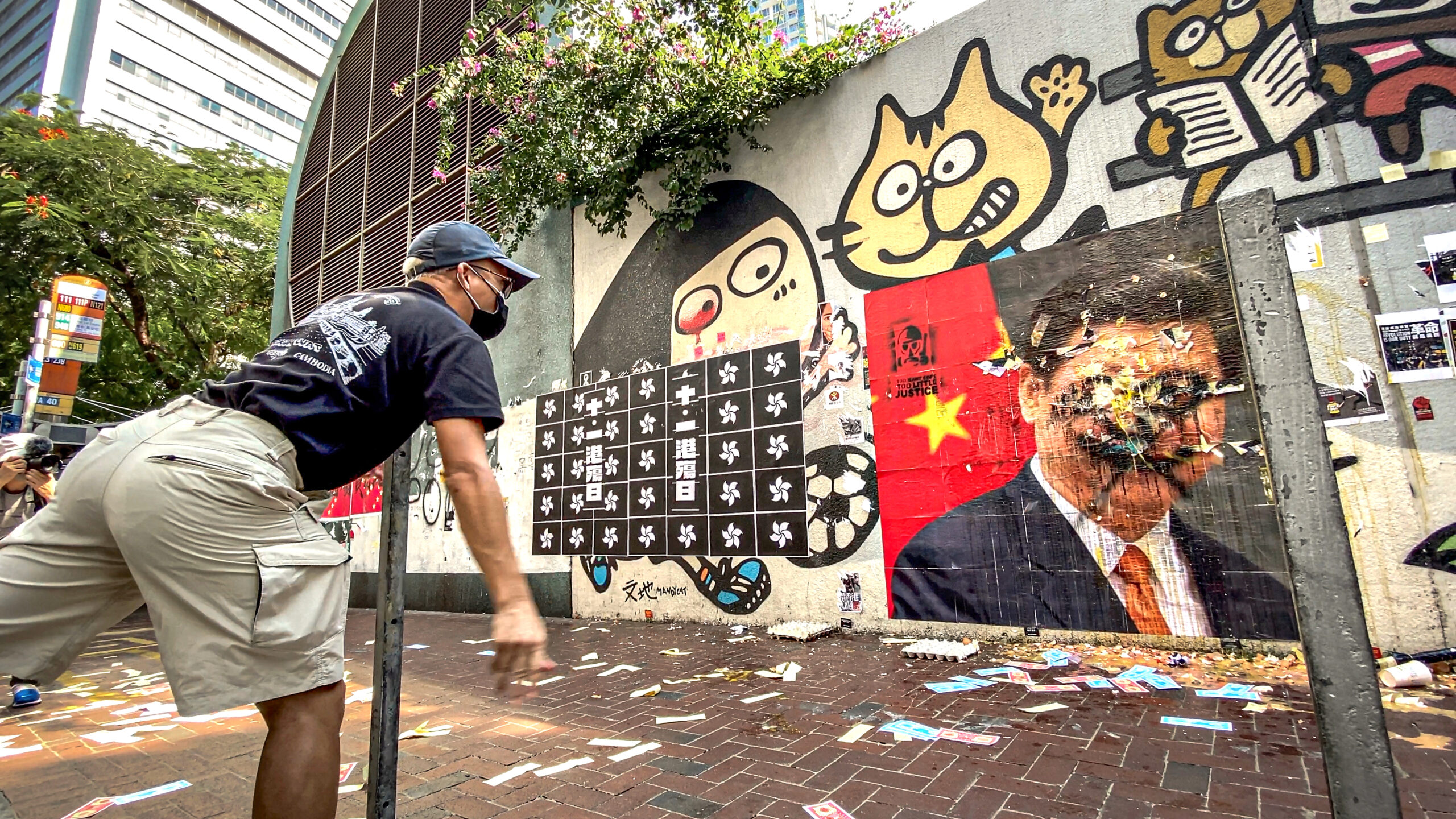
Hong Kong protester throws egg at President Xi Jinping’s portrait on China’s National Day, Oct. 1, 2019. (Studio Incendo, CC BY 2.0, Wikimedia Commons)


By Tony Kevin
Johnmenadue.com


The address to Federal Parliament by Chinese President Xi Jinping on Nov. 17, 2014, marked a highwater mark in bilateral relations. Xi was in Australia for the G-20 summit in Brisbane hosted by Prime Minister Tony Abbott. His theme was that China was committed to peace but ready to protect its interests.

Since then, the relationship has gone downhill — first slowly and haltingly, but over the past two years with sickening acceleration. Now the relationship seems irretrievable. For educated Chinese, Australia is now an object lesson in Western arrogance, hypocrisy and betrayal of friendship. The dinner party has ended in upended chairs, shouts and bitter accusations as both sides angrily walk away.

After the high symbolism of the Xi speech, all seemed well. In 2015 the Darwin Port was leased to a Chinese company for 99 years. Growing numbers of Chinese students and tourist visitors to Australia were becoming mainstays of Australia’s thriving higher education, tourism and property sectors. China as an Australian export market grew steadily in significance: last year it represented nearly 50 percent of Australian commodity export earnings. Victoria in 2018 signed a memorandum of understanding with China to work with China’s Belt and Road Initiative.

From the beginning, there were signs that powerful forces were determined to cripple Australian-Chinese engagement: and they have now seemingly won. The present breakdown is tragic for Australian economic and political interests. Many innocent Australians’ livelihoods are being harmed by our own government’s and political class’ stupidity. It is hard to see now how the damage done to Australia-China relations may be healed anytime soon.

Covert Interference


Diagram of the “Five Eyes” intelligence network including the U.S., Canada, the U.K., Australia, New Zealand. (@GDJ, Openclipart)

Controversially, I contend that Australia has over the past six years lived through a textbook experiment of covert foreign policy interference by powerful Anglo-American influences, subtly working through local sympathizers in public life here. Australian political elites — already culturally predisposed to trust Anglo-American friends, and naive as to their power and guile — have been persuaded to adopt increasingly adversarial positions against China across a broad front. This essay can only hint at the breadth and skill of this classic Five Eyes information warfare operation: it would take a book to expose it fully.


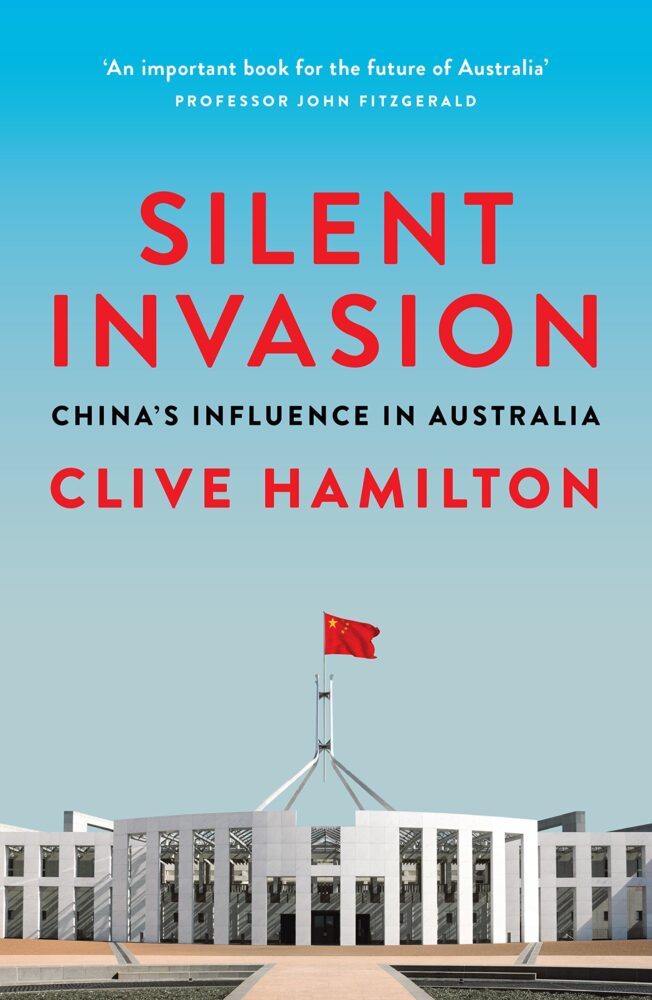
Clive Hamilton’s notorious attack on China, Silent Invasion, was published early in 2018. Hamilton had been China-bashing on the fringes of Australian academe for some years beforehand but was still being generally dismissed as an embarrassing outlier. Andrew Podger’s 21 March 2018 review in The Conversation was typical of the Australian mainstream rebuttal of Hamilton’s views, then considered extreme:

“Perhaps Hamilton’s book is a useful reminder that we must not be naïve about our relationship with China. But his prescription, premised on China being our enemy and determined to achieve world domination, is precisely the wrong direction for addressing the genuine issues he raises. We should engage more, not less.”

Meanwhile, negative views of China’s agenda, supported by well-funded Canberra think-tanks like Australian Strategic Policy Institute and Lowy Institute, were quietly gaining influence in strategic areas of Australian governance. Attorney-General Christian Porter, Home Affairs Minister Peter Dutton, backbencher Andrew Hastie and Senator Eric Abetz emerged as vocal critics of China. On the Labor side, Penny Wong and Kimberley Kitching seemed ready to join the pile-on. Others were silent, anxious not to be tagged as “panda-huggers.”

In 2018, the influential and U.S.-sympathetic Joint Parliamentary Committee on Foreign Affairs Defence and Trade supported Malcolm Turnbull’s Foreign Interference Legislation, pressed by Australian security agencies and aimed principally at China. The law was passed in 2019.

Chinese academics and journalists, even a senior NSW parliamentarian, have been harassed and vilified under its powers. Now, a further bill will strengthen Commonwealth control over state and university links to foreign governments: again, the prime target is China, and any Australian premiers who may dare to enmesh their states economically with her. Victoria’s and Western Australia’s Labor premiers are particular targets.

Hong Kong Critic

On the foreign policy front, Australia, misled by obviously foreign-encouraged street violence against the Hong Kong government, became a vocal critic of China on democracy issues there. Australia criticized alleged human rights abuses against the Uighur ethnic group in Xinjiang Province. But we do not criticize human rights abuses in India and Palestine.

Australia conducts repeated naval freedom of navigation exercises in the South China Sea, in protest against Chinese consolidation of its military control over islands there. Australia supported a bogus U.S.-influenced South China Sea case against China in the International Court of Arbitration, a case bitterly condemned and rejected from the outset by China.

Since 2018, Australia responding to American pressure has banned Huawei from telecom operations here, causing a major rift. The philosophy of economic engagement expounded by Abbott and Xi in 2014 is since 2018 under direct frontal attack. In August 2020, a non-strategic Chinese purchase of a large Australian dairy company was vetoed.

The message had now become, Australia wants to go on profitably exporting minerals and foodstuffs to China but to have as little to do with China as possible at the human level. Chinese students here have been accused of doing the bidding of the Chinese Communist Party, and concerns raised about Chinese influence in our universities. Chauvinism and Sinophobia in Australia have grown.

Covid-19 caused further major rifts in 2020. Prime Minister Scott Morrison clumsily mishandled a peremptory Australian demand to WHO – reportedly originating in a request to him from U.S. President Donald Trump – to mount an intrusive international investigation in Wuhan into the origins of the “Chinese virus.” China saw that act in particular as a gross act of treachery by a friend. Morrison never apologized.


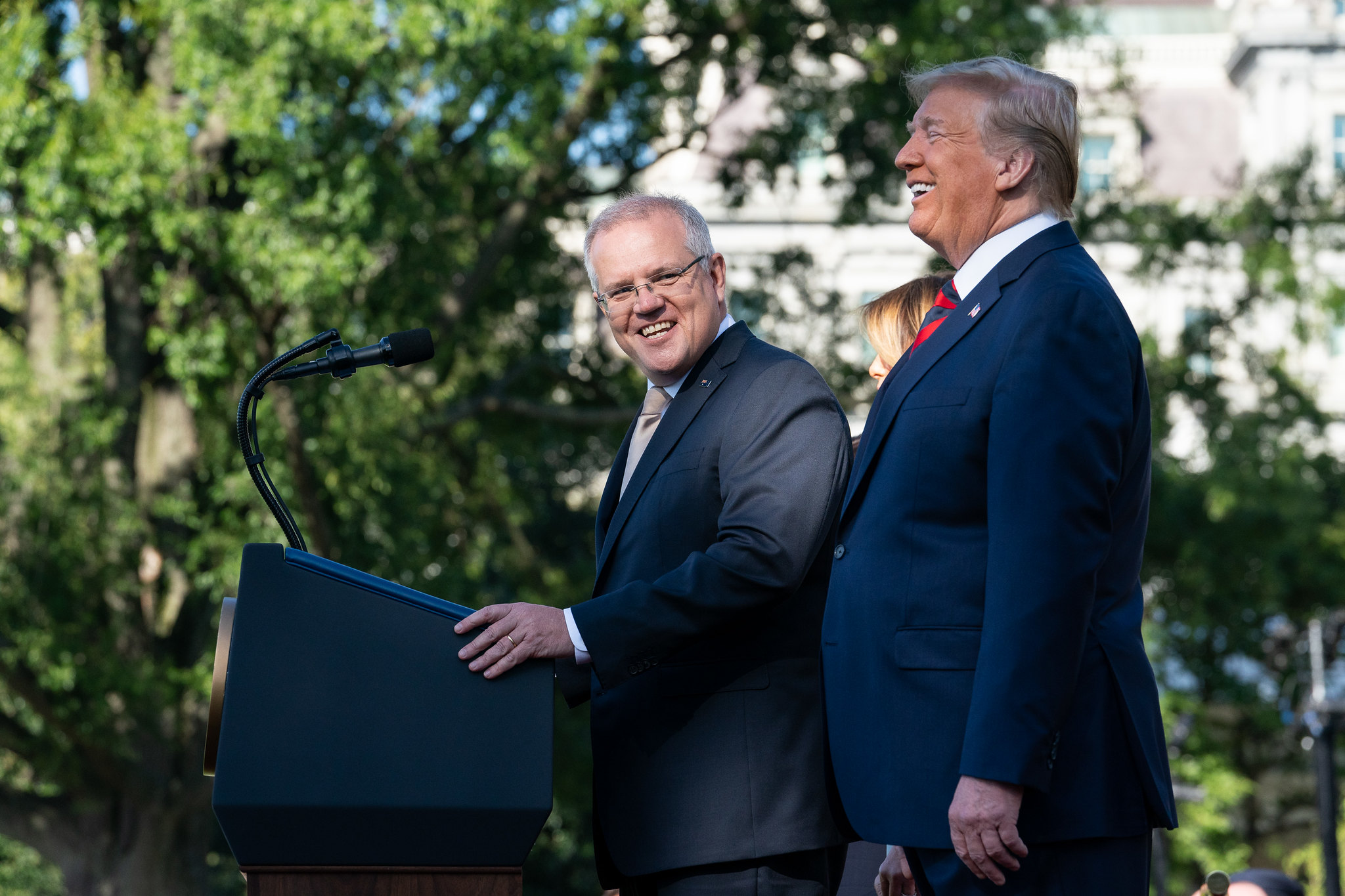
Australian Prime Minister Scott Morrison with U.S. President Donald Trump in Washington, D.C., Sept. 20, 2019, on the South Lawn of the White House. (White House, Shealah Craighead)


The tone of Australian mainstream media commentary on China has by now changed utterly to hostility. Establishment commentators and leader writers compete on who can season their journalism with the strongest anti-Chinese language. All pretence of objectivity or straight reporting of tensions is gone: this is now advocacy journalism. Dissenting opinions are discouraged. As media increasingly runs with the ball of Sinophobia, Morrison has begun to try to step back.

He and Turnbull having started the hares running, now call unconvincingly for moderation. Not just the Murdoch Press but the Australian Financial Review is full of anti-Chinese polemic. China is bitterly criticized as seeking to dictate terms to the world. The Western media outside Australia are picking up the cue. The campaign has taken on McCarthyist, even racist-tinged tones: how dare these Chinese presume to stand up to our Western “universal values?”

Every Chinese effort to rebut the growing abuse is taken as sign of further Chinese bullying. Their Canberra embassy’s circulated “fourteen grievances” – an effort to list the problem China has with Australian behavior towards them as a basis for public discussion – were mocked. China is falsely stereotyped as the provocateur and Australia the victim.


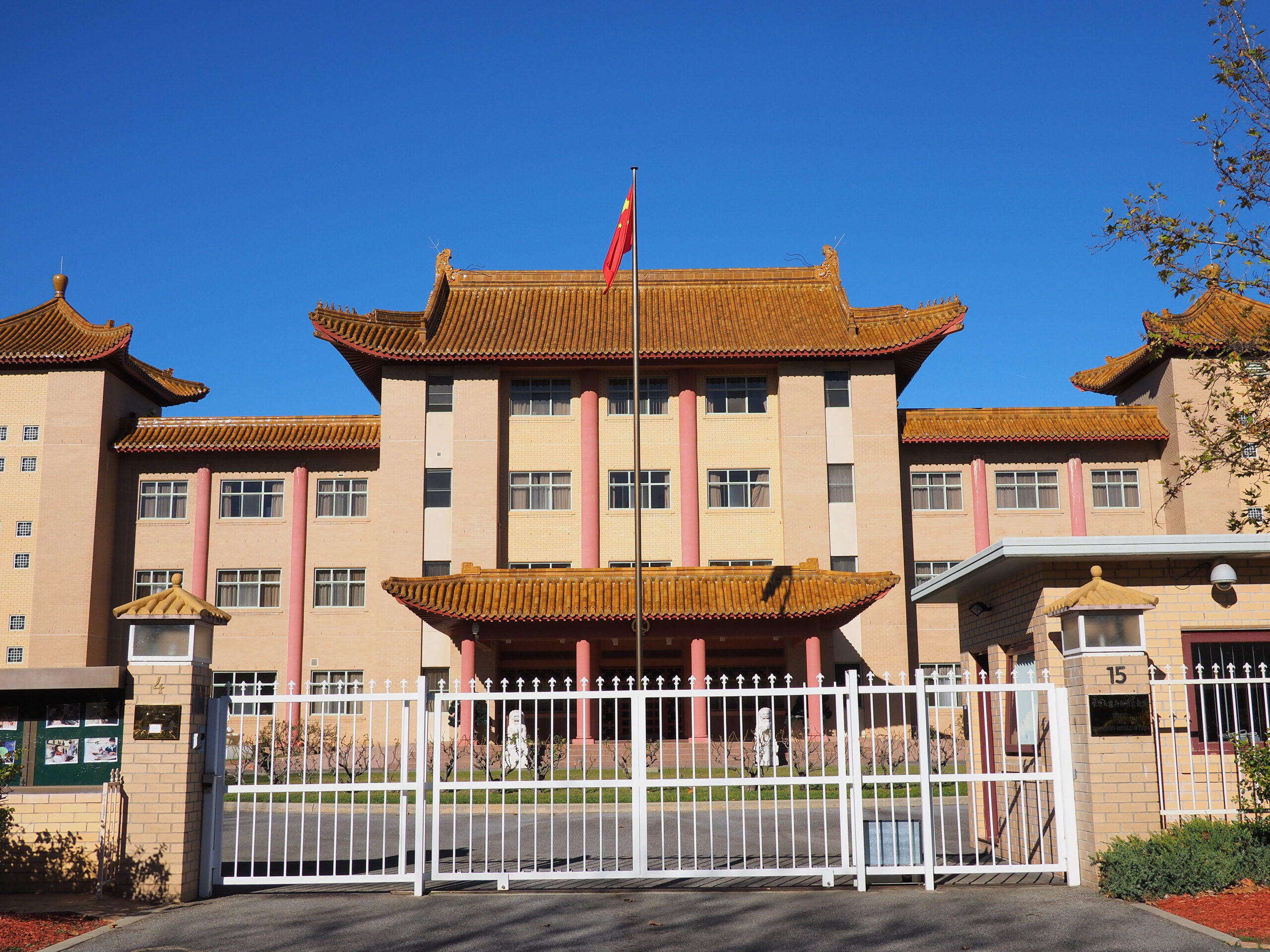
Chinese embassy in Canberra, Australia. (Nick-D, CC BY-SA 3.0, Wikimedia Commons)


Around a few weeks ago, China would have finally decided that Australia could no longer be regarded as a trustworthy and decent partner in dialogue. They would have given up on Australia. The Brereton Report with its reported SAS murders in Afghanistan was an irresistible opportunity for what the West has offensively labelled “wolf warrior” Chinese diplomacy. The photoshopped image of an SAS baby murder, illustrating a tweet by a senior Chinese foreign ministry official criticizing Australian hypocrisy, was emphatically condemned by Morrison, who demanded a Chinese apology. China refused.

La commedia e finita. Australian politicians have swung in behind Morrison, while our traders and growers look on with helpless horror. How can what was a good relationship in 2015 have degenerated to this in just five years? Senior people in industry and trade – like Morrison’s own Covid recovery adviser Nev Power pleaded on Dec. 2 for a diplomatic solution to ease tensions between Beijing and Canberra.

But those who want to see Australia decoupled from China in as many ways as possible stay contentedly silent, looking back with satisfaction on their hidden work of destruction. Australia is safely back in the Five Eyes laager, and those who hoped economic rationality would triumph over global geopolitical exclusion games have been defeated.

Australia’s all-important Asia-Pacific region quietly draws a different lesson from this sad story: the lesson is, do not behave as Australia has done in dealing with China. Treat China with normal diplomatic respect and courtesy, as befits friendly neighbors. Even regional countries that have clashed militarily with China know not to provoke her needlessly, as Australia has done.

Morrison probably sees stoking up anti-Chinese prejudices as a useful distraction from his many governance failures at home: on Robodebt, on Covid-19 preparedness, on bushfires and climate change. Sock the Chinese as if there are no consequences for us.

But the consequences will be great. Australia will be needlessly poorer, more isolated from our region, and more dependent on the uncertain protection of faraway Five Eyes friends. Without a dialogue with China, our necessary engagement with our region will be handicapped. Lee Kuan Yew’s friendly warning — “be careful or you will be the poor white trash of Asia” — comes back now to haunt us.

Tony Kevin is a former Australian ambassador to Poland and Cambodia, an emeritus fellow at Australian National University, Canberra, and the author of Return to Moscow (2017).


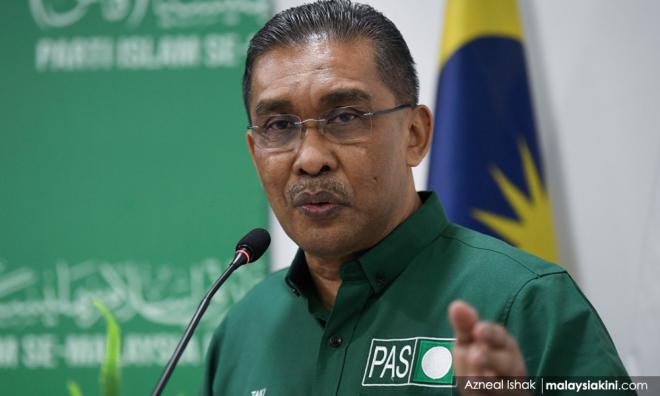
Taki has been promoted, not demoted, according to Taki


Change in portfolio not a downgrade - Takiyuddin (extracts)

Newly minted Energy and Natural Resources Minister Takiyuddin Hassan said he did not see the change in his portfolio as a downgrade.

The Kota Bharu MP, who was the de facto law minister in the previous administration, said the changes were made because Prime Minister Ismail Sabri Yaakob had his own plans and work implementation targets.

“It is up to everyone’s judgment. There are also some people who said that I have been promoted because my previous post was under the Prime Minister’s Department.

😜😁😂


Anwar-Shafie competition ruined opposition’s chances - thanks to "Someone"


Anwar-Shafie competition ruined opposition’s chances, hints youth leader


Shafie Apdal had been in the running for the prime minister’s job at first but later decided to throw his support behind Anwar Ibrahim. (Bernama pic)

KOTA KINABALU: The rivalry between PKR chief Anwar Ibrahim and Warisan president Shafie Apdal over who should be the prime minister candidate had cost the bloc its chances to regain the hot seat, a Sabah opposition youth leader has hinted.

Without specifically mentioning the names of the two leaders, Upko Youth chief Felix Joseph Saang said: “There is no doubt that in the beginning, there was a bit of internal competition and confusion in the opposition itself on the selection of the PM candidate.

“This ultimately hurt all the parties in the opposition,” he said in a statement here today.

“However, that is in the past. Let this be a lesson to us all. Let us not repeat the same mistake, especially in the 15th general election (GE15).”

In the end, he said the opposition bloc eventually managed to garner the support of 105 MPs for Anwar although it was not enough to elevate him as Malaysia’s ninth premier.

Shafie was initially in the running with Anwar to be the opposition’s candidate for the then vacant prime minister’s post.

The final choice, however, depended on who could get the additional support needed from outside the bloc of opposition parties.

Shafie backed out of the running later, saying his party would fully support Anwar.

Despite this setback, Saang noted the opposition could learn from the experience, saying “it is safe to say that there is room for improvement”.

As such, he called on all the other opposition parties to accept the invitation made by Anwar for them to join or work with Pakatan Harapan (PH).

“The opposition must first settle their differences among themselves before they can come up with common policies and effective plans in taking the country forward, such as the handling of the pandemic and the recovery of the economy,” he said.

Yesterday, Anwar said he would meet leaders of other opposition parties to invite them to join or work with PH.

In a statement, PH’s presidential council said this was in line with the coalition’s “big tent” concept in strengthening the opposition bloc.

Saang said this proposal warranted serious consideration from all opposition parties so that they can have a common agenda of providing a real and solid alternative for the people in GE15.

“The opposition does not have much time left as the elections could be held any time soon.

“We must be prepared and our grassroots must start acting now. It is high time for the opposition parties to unite. We must act as one voice,” he said.

Upko Youth, he added, would remain steadfast in its stand to support the top leadership’s decision to work with parties that fight for multiracial ideologies.

Upko now has one MP in Wilfred Madius Tangau.


Shit creek doesn't look like ending

MM:

Malaysia adds 22,597 new Covid-19 cases today


Healthcare workers collect swab samples to test for Covid-19 at the Selcare Clinic in Shah Alam June 24, 2021. — Picture by Miera Zulyana

KUALA LUMPUR, Aug 28 — The Health Ministry reported 22,597 new Covid-19 infections nationwide today, a slight increase from yesterday.

Yesterday saw 22,070 cases, while Thursday saw 24,599 cases nationwide.


Turtle-Egg Head by ‘playing safe’ on cabinet line-up, has likely put himself in danger


“New Cabinet mirrors Muhyiddin Cabinet 2.0 more than anything else”

By Prof Wong Chin Huat


PRIME Minister (PM) Datuk Seri Ismail Sabri Yaakob’s new cabinet may be better characterised as a “Cabinet reshuffle”.

Excluding the end of tenure for former PM Tan Sri Muhyiddin Yassin’s three ministerial special envoys, only nine (13%) government frontbenchers including Muhyiddin have been dropped and replaced by eight new ones.

The total number dropped by one from 70 to 69 – no more no less.

As such, this may be seen as Muhyiddin Cabinet 2.0. It is hard to imagine how almost a same line-up with some swap of portfolios – most notably between Khairy Jamaluddin (now Health Minister) and Datuk Seri Dr Adham Baba (now Science, Technology and Innovation Minister) – can avoid being labelled as #KerajaanGagal2.

Ismail Sabri is overly cautious in not dropping deadwood ministers like Dr Adham or Datuk Seri Rina Harun or promoting Khairy Jamaluddin as a senior minister in charge of pandemics.

Ismail Sabri has wasted his newly gained political capital from his peace-making with the opposition on Wednesday (Aug 25).

With an expected Confidence and Supply Agreement (CSA) with the opposition in his hand, he should have been bolder to fend off the competing demands from Bersatu, Umno and GPS to build a team with some bright spots.

By ‘playing safe’ on his cabinet line-up, he has likely put himself in danger. Any blunder by his ministers will likely provoke more anger and frustration from the public.

Umno Supreme Council whose meeting has been postponed allegedly five times on Ismail Sabri’s request would likely be furious.

Clear loser

Only one of Umno’s demands is met: no Deputy PM. Two inter-related issues are likely to reignite the Umno civil war as Muhyiddin is seen as Ismail Sabri’s invisible minister mentor.

First, with 87% similar administration, Umno fears itself would pay dearly for the government’s continuous failure. Second, Umno’s main contention of Bersatu’s dominance in Government is hardly addressed with the latter losing in net one minister’s post and two deputy ministers’ post.

Most of Umno’s 15 – even if they are not part of the court cluster – and Supreme Council members who back them are clear losers.

Datuk Seri Dr Shamsul Anuar Nasarah who fired the first slot in resigning is left out of the cabinet. Deputy president Datuk Seri Mohamad Hasan is not given a minister’s job by way of senatorial appointment.

The able and popular ex-Deputy Speaker Datuk Seri Azalina Othman Said is likewise sidelined. Only Datuk Seri Dr Noraini Ahmad and Tan Sri Noh Omar are included in Ismail cabinet.

Meanwhile, two Muhyiddin loyalists are rewarded, Tan Sri Annuar Musa is given the strategic portfolio of Communications and Datuk Seri Shahidan Kassim is made Minister of Federal Territories.

Umno is also worried that the Registrar of Societies (ROS) under Bersatu’s Home Minister Datuk Seri Hamzah Zainuddin’s control may be used to force an early party election for Ismail’s takeover or to de-register Umno if the stand-off gets out of hand.

However, it would be suicidal if the Opposition thinks that they can try another round of number game whether it is under Datuk Seri Anwar Ibrahim, Datuk Seri Shafie Apdal or whosoever.

The public has no tolerance for such repetition of a failed game. The Opposition’s best option is perhaps to secure a CSA with Ismail Sabri on much more favourable term than what Muhyiddin offered on August 13.

And to ultimately form its shadow cabinet to compete on the policy front by providing a stark comparison to the Muhyiddin 2.0 Cabinet for the disappointed Malaysians. – Aug 27, 2021


Prof Wong Chin Huat is a political scientist from the Jeffrey Cheah Institute on Southeast Asia.


RCI to investigate judiciary is unconstitutional


RCI to investigate judiciary is unconstitutional


From Philip Koh

There is a call to set up a Royal Commission of Inquiry (RCI) to investigate allegations of interference on the judiciary.

Such a call is wrong and must be rejected.

The judiciary is a constitutional organ (Part IX of Federal Constitution). The exercise of judicial power is part of basic feature of the Malaysian Federal Constitution as an important bastion of the system of separation of powers.

It provides check and balance to the exercise of the executive authority and legislative power.

Any matters arising from the conduct of the judiciary must be dealt with by the judiciary, as they have their own Code of Ethics Article 125(3B) and internal governance.

Even any discussion of the conduct of judges in both the Dewan Rakyat and Dewan Negara is constrained.

This is because Article 127 restricts Parliamentary discussion on the conduct of judges. Discussion can only be effected by way of substantive motion of which notice is given by not less than one quarter of the members of the legislative bodies.

State legislative assemblies are prohibited altogether from discussing the conduct of the judiciary.

Article 126 provides for the power to punish for contempt against the Federal Court, Court of Appeal and High Court.

There is also a provision for a Judicial Legal service Commission in Article 138..

Allegations of misconduct is dealt with either by the Code of Ethics administered by the judiciary or if sufficient allegation of seriousness, then by the setting up of a Tribunal under Article 125(3)(#A)(4) of the Federal Constitution.

To permit a RCI, which is a creature of statute to “investigate“ issues arising from the judiciary or alleged interference, will undermine the protection granted over the judiciary to decide without fear or favour over matters coming before the courts .


Philip Koh is an Adjunct Professor with Universiti Malaya and an FMT reader.