
Monday, May 4, 2026
Germany Overtakes France, UK as Europe’s Defense Powerhouse; Why is Paris Disturbed By Berlin’s Rise?
By Prakash Nanda
If anything, the weakening of ties between the United States, led by President Donald Trump, and Germany under the Chancellorship of Joachim-Friedrich Martin Josef Merz, is said to have accelerated the momentum of German rearmament.
This, in turn, seems to be complicating the balance of power in Europe that has existed since the end of World War II.
And when one talks of the balance of power in Europe, it is primarily between Germany and France, who, incidentally, happened to be bitter “hereditary enemies” for nearly 150 years. Intense nationalism and border disputes over regions like Alsace-Lorraine had led them to fight the Napoleonic Wars (1803–1815), the Franco-Prussian War (1870–1871), and both World Wars ( 1914-18; 1939-45).
However, this rivalry shifted dramatically to close friendship after 1945, for which the US could take some credit. European security after 1945 was built on a simple understanding that while Germany should focus on economic strength by building industry and becoming economically integrated with the continent, France and the UK should provide military stability through their nuclear weapons and “permanent memberships” in the United Nations Security Council.
Germany had nothing to fear since the US, in any case, guaranteed its defense through NATO. This arrangement worked well by calming historical fears and allowed European integration to proceed, resulting in the formation of the European Union (EU).
And here, since the UK is essentially an island-nation, in the European mainland, France viewed itself as the continent’s military leader and principal security-provider, thanks to its nuclear weapons, a blue-water navy, and expeditionary experience in Africa and the Levant.
Apparently, this balance of power in Europe is now being questioned by the ruling elites, particularly in France and, to a certain extent, in Poland, with Germany pursuing a significant increase in its defense expenditure.
With a €85-90 billion annual defense budget and Chancellor Scholz’s call for Germany to become the “backbone of conventional defense in Europe” by becoming “Europe’s largest and best army”, the French President Macron now argues that Europe cannot outsource its security to either Washington or Berlin.
Macron and other French officials are apprehensive that the so-called revitalization of Germany’s defense sector would involve signing large contracts for American systems, which could limit European “strategic autonomy” and increase dependence on external suppliers.
For them, the correct approach is to strengthen European cooperation in the defense sector through collaboration and joint production of arms and reduce dependence on non-European suppliers.
The French do not seem to appreciate that Germany is on track for a 3.5% defense spending target by 2029, while Paris faces fiscal pressures (third-highest debt in the EU) and plans to spend only around 2.6% by 2030, limited as its hands are under the so-called “Chainsaw Plan” to cut €43.8 billion from public spending to manage its debt.
It may be noted that following the Russian invasion of Ukraine, Germany created a €100 billion special fund to build its military and is committed to meeting NATO’s 2% of GDP target. This fund was created outside normal budget rules. As a result, by 2024, German defense spending had risen to €90.6 billion, making it the largest defense budget in the EU.
At present, Germany is already spending much more than its European partners, overtaking them to reach the target that all NATO countries agreed at their summit last year to fund core military requirements at 3.5 percent of national income by 2035.
According to the Atlantic Council, a Washington-based research organization, Germany is expected to spend about $127 billion this year, by far the most in Europe. In contrast, the UK will spend about $84 billion, and France about $70 billion.
It is said that this gap between Germany and other NATO partners in Europe is only going to expand. Whereas the UK is committed to reaching 2.5 percent by 2027, France aims to reach 2.3 percent by 2028, and Italy is targeting 2 percent by 2028, Germany is confident of spending 3. 5 percent of national income by 2029 — an estimated $189 billion a year, according to the Atlantic Council tracker.
In other words, the imbalance in defense spending between Germany and others will only become steeper.
With a deeper pocket to spend, Germany’s procurement budget is believed to reshape the European arms market. What worries the French the most is that Germany has already ordered F-35s, CH-47 helicopters, P-8 patrol aircraft, and Arrow-3 missiles worth tens of billions of dollars.
This is most likely to bypass, so runs the argument, European programs like FCAS, Eurodrone, and MGCS, in which France has vital stakes. In the process, it would diminish the importance of France and of France’s military industry, led by Dassault, Naval Group, Nexter, and Thales.
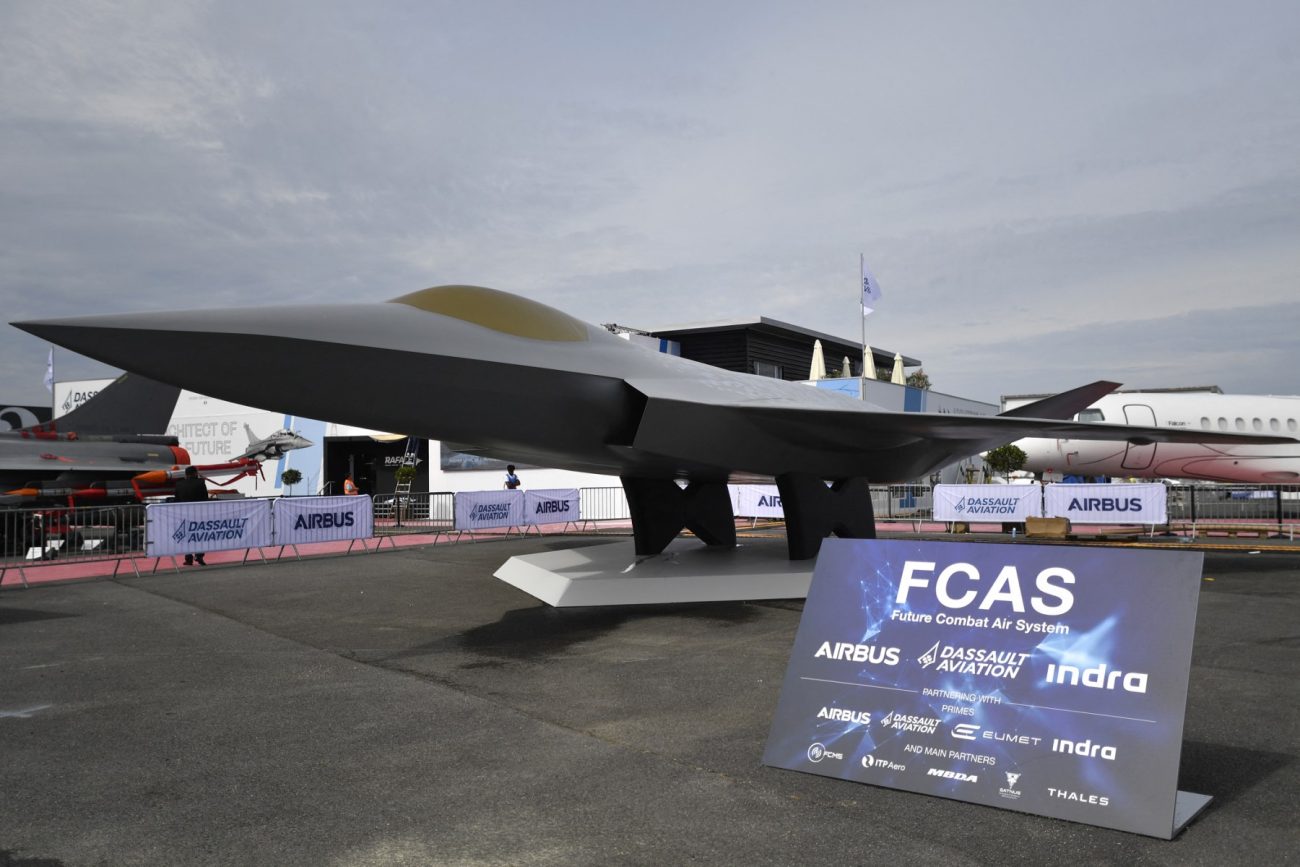
This photograph taken on June 18, 2023 shows a mock-up of the European New Generation Fighter (NGF) for the Future Combat Air System (FCAS) under development by Dassault Aviation, Airbus and Indra Sistemas during the International Paris Air Show at the Paris–Le Bourget Airport. (Photo by JULIEN DE ROSA / AFP)
Even otherwise, the EurAsian Times had once explained the growing differences between France and Germany over major Franco-German military projects. For instance, the Future Combat Air System (FCAS) fighter jet program, a next-generation fighter jet with a network of drones, is not progressing due to big differences between France’s Dassault Aviation and Germany’s Airbus Defense and Space over the project’s leadership roles, workshare, and technical specifications.
France wants the overall leadership status in the project, which Germany is not prepared to accept. The “primary pillar of FCAS” is the New Generation Fighter (NGF). The development of this combat aircraft is led by Dassault Aviation, the French aerospace company that currently produces the Rafale. Dassault sees the NGF as the “heart” of the FCAS, around which other pillars are arranged.
The principal German contractor for FCAS – Airbus Germany – leads work on its second pillar, the Combat Cloud, a decentralized, distributed, and delegated information-sharing and command-and-control system designed to integrate sensors, responsibilities, and weapons. It is intended to be platform-agnostic, combining manned and unmanned systems, satellite and aerial surveillance, and potentially ground- and sea-based platforms, whether developed through FCAS or otherwise.
A third pillar comprises remote carriers—“heavy” (reusable) or “light” (single-use) unmanned vehicles that operate in conjunction with manned platforms. While Airbus is designated as the lead contractor, the French division of MBDA is tasked with the “light” carrier.
Dassault argues that the NGF is FCAS’s “heart”, and, therefore, the other pillars – remote carriers and the Combat Cloud – serve to enhance the fighter on which the whole project rests. However, Germany is said to favor integrating its existing non-FCAS systems, such as the Eurofighter (Airbus) and the F-35 (Lockheed Martin), into the FCAS cloud.
Incidentally, France and Germany also differ on another joint project, the Main Ground Combat System (MGCS), regarding the tank’s design, technology, and industrial responsibilities.
Here, the principal difference between Paris and Berlin is that while the former favors a lighter tank for global deployment, the latter prefers a heavier, more heavily armored tank suited for a potential conflict with Russia.
Similarly, in the Eurodrone unmanned aerial system project, which is being developed in partnership among Germany, France, Italy, and Spain, while Berlin favors a twin-engine design for domestic safety, Paris wants a lighter system for combat zones.
Apparently, the above differences have only lent credence to the French apprehensions over the German rearmament plans and defense spending. The historical wars and conflicts between the two countries are resurfacing in the minds of France’s strategic elites.
But then, France is not alone here. As Mark Leonard, director of the European Council on Foreign Relations, an international think tank, points out, in Poland there is also “ a strong popular memory of German military horrors”.
Historian Liana Fix, a senior fellow at the New York-based Council on Foreign Relations, argues in her 2026 book “Germany Rearmed” that while Germany’s rapid rearmament is necessary for European security, it creates major risks regarding European stability, power imbalances, and potential political misuse. Therefore, she advocates that necessary military growth in Europe requires intense EU integration to prevent what could be a new, dangerous German hegemony. “Partnership-based leadership, yes; hegemonic fanatics, No”.
According to Christian Molling, a military expert and director of a Berlin-based research institution, European Defense in a New Age, “The impact of German defense spending is multiple, nationally and internationally. What’s good for Germany on several levels is both good and bad for our neighbors and partners, and it depends a lot on the communication.”
Steven E. Sokol, President of the American Council on Germany, a New York-based nonprofit organization, outlines why Germany will have to navigate its more assertive role “carefully but decisively, while at the same time providing assurances to its European neighbors.”
In sum, there seems to be a consensus among strategic experts that debates over Germany’s rearmament should promote a balanced strategy that combines national interests, European autonomy, and responsibility to allies. The need of the hour, therefore, is the coordination of procurement, financial mechanisms, and joint investments in new defense technologies to ensure trust among partners.
And here, it is said that Germany has to play a larger role, as it is Europe’s largest economy, most populous state, and sits at the center of the continent. Any misperception of its growing military power and economic dominance could upset the regional balance, which has preserved peace on the continent for over 80 years.


No comments:
Post a Comment