Murray Hunter

Middle East conflict: Most powerful weapon is the disruption of economic stability
Oil and gas prices have already surged, pushing Brent crude well above USD 100 per barrel in recent weeks and threatening to climb further.
Mar 24, 2026
This is my third column in The Vibes. Hope to go to national issues next week.
THE Middle East conflict that began with US and Israeli strikes on Iran has now entered its fourth week, and the narrative has completely shifted.
Murray Hunter is a reader-supported publication. To receive new posts and support my work, consider becoming a free or paid subscriber.
US President Donald Trump initially justified the campaign as a necessary strike to eliminate Iran’s nuclear capability.
This is despite him earlier claiming that American air raids in June had already “destroyed” Iran’s nuclear programme.
However, the world quickly saw through the rhetoric. What unfolded was not a surgical operation against weapons of mass destruction, nor was it a genuine push for regime change.
It was, from the very beginning, an economic war dressed in security language.
The initial attacks quickly morphed into a political decapitation attempt that went badly wrong.
The body of the Iranian leadership survived, the nuclear sites proved far more resilient than believed, and the conflict escalated because the true objectives were never about bombs but about control of energy flows and global financial architecture.
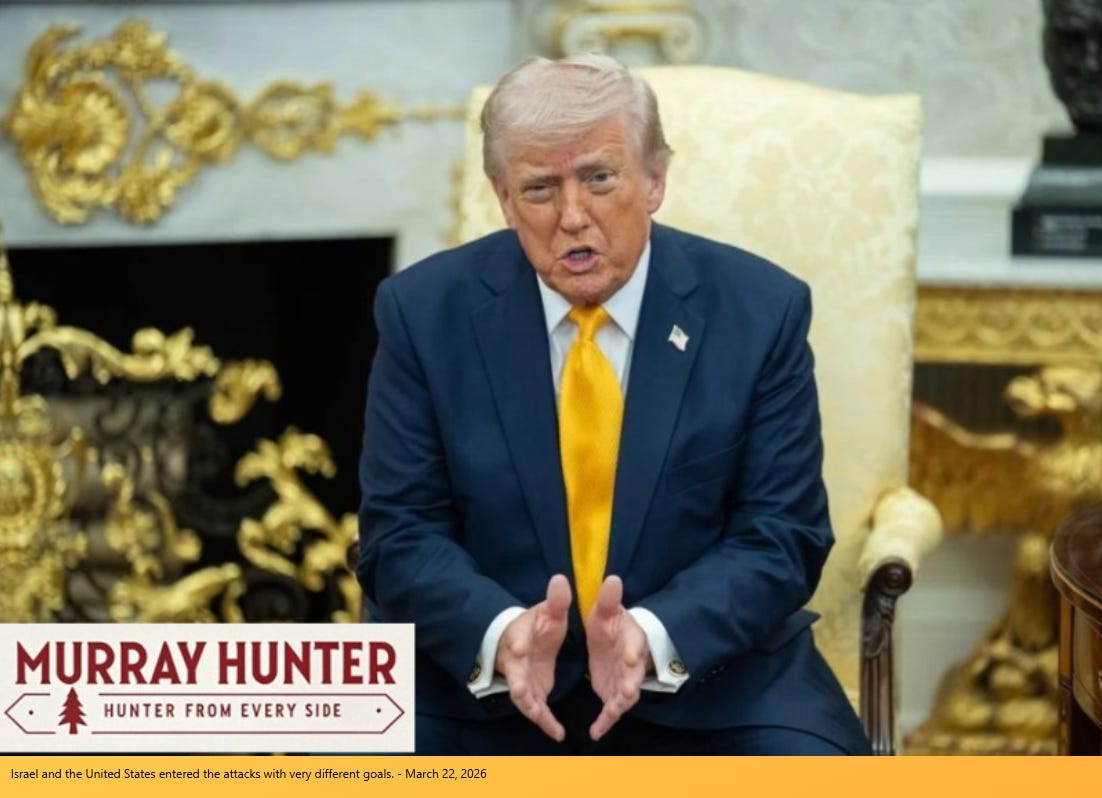
Israel and the United States entered the attacks with very different goals.
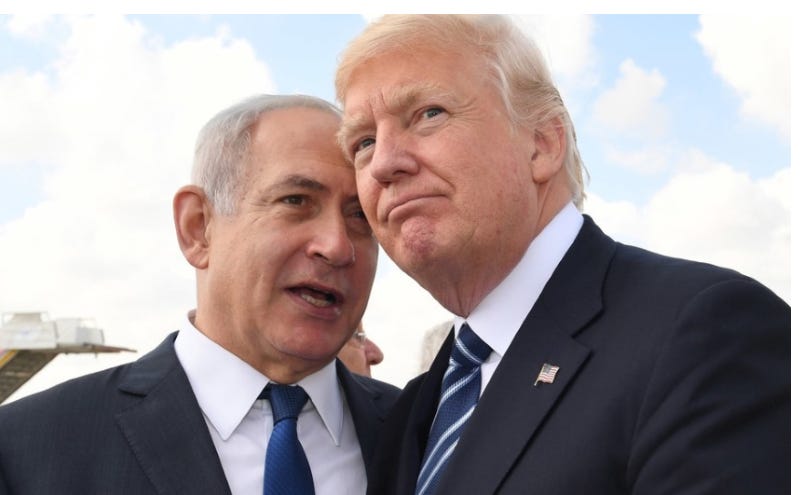
Israel sought to create political chaos inside Iran on the model that had previously applied to Iraq and Syria — fragmenting the state, weakening its regional influence, and removing a strategic threat.
The United States, under Trump, pursued deeper, with more structural aims. This was to disrupt the sea lanes that supply China with energy, to undermine the viability of the BRICS grouping, and to reassert dollar dominance in global energy trade.
This is why the Strait of Hormuz became the central theatre almost immediately.
When Israel destroyed key Iranian gas infrastructure, Iran responded in kind by striking Saudi and Qatari oil and gas facilities. The message by Iran was clear: if the West wants Iran to feel pain, the Gulf Arab states, which have been America’s traditional partners, would share it.
Iran then took the bold step of effectively controlling passage through the Strait. Major shipping lines suspended operations.
Iran has now begun imposing conditions. Ships could pass only if payments for oil and gas were made in Chinese Yuan, and a transit toll was paid.
What started as a wartime measure now shows every sign of becoming something permanent.
The result has been exactly what Iran intended and what many in Washington most feared.
Global scarcity of oil, gas, urea fertiliser, and petrochemical-based plastics is beginning to drive prices skyward.
Reports indicate that Iranian oil is moving in greater volumes than before the conflict through alternative routes, while Russia has benefited enormously from higher prices and diverted demand.
The blockade has weakened the US dollar’s role in energy settlements and pushed Washington further outside the Gulf Arab states, which now find themselves under sustained Iranian pressure.
This is no longer a conventional military confrontation. It is a fight over the shape of the new world order.
Control of the Strait of Hormuz has become symbolic of who will write the rules of energy trade in the 21st century.
By forcing payments in Yuan and extracting tolls, Iran is accelerating the de-dollarisation trend that BRICS has been quietly advancing.
The United States miscalculated badly. Instead of isolating Iran and strengthening the petrodollar, the policy has strengthened multipolar alternatives and exposed the limits of American power projection.
Politically, the war is already backfiring. In Israel, Prime Minister Benjamin Netanyahu’s position grows more precarious with every passing week of escalation.
In the United States, Trump and the MAGA movement face mounting domestic criticism as fuel prices climb and supply chains buckle. Both leaders are discovering that military adventurism in the Gulf carries high political costs when the economic blowback hits voters at the petrol pump and the supermarket.
Yet the real damage is economic and global. In the short term, certainly for the next six to twelve months, the world faces significant chaos.
Oil and gas prices have already surged, pushing Brent crude well above USD 100 per barrel in recent weeks and threatening to climb further.
Transport and logistics costs are rising sharply. Farming input costs, especially fertiliser, are climbing in tandem.
These pressures will translate into higher food prices and broader consumer inflation within months.
Governments everywhere will be tested. Central banks will struggle to balance inflation control with growth.
Supply-chain disruptions will compound the pain. Countries without domestic energy resources will face the harshest adjustments. Those that possess oil and gas will be relatively better placed, but only if they manage their resources wisely, by recalibrating pricing policies and reducing dependence on volatile international markets.
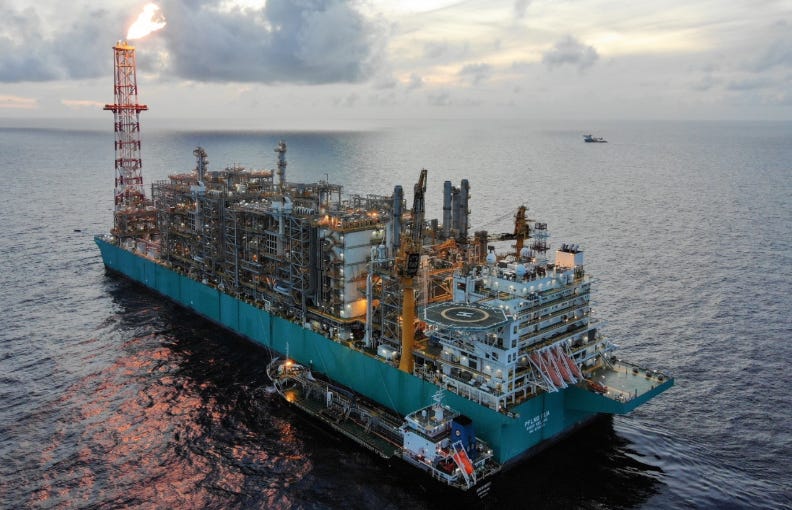
Malaysia, fortunately, sits in a stronger position than many. As an ASEAN member with substantial oil and gas reserves through Petronas, the country stands to gain from elevated energy prices in the same way it did during previous Gulf crises.
Sustained high Brent prices could add billions to Petronas’ revenue and help narrow the fiscal deficit or fund targeted subsidies.
The parallel rise in palm-oil prices creates a golden opportunity to accelerate biodiesel production for the domestic market, reducing reliance on imported diesel and creating new value chains in the plantation sector.
Washington hoped the war with Iran would fracture the BRICS grouping.
However, it has instead highlighted its resilience. Iran’s membership and the aggression it has faced have accelerated internal cohesion and agenda implementation.
Malaysia’s deepening engagement with BRICS offers a pathway to diversify trade, reduce exposure to US tariffs and audits, and participate in new financial mechanisms that bypass traditional dollar channels.
The war has also delivered a masterclass in modern deterrence. Iran has demonstrated that asymmetric capabilities such as drones, precision missiles, and strategic chokepoint control can neutralise conventional military superiority and inflict economic pain far beyond the battlefield.
Looking ahead, the conflict shows no immediate off-ramp. Iran has no interest in a premature ceasefire while its strategic objectives remain unmet.
The United States and Israel lack a credible exit strategy, even though Trump is hinting at an exit.
This episode has taught the world a truth that the most powerful weapon in today’s global arena is not missiles or aircraft carriers but disturbing economic stability.
Control over energy flows, currency settlement, and supply chains can achieve strategic objectives more effectively than kinetic force. The Gulf conflict is the clearest recent example of this new reality. – March 22, 2026


No comments:
Post a Comment