THANKS MF:
Tore Says:
The PHANTOM WAKE Warning: 16 Ships Rehearsing Cable Sabotage Across Four Oceans
Tore Says
Mar 31, 2026
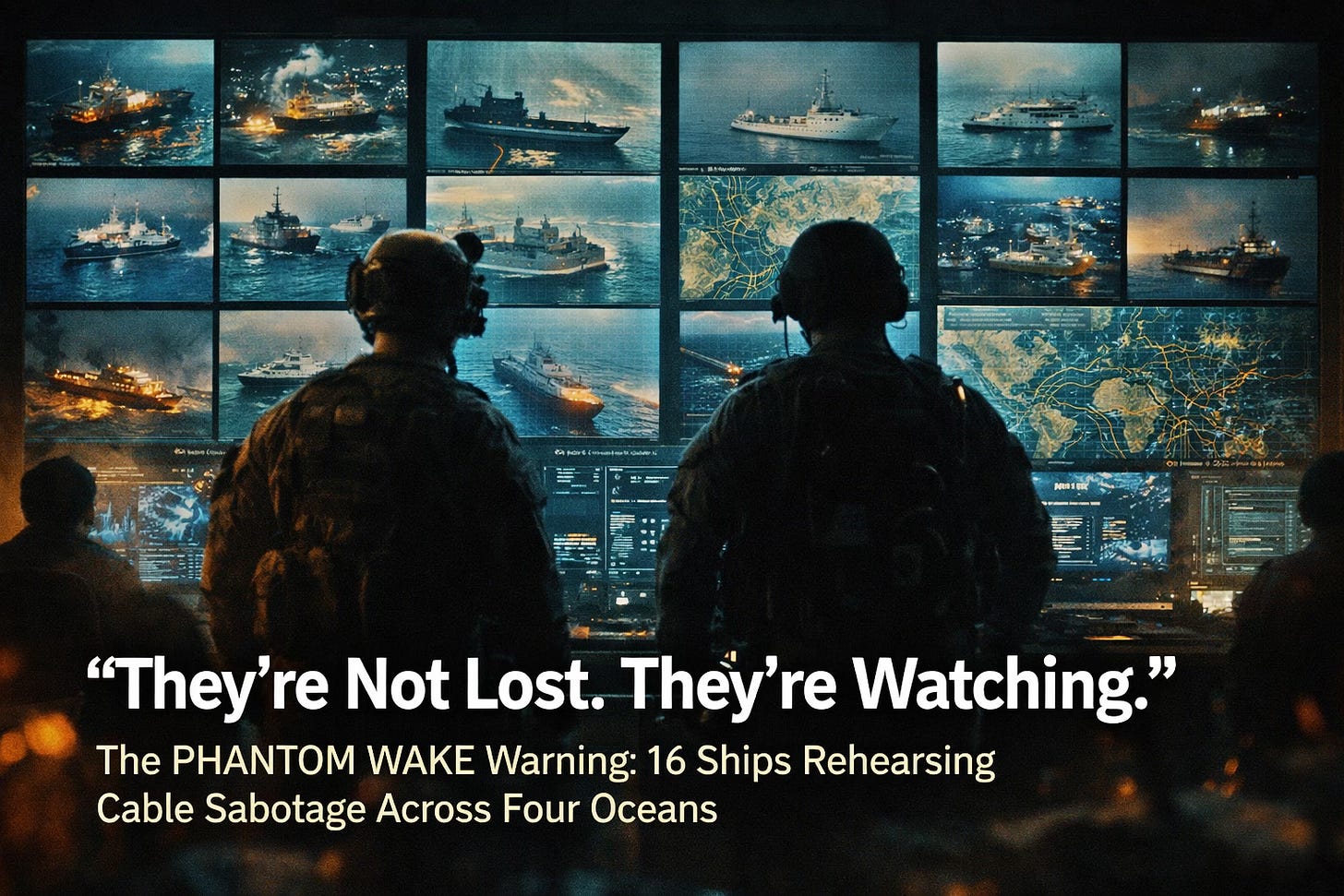
Sixteen ships. Four oceans. Nineteen hours. A new OSINT tool just revealed a pattern of suspicious vessel behavior near the cables that carry 95% of the world's internet traffic — and it looks less like coincidence and more like a rehearsal.
Most people picture missiles, or cyberattacks, or some elaborate Hollywood scenario involving supercomputers and shadowy hackers. The answer is far simpler. Far older. And because of that simplicity, far more terrifying. The answer is a ship. An anchor. And the willingness to drag that anchor across the right stretch of ocean floor at the right moment.
Because right now, beneath the surface of every major ocean on this planet, there is an invisible web of cables — most of them no thicker than a garden hose — that carry ninety-five percent of all international internet traffic. Not satellites. Not the cloud. Not wireless. Cables. Sitting on the seafloor, in some of the most remote and legally ungoverned waters on earth, largely unguarded, largely invisible to the public conversation about national security.
Every wire transfer moves through those cables. Every military communication routed over civilian infrastructure. Every stock trade, every intelligence dispatch, every call between an American soldier overseas and his family back home. The entire circulatory system of modern civilization runs through them. And someone — right now — appears to be studying exactly where to make the cut.
Mar 31, 2026
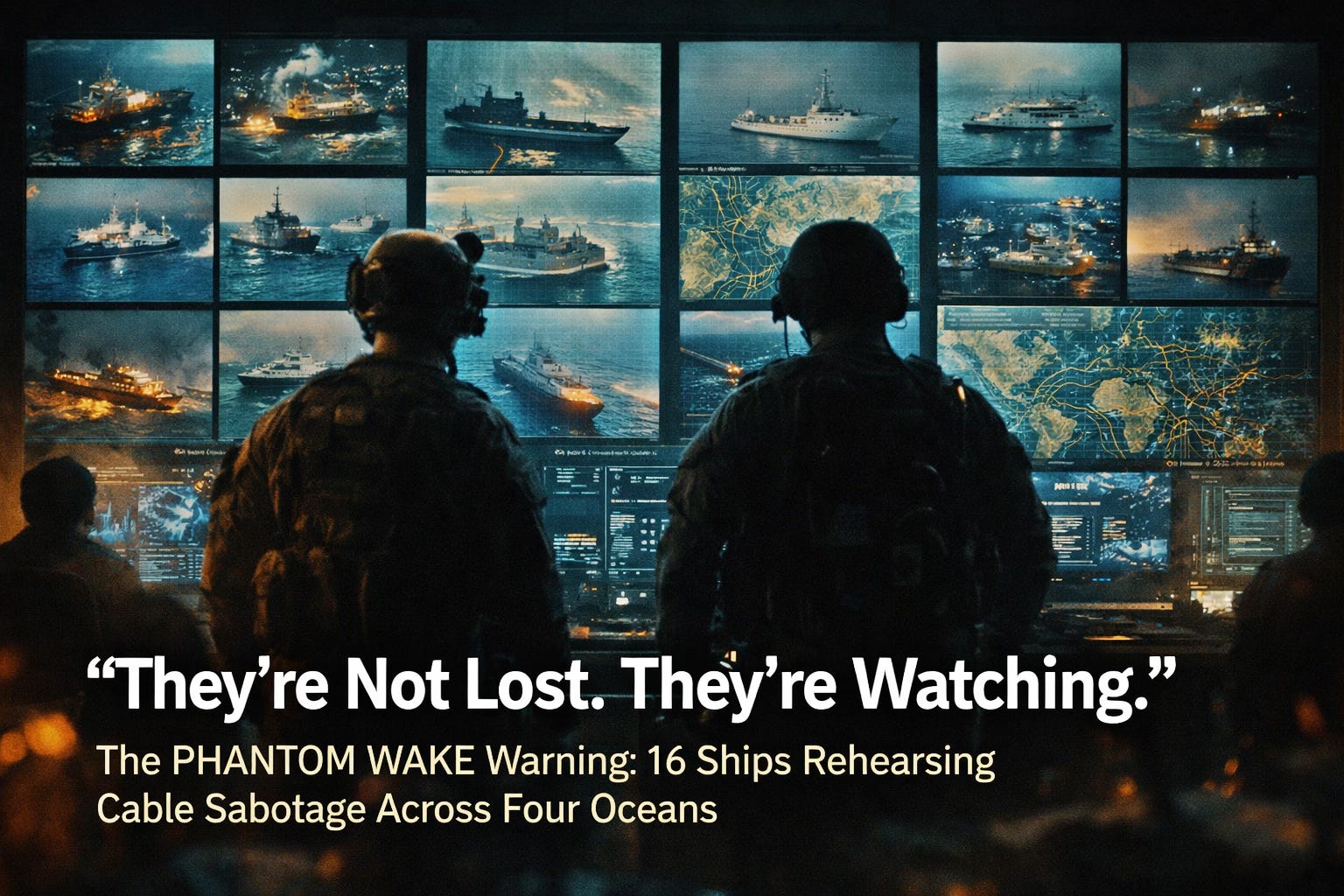
Sixteen ships. Four oceans. Nineteen hours. A new OSINT tool just revealed a pattern of suspicious vessel behavior near the cables that carry 95% of the world's internet traffic — and it looks less like coincidence and more like a rehearsal.
Most people picture missiles, or cyberattacks, or some elaborate Hollywood scenario involving supercomputers and shadowy hackers. The answer is far simpler. Far older. And because of that simplicity, far more terrifying. The answer is a ship. An anchor. And the willingness to drag that anchor across the right stretch of ocean floor at the right moment.
Because right now, beneath the surface of every major ocean on this planet, there is an invisible web of cables — most of them no thicker than a garden hose — that carry ninety-five percent of all international internet traffic. Not satellites. Not the cloud. Not wireless. Cables. Sitting on the seafloor, in some of the most remote and legally ungoverned waters on earth, largely unguarded, largely invisible to the public conversation about national security.
Every wire transfer moves through those cables. Every military communication routed over civilian infrastructure. Every stock trade, every intelligence dispatch, every call between an American soldier overseas and his family back home. The entire circulatory system of modern civilization runs through them. And someone — right now — appears to be studying exactly where to make the cut.
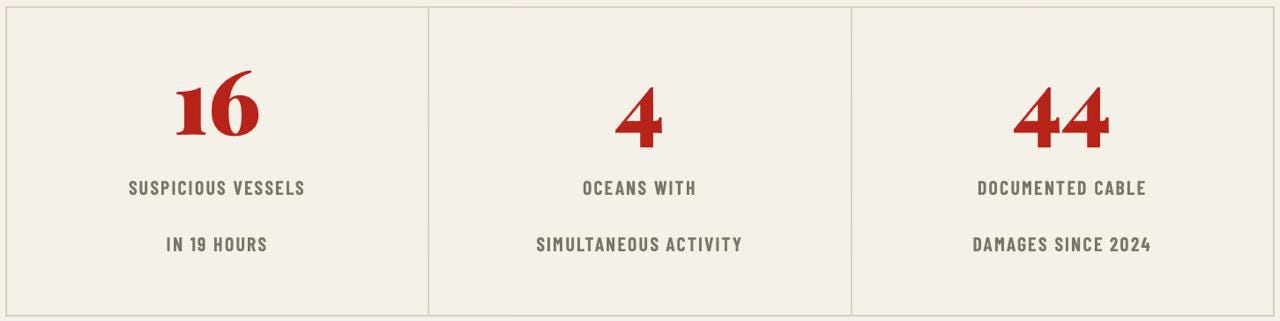
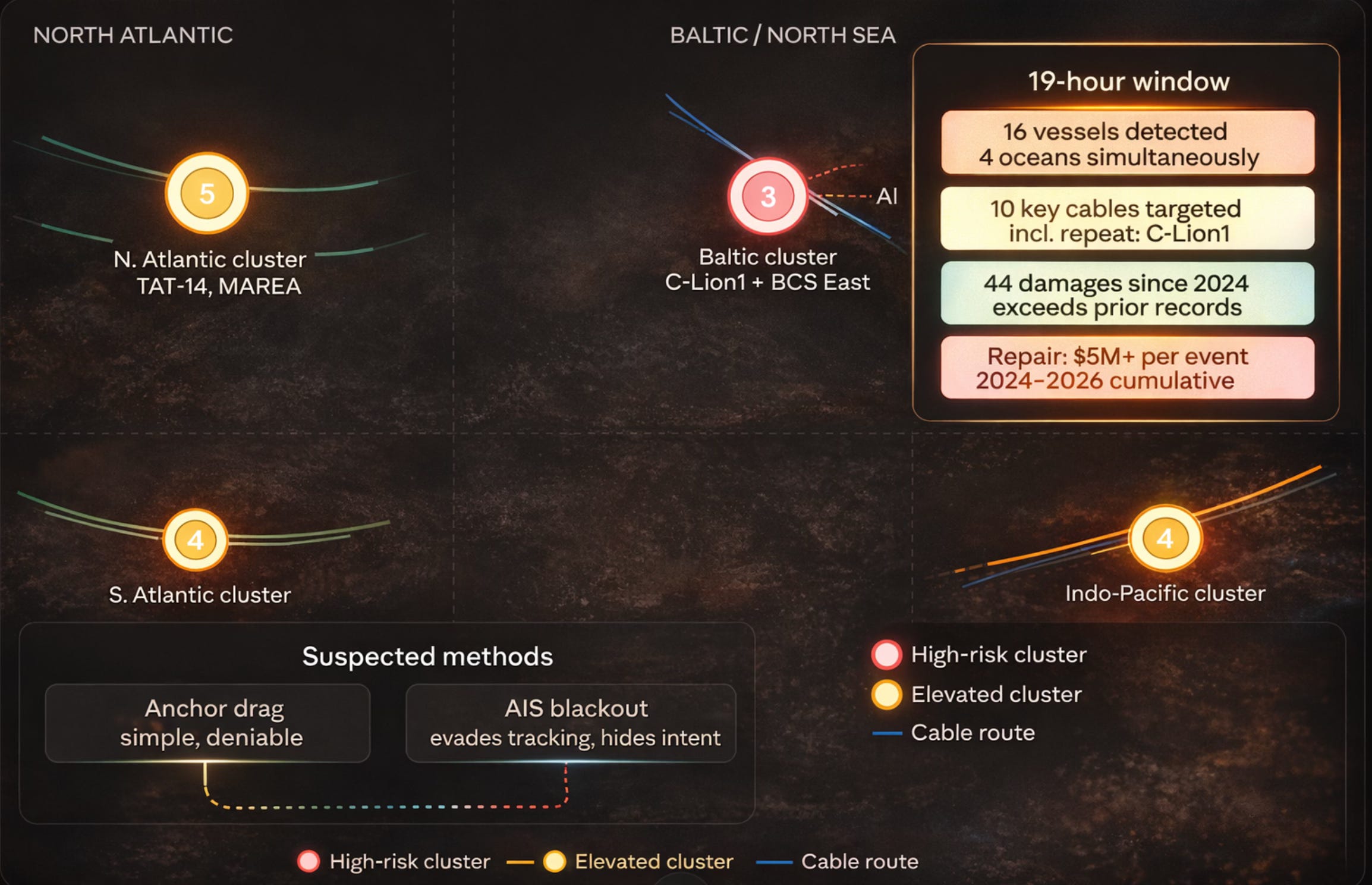
Those numbers didn’t come from a classified briefing. They didn’t come from a NATO intelligence summary or a State Department cable. They came from an open-source intelligence tool called PHANTOM WAKE — built by Jackie Singh, a cybersecurity professional and national security researcher who saw a critical gap in how the world was monitoring its most essential infrastructure, and decided to fill it herself. Singh built PHANTOM WAKE to cross-reference live maritime vessel data against the known geographic routes of undersea cables, flagging ships behaving in ways that have no good innocent explanation. Drifting. Slowing. Going dark — cutting off the AIS tracking signal that maritime law requires every large vessel to broadcast — right as they pass over a cable corridor.
What PHANTOM WAKE found over a nineteen-hour window was not one ship behaving strangely. It was sixteen vessels — spread across four separate oceans — each exhibiting the hallmark behaviors of a vessel engaged in either reconnaissance or active sabotage near subsea cable infrastructure. Anchor drag patterns. AIS blackouts. Unexplained slow passes over cable-dense corridors. Sixteen ships. Four oceans. One nineteen-hour window. Let that sit with you for a moment.
The Infrastructure Nobody Talks About
We have built an entire civilization on top of a network that most people don’t know exists. There are roughly 1.3 million kilometers of submarine cable currently active across the world’s oceans. When you send an email from New York to London, it travels through a cable on the floor of the Atlantic Ocean. When a bank in Tokyo clears a transaction with a correspondent bank in Frankfurt, that instruction moves through a cable. When the Pentagon sends a communication to a forward operating base routed through civilian infrastructure — as happens constantly — it goes through a cable.
The satellite industry will tell you that Starlink and its competitors are changing this picture. They are not — not yet, and not at the scale that matters. Satellites carry a fraction of global data traffic. They are expensive, bandwidth-constrained, and latency-prone in ways that make them unsuitable for the high-volume, low-latency demands of financial systems and military communications. The world runs on cables, and it will for the foreseeable future.
UNDERSTANDING AIS — AND WHY GOING DARK MATTERS
The Automatic Identification System requires all commercial vessels above 300 gross tons to continuously broadcast their identity, position, speed, and heading. This data is publicly receivable and forms the backbone of global maritime tracking. When a ship switches off its AIS transponder — what analysts call “going dark” — it doesn’t disappear physically. It disappears from the tracking record. In normal maritime operations, there are very few legitimate reasons to do this. Near a major undersea cable route, there is essentially none. It is the maritime equivalent of turning off your phone’s location services before you go somewhere you don’t want anyone to know you’ve been.
Which is exactly why cables are such an attractive target for actors who want to cause maximum disruption with minimum fingerprints. A severed cable doesn’t announce who cut it. There’s no explosion, no missile trail, no satellite image of a weapon being fired. There is just, suddenly, a service interruption. And by the time investigators determine whether this was an accident or something else — if they ever do — the ship is gone.
The Dead Don’t Talk: MH370, Zhang, and What Was at Stake
I have been covering undersea cable systems as a geopolitical battleground for years — long before it became fashionable to do so. If you want to hear the audio, go to toresaid.com and search “underwater cables.” It’s all there. But one story from my IC Series published in December 2024 is directly relevant to everything PHANTOM WAKE is now showing us, and it deserves to be part of this conversation.
On March 7, 2014, in Kuala Lumpur, a consortium of over fifteen major telecommunications operators — including China Telecom Global, Singtel, and Orange — signed the Construction and Maintenance Agreement for SEA-ME-WE 5. That’s South East Asia – Middle East – Western Europe 5. A 20,000-kilometer submarine cable system connecting seventeen countries, built to carry the data flows of half the world, designed to be the new digital artery between Asia, the Middle East, and Europe.
One of the key figures in that project was Hualian “Happy” Zhang — co-chair of Network Planning for China Telecom Global. She knew this cable intimately. Its routing. Its vulnerabilities. Its encryption architecture. Its geopolitical significance. She was, in the language of intelligence, a high-value asset — the kind of person whose knowledge, in the wrong hands or the right ones, could change the strategic calculus around one of the most important pieces of infrastructure on earth.
The C&MA was signed March 7, 2014.
Zhang boarded Malaysia Airlines Flight MH370 on March 8, 2014.


The Phantom Menace
ReplyDelete