
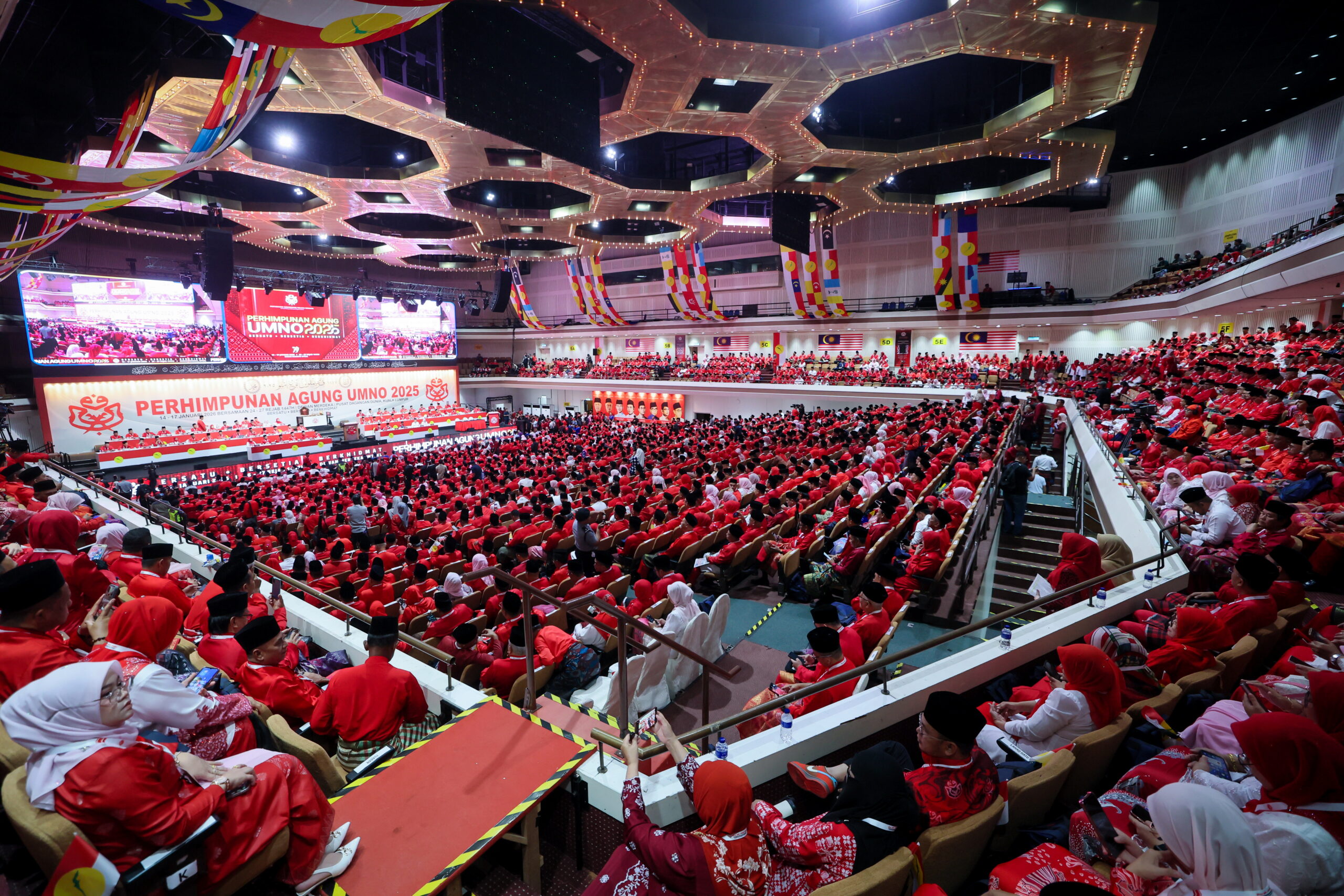
Delegates at the Opening Ceremony of the Umno General Assembly 2025, held at Dewan Merdeka, WTC Kuala Lumpur. - Bernama pic, January 21, 2026
Umno’s glory days to grey days – Ravindran Raman Kutty
From the red-washed streets of PWTC to today’s muted gatherings at WTCKL, UMNO’s annual assembly mirrors the party’s long slide from unquestioned dominance to uncertain relevance, as corruption scandals, electoral shocks and generational change drain the colour, confidence and euphoria that once defined its grip on Kuala Lumpur and on Malaysian politics
KUALA LUMPUR no longer turns red for Umno. What was once a carnival of power centred on PWTC has faded into a careful, crowded, but curiously colourless ritual at the rebranded World Trade Centre Kuala Lumpur.
When KL throbbed Umno red
A decade ago, Umno General Assembly week was when the city stopped to salute a single party. By mid‑week, the approach roads – Jalan Tun Razak, Jalan Raja Laut, Jalan Kuching – thickened into a slow‑moving red tide of buses and MPVs bearing division banners from every corner of the peninsula. Buntings and Street lights.
Along the main arteries leading into the World Trade Centre Kuala Lumpur, the city seems to dress itself in Umno’s colours. From Jalan Tun Razak and Jalan Kuching right up to Jalan Putra and the approaches around Sunway Putra Mall, every lamppost and divider is draped with red-dominated party banners, buntings and vertical standees welcoming delegates to the Perhimpunan Agung Umno.
The designs are typically striking: bold red backgrounds, the white keris logo, portraits of national leaders, and taglines about party unity and Malay solidarity, all repeated in tight intervals so that convoys of cars and buses move through what feels like a continuous corridor of partisan imagery.
Hanging buntings flutter from median railings and overhead bridges, while tall standees on street-light poles line both sides of the roads, turning this stretch of Kuala Lumpur into a festive, almost carnival-like “Umno zone” for the duration of the assembly.
PWTC stood like a fortress of power, draped in party flags and giant faces of presidents and prime ministers gazing down from billboards. The old Pan Pacific Hotel, stitched into the complex, became Umno’s unofficial inner sanctum, its lobby a permanent traffic jam of ministers, warlords and journalists jostling for eye contact and leaked lines.
Hotel clerks from Chow Kit to Bukit Bintang murmured the same phrase: “Penuh, bang, sampai Ahad.” Delegates spilled into every available room in Seri Pacific, Sunway Putra, and as far as Jalan Ampang, while coffee houses ran 24‑hour shifts, their tables colonised by branch chiefs plotting motions over endless teh tarik.
Outside, the city dressed itself accordingly. Street vendors sold Umno scarves and songkok near the LRT, taxis lined up three‑deep by the river, and every other person seemed to be in baju Melayu merah, turning downtown into a walking, talking, laughing party congress.
From dominance to doubt
But even in those crowded years, hairline cracks were forming in the party’s armour. By the mid‑2010s, Umno’s assemblies were already shadowed by 1MDB, donation controversies and open dissent from figures like Muhyiddin Yassin and Dr Mahathir Mohamad, even as Najib Razak projected unshakeable control from the main stage.
Delegates still came in their thousands, yet the conversations in those packed hotel lobbies began to turn from development and mega‑projects to court cases, rising living costs and whether the leadership had lost the moral right to rule. The spectacle looked strong, but the social contract that once gave Umno its swagger was quietly unravelling.
GE14 and GE15 shattered the illusion. From the unchallenged anchor of Barisan Nasional, Umno became a diminished pillar in a hung‑parliament era, losing Malay votes to PAS and Bersatu while carrying the weight of “court cluster” headlines and internal factional feuds.
The pale assembly of a wounded party
Fast forward to the 2025 General Assembly, held in January 2026: the same river, the same halls, but a different Malaysia – and a different Umno. WTCKL was busy, the president’s briefing was reportedly well attended, yet the mood felt less like a coronation and more like a group therapy session for a party searching for a story.
This time, the headlines were about reconciliation and reinvention, not supremacy. Khairy Jamaluddin’s invited presence – after his sacking in 2023 – became emblematic of a party trying to signal openness while still led by a president whose ongoing court cases and unpopular image remain a political millstone.
Kuala Lumpur did not stop for Umno. The hotels filled, but not overflowed; the coffee houses were busy, not besieged. The city no longer orbits around a single party’s calendar, because the party no longer orbits at the centre of national politics.
Why the euphoria died
Several currents explain why Umno’s once‑raucous assembly now feels restrained, even when the halls are numerically full.
The party’s moral aura has been eroded by years of corruption scandals, from 1MDB to ongoing “court cluster” trials, hollowing out the pride that once powered its red wave.
Its monopoly over Malay representation has been broken by PAS and Bersatu, whose rise reflects a shift in the Malay electorate towards more overtly Islamist and alternative Malay‑based platforms.
Internally, factionalism and leadership fatigue have left many grassroots members caught between loyalty to “the party” and frustration with the personalities who dominate it.
Externally, a more fragmented, coalition‑driven landscape – and Umno’s role as a junior partner in the Unity Government – means the assembly no longer decides the fate of the country in quite the same way.
In a Malaysia where no single bloc commands a grand majority, the old UMNO assembly euphoria feels almost indecent: a relic of a time when power was unambiguous, and its rituals could be celebrated without irony. Today’s politics is pale, unclear, murky and divided and Umno is both a victim and an author of that story.
What Umno must do to matter again
To stay relevant, Umno must decide whether it wants to be a nostalgic museum of its own glory days, or a serious vehicle for a new generation of Malaysians. Several hard choices stand between it and any future euphoria.
Clean leadership, not court baggage: As long as its top tier is associated with trials and past scandals, UMNO will struggle to win back trust from an electorate exhausted by elite impunity.
A credible Malay centre, not ethno‑fearmongering: Having helped normalise more hardline rhetoric, UMNO now finds itself outflanked by PAS and PN; reclaiming the middle ground means speaking to Malay dignity without demonising others.
Real answers on jobs, wages and housing: Younger voters – half the electorate – care less about party nostalgia and more about income, mobility and fairness, something even UMNO leaders now openly acknowledge.
Internal democracy and genuine renewal: The party cannot keep sacking, silencing or sidelining its own talent and then complain that the youth have abandoned it.
If Umno can truly pivot, then perhaps one day Kuala Lumpur will once again crackle with energy when the red tide rolls in, not with the old, deafening roar of uncontested power, but with the more honest, hard-earned excitement of a party that has found its soul in a far more complex Malaysia.
The baby boomers grew up immersed in that euphoria, when UMNO’s presence coloured the city and defined the era, but Generations X, Y (millennials), Z and now even Alpha do not instinctively feel the same pull. To them, UMNO too often resembles a grey, fading dowager, dignified but distant and only a genuine renewal of ideas, leadership and culture will convince these newer generations that the party is more than a memory dressed in red. – January 21, 2026
Umno’s glory days to grey days – Ravindran Raman Kutty
From the red-washed streets of PWTC to today’s muted gatherings at WTCKL, UMNO’s annual assembly mirrors the party’s long slide from unquestioned dominance to uncertain relevance, as corruption scandals, electoral shocks and generational change drain the colour, confidence and euphoria that once defined its grip on Kuala Lumpur and on Malaysian politics
KUALA LUMPUR no longer turns red for Umno. What was once a carnival of power centred on PWTC has faded into a careful, crowded, but curiously colourless ritual at the rebranded World Trade Centre Kuala Lumpur.
When KL throbbed Umno red
A decade ago, Umno General Assembly week was when the city stopped to salute a single party. By mid‑week, the approach roads – Jalan Tun Razak, Jalan Raja Laut, Jalan Kuching – thickened into a slow‑moving red tide of buses and MPVs bearing division banners from every corner of the peninsula. Buntings and Street lights.
Along the main arteries leading into the World Trade Centre Kuala Lumpur, the city seems to dress itself in Umno’s colours. From Jalan Tun Razak and Jalan Kuching right up to Jalan Putra and the approaches around Sunway Putra Mall, every lamppost and divider is draped with red-dominated party banners, buntings and vertical standees welcoming delegates to the Perhimpunan Agung Umno.
The designs are typically striking: bold red backgrounds, the white keris logo, portraits of national leaders, and taglines about party unity and Malay solidarity, all repeated in tight intervals so that convoys of cars and buses move through what feels like a continuous corridor of partisan imagery.
Hanging buntings flutter from median railings and overhead bridges, while tall standees on street-light poles line both sides of the roads, turning this stretch of Kuala Lumpur into a festive, almost carnival-like “Umno zone” for the duration of the assembly.
PWTC stood like a fortress of power, draped in party flags and giant faces of presidents and prime ministers gazing down from billboards. The old Pan Pacific Hotel, stitched into the complex, became Umno’s unofficial inner sanctum, its lobby a permanent traffic jam of ministers, warlords and journalists jostling for eye contact and leaked lines.
Hotel clerks from Chow Kit to Bukit Bintang murmured the same phrase: “Penuh, bang, sampai Ahad.” Delegates spilled into every available room in Seri Pacific, Sunway Putra, and as far as Jalan Ampang, while coffee houses ran 24‑hour shifts, their tables colonised by branch chiefs plotting motions over endless teh tarik.
Outside, the city dressed itself accordingly. Street vendors sold Umno scarves and songkok near the LRT, taxis lined up three‑deep by the river, and every other person seemed to be in baju Melayu merah, turning downtown into a walking, talking, laughing party congress.
From dominance to doubt
But even in those crowded years, hairline cracks were forming in the party’s armour. By the mid‑2010s, Umno’s assemblies were already shadowed by 1MDB, donation controversies and open dissent from figures like Muhyiddin Yassin and Dr Mahathir Mohamad, even as Najib Razak projected unshakeable control from the main stage.
Delegates still came in their thousands, yet the conversations in those packed hotel lobbies began to turn from development and mega‑projects to court cases, rising living costs and whether the leadership had lost the moral right to rule. The spectacle looked strong, but the social contract that once gave Umno its swagger was quietly unravelling.
GE14 and GE15 shattered the illusion. From the unchallenged anchor of Barisan Nasional, Umno became a diminished pillar in a hung‑parliament era, losing Malay votes to PAS and Bersatu while carrying the weight of “court cluster” headlines and internal factional feuds.
The pale assembly of a wounded party
Fast forward to the 2025 General Assembly, held in January 2026: the same river, the same halls, but a different Malaysia – and a different Umno. WTCKL was busy, the president’s briefing was reportedly well attended, yet the mood felt less like a coronation and more like a group therapy session for a party searching for a story.
This time, the headlines were about reconciliation and reinvention, not supremacy. Khairy Jamaluddin’s invited presence – after his sacking in 2023 – became emblematic of a party trying to signal openness while still led by a president whose ongoing court cases and unpopular image remain a political millstone.
Kuala Lumpur did not stop for Umno. The hotels filled, but not overflowed; the coffee houses were busy, not besieged. The city no longer orbits around a single party’s calendar, because the party no longer orbits at the centre of national politics.
Why the euphoria died
Several currents explain why Umno’s once‑raucous assembly now feels restrained, even when the halls are numerically full.
The party’s moral aura has been eroded by years of corruption scandals, from 1MDB to ongoing “court cluster” trials, hollowing out the pride that once powered its red wave.
Its monopoly over Malay representation has been broken by PAS and Bersatu, whose rise reflects a shift in the Malay electorate towards more overtly Islamist and alternative Malay‑based platforms.
Internally, factionalism and leadership fatigue have left many grassroots members caught between loyalty to “the party” and frustration with the personalities who dominate it.
Externally, a more fragmented, coalition‑driven landscape – and Umno’s role as a junior partner in the Unity Government – means the assembly no longer decides the fate of the country in quite the same way.
In a Malaysia where no single bloc commands a grand majority, the old UMNO assembly euphoria feels almost indecent: a relic of a time when power was unambiguous, and its rituals could be celebrated without irony. Today’s politics is pale, unclear, murky and divided and Umno is both a victim and an author of that story.
What Umno must do to matter again
To stay relevant, Umno must decide whether it wants to be a nostalgic museum of its own glory days, or a serious vehicle for a new generation of Malaysians. Several hard choices stand between it and any future euphoria.
Clean leadership, not court baggage: As long as its top tier is associated with trials and past scandals, UMNO will struggle to win back trust from an electorate exhausted by elite impunity.
A credible Malay centre, not ethno‑fearmongering: Having helped normalise more hardline rhetoric, UMNO now finds itself outflanked by PAS and PN; reclaiming the middle ground means speaking to Malay dignity without demonising others.
Real answers on jobs, wages and housing: Younger voters – half the electorate – care less about party nostalgia and more about income, mobility and fairness, something even UMNO leaders now openly acknowledge.
Internal democracy and genuine renewal: The party cannot keep sacking, silencing or sidelining its own talent and then complain that the youth have abandoned it.
If Umno can truly pivot, then perhaps one day Kuala Lumpur will once again crackle with energy when the red tide rolls in, not with the old, deafening roar of uncontested power, but with the more honest, hard-earned excitement of a party that has found its soul in a far more complex Malaysia.
The baby boomers grew up immersed in that euphoria, when UMNO’s presence coloured the city and defined the era, but Generations X, Y (millennials), Z and now even Alpha do not instinctively feel the same pull. To them, UMNO too often resembles a grey, fading dowager, dignified but distant and only a genuine renewal of ideas, leadership and culture will convince these newer generations that the party is more than a memory dressed in red. – January 21, 2026
Ravindran Raman Kutty is not a political writer or a commentator, but truly misses the fun, colour and pageantry that Umno provided to many including him


No comments:
Post a Comment