
Saturday, January 17, 2026
U.S. Attack on Iran: Why Pakistan Could Pay The “Highest Price” of U.S. Military Operations on Tehran?
By EurAsian Times Desk
-January 17, 2026
A possible US attack on Iran has not only rattled Tehran but also almost all its neighbours, including Saudi Arabia, Qatar, and even Pakistan.
After provocative statements like “help is on the way” and warning of stern action against Iran’s hanging of protestors, Trump has dialled down the rhetoric in the past few days.
The threat of an attack is far from over, with the USS Abraham Lincoln carrier strike group now on its way to the Middle East. Some reports also claimed that the George H.W. Bush Carrier group was also headed to the region.
The last time the Pentagon ordered such a heavy deployment, we saw the capture of Venezuelan head of state Nicolas Maduro and his wife.
The fear of possible US strikes on Iran has stirred regional uneasiness for a variety of reasons.
The biggest concern among the US allies in the region is potential Iranian retaliation on the American military bases spread across the region, from Saudi Arabia to Turkey, as an Iranian official recently warned.
The Gulf oil-producing states have warned that an escalation could lead to the closure of the Strait of Hormuz, a critical chokepoint for global oil trade. This would result in a massive uptick in oil prices, dealing a big blow to global markets. But more importantly, analysts believe that a reduction in Gulf oil supplies could prompt major oil consumers, such as China, to seek alternative suppliers.
However, there is another country that fears that a strike on Iran and a possible weakening of the Islamic Republic could cause an upheaval on its borders.
Pakistan At Direct Risk?
Pakistan believes that a stable and peaceful Iran is in Islamabad’s interest.
“Any US military attack on Iran would have dangerous, destabilizing consequences for the entire region,” former diplomat and political analyst Maleeha Lodhi told AFP. “Pakistan in particular would be seriously affected if there is a spillover across its border. Any ungoverned space opening up near its border would strengthen militants in its restive province of Balochistan and pose a grave security threat to Pakistan,” she added.
Since June 2025, when Israel attacked Iran and triggered the ’12-day war’, Pakistan has been opposing all attacks on Iran despite cozying up with the United States after the four-day conflict with its arch-rival, India.
The reasons behind this are manifold.
Pakistan and Iran share an approximately nine-hundred-kilometre border, which has been a haven for Baluch militancy on both sides.
The Baluch-Sistan province of Iran, bordering Pakistan’s Balochistan, is home to Baloch separatists who are in a constant state of strife with Islamabad.

Pakistani troops speak with a visitor as they stand guard at a checkpost near the Kot Lakhpat Jail on the outskirts of Lahore (Photo by Arif Ali / AFP)
Pakistan alleges that militant groups like the Baloch Liberation Army (BLA) and the Balochistan Liberation Front (BLF) have factions across the border, which allows the militants to launch attacks on Pakistani security forces with impunity.
Similarly, Pakistan’s Balochistan province is a haven for anti-Iran militias like the Jaish al-Adl and Ansar Al-Furqan that frequently target Iranian security forces.
This has caused a mutual distrust between the two neighbours, with both countries accusing the other of harbouring terrorists.
These tensions peaked in January 2024 when Iran launched missile and drone strikes on Jaish al-Adl bases in Pakistan’s Panjgur district. Pakistan retaliated with Operation Marg Bar Sarmachar, using drones, rockets, and aircraft to strike BLA and BLF hideouts in Iran’s Saravan, as reported by the EurAsian Times at the time.
The two countries made peace later and took coordinated measures to restore ties. Later, during his 2025 visit to Pakistan, Iranian President Masoud Pezeshkian reiterated the brotherhood between the two countries and signed 12 agreements with Islamabad.
A potential US attack on Iran has stirred fears that anarchy, weakening of the Iranian regime, and the potential of borders being left ungoverned could be disastrous for Pakistan’s security, as it will essentially embolden the Baloch militias to further intensify attacks on Pakistan.
With a rise in Baloch militia attacks in recent times, such as the daredevil hijack of the Jaffar Express in March 2025, Pakistan’s fears seem more than valid. Moreover, Pakistan already has unstable borders with the Taliban-run Afghanistan as well as with India, and cannot afford another unstable frontier.
Pakistan alleges that militant groups like the Baloch Liberation Army (BLA) and the Balochistan Liberation Front (BLF) have factions across the border, which allows the militants to launch attacks on Pakistani security forces with impunity.
Similarly, Pakistan’s Balochistan province is a haven for anti-Iran militias like the Jaish al-Adl and Ansar Al-Furqan that frequently target Iranian security forces.
This has caused a mutual distrust between the two neighbours, with both countries accusing the other of harbouring terrorists.
These tensions peaked in January 2024 when Iran launched missile and drone strikes on Jaish al-Adl bases in Pakistan’s Panjgur district. Pakistan retaliated with Operation Marg Bar Sarmachar, using drones, rockets, and aircraft to strike BLA and BLF hideouts in Iran’s Saravan, as reported by the EurAsian Times at the time.
The two countries made peace later and took coordinated measures to restore ties. Later, during his 2025 visit to Pakistan, Iranian President Masoud Pezeshkian reiterated the brotherhood between the two countries and signed 12 agreements with Islamabad.
A potential US attack on Iran has stirred fears that anarchy, weakening of the Iranian regime, and the potential of borders being left ungoverned could be disastrous for Pakistan’s security, as it will essentially embolden the Baloch militias to further intensify attacks on Pakistan.
With a rise in Baloch militia attacks in recent times, such as the daredevil hijack of the Jaffar Express in March 2025, Pakistan’s fears seem more than valid. Moreover, Pakistan already has unstable borders with the Taliban-run Afghanistan as well as with India, and cannot afford another unstable frontier.
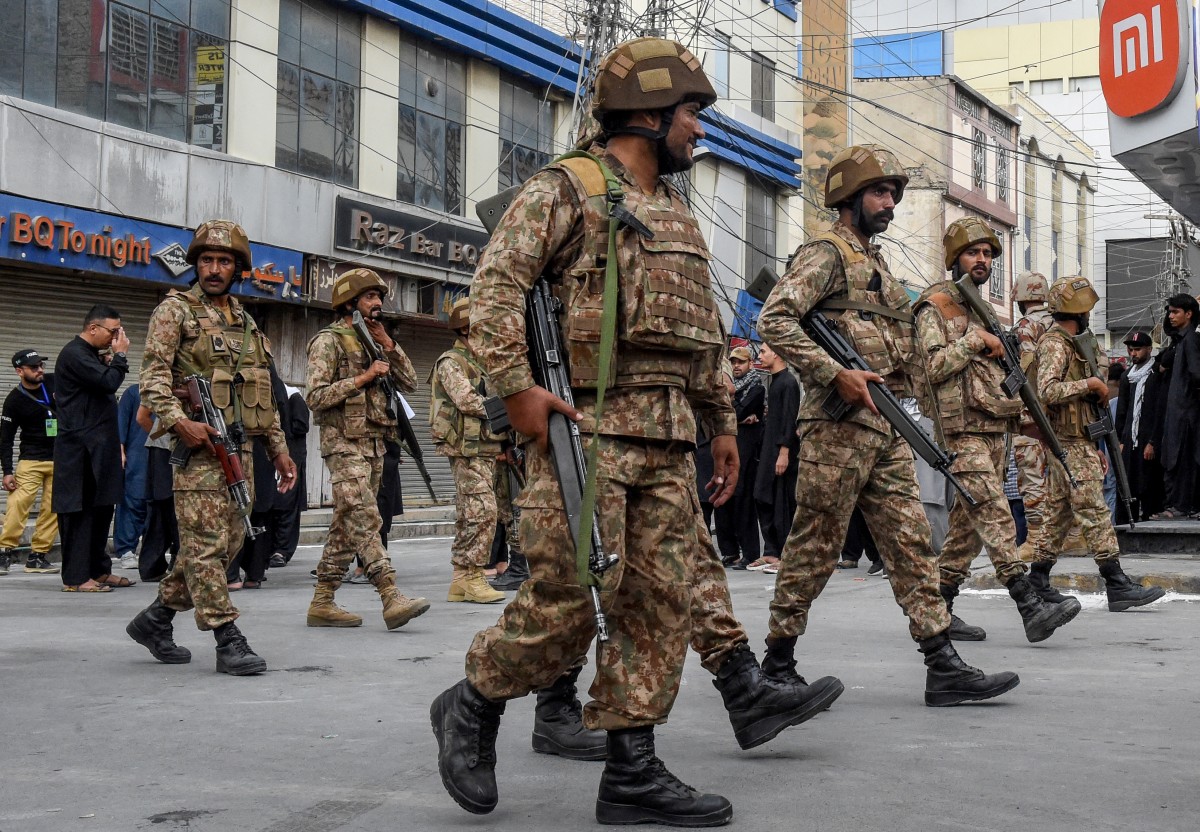
Pakistani soldiers escort a Shiite Muslim religious procession in Quetta on July 3, 2025, during the Islamic holy month of Muharram in the lead-up to Ashura, a 10-day period commemorating the seventh-century killing of Prophet Mohammed’s grandson, Imam Hussein. (Photo by Banaras KHAN / AFP)
In addition, Pakistan could find itself in the middle of a US-Iran escalation due to its friendly relations with the United States.
The US could use Pakistan’s military facilities and airspace to strike Iran — which could further strain already difficult ties between the two neighbours.
Earlier this week, Pakistan’s Ministry of Information and Broadcasting refuted claims on social media that Islamabad would be used as a launchpad to assist the US in a potential military attack against Iran.
Recall the US invasion of Iraq in 2003. Iran bolstered Shia militias that indirectly affected neighbouring states, and a similar dynamic could unfold if Iran views Pakistan as a US ally.
An American attack on Iran could have a cascading effect on cross-border terror by emboldening the militias to launch more attacks on Pakistani soil.
For now, it is unclear whether Pakistan, like its Gulf counterparts, is lobbying the United States to stave off a crisis. However, it expressed its hope to the UN Security Council for early normalization of the situation in Iran, arguing that international law and the UN Charter prohibit external intervention in a state’s domestic affairs.
“The UN Charter prohibits the threat or use of force against other states’ territorial integrity or political independence, or interference in matters essentially within the domestic jurisdiction of states,” Ambassador Asim Ahmad, Pakistan’s permanent representative to the UN, said at an emergency meeting.
In addition, Pakistan could find itself in the middle of a US-Iran escalation due to its friendly relations with the United States.
The US could use Pakistan’s military facilities and airspace to strike Iran — which could further strain already difficult ties between the two neighbours.
Earlier this week, Pakistan’s Ministry of Information and Broadcasting refuted claims on social media that Islamabad would be used as a launchpad to assist the US in a potential military attack against Iran.
Recall the US invasion of Iraq in 2003. Iran bolstered Shia militias that indirectly affected neighbouring states, and a similar dynamic could unfold if Iran views Pakistan as a US ally.
An American attack on Iran could have a cascading effect on cross-border terror by emboldening the militias to launch more attacks on Pakistani soil.
For now, it is unclear whether Pakistan, like its Gulf counterparts, is lobbying the United States to stave off a crisis. However, it expressed its hope to the UN Security Council for early normalization of the situation in Iran, arguing that international law and the UN Charter prohibit external intervention in a state’s domestic affairs.
“The UN Charter prohibits the threat or use of force against other states’ territorial integrity or political independence, or interference in matters essentially within the domestic jurisdiction of states,” Ambassador Asim Ahmad, Pakistan’s permanent representative to the UN, said at an emergency meeting.


No comments:
Post a Comment