
Trump’s 50% Military Budget Surge to $1.5 Trillion: Tucker Carlson Warns of a World War
20 Jan 2026 • 6:00 PM MYT

TheRealNehruism
An award-winning Newswav creator, Bebas News columnist & ex-FMT columnist
20 Jan 2026 • 6:00 PM MYT
TheRealNehruism
An award-winning Newswav creator, Bebas News columnist & ex-FMT columnist
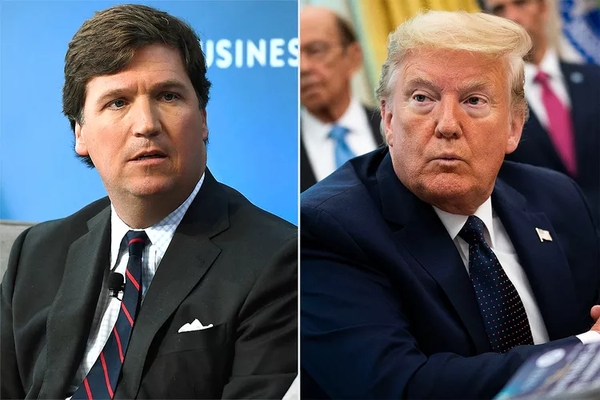
Image credit: People
When US President Donald Trump called for American military spending to rise to an unprecedented $1.5 trillion by 2027, the figure itself was staggering. It represents a more than 50% increase from the already enormous $901 billion defence budget approved by Congress in December. But numbers in politics are never just numbers. They are signals. And in this case, the signal being sent is hard to ignore: the United States is preparing for a world defined not by stability, but by large-scale war.
Trump justified the proposed increase by citing “very troubled and dangerous times” and promising to build what he described as a “Dream Military” capable of keeping America “safe and secure, regardless of foe.” On the surface, this sounds like familiar political rhetoric. Yet when placed against the backdrop of escalating global tensions and the historical logic of military spending, the conclusion becomes unavoidable. States do not allocate wartime-level budgets unless they expect wartime-level threats.
Wartime Spending in Peacetime Language
A $1.5 trillion defence budget is not normal even by American standards. The United States already spends more on its military than the next several countries combined. During the Cold War, during the wars in Iraq and Afghanistan, and even at the height of post-9/11 militarisation, US military expenditure never reached this level in real terms without an active, large-scale conflict underway or clearly imminent.
This is precisely why figures such as American journalist Tucker Carlson have argued that Trump’s proposal is not a fiscal choice but a strategic confession. According to Carlson, budgets of this magnitude are typical of states preparing for major regional or global wars, not routine deterrence. In his assessment, there are no convincing alternative explanations for such a dramatic increase. You do not spend like this unless you believe something catastrophic is coming.
The logic is simple. Defence budgets reflect threat perception. When leaders truly believe that peace will hold, they invest in growth, welfare, and infrastructure. When they believe that war is likely, they invest in weapons, factories, and stockpiles.
Trump’s own language reinforces this interpretation. He has complained that military equipment is not being produced quickly enough and has urged defence companies to build new and modern manufacturing plants. This is not the language of symbolic deterrence. It is the language of mobilisation.
When US President Donald Trump called for American military spending to rise to an unprecedented $1.5 trillion by 2027, the figure itself was staggering. It represents a more than 50% increase from the already enormous $901 billion defence budget approved by Congress in December. But numbers in politics are never just numbers. They are signals. And in this case, the signal being sent is hard to ignore: the United States is preparing for a world defined not by stability, but by large-scale war.
Trump justified the proposed increase by citing “very troubled and dangerous times” and promising to build what he described as a “Dream Military” capable of keeping America “safe and secure, regardless of foe.” On the surface, this sounds like familiar political rhetoric. Yet when placed against the backdrop of escalating global tensions and the historical logic of military spending, the conclusion becomes unavoidable. States do not allocate wartime-level budgets unless they expect wartime-level threats.
Wartime Spending in Peacetime Language
A $1.5 trillion defence budget is not normal even by American standards. The United States already spends more on its military than the next several countries combined. During the Cold War, during the wars in Iraq and Afghanistan, and even at the height of post-9/11 militarisation, US military expenditure never reached this level in real terms without an active, large-scale conflict underway or clearly imminent.
This is precisely why figures such as American journalist Tucker Carlson have argued that Trump’s proposal is not a fiscal choice but a strategic confession. According to Carlson, budgets of this magnitude are typical of states preparing for major regional or global wars, not routine deterrence. In his assessment, there are no convincing alternative explanations for such a dramatic increase. You do not spend like this unless you believe something catastrophic is coming.
The logic is simple. Defence budgets reflect threat perception. When leaders truly believe that peace will hold, they invest in growth, welfare, and infrastructure. When they believe that war is likely, they invest in weapons, factories, and stockpiles.
Trump’s own language reinforces this interpretation. He has complained that military equipment is not being produced quickly enough and has urged defence companies to build new and modern manufacturing plants. This is not the language of symbolic deterrence. It is the language of mobilisation.
The Military-Industrial Acceleration
Trump’s attacks on defence contractors are also revealing. He accused major arms manufacturers of prioritising shareholder payouts and stock buybacks over production capacity. He criticised what he called “exorbitant” executive compensation and even proposed capping executive pay at $5 million. More significantly, he threatened to cut companies off from government contracts unless they rapidly expand manufacturing.
In one particularly pointed statement, Trump singled out Raytheon, calling it the “least responsive” to America’s defence needs and warning that it could lose business with what he pointedly referred to as the “Department of War.” That choice of words matters. It signals a mindset shift away from defence as abstract preparedness and toward war as an operational expectation.
Markets understood the signal immediately. Shares in Lockheed Martin, Northrop Grumman, and Raytheon jumped sharply following Trump’s announcements. Investors are not sentimental. They respond to anticipated demand. Their reaction suggests an expectation of long-term, large-scale arms production, not short-term political theatre.
A World Growing More Dangerous
Trump’s proposal does not exist in a vacuum. It comes amid a cascade of geopolitical flashpoints that increasingly resemble the preconditions of global conflict.
The United States has seized a Russian-flagged oil tanker accused of violating sanctions, further escalating tensions with Moscow. It has also captured Venezuelan President Nicolás Maduro, transporting him to the US to face drug trafficking charges, a move that dramatically raises the stakes in Latin America.
Meanwhile, China has conducted military drills around Taiwan, simulating blockades and seizures of key areas in response to what Beijing views as separatist provocations. Taiwan’s own efforts to ramp up defence spending have only intensified the standoff. These are not isolated incidents. They are interconnected pressure points involving nuclear powers, major regional actors, and competing global systems.
History teaches us that world wars rarely begin with a single dramatic declaration. They emerge from overlapping crises, miscalculations, and escalating commitments. The current international environment fits that pattern uncomfortably well.
The Russia Question
Carlson has made a further, more controversial argument: that in the event of a global war, the United States cannot survive without Russia. From his perspective, treating Russia as an enemy while preparing for worldwide confrontation is strategically irrational. Russia is the largest country on Earth, rich in energy, minerals, and strategic depth. In a true world war scenario, these resources would be decisive.
Whether one agrees with Carlson or not, his argument underscores the scale of conflict implied by Trump’s budget. This is not about counterterrorism or limited regional wars. It is about a confrontation so vast that alliances, resources, and civilisational blocs become existential factors.
Economics of the Impossible
There is also the economic dimension. Economists have warned that the gap between US spending and income is already unsustainable. Trump has brushed aside these concerns, insisting that tariffs will generate enough revenue to “easily hit” the $1.5 trillion target. But even if that were true, the political choice is telling. When states are convinced that survival is at stake, fiscal restraint becomes irrelevant.
World wars have always rewritten economic rules. Debt ceilings collapse, deficits explode, and governments justify extraordinary measures in the name of national security. Trump’s proposal fits squarely within that historical pattern.
A Budget as a Warning
Taken together, Trump’s call for a $1.5 trillion military budget reads less like policy and more like prophecy. It is a warning encoded in appropriations and procurement plans. It suggests that decision-makers in Washington believe the era of managed competition is ending and that the era of open confrontation is approaching.
One does not need to believe that war is inevitable to recognise the direction of travel. Military budgets shape reality. They lock in priorities, mobilise industries, and normalise expectations. By proposing such an extraordinary increase, Trump is not merely responding to danger. He is institutionalising the assumption that danger will define the coming years.
In that sense, the $1.5 trillion figure is not just a number. It is a statement about the world as American power now sees it: fragmented, hostile, and racing toward a conflict that few want to name, but many appear to be preparing for.
***
Suits the Clown - he's MAD as a hatter


NATO's new defense spending requirement, agreed upon at the 2025 The Hague Summit, is for members to invest 5% of their Gross Domestic Product (GDP) annually on defense and security by 2035, a significant increase from the previous 2% guideline. This includes allocating at least 3.5% to core defense needs and up to 1.5% for related areas like cyber defense, innovation, and civil preparedness, with annual progress reports required.
ReplyDelete1.5 trillion is 4.82% of current Western Bully’s GDP.
So What Is The Problem Here???
Western Bully is 8 years early to reach 5% of GDP for defense spending.
ReplyDeleteSo what are the other NATO countries spending for defense in 2027?