
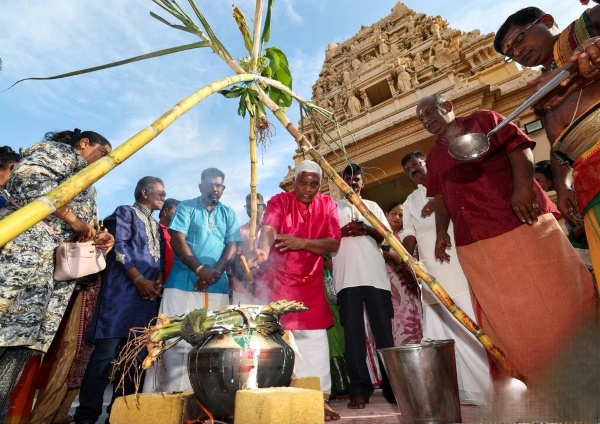
Hindu devotees celebrate the Pongal Festival during a visit to the Sri Maha Mariamman Temple in Skudai, Johor. - Bernama pic, January 18, 2026
Is Malaysia the right place for imported Dravidian politics? – Sandru Narayanan
A recent MIC controversy over Pongal has reignited deeper questions about cultural accuracy, political ideology, and whether Malaysian Tamil identity should be reshaped by narratives imported from Tamil Nadu

Sandru Narayanan
Updated 3 seconds ago
18 January, 2026
12:00 PM MYT
IS Malaysia the right place to practise Dravidianism—an ideology born out of Tamil Nadu’s political battles and identity struggles? More importantly, should Malaysian Tamil culture be reshaped by narratives imported from across the Straits of Malacca?
These questions resurfaced after MIC leaders triggered a storm of criticism by wishing Malaysians a “Happy Tamil New Year” on January 15, coinciding with Pongal. Social media erupted with backlash, memes and sharp criticism. Many Malaysians—especially Tamils—were left scratching their heads: how could a party that claims to represent the Indian community get something so basic so wrong?
The truth is simple and well established: Pongal is not Tamil New Year. Pongal is celebrated in the Tamil month of Thai, dedicated to the Sun God (Surya Deva), and its timing is strictly calculated according to the Hindu Panchangam (calendar). Even the name Thai is derived from the Vedic nakshatra Tishya. From its astronomy to its theology, Pongal is inseparably rooted in Hindu tradition.
Tamil New Year, on the other hand, falls in Chithirai, around April, when the sun enters Mesha rashi. This is clearly documented in Tamil Sangam (ancient Tamil literature) texts dating back over 2,000 years. The Tamil calendar itself begins with Chithirai, marking a new year of beginnings. This is not a matter of opinion or political interpretation—it is history, culture and astronomy combined.
So why did MIC make this mistake?
Anyone who follows Tamil politics knows how closely MIC has aligned itself with the Dravida Munnetra Kazhagam (DMK) over the past decade. Several MIC leaders have openly shared visits and meetings with DMK figures on social media, highlighting these ties with pride. Against this backdrop, the confusion between Pongal and Tamil New Year looks less like a simple oversight and more like the quiet importation of DMK’s ideological narratives.
DMK, a political party barely 80 years old, has long promoted an agenda that seeks to detach Tamil identity from its Hindu roots by selectively reinterpreting culture and tradition. This ideology encourages the rewriting of long-established practices for political purposes. By conflating Pongal with Tamil New Year, MIC appears to have echoed that distortion—whether knowingly or otherwise.
This concern deepened after I spoke to representatives from MIC following the controversy. I was disappointed by their response, which suggested that MIC sees little issue with its close ideological and political alignment with DMK, while sidestepping the core cultural confusion that sparked the backlash in the first place.
They argued that comparisons with other local political parties should take historical context into account, noting that parties such as PKR, DAP and MCA only began publicly wishing Pongal in recent years following the formation of the Madani government.
But this defence misses the point entirely. Whether these parties started early or late is irrelevant. At least they got their messaging right. They wished Pongal as Pongal—without confusing it with Tamil New Year or blurring long-established cultural distinctions. Cultural accuracy matters more than seniority in issuing greetings.
MIC also claimed that much of the criticism originated from individuals who idolise All India Anna Dravida Munnetra Kazhagam (ADMK), Tamilaga Vettri Kazhagam (TVK) or Bharatiya Janata Party (BJP) politics, projecting Indian political preferences onto Malaysian Indian discourse. According to them, this issue resurfaces almost every year, driven by the same arguments.
This is a convenient but flawed dismissal. One does not need to align with ADMK, TVK, BJP—or any Indian political party—to know that Pongal is not Tamil New Year. This is not ideological debate; it is basic cultural literacy. Reducing genuine cultural concern to political allegiance avoids addressing the real issue: a factual misrepresentation of Tamil tradition.
Calling out misinformation is not “creating friction”. It is an act of preservation. Unity cannot be built on inaccuracies, and goodwill cannot replace truth. When culture is reduced to slogans or poorly thought-out social media posts, respect is lost—especially when even a Chinese-based party like MCA manages to get its Pongal greetings right while MIC does not.
For Malaysian Tamils, these traditions are living heritage, passed down through generations. Pongal is a festival of thanksgiving to the Sun God in the month of Thai. Tamil New Year is a celebration of renewal in Chithirai. Mixing the two is like calling Christmas Easter—it is careless, confusing and disrespectful.
MIC must ask itself a serious question: is it representing the Malaysian Indian community, or is it uncritically importing ideological battles from Tamil Nadu that do not belong here? Malaysian Tamils have their own cultural continuity and lived traditions. They do not need political reinterpretation dressed up as progress.
The takeaway is clear: Pongal is Pongal. Tamil New Year is Tamil New Year. Nothing less, nothing more. The social media backlash was not mere outrage—it was a reminder that people notice when culture is mishandled, and credibility is hard to regain once lost.
Some may feel this issue is petty, but for Tamils, culture is close to the heart. – January 18, 2026
Is Malaysia the right place for imported Dravidian politics? – Sandru Narayanan
A recent MIC controversy over Pongal has reignited deeper questions about cultural accuracy, political ideology, and whether Malaysian Tamil identity should be reshaped by narratives imported from Tamil Nadu
Sandru Narayanan
Updated 3 seconds ago
18 January, 2026
12:00 PM MYT
IS Malaysia the right place to practise Dravidianism—an ideology born out of Tamil Nadu’s political battles and identity struggles? More importantly, should Malaysian Tamil culture be reshaped by narratives imported from across the Straits of Malacca?
These questions resurfaced after MIC leaders triggered a storm of criticism by wishing Malaysians a “Happy Tamil New Year” on January 15, coinciding with Pongal. Social media erupted with backlash, memes and sharp criticism. Many Malaysians—especially Tamils—were left scratching their heads: how could a party that claims to represent the Indian community get something so basic so wrong?
The truth is simple and well established: Pongal is not Tamil New Year. Pongal is celebrated in the Tamil month of Thai, dedicated to the Sun God (Surya Deva), and its timing is strictly calculated according to the Hindu Panchangam (calendar). Even the name Thai is derived from the Vedic nakshatra Tishya. From its astronomy to its theology, Pongal is inseparably rooted in Hindu tradition.
Tamil New Year, on the other hand, falls in Chithirai, around April, when the sun enters Mesha rashi. This is clearly documented in Tamil Sangam (ancient Tamil literature) texts dating back over 2,000 years. The Tamil calendar itself begins with Chithirai, marking a new year of beginnings. This is not a matter of opinion or political interpretation—it is history, culture and astronomy combined.
So why did MIC make this mistake?
Anyone who follows Tamil politics knows how closely MIC has aligned itself with the Dravida Munnetra Kazhagam (DMK) over the past decade. Several MIC leaders have openly shared visits and meetings with DMK figures on social media, highlighting these ties with pride. Against this backdrop, the confusion between Pongal and Tamil New Year looks less like a simple oversight and more like the quiet importation of DMK’s ideological narratives.
DMK, a political party barely 80 years old, has long promoted an agenda that seeks to detach Tamil identity from its Hindu roots by selectively reinterpreting culture and tradition. This ideology encourages the rewriting of long-established practices for political purposes. By conflating Pongal with Tamil New Year, MIC appears to have echoed that distortion—whether knowingly or otherwise.
This concern deepened after I spoke to representatives from MIC following the controversy. I was disappointed by their response, which suggested that MIC sees little issue with its close ideological and political alignment with DMK, while sidestepping the core cultural confusion that sparked the backlash in the first place.
They argued that comparisons with other local political parties should take historical context into account, noting that parties such as PKR, DAP and MCA only began publicly wishing Pongal in recent years following the formation of the Madani government.
But this defence misses the point entirely. Whether these parties started early or late is irrelevant. At least they got their messaging right. They wished Pongal as Pongal—without confusing it with Tamil New Year or blurring long-established cultural distinctions. Cultural accuracy matters more than seniority in issuing greetings.
MIC also claimed that much of the criticism originated from individuals who idolise All India Anna Dravida Munnetra Kazhagam (ADMK), Tamilaga Vettri Kazhagam (TVK) or Bharatiya Janata Party (BJP) politics, projecting Indian political preferences onto Malaysian Indian discourse. According to them, this issue resurfaces almost every year, driven by the same arguments.
This is a convenient but flawed dismissal. One does not need to align with ADMK, TVK, BJP—or any Indian political party—to know that Pongal is not Tamil New Year. This is not ideological debate; it is basic cultural literacy. Reducing genuine cultural concern to political allegiance avoids addressing the real issue: a factual misrepresentation of Tamil tradition.
Calling out misinformation is not “creating friction”. It is an act of preservation. Unity cannot be built on inaccuracies, and goodwill cannot replace truth. When culture is reduced to slogans or poorly thought-out social media posts, respect is lost—especially when even a Chinese-based party like MCA manages to get its Pongal greetings right while MIC does not.
For Malaysian Tamils, these traditions are living heritage, passed down through generations. Pongal is a festival of thanksgiving to the Sun God in the month of Thai. Tamil New Year is a celebration of renewal in Chithirai. Mixing the two is like calling Christmas Easter—it is careless, confusing and disrespectful.
MIC must ask itself a serious question: is it representing the Malaysian Indian community, or is it uncritically importing ideological battles from Tamil Nadu that do not belong here? Malaysian Tamils have their own cultural continuity and lived traditions. They do not need political reinterpretation dressed up as progress.
The takeaway is clear: Pongal is Pongal. Tamil New Year is Tamil New Year. Nothing less, nothing more. The social media backlash was not mere outrage—it was a reminder that people notice when culture is mishandled, and credibility is hard to regain once lost.
Some may feel this issue is petty, but for Tamils, culture is close to the heart. – January 18, 2026
Sandru is a journalist at Scoop.my


No comments:
Post a Comment