Why Britain’s Air Defence Destroyer HMS Duncan Can’t Protect Key Bases From Iranian Strikes
Middle East , Naval
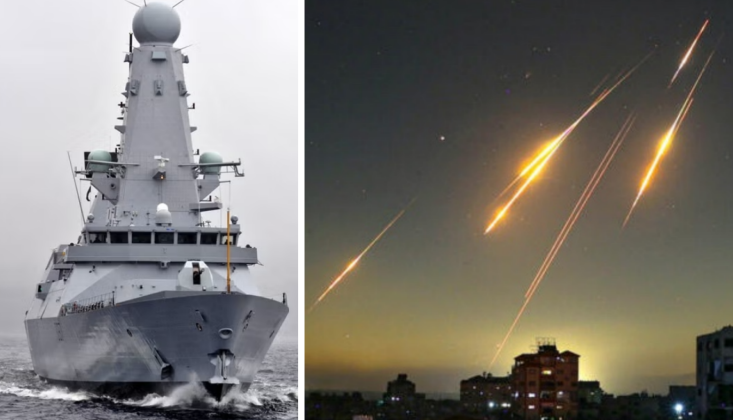
The British Ministry of Defence was reported on March 3 to have decided to dispatch the Type 45 class destroyer HMS Duncan to Cyprus to help defend British military facilities there, after several reports indicated that multiple Iranian drones had targeted RAF Akrotiri, a major Royal Air Force base. This has occurred amid a broader buildup by multiple NATO member states in the theatre of operations, including France, Germany and Greece, as the growing depletion of the air defences of the United States, Israel and their strategic partners in the Gulf region has raised serious questions regarding how long they can sustain their assault against Iran. The Iranian Islamic Revolutionary Guard Corps fields one of the largest arsenals of ballistic missiles and single use attack drones in the world, and has widely targeted the U.S. and its strategic partners’ military facilities, after the United States and Israel launched attacks on targets across Iran on February 28.
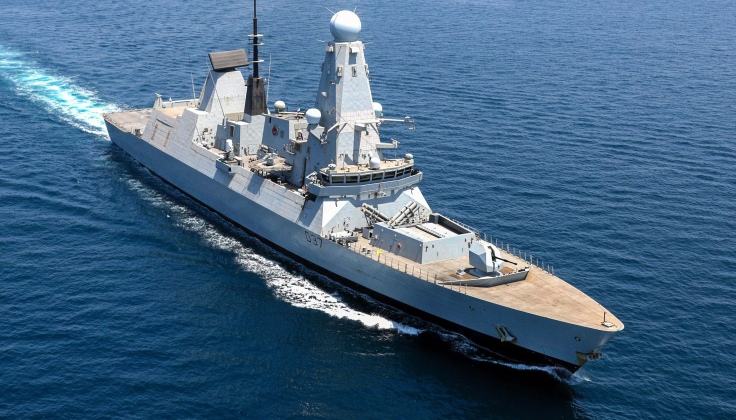
The Type 45 is a heavily specialised air defence destroyer, and lacks a cruise missile strike capability or any significant offensive capabilities against surface ships or ground targets. Despite this specialisation, its air defence capabilities remain highly limited, particularly compared to those of U.S. Navy Arleigh Burke class destroyers deployed in the Middle East. Against drone attacks, Type 45 class ships are highly prone to being overwhelmed, as they carry some of the smallest missile arsenals in the world, with just 48 vertical launch cells. To place the limitations of the ships’ arsenals in perspective, Arleigh Burke class destroyers integrate 96 vertical launch cells, while Chinese Type 055 class destroyers integrate 112 cells. With Iranian forces having deployed swarms of hundreds of attack drones in the past, the Type 45 is far from an optimal asset to engage them.
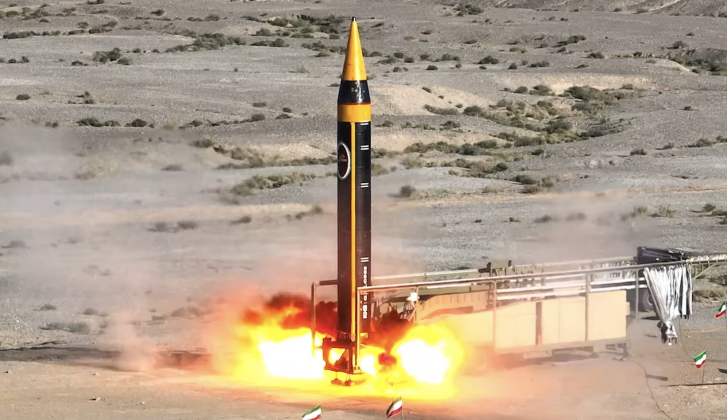
In spite of its focus on air defence operations, Type 45 class destroyers have no ballistic missile defence capabilities, again contrasting to Arleigh Burke Class ships which integrate a multi-layered networks built around the SM-2, SM-3 and SM-6 anti-ballistic missiles. At a Defence Select Committee in early 2021 it was highlighted that this had left the British Armed Forces without any maritime ballistic missile defence capability. Dr Sidharth Kaushal, a research Fellow at the Royal United Services Institute, stressed “the absence of a capability to counter anti-ship ballistic missiles on the Type 45 destroyer.” “That was discussed in the 2015 strategic defence and security review, as part of a wider ballistic missile defence capability for the vessel, but it was absent in this review, which I thought was noteworthy,” he added.
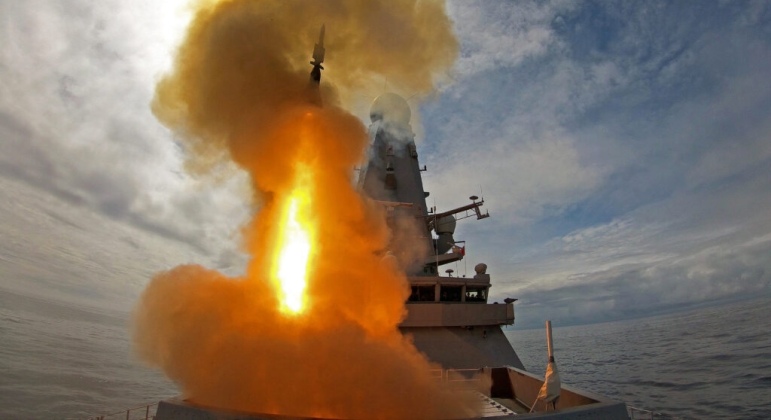
Regarding the Type 45’s inability to defend against ballistic missile attacks, Rear Admiral Alex Burton in 2021 similarly observed: “one of the gaping holes within the defence review is an anti-ballistic missile defence mechanism, both at sea and ashore.” “There is a gaping hole in our ability to defend a carrier against a ballistic missile without the support of our allies… The Navy has been clear that there has been a national capability gap, for the last 10 years, at least, in an anti-ballistic missile defence capability,” he added. Although Type 45 class destroyers are scheduled to be modernised with subsystems and new missiles that will allow them to defend against ballistic missile attacks under the Sea Viper Evolution Programme, this will only meet required standards in the late 2030s or early 2040s. Thus while the deployment of a Type 45 class destroyer will represent a show of force, its practical utility remains limited. Moreover, Iran’s advanced anti-ship ballistic missile capabilities may lead it to escalate by seeking to fire on the vessel, which represents a high value target for such strikes.
***
Used to be one of the best navies, now RN has gone to the dogs🙄🥴


Where are HMS Queen Elizabeth and Prince of Wales? Hiding in some dockyard? Useless Starmer.
ReplyDeletethe 2 carriers have been facing serviceability problems
DeleteWhen Brittania needed a Churchill (WW2) or a Thatcher (Falklands) they got a Wishy Washey Left Wing Labour Wimp.
ReplyDeleteOooop… mfer, don't just looked at the warring records of these two overhyped pommies.
DeleteCheckmaye their overall administrative ability over the long terms.
This Wishy Washey Left Wing Labour Wimp os the accumulation of am the sum of the past pommieland political overplays
Donald Trump said earlier it was 'possible' Starmer was pandering to Muslims.
ReplyDelete12 hours later, here is he is holding a 'Westminster Hall iftar' telling the Muslim community that Britain was not involved in attacking the Iranian terror regime.
Donald Trump was right.
https://x.com/inevitablewest/status/2028941239895126383?s=46
After Pearl Harbour Western Bully was forced into the Pacific Theatre outnumbered by IJN in aircraft carriers. Churchill, desperately short in warships himself, actually loaned US an old one HMS Victorius. Western Bully also made do with their own badly damaged carriers, barely patched together with bandaid. Old tankers were flat-topped and converted to carriers. Their Navy and Marines servicemen risked their lives on these barely seaworthy leaky tubs.
ReplyDeleteWhen the Falklands war erupted Thatcher ordered “old-faithfuls” vintage HMS Hermes and Invincible to battle. No excuses from the cigar puffing Admirals. She kicked all their asses. Iron Lady.
Today we understand what 47 means when he said “Softie Starmer is no Churchill”.
Even with sumbat jambans 47 ordered Gerard R Ford into battle. “Shit in your pants if you have to. I don’t care. For your country. I’ll give you all Purple Hearts.”
Better late than never Frenchie…
ReplyDeleteStarmer you are a COWARD.
JUST IN 🇮🇷🇺🇸: France Enters the Iran War
President of France Emmanuel Macron:
"I have ordered the aircraft carrier Charles de Gaulle to head to the Middle East.
We have deployed Rafale aircraft, air defense systems, and radars in the past few hours, and this will continue.
We have defense agreements with Qatar, Kuwait and the UAE. We must stand with them."
https://x.com/samartoor3086/status/2028943527196148034?s=46