
OPINION | When Fanatics Advance and Moderates Retreat: The Slow Collapse of Multiracial Malaysia
12 Feb 2026 • 4:00 PM MYT

TheRealNehruism
An award-winning Newswav creator, Bebas News columnist & ex-FMT columnist
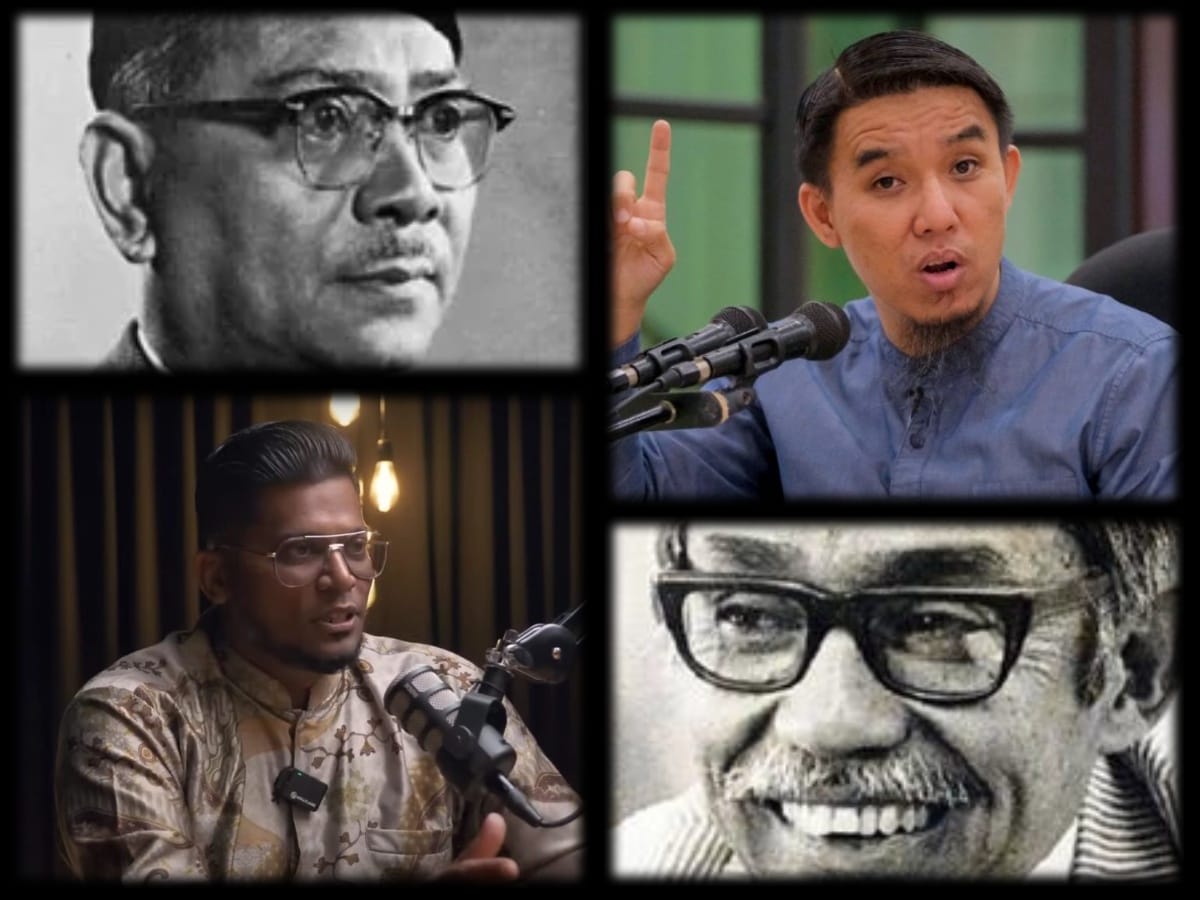
Image credit: Britannica / Malaysian Gazette / Tokoh Malaysia / Scoop
If we imagine social psychology as a spectrum, the middle is occupied by moderates, while the extremes are occupied by fanatics. The difference between the two is not merely ideological intensity — it is existential orientation.
As a rule, a moderate is oriented toward happiness and success.
A fanatic, on the other hand, is oriented toward being themselves.
This distinction explains far more about social conflict than ideology ever could.
A moderate possesses a flexible sense of self. Their identity is adaptable, negotiable, and fluid. They are willing to modify habits, language, dress, diet, rituals, or even cultural attachments if doing so improves their chances of happiness and success. For the moderate, identity is usually just something that you are born with — it is not something that you are stuck with - if the pursuit or happiness or success requires one to modify or change their identity, a moderate is usually a person who is amenable towards changing their identity.
For example, I consider myself as a moderate, in the sense that none of my identities - that of being an Indian, or a Malaysian, or a writer or a teacher -is etched in stone. I am not very proud of being a Malaysian or an Indian, I am just not ashamed of it. Everybody has a race and and a nationality, and mine happens to be such and such. When I see somebody with a different identity or nationality, I tend to not attach a lot of meaning to it. Rather than their identities, it is usually their capacity to pursue success or happiness that I am interested in. If I see someone from a different nationality or race being more capable than me in pursuing success or happiness, I might even adopt some of their characteristics, even if it is an identity characteristic, in order to improve my own chances of pursuing success or happiness.
A fanatic, by contrast, holds an intensely rigid sense of self. Their identity, to them, is sacred, fixed, and non-negotiable. As a result, they will insist on remaining exactly as they are, even when doing so makes them miserable or unsuccessful.
In another word, a fanatic is someone that will speak only the language they identify with, even when it disadvantages them.
They will follow rituals that they identify it even if they see not benefit in it.
They will preserve habits that no longer serve them.
They will defend symbols that they don't even understand.
They will do it, even when these attachments produce humiliation, stagnation, and failure, pain or even death. They will refuse to change — because if you are fanatic, happiness and success has no meaning to you, unless you are able to be exactly who you think you are. If you had to choose between being successful or happy not being yourself, or miserable and failing while being yourself, a fanatic will gladly choose the later.
In short, moderates want to live well; fanatics want to die as themselves.
Every identity group contains both moderates and fanatics. But when fanatics from different groups come into sustained contact, conflict becomes inevitable.
As Winston Churchill once famously said, “A fanatic is someone who can’t change their mind and won’t change the subject.”
Fanatics have no middle ground. They cannot compromise because to a fanatic, compromise feels like betrayal. They cannot negotiate because negotiation feels like submission. They cannot adapt because adaptation feels like humiliation. When two fanatics from two different identity group make contact, one will attempt to impose while the other will resist to the bitter end. The result is always friction, escalation, and eventually, explosion.
Moderates, on the other hand, possess middle ground. They can negotiate, adapt, exchange, learn, and transform. When moderates from different identity groups interact, what emerges is not conflict but social entropy — or a gradual mixing, learning, and convergence, in the pursuit of success or happiness, that slowly produces a new overarching identity, that is sufficiently distinct from any of the component identities that make it, although much of its features is derived from the original component identities.
In a monocultural society, it is possible to build to society where the fanatics are influential, but in a multicultural society, if it one or more of the fanatical faction of the of the various identity group that is calling the shots, it will bring about collapse of a the multicultural society, either by transforming the multicultural society into a monocultural one, or splinter the multicultural society through cultural wars.
The Structural Role of Moderates and Fanatics
Fanatics, despite their unsavory reputation, are by themselves, not evil or perfidious. They actually serve a crucial function: they are the guardians of identity. They preserve language, rituals, traditions, symbols, and collective memory. They are also the group most willing to make sacrifices to defend these markers.
Without fanatics, identity dissolves.
But without moderates, identity stagnates — societies are unable to evolve and become stuck in a world that no longer exists.
Moderates, therefore, are the agents of evolution. They allow communities to adapt to changing economic, social, and political realities. They ensure that identity remains relevant, functional, and forward-looking.
Fanatics on the other hand, are agents of preservation. Without fanatics, communities might change so rapidly that they will too rapidly lose as sense of who they are. .
A healthy society requires both. But it requires them in the correct proportion and structure.
In a multicultural country like Malaysia, moderates must always outnumber fanatics sufficiently so that fanatics remain structurally embedded within their own communities, while intergroup engagement is conducted primarily by moderates.
This creates a vital buffer zone.
Fanatics preserve identity internally.
Moderates manage coexistence externally.
When this structure holds, diversity becomes strength.
When it breaks, however, diversity becomes a fault line.
If we imagine social psychology as a spectrum, the middle is occupied by moderates, while the extremes are occupied by fanatics. The difference between the two is not merely ideological intensity — it is existential orientation.
As a rule, a moderate is oriented toward happiness and success.
A fanatic, on the other hand, is oriented toward being themselves.
This distinction explains far more about social conflict than ideology ever could.
A moderate possesses a flexible sense of self. Their identity is adaptable, negotiable, and fluid. They are willing to modify habits, language, dress, diet, rituals, or even cultural attachments if doing so improves their chances of happiness and success. For the moderate, identity is usually just something that you are born with — it is not something that you are stuck with - if the pursuit or happiness or success requires one to modify or change their identity, a moderate is usually a person who is amenable towards changing their identity.
For example, I consider myself as a moderate, in the sense that none of my identities - that of being an Indian, or a Malaysian, or a writer or a teacher -is etched in stone. I am not very proud of being a Malaysian or an Indian, I am just not ashamed of it. Everybody has a race and and a nationality, and mine happens to be such and such. When I see somebody with a different identity or nationality, I tend to not attach a lot of meaning to it. Rather than their identities, it is usually their capacity to pursue success or happiness that I am interested in. If I see someone from a different nationality or race being more capable than me in pursuing success or happiness, I might even adopt some of their characteristics, even if it is an identity characteristic, in order to improve my own chances of pursuing success or happiness.
A fanatic, by contrast, holds an intensely rigid sense of self. Their identity, to them, is sacred, fixed, and non-negotiable. As a result, they will insist on remaining exactly as they are, even when doing so makes them miserable or unsuccessful.
In another word, a fanatic is someone that will speak only the language they identify with, even when it disadvantages them.
They will follow rituals that they identify it even if they see not benefit in it.
They will preserve habits that no longer serve them.
They will defend symbols that they don't even understand.
They will do it, even when these attachments produce humiliation, stagnation, and failure, pain or even death. They will refuse to change — because if you are fanatic, happiness and success has no meaning to you, unless you are able to be exactly who you think you are. If you had to choose between being successful or happy not being yourself, or miserable and failing while being yourself, a fanatic will gladly choose the later.
In short, moderates want to live well; fanatics want to die as themselves.
Every identity group contains both moderates and fanatics. But when fanatics from different groups come into sustained contact, conflict becomes inevitable.
As Winston Churchill once famously said, “A fanatic is someone who can’t change their mind and won’t change the subject.”
Fanatics have no middle ground. They cannot compromise because to a fanatic, compromise feels like betrayal. They cannot negotiate because negotiation feels like submission. They cannot adapt because adaptation feels like humiliation. When two fanatics from two different identity group make contact, one will attempt to impose while the other will resist to the bitter end. The result is always friction, escalation, and eventually, explosion.
Moderates, on the other hand, possess middle ground. They can negotiate, adapt, exchange, learn, and transform. When moderates from different identity groups interact, what emerges is not conflict but social entropy — or a gradual mixing, learning, and convergence, in the pursuit of success or happiness, that slowly produces a new overarching identity, that is sufficiently distinct from any of the component identities that make it, although much of its features is derived from the original component identities.
In a monocultural society, it is possible to build to society where the fanatics are influential, but in a multicultural society, if it one or more of the fanatical faction of the of the various identity group that is calling the shots, it will bring about collapse of a the multicultural society, either by transforming the multicultural society into a monocultural one, or splinter the multicultural society through cultural wars.
The Structural Role of Moderates and Fanatics
Fanatics, despite their unsavory reputation, are by themselves, not evil or perfidious. They actually serve a crucial function: they are the guardians of identity. They preserve language, rituals, traditions, symbols, and collective memory. They are also the group most willing to make sacrifices to defend these markers.
Without fanatics, identity dissolves.
But without moderates, identity stagnates — societies are unable to evolve and become stuck in a world that no longer exists.
Moderates, therefore, are the agents of evolution. They allow communities to adapt to changing economic, social, and political realities. They ensure that identity remains relevant, functional, and forward-looking.
Fanatics on the other hand, are agents of preservation. Without fanatics, communities might change so rapidly that they will too rapidly lose as sense of who they are. .
A healthy society requires both. But it requires them in the correct proportion and structure.
In a multicultural country like Malaysia, moderates must always outnumber fanatics sufficiently so that fanatics remain structurally embedded within their own communities, while intergroup engagement is conducted primarily by moderates.
This creates a vital buffer zone.
Fanatics preserve identity internally.
Moderates manage coexistence externally.
When this structure holds, diversity becomes strength.
When it breaks, however, diversity becomes a fault line.
Why Malaysia Is Becoming More Tense
Malaysia’s growing racial, religious, and regional turbulence is not accidental. It reflects the weakening of moderates across one or more identity groups, allowing fanatics to move to the forefront and engage directly with other identity groups, or worse, with the fanatics of other identity groups.
Social media has accelerated this process dramatically. It bypasses traditional social buffers and enables direct, constant, and emotionally charged contact between fanatics of different groups. In doing so, it amplifies outrage, identity insecurity, and radicalization.
Once fanatics from one group become aggressive, moderates in other groups gradually weaken and retreat, allowing their own fanatics to emerge in defense. This creates a vicious escalation loop:
Fanatic contact → Identity defensiveness → Moderate collapse → Mutual radicalization
At this stage, intergroup interaction ceases to be adaptive and becomes purely confrontational. Society moves from negotiation to mobilization, from cooperation to antagonism.
The Political Consequence Malaysia Cannot Ignore
If Malaysia seeks lasting social stability, the answer does not lie in censorship, repression, or authoritarian control. Nor does it lie in moral lectures about tolerance. The real challenge is far more structural: how the state manages the positioning, contact, and interaction between moderates and fanatics across identity groups.
At present, the balance is tilting dangerously.
The spatial, social, and psychological distance between moderates and fanatics is collapsing, while direct contact between fanatical elements of different communities is rapidly increasing. This is pushing Malaysia away from the delicate equilibrium required for multicultural coexistence and steering it toward two equally destabilising outcomes: the forced emergence of monocultural dominance, or the fragmentation of the multicultural state itself.
Either path will not unfold peacefully.
Both will be paved with prolonged tension, social bitterness, identity hardening, and periodic explosions of conflict. There is no smooth transition from multiculturalism to monoculturalism, just as there is no gentle disintegration of a plural society. What lies in between is always turbulence.
To prevent such an outcome, the state must urgently rethink how it structures identity relations in the country.


Yapan rejects multiculturism...
ReplyDeleteWhen asked at Davos if Japan needs more foreign workers, Minister Katayama answered: “Japan will not follow Europe and become an immigrant society.”
https://x.com/gaijinthoughts/status/2014832911908811194?s=20
🚨BREAKING:
ReplyDelete🇯🇵 An anti-Globalist REVOLUTION is happening in Japan:
"Once Immigration crosses a certain line and Japanese society changes, there is no going back."
Japan doesn't want to follow the footsteps of Europe.
https://x.com/HungaryBased/status/2017304303011303493?s=20
Japan’s new PM allegedly said she’ll remove “culturally incompatible” foreigners, including Islamist migrants who reportedly seized a kids’ playground to pray and push Sharia.
ReplyDeleteDo you agree?
https://x.com/akafaceUS/status/2015270149482295629?s=20
🚨BREAKING:
ReplyDelete🇯🇵 Prime Minister of Japan, Sanae Takaichi EXPOSES Western Globalism.
"Japan will not take in illegal migrants anymore, fake refugees will be deported."
https://x.com/HungaryBased/status/2005321596022735000?s=20
🚨BREAKING - JAPANESE PM TAKAICHI SECURES SUPER-MAJORITY WIN
ReplyDeleteThe Japanese have REJECTED immigration outright so that they "dont end up like Europe"
The Japanese have SPOKEN, they choose culture over GDP growth and immigration.
https://x.com/Tablesalt13/status/2020659693551808539?s=20
Yitaly too....!!!
ReplyDelete🚨 BREAKING: Italian PM Giorgia Meloni has just announced a SURGE in deportations of 3rd world migrants and tougher immigration policies
"We are fighting mass illegal immigration!" 🔥
"We are KEEPING a commitment we made to the citizens!"
Meloni is a BEACON of Europe! 🇺🇸🇮🇹
https://x.com/EricLDaugh/status/2022129964620165525?s=20
🚨🇪🇺BREAKING: The European Parliament has just declared trans women as women.
ReplyDeleteDuring today’s vote, the Parliament adopted a resolution recognizing trans women as women, with 340 MEPs voting in favor.
Therefore, according to the European Parliament as of today this is a woman....(& accused murderer)
https://x.com/DVATW/status/2022021545296593341?s=20
This comment has been removed by a blog administrator.
ReplyDeleteAs of February 2026, the claim that the new Japanese Prime Minister said she will deport all "culturally incompatible foreigners" is false and a misrepresentation of policies that have circulated online.
DeleteReuters
Reuters
+1
While Japan’s new Prime Minister, Sanae Takaichi (who took office in October 2025 and won a landslide election in February 2026), has adopted a strict stance on immigration and foreign resident behavior, she has not called for the mass deportation of "culturally incompatible" people.
***
This is an example of why I have often delete your kerbau comments
She’s sick of multiculturism…..
ReplyDeletehttps://x.com/rickydoggin/status/2021390419431653765?s=46