
OPINION | The Biggest Winners of Anwar’s Cabinet Reshuffle
17 Dec 2025 • 3:30 PM MYT

TheRealNehruism
An award-winning Newswav creator, Bebas News columnist & ex-FMT columnist
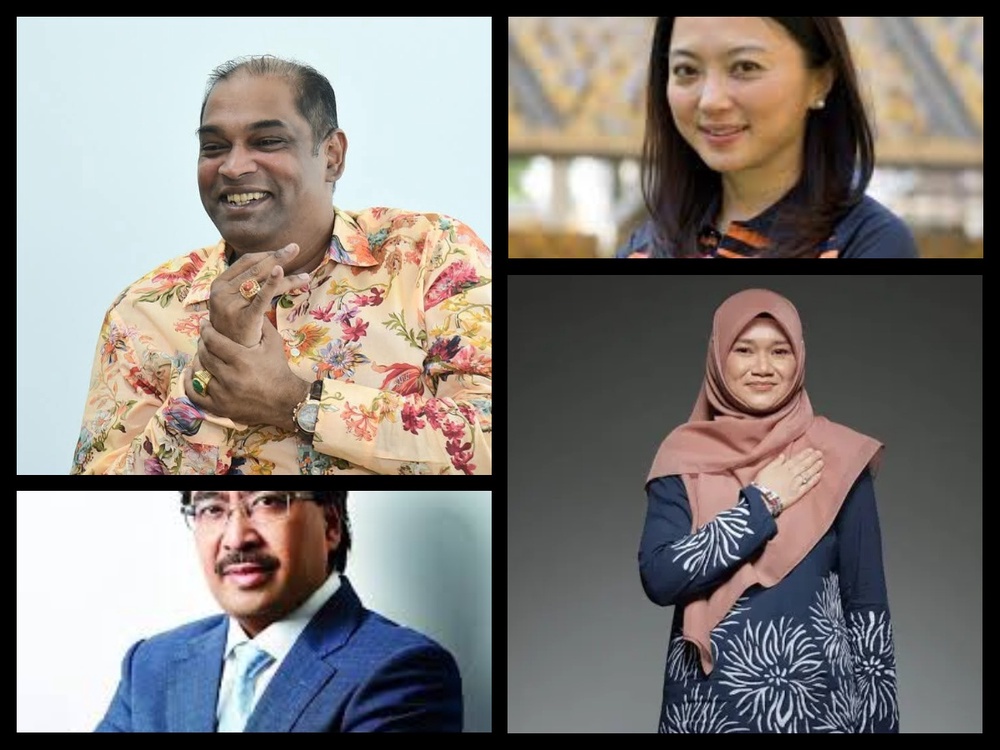
Image credit: Kosmo / Jo Ghani FB / Hannah Yeoh FB / Al Hijrah
Before we even begin to ask who the biggest winners of Anwar Ibrahim’s latest cabinet reshuffle are, we should first be clear about what this reshuffle tells us about how Anwar governs.
Taken as a whole, the reshuffle reveals a prime minister who rules primarily through political calculation and personal preference, rather than through any coherent desire to improve governance, strengthen institutions, or move the country decisively forward.
I say this because if you look at the at the cabinet reshuffle, from the point of view of how does this benefit the people and the country, you will only end up bewildered and confused.
However if you see from the angle of how will this cabinet reshuffle be able to satisfy the political demands of the various parties that make up the unity government as well fulfill Anwar’s own preference - as to who he likes, trust or desires to reward - then and only then will all the pieces will fall together.
With that in mind, let us turn to the biggest winners of Anwar’s cabinet reshuffle.
The Biggest Winner: R. Ramanan
Without question, the standout beneficiary of the reshuffle is R. Ramanan.
Ramanan has been elevated from deputy minister to Minister of Human Resources, replacing DAP’s Steven Sim, who has in turn been shifted—one might say demoted—to the less prestigious Ministry of Entrepreneur and Cooperatives Development.
The obvious question is: why?
Why was Ramanan promoted, and why was Steven Sim removed from Human Resources?
If performance were the yardstick, this decision would make little sense. Steven Sim cannot reasonably be accused of having failed as Human Resources Minister. In fact, in a portfolio notorious for swallowing ministers whole, Sim performed better than most. The Human Resources Ministry is a political minefield: trade unions are perpetually hostile, scandals are never far away, and ministers often fall in spectacularly undignified fashion.
Sim survived all of that. He endured years of hostility from unions such as NUBE, weathered the HRDF scandal without being dragged down, and exited the ministry without any catastrophic personal implosion. By Malaysian standards, that already places him above average.
So what, then, qualifies Ramanan to replace him?
What exceptional achievements did Ramanan demonstrate as Deputy Minister of Entrepreneur and Cooperatives Development that would make him the obvious choice to helm such a sensitive and complex ministry?
Your guess is as good as mine.
The only explanation that truly makes sense is the simplest one: Anwar likes Ramanan.
Ramanan is, by PKR standards, a political latecomer. He only joined the party in 2020—long after PKR and Pakatan Harapan had endured years of struggle, sacrifice, and political exile, and two years after PH had already formed the government in 2018.
During the PKR party elections last May, Rafizi Ramli himself criticised Ramanan by saying that manner was still unfamiliar with PKR’s culture and history - an allusion that Ramanan's manner of campaigning for the post of PKR Vice President was unsuited for PKR.
Yet since joining PKR, Ramanan’s ascent has been nothing short of meteoric.
In the 2022 general election, barely two years after joining the party, he was handed the Sungai Buloh seat—a high-profile and relatively safe constituency—which he won by the narrowest of margins against Umno heavyweight Khairy Jamaluddin.
By December 2023, he was appointed a deputy minister.
In May 2025, he secured a position as PKR vice-president.
And now, barely half a year later, he finds himself appointed Minister of Human Resources.
All this, despite the fact that most Malaysians would struggle to name a single major policy achievement or reform associated with him.
When Ramanan clashed with PKR veteran and former number two Rafizi Ramli during the party elections, it was Rafizi who fell—and Ramanan who soared. In a party that once claimed to stand for meritocracy and reform, that outcome tells its own story.
In Malaysia, advancement is still too often determined by selection and preference rather than competition and competence. For all their rhetoric about change, PKR and Anwar appear far less different from the old regime than their supporters would care to admit.
Winning by Not Losing: Fadhlina Sidek
Another major winner of the reshuffle is Fadhlina Sidek—though her victory lies not in promotion, but in survival.
Escaping a major loss, after all, can be its own form of triumph.
Before the reshuffle, Fadhlina’s position as Education Minister appeared precarious. A relentless stream of horrifying incidents emerging from Malaysian schools—extreme bullying, sexual violence, and even murder—had inflicted severe damage on her public standing.
Worse still, her responses often appeared overwhelmed and uncertain, reinforcing the perception of a minister out of her depth. Political pressure mounted, with MCA among the latest to publicly demand her removal.
Yet Fadhlina survived.
Perhaps it helped that she sang Anwar a birthday song earlier this year. Perhaps it helped that her father, Siddiq Fadzil, former ABIM president, was a close friend of Anwar’s. In Malaysian politics, such connections have a habit of outweighing performance metrics.
When faced with a choice—between the educational welfare of millions of Malaysian students and the political comfort of a trusted friend’s daughter—the outcome speaks volumes about Anwar’s priorities.
Other Winners: Jo Ghani and Hannah Yeoh
Beyond Ramanan and Fadhlina, there are other, quieter winners.
Jo Ghani emerges as one. His move from the relatively colourless Ministry of Plantation and Commodities to the far more prestigious Ministry of Investment, Trade and Industry is undeniably an upgrade. It is almost certainly a position he has long coveted, and a winner, at the simplest level, is someone who gets what they desire.
Hannah Yeoh, too, can count herself among the beneficiaries. Her transfer from Youth and Sports to the Federal Territories Ministry is not an outright promotion, but neither is it a demotion—and, crucially, it places her in a portfolio that better suits her temperament and skillset.
Hannah was never a natural fit for Youth and Sports. In personality, presentation, and performance, she often appeared like a fish out of water. Her exit comes at a particularly convenient moment: amid the explosive FAM foreign player naturalisation scandal, a debacle that threatens Malaysia’s international sporting reputation and exposes deep institutional rot.
Being moved out just as that storm gathers is, by any reasonable definition, a relief—and therefore, a win.
Taken together, the reshuffle does not project confidence, reform, or renewal. Instead, it reinforces an uncomfortable truth: under Anwar Ibrahim, loyalty still trumps competence, preference still outweighs performance, and politics remains a game of personal calculus rather than public good.


No comments:
Post a Comment