Tuesday, August 04, 2020

PERKASA objecting to Ambiga as EC Chair is OK but NOT for idiotic reason

MM Online:

Ambiga denies being considered for EC chairmanship, tells Perkasa to check its facts


Datuk Ambiga Sreenevasan Ambiga also lamented that Azhar’s exit from the Commission has now left it 'vulnerable' ― Picture by Hari Anggara


KUALA LUMPUR, Aug 2 — Lawyer and human rights activist Datuk Ambiga Sreenevasan today denied rumours that she is being considered to head the Election Commission (EC) replacing Datuk Azhar Azizan Harun who resigned to take up the Dewan Rakyat Speaker post.

Ambiga took right-wing Malay group Pertubuhan Pribumi Perkasa Malaysia (Perkasa) to task for their being up-in-arms over her alleged appointment, to the point of them bringing up her advocacy for LGBT rights.

Speaking to Malay Mail, Ambiga said that the appointment of the next EC chairman is now being closely watched by those who have been fighting for a clean and fair election system.

Ambiga also lamented that Azhar’s exit from the Commission has now left it “vulnerable”.

“Perkasa should really check its facts before going on a long racist and homophobic tirade. I am not being nominated for EC chair, and I would be very surprised if I was even in the running.

“As far as the chairmanship of the EC is concerned, all of us who fought for years for clean and fair elections are watching this very closely. The former EC chair’s resignation has unfortunately left this important Commission vulnerable. I hope those in Perikatan Nasional (PN) who were with us in our struggle for free and fair elections, will recall the years and years of hard work by the rakyat to see the establishment of an independent Election Commission.

“This important appointment of the EC chair will surely demonstrate if in fact, PN remains committed to free and fair elections. It would be shocking if they are not,” she said.

Malaysia Gazette quoted Perkasa secretary-general Syed Hassan Syed Ali, saying that Ambiga is unfit for public office, owing to her pro-LGBT stance.

Syed Hassan also claimed that rumours have been circulating that the now-former EC Commissioner, Datuk Seri Ramlan Ibrahim had resigned from the Commission recently, purportedly in protest over the PN government’s suggestion to appoint Ambiga to head the EC.

“But coming back to Perkasa’s attack on one of the most vulnerable communities in Malaysia, the LGBT community, which they seem to have a preoccupation with, what part of what I say are they objecting to?

“Is it the part where I say all human beings (including the LGBT community) deserve to be treated with dignity? That no one should have to live in fear? That no one should be threatened or physically harmed or their lives put at risk because of who they are? That all Malaysians regardless of who they are, enjoy the same fundamental rights under the (Federal) Constitution?

“Which part of that does anyone have an issue with? It merely requires all of us to behave humanely and justly and I make no apologies for advancing my defence of any oppressed community,” she added.

Monday, August 03, 2020

Azmin, Guan Eng clash over Cabinet minutes on trade pact under PH govt

FMT:

Azmin, Guan Eng clash over Cabinet minutes on trade pact under PH govt


International Trade and Industry Minister Mohamed Azmin Ali clashes with Bagan MP Lim Guan Eng in the Dewan Rakyat today


KUALA LUMPUR: A disagreement over the ratification of an international free trade agreement sparked an argument today between MPs Mohamed Azmin Ali and Lim Guan Eng, both of whom were ministers under the Pakatan Harapan (PH) government.

Azmin, who is now international trade and industry minister under Perikatan Nasional government, claimed that the PH government had agreed to ratify the Comprehensive and Progressive Agreement for Trans-Pacific Partnership (CPTPP).

The CPTPP is an agreement between 11 countries.

Azmin said a decision on the ratification was made in September 2018 when the Cabinet agreed to ratify the agreement without any time limit.

“We are now continuing discussions with stakeholders and the Attorney-General’s Chambers before we put it forward to the Cabinet for a new mandate,” he said when wrapping up his ministry’s policies.

Hearing this, Lim (PH-Bagan) stood to object, saying the PH Cabinet had not agreed to the ratification as “we did not want foreigners to interfere”.

“So it is not true that the Cabinet agreed. I hope you can correct the facts,” Lim told Azmin who was in charge of economic affairs under the PH government.

But Azmin told Lim to check the minutes of the Sept 5, 2018 meeting, at which Lim asked Azmin to look up the latest minutes of the meeting in 2019.

“Or check with (an) ex-Miti minister. Don’t twist the facts. Ask Langkawi MP (Dr Mahathir Mohamad), too.

“Speak the truth,” said Lim, who was the finance minister in the PH government.

To this, Azmin asked: “Why do you suggest that you are the only person who is speaking the truth?”

Ong Kian Ming, the former deputy international trade and industry minister, asked for permission to interject while Wong Chen (PH-Subang) asked for historical facts.

Earlier, Azmin told the Dewan Rakyat that up to May 31, 2020, Malaysia had received 32 projects from foreigners worth RM17.5 billion, out of which 28 projects had been approved.

Mukhriz Mahathir (Independent-Jerlun) then said big projects took at least a year to materialise and asked if the dealings were approved during the PH administration.

Mukhriz also asked about the types of promotion being carried out to attract foreign direct investments as the country was facing political uncertainties.

Azmin replied that even though the opposition claimed there were political uncertainties in the country, rating agencies and the World Bank had said that Malaysia’s economy would be one of the earliest to recover next year due to the stimulus packages and various measures taken by the PN government.

He further asked opposition MPs to change the narrative of fear in this regard to help create confidence in the country’s economy.

He said the slowdown was a global phenomenon, and due to that Putrajaya had carried out stimulus packages to cushion the economic impact of the crisis.

He was replying to Lim who told him that Fitch Ratings had revised its outlook on Malaysia’s long-term foreign currency issuer default rating from stable to negative, and affirmed the rating at A-.

*********

kaytee notes:

Much as I don't like Guan Eng with regards to many things, I support him on this because I just don't bloody trust the other party wakakaka, thus making Guan Eng truthful by default, wakakaka again.

😂😂😂


Kenny Chua defected out of loyalty to Anwar

MM Online:

I defected out of loyalty for Anwar, Sabah rep Kenny Chua says


Datuk Seri Anwar Ibrahim is pictured at PKR’s headquarters in Petaling Jaya June 19, 2019. — Picture by Yusof Mat Isa


KOTA KINABALU, Aug 3 — State assemblyman Kenny Chua has broken his silence on his defection to support the opposition’s bid to topple the Sabah government, saying he did it out of his loyalty to his former party PKR and its president Datuk Seri Anwar Ibrahim.

In a statement today, Chua, a former assistant finance minister said he could not see himself being part of an administration that supports former prime minister Tun Dr Mahathir Mohamad.

PKR sacks Inanam assemblyman Kenny Chua | Borneo Post Online

“It would go against my principle to be part of a state government that was led by Warisan because this party had openly declared its support for Dr Mahathir. It was even reported that it was ready to amend its constitution to welcome him into the party.

“I’ve repeatedly said that as a PKR leader in Sabah, it was only right for me to stay loyal to my party president and threw my undivided support for him as the country’s next prime minister as what all Malaysians and Sabahans had been promised during the last general election,” he said.

Chua, who was a state PKR vice-chairman said that he commiserated with the negative sentiments the majority of Sabahans harboured towards Dr Mahathir for changing the political landscape since the 1980s.

Chua was one the 13 elected and nominated assemblyman who decided to switch sides and rally behind former Sabah chief minister Tan Sri Musa Aman in his bid to topple the Warisan-led state government.


The attempt, however, was foiled after Warisan, led by Datuk Seri Shafie Apdal, sought for the dissolution of the state legislative assembly to pave way for a snap state election.

Chua, who was sacked by his party for switching sides, denied allegations that he had been offered huge sums of money to defect.

“The relevant authorities can investigate me. They can check my bank accounts if they suspect that I had been offered millions of cash. But perhaps in all fairness, they should also call for investigation on those elected representatives who switched sides to help Warisan form the state government in 2018,” he claimed.

Chua said that of the 13 who defected, he had the most to lose.

“I’ve been criticised for switching sides. But come to think about it, why would I ever want to jeopardise my position in the government if it had not been for things happening in government and local politics which I didn’t think were right?”

“And the mother of all problems is the [undocumented migrant] and statelessness issue which I’ve repeatedly highlighted in the media even before I was an elected representative,” he said, adding that he would reveal more eventually.


Chua also said that the state government lacks the funds to develop the state and that it was critical to have federal funds.

He also attributed his crossover to Warisan’s treatment towards its partners, PKR, Upko and DAP.

Chua said that he would like the chance to prove his intentions to the people if given the chance for re-election.

Last week, Shafie sought for a dissolution of the State Assembly following the defection of the 13 assemblymen, which gave Musa a simple majority in the 65 member House.

The Election Commission has yet to name a date for the state polls.

Is Perikatan Nasional breaking up?

FMT:

Is Perikatan Nasional breaking up?


The Perikatan Nasional (PN) appears doomed – even before it becomes a formal, registered coalition. This will not come as a surprise to many, given the fact that it was hastily stitched together by a group of leaders who saw an opportunity to take power without seeking a mandate from voters.

The strongest indication of PN’s vulnerability came on July 30 when Umno president Ahmad Zahid Hamidi snubbed Muhyiddin Yassin by saying his party would not enter into a formal pact with the latter’s PPBM.

However, Zahid said Umno would continue to back the federal government headed by Muhyiddin and would continue to be part of his government.

“We feel that Muafakat Nasional (MN) is the best platform for PAS, Umno and Barisan Nasional (BN) parties to face whatever possibilities in the near future,” Zahid added.

This is a major blow to Muhyiddin, for Umno, with 39 MPs, is the largest bloc propping up his government.

Why this decision? Some say it is Umno’s way of showing displeasure at the outcome of the corruption trial of Najib Razak, its former president.

Former prime minister Najib was sentenced to 12 years in jail and fined RM210 million by the High Court after he was found guilty of all seven charges involving abuse of power, criminal breach of trust and money laundering linked to the SRC International scandal.

It is certainly a message to Muhyiddin, coming as it does two days after Najib’s conviction – especially since Zahid himself is facing a slew of corruption, CBT and money laundering charges.

PN has yet to be registered but the process has already started. A source told Singapore’s The Straits Times that Muhyiddin would go ahead with PN despite Umno’s stand. The source also said PN had been registered and to wait for the announcement.

If indeed PN had been registered, one would have thought that Muhyiddin would have rushed to announce it so as to show the people PN was stable, but that hasn’t happened.

While Umno said it would not join PN but would cooperate at government level, PAS president Hadi Awang said his party would continue to cooperate with PPBM at both party and government levels.

Meanwhile, PAS secretary-general Takiyuddin Hassan said MN did not hold any discussion prior to Zahid’s announcement that Umno would not join PN. “We are unsure in relation to the matter. We need to discuss the matter,” he said, indicating it came as a surprise to PAS. However, Umno Youth chief Asyraf Wajdi Dusuki said Umno had twice stated at the MN main committee meeting that it would not formally join PN. What does that say about Umno-PAS understanding?

It’s interesting that MN has, in turn, invited PPBM to join it. In fact, Zahid was reported as saying, in stressing that Umno would not become a PN component party, that Muhyiddin had expressed interest in joining MN.

PPBM secretary-general Hamzah Zainudin said the party’s Supreme Leadership Council was debating the matter and a decision would be made soon. He said PPBM was reviewing several matters, including the structure of the MN main committee and “how the three parties can chart MN”.

For Zahid, the maths is simple: If Umno joins PN, he would be acknowledging Muhyiddin’s authority or PPBM’s status as leader; if PPBM joins MN, it will indicate PPBM is willing to accept the leadership of Umno. It’s a game; a power play.

By not being part of PN, Umno can negotiate better terms in the run-up to the next general election: how many seats it will contest and whose party will nominate the next prime minister.

Also, PPBM may or may not exist after the next general election whereas Umno and PAS, with their vast networks and spread-out roots, will be around for a long time in Malay and Malaysian politics.

If PPBM joins MN led by Umno, the Umno president will have more power to call the shots at the next general election. This power will be crucial when it comes to apportioning seats to be contested as in the previous general election, PPBM contested almost all the seats that Umno considers its traditional seats.

Perhaps Zahid is also trying to force Muhyiddin’s hands, to add to the pressure so that Muhyiddin calls for snap elections. Reports indicate that Umno and PAS are confident of winning more seats and forming the government in the next general election. Political analysts think so too, according to media reports.

A glimpse of what’s likely to happen at the 15th general election is currently on show in Sabah, where the state assembly has been dissolved.

Even before the dates for an election have been set, Umno and PPBM are quarrelling over seats.

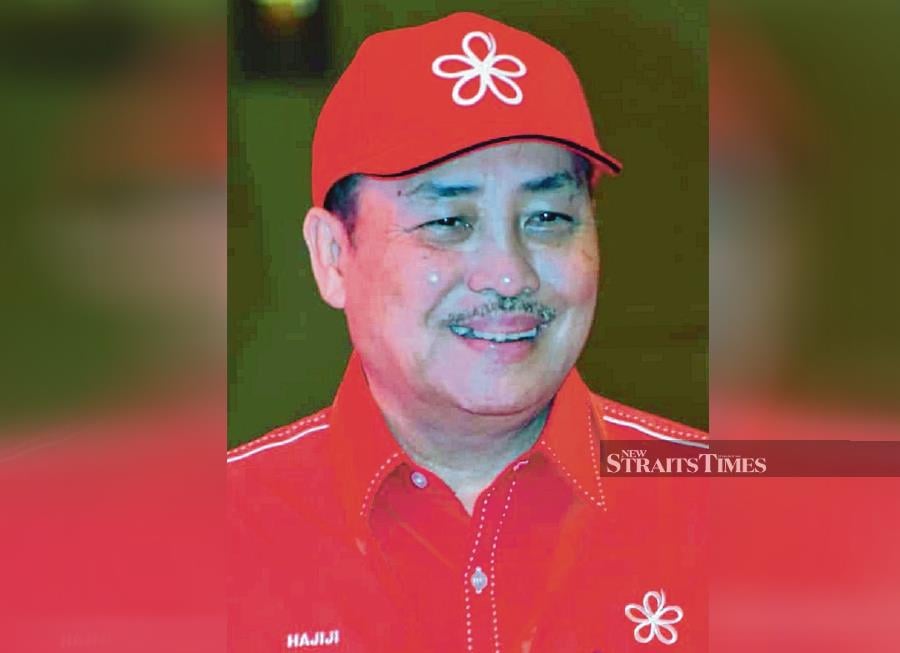
Sabah PPBM chief Hajiji Mohd Noor, an Umno man who crossed over to PPBM, said his party would contest in 45 of the 73 state seats. No sooner had he said this than Sabah Umno information chief Shahril Hamdan charged in to say: “Two words – don’t dream. My suggestion to Sabah Bersatu (PPBM) is that if they want to be friends with Umno, let’s do it on friendly terms. We can discuss. We can negotiate.”

Umno vice-president Mohamed Khaled Nordin was more blunt: “He (Hajiji) has his party, we have ours. Bersatu exists in Sabah only because of a group of traitors. Umno will continue to receive the support of the grassroots.”

Sabah Umno chairman Bung Moktar Radin said Umno intended to defend all 32 state seats it had previously contested and some of the 13 new seats created in July 2019 when Parliament approved a bill to increase the state constituencies from 60 to 73.

Then again, squabbles over seats among coalition partners are not new. Warisan, the DAP and PKR will face trouble in the Sabah elections too.

At the federal level, PN is hanging on to power by the slimmest of majorities; it won the move to replace the speaker of the Dewan Rakyat by a mere two votes. And it is telling that when Umno talks about giving Muhyiddin’s government support, it almost always ends with “until the 15th general election”.

All it needs is for some MPs from Umno or its Sarawak partner GPS to quit for PN to collapse, which means Muhyiddin will be desperately trying to maintain support for his shaky government. There are many ways a prime minister can do this

So, is PN breaking apart? Will it be a short-lived coalition? The writing is on the wall.


Pahang Jawi signage row – DAP leadership's party-first, not principle-first stand

Malaysiakini:

Pahang Jawi signage row – DAP leadership's party-first, not principle-first stand

by S Thayaparan

"If you give me six lines written by the hand of the most honest of men, I will find something in them which will hang him."

- Attributed (disputed) to Cardinal Richelieu


Malaysiakini


In defending Tras assemblyperson Chow Yu Hui's lawsuit that challenged a mandatory directive to include Jawi script on signboards, DAP Youth secretary Eric Teh said: "We should oppose any cultural hegemony instead of surrendering to it, and I think (DAP Youth chief) Howard Lee (who criticised Chow) has forgotten this."

Let us begin with the basics. Culture is a one-way street in Malaysia. The non-Malays have no choice but to learn about Malay culture while the Malays get to retreat to a mainstream political system that claims their culture, economic survival and political system are under threat because of the non-Malays - that generally means the Chinese community.

Therefore, this is not only a question about cultural hegemony but also of political expediency. I have no idea why the Pahang state government is adamant that Jawi is to be incorporated on all signages in the state, even business operations. After all, does the state government need Jawi signage to be part of non-halal businesses that revolve around the sale and distribution of alcohol?

As it stands in this country, certain words are verboten, by law, to the non-Malay community, where books are banned and people hauled up for sedition or hurting the sensitivities of others. This idea that the Tras assemblyperson and his lawsuit is attracting more trouble for the DAP is, well, ludicrous.

The fact of the matter is that Malay power structures have always demonised the DAP because it serves a political purpose. The old maverick and two-time prime minister admitted this and has been trying to walk back on earlier strategic decisions now that he needs the DAP. All this is a matter of public record.

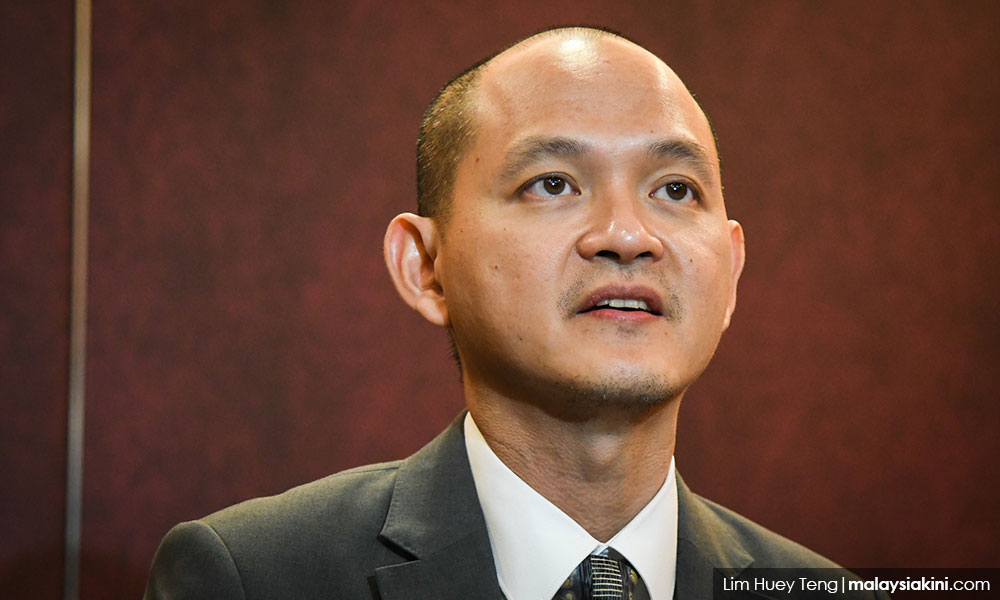
DAP assistant political education director Ong Kian Ming called the lawsuit “totally unnecessary” and the folks involved “wannabe heroes”. Oh, really? What about the time Ong waxed lyrical about reading the Bible in the Malay language and admonished those who would restrict usage of the word “Allah” by Christians and warned of the slippery slope if this was not countered?


"To say that Christians should change the word Allah to Tuhan is to disrespect the rights of a religious group – Christians, in this case – to have autonomy and control over their own religious texts," Ong (above) had said.

"It could easily lead to other 'slippery slope'-type arguments. For example, if the usage of the word Allah by Christians might offend or confuse Muslims and this word has to be changed, would other things in the Bible that may be offensive or confusing to Muslims – such as the many references to Jesus as God and Savior – also be required to be changed?" Ong asked in a post on his blog.

What Ong was describing in his blog post about the Allah controversy is an instinctual reaction to cultural hegemony and the need to protect the freedom of expression and belief that is the foundation of a democratic polity.

You could argue that when Ong was pontificating about the need to respect one another’s culture, he was painting a target on the DAP’s back too. This, of course, did not stop the big guns of the DAP from pursuing this issue and using it as a political prop.

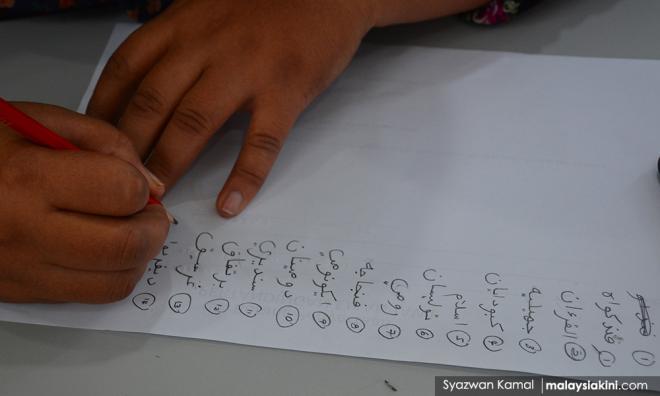
The DAP at that time was supportive of efforts to ensure that free expression and belief remained in political and personal spaces. Of course, with the subsequent “khat” controversy and the various backtrackings since coming into power, the new tone seemed to be “do not spook” the Malays.

What benefit is there to have Jawi signage in stores that sell non-Muslim religious accoutrements? How will having Jawi signages for non-halal businesses “empower” Jawi writing? What this is really all about is the demonstration of religious power over the masses in an effort to negate the pluralism of a religiously diverse polity.


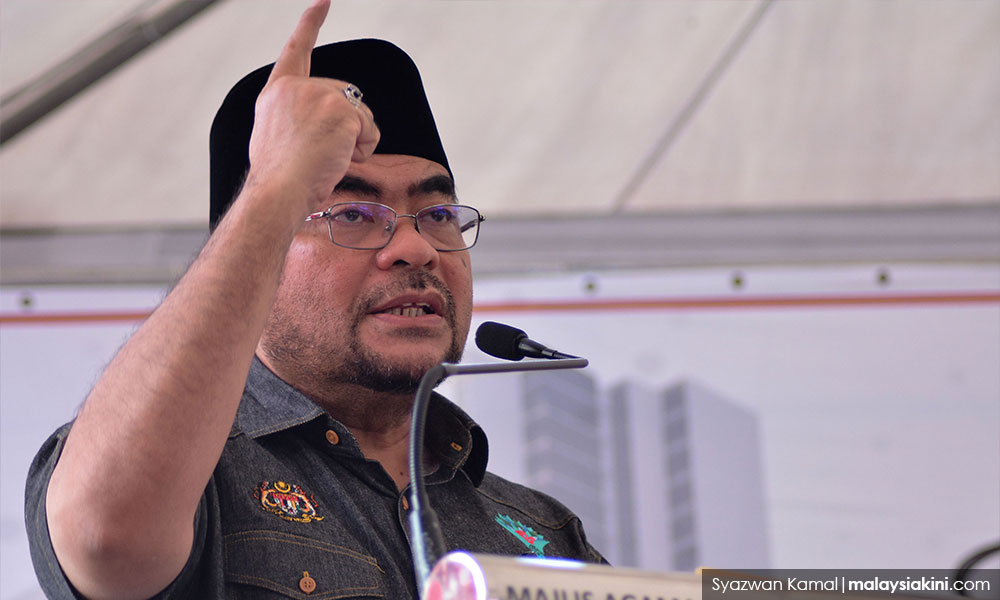
At the height of the Jawi/khat controversy, former Harapan religious czar Mujahid Yusof Rawa (photo), in a piece expressing his devotion to Jawi, made the same claims, or rather, he conflated certain concepts.

Mujahid, who was then minister in the Prime Minister's Department (Religious Affairs), made the claim that learning Jawi is an honour for Malaysians and spawned the rather noxious meme that "in order to be a united Bangsa Malaysia, we would cherish Jawi as one people". This passage came from a piece where I debunked the argument that Jawi/khat had nothing to do with religion.

DAP Youth chief Howard Lee, writing in "Jawi" no less, admonished Chow and claimed that the DAP needed to focus on more pressing issues. From now on, Lee should only tweet in Jawi or Malay because, maybe, he could then make inroads into the target audience the DAP needs to demonstrate that the party is not anti-Malay.

How does it look when a DAP youth leader uses the Jawi language as some sort of sarcastic retort to the action of another DAP political operative who was deemed religiously insensitive?


I am not interested in the political manoeuvrings behind this latest provocation of using language as a means of cultural hegemony. What I am interested in addressing, in this piece, is that the phobia against cultural hegemony in this country is justified and like it or not, it falls on the DAP to protect our personal and public spheres.

The only language that needs to be in all business operations or general signage is Bahasa Malaysia (first) and, beyond that, any language that the target demographic understands. Anything beyond that is purely political and the imperative behind that reasoning needs to be questioned.

The Tras assemblyperson's actions are justifiable, if not politically expedient. This is a good thing as far as I am concerned.


S THAYAPARAN is Commander (Rtd) of the Royal Malaysian Navy. A retired barrister-at-law, he is one of the founding members of Persatuan Patriot Kebangsaan


Related:

DAP's "Don't spook the Malays"

Mahathir failed to create the ‘Malaysian race’ he proposed because he as usual lied about it

TMI:

Vision 2020 architect says it failed to create ‘Malaysian race’


VISION 2020 has succeeded in reducing the income gap between races and turned the country from an agrarian society into an industrial nation but it has failed to create a Malaysian race, said Dr Mahathir Mohamad.

“When I proposed a Malaysian race (Bangsa Malaysia) to call our own, I believed that we could be like countries such as the USA,” said the 95-year-old on Facebook Live last night.

*********

kaytee notes:

kok-tok again. Didn't he say the Chinese virtually own all the towns and cities? Now he admits his "VISION 2020 has succeeded in reducing the income gap between races ...".

He proposed a Bangsa Malaysia but he kept tokking kok on racial inequality, Malay Dignity and ketuanan Melayu and even held a congress to emphasise that, when he called non-Malay Malaysians as 'orang asing' who like it so much here they won't go home.


This man is really thick skinned, shameless and an incorrigible liar. He has been horrendously wicked, so wicked he lied and lied and lied to Anwar and other colleagues in PH.


Sunday, August 02, 2020

The Umno-Bersatu Gangrenous Wounds

Extracts (only) from Malaysia-Today's The Umno-Bersatu Wounds Will Take Time To Heal:


The Umno grassroots hate PPBM so the Perikatan Nasional relationship is very fragile

And, of course, it is even more difficult for the five-month old Umno-PPBM marriage — a.k.a. Perikatan Nasional. The hatred, currently at least, by the Umno grassroots for PPBM is far worse than their hatred for PAS.

So, this Umno-PAS-PPBM orgy is actually an Umno-PAS-PPBM hate-fest. Of course, the three may be sleeping together in the same bed. But its only for sex. There is absolutely no love involved in this threesome.

The Sabah state elections is going to be the acid test. If Perikatan Nasional can settle their internal differences (especially on the seat distribution issue) and survive Sabah, then they can make it to GE15, whenever that may be.

And there are going to be many people who will try to sabotage the Sabah state election seat negotiations to see three or more corner contests and the resulting collapse of Perikatan Nasional.

PAS may have to play the “pacifier” in the Umno-PPBM relationship to keep Perikatan Nasional together

Who of those many loose mouths are just being stupid and who are actually saboteurs? Not sure, but whatever the case may be, both are damaging Perikatan Nasional solidarity.

Politicians love talking about korban or sacrifice, especially in this season of Hari Raya Haji. But no one practices that so-called korban (they want us, not themselves, to korban). They cannot even korban their ego and they keep talking as if they are so tera and are Allah’s anugerah to humankind.

*********

kaytee notes:

I agree with RPK in that UMNO hates Bersatu with a vengeance.

Bersatu is of course Parti Pribumi or PPBM, a.k.a UMNO Baru-er, Mahathir's 3rd UMNO and the 2nd he forges himself though he appears to have lost control of it now, BUT his cosy relationship with Ass-binte makes us wonder whether his resignation and undeniable consequential loss of the PH government to the Malay Dignity consortium has in fact been a deep deep deep conspiracy of highly convoluted Machiavellian-ism - we bear in mind Mahathir's not too recent remarks was his detestation for both Anwar and the DAP.


Parti Pribumi (PPBM) or UMNO III


But Machiavellian-ism  or not, UMNO grassroots remember all too vividly the unexpected loss of their presumed "perpetually-in-power" UMNO (II) has been coincidental with Parti Pribumi's participation in Paktan Harapan. Of course many inclduing Malaysiakini's P Gunasegaram and yours truly believe (and still do) that Pakatan Harapan was already on the cusp of victory in May 2018, Mahathir with them or otherwise.

The Old Man went into PH gnam gnam to claim credit for the PH victory, even though his Parti Pribumi won a measly 13 seats out of 52 allocated, whereas PKR won 47 out of 71, DAP 42 out of 47, Amanah 11 out of 34. The victory gave him 113 seats to claim majority rule in Malaysia.

But Mahathir's Parti Pribumi's paltry wins showed that his support in the Heartland was abysmal, and it was only the incorrect strategy of UMNO and PAS in splitting votes that saw PH scrapped through.

Overall PH won only 45.68% of the total votes counted - PKR winning 16.94%, DAP 18.92%, Amanah 5.43% and Parti Pribumi a pitiful 5.95%. OTOH, UMNO won 20.9% whilst PAS secured 16.82%.

Pathetic old man | Robin Staal | Flickr

As if that was not enough treachery by the founder of UMNO II (the loser of GE14) to eff his old party into opposition, he commenced his frogology by sucking more frogs out of UMNO II, with the aim of making his Parti Pribumi more strong than PKR or the DAP, wakakaka, even if it would be by 'crook' rather than by 'hook', to wit, the people's choice.

UMNO-ites thus hate Parti Pribumi, whether the original Atuk-founded or the Mark II version headed (not helm please) by Muhyiddin and aided by Sembu-nyi.

They're gonna to eff him and his Parti Pribumi whichever whatever whenever way.

Nowadays, shunned by his former over-trusting and over-naive colleagues he preaches nonsense which he didn't doesn't nor will ever practise himself. It carries no credibility but incurs only more wrath. I feel sorry for the inevitable animosity his children will experience.

Euripides quote: The gods visit the sins of the fathers upon the...


Mahathir poisons socio-politico-cultural relationship of Malaysians

Malaysiakini:

Dr M’s ‘Malay Dilemma’ misshaping race discourse

by Lim Teck Ghee


Malaysiakini


COMMENT | In Malaysia, the claim of victimhood and adoption of a victim mentality in the race discourse has long been a lucrative industry. This phenomenon is most pronounced among some leaders of the ‘oppressed’ community including the most educated and those who have achieved the greatest socio-economic and political mobility by taking advantage of their so-called victim status.

The major work influencing Malaysia’s racial stereotyping and feeding into the country’s culture of victimhood and racism has been the book by Dr Mahathir Mohamad, ‘The Malay Dilemma’. Published in 1970, the political tract was aimed at reshaping Malay and Malayan politics and society in the aftermath of the racial violence of May 13, 1969.

Initially banned for its alleged seditious content and potential to destabilise a society reeling from the trauma of May 13, the ban was lifted in 1981 when Mahathir became prime minister.

The book, though prohibited, was successful in reshaping the debate on the country’s future in several ways. For one, it has been one of the main factors for the political rise of Mahathir. It has also ensured his ascendency and durability in Malay politics; and spawned a generation of similar ethnic champions.

More critically, it has been the basis for a wide range of racially-skewed political, socio-economic and educational public policies under the New Economic Policy and various successor national policies during the last 50 years and continuing until today.

Perhaps the most important legacy of the book is its role in shaping and nurturing the toxic racial and victimhood discourse in the country. This has been a legacy which few public figures want to discuss or bring out into the open but its propositions define the agenda in the nation’s politics and governance.

The recent soul searching over race relations in the United States and elsewhere in the world gives us an opportunity to reassess the arguments contained in the ‘The Malay Dilemma’ and its applicability to the current situation in 2020.

Social Darwinism

Many readers and reviewers, from within and outside the country, have noted that the central argument underpinning the objective of the book - to ensure that the indigenous community would be accorded “a place in the Malayan sun” - stems from a social Darwinist understanding of Malayan society gleaned by Mahathir and his peer group during the era of British colonialism.

Social Darwinism and other related theories of society seeking to apply biological or environmental concepts of natural selection and survival of the fittest to social development and politics were first propounded in the 1870s in Britain, the United States and Western Europe. Besides its application to the home constituency, the doctrine and its accompanying ideologies were used to justify colonialism, imperialism, eugenics, racism and social differentiation policies that were introduced at various points in time.

More recently, the application of social Darwinism and eugenics are found in the ideas and practices that informed and motivated German doctors and administrators in the operation of the Nazi state. It resulted in Hitler’s efforts to breed a superior Aryan race and the Nazi regime’s determination to exterminate the non-Aryan Jews and gypsies.

At the time of the writing of the book by Mahathir, despite the horrendous lessons of the Holocaust, a social Darwinist view adhering to the belief that there are genetic differences in the human population based on races and the notion of superior and inferior races was still prevalent in some circles.

But its relevance today 50 years later needs to be reassessed by our new generation of policymakers and politicians.

‘Malays can change’

One recent reader has described his response to the book on the internet this way:

“I disagreed with this book in every possible way. It rambles on and on about the same points, which are steeply based in the author's own interpretations of history and society. Crude, broad generalisations and overall a terrible attempt at justifying institutionalised racism.”

Another reader provides the following comment:

“I would like to elaborate more but I think this should be enough. What I can conclude is, me as a Malay can stand by ourselves. We don’t need any protection. Psychologically, man has potential to develop themselves. Technically, we can compete with others in many things.

“Personally, I don’t appreciate the way he despises Malay. And to be frank, I don’t know what is the hidden message, if there is any. For me, this book somehow encourages me to keep fighting for reaching my own target. I believe everyone can change. Melayu tak malas. Malays can change.”

Finally, a Malay colleague had this to say:

“One of the most devastating impacts of ‘The Malay Dilemma’ and Mahathir's subsequent actions was the implementation of equality of outcome in education and in governance.

“Instead of providing the means and ability for Malays to solely compete on merit, it imposes quota of results without regards to merit. This allowed massive numbers of non-qualified persons to attain and maintain entry and positions they are wholly incapable of performing in the civil service and GLCs. We basically instituted the Peter principle in education and governance for the last 30 to 40 years. That was our recipe for the disaster that we have today.”

How the claims of victimhood replete in ‘The Malay Dilemma’, and never repudiated by the author, have morphed into a supremacist ideology explains the racial journey and metamorphosis that the nation has undertaken.

‘The Malay Dilemma’, with its contentious and misleading assumptions and conclusions that are not limited to the doctrine of social Darwinism but covers the spectrum of race relations, has cast the longest and darkest shadow on the country’s race discourse.

Now is the time for our leaders to take the book out for fumigation.


LIM TECK GHEE is a public policy analyst and author of the book ‘Challenging Malaysia's Status Quo’. He is editor-in-chief of the Myhometown website.

Mahathir has thick corrugated iron face-skin

FMT:

Mahathir decries ‘sweet promises’ to betray people’s vote


Former prime minister Dr Mahathir Mohamad says politicians should honour their promises.

PETALING JAYA: Former prime minister Dr Mahathir Mohamad has chided elected representatives who switch allegiances, and said they should not renege on promises made at the general election and honour the people’s trust.

“The problem in our country, after the people have chosen the government, there is a method that can be used to deny the people’s choice. This should not be done because we made promises to the people, and the people supported us based on the promises,” he said at a public forum tonight.

Mahathir made his remarks while answering questions during the forum on events in Sabah, where some assembly members had switched to backing an attempt by former chief minister Musa Aman to force the collapse of the Warisan-run government.

Mahathir said that Malaysia is a democratic country and the people had the right to choose a government. Politicians should honour the people’s right to choose, he said.

Elected representatives should not change their principles, even if the party he joined had changed direction from the party’s original goal. “They should remain true to their principles, not to the party,” he said. “We can leave the party if it deviates.”

“When sweet promises are made by others, we sometimes forget the promises we made to the people. This is not good for a democratic country, when we ignore promises to the people,” he said.

*********

kaytee notes: This bloke has the brazen nerve, shameless (or lack of) conscience and thick-corrugated iron face-skin to say such "advice" which he himself couldn't follow.

Saturday, August 01, 2020

UMNO to PPBM: You are nourished by traitors

MM Online:

You exist thanks to ‘group of traitors’, Umno veep tells Bersatu ahead of Sabah polls


Datuk Seri Khaled Nordin today hinted that Umno may not co-operate with Bersatu to win Sabah. ― Picture by Hari Anggara

KUALA LUMPUR, Aug 1 — Despite being in government federally, Umno bared its fangs today at Perikatan Nasional (PN) co-affiliate Parti Pribumi Bersatu Malaysia (Bersatu) and signalled each party will be on its own in the coming Sabah state election that must be called in the next 60 days.

Umno vice-president Datuk Seri Mohamed Khaled Nordin went on the offensive on Facebook in response to a news report citing Sabah Bersatu chief Datuk Seri Hajiji Noor saying his party is gunning to contest in at least 45 out of the 65 seats in the state legislative assembly.

“He has his party, we have ours. Bersatu exists in Sabah only because of a group of traitors.

“Umno will continue to receive the support of the grassroots,” Khaled wrote on Facebook.

He was not alone in suggesting Umno may not co-operate with Bersatu to win Sabah.

Umno information chief Shahril Hamdan was reported telling Bersatu “don’t dream” of contesting that many seats in Sabah.

“Today, Sabah Bersatu said they will contest 45 out of the 73 state seats in the upcoming Sabah election.

“Two words: Don’t dream,” he was quoted saying by Malaysiakini in a report earlier today.

[...]

Shahril was also quoted saying that Bersatu should start acting like an ally if the party intends to remain friendly with Umno.

“We can discuss, we can negotiate. Sabah Umno has the autonomy to decide on the candidates and seats to be contested.

“But if Bersatu is already professing its intention to contest in 45 out of the 73 seats even before negotiations, then it is not based on wisdom and sincerity.

“In the current political scenario, Sabah Bersatu should think before making a move or statements as every action will impact the grassroots and it is not confined to Sabah,” Shahril told Malaysiakini.

He also expressed his confidence in Sabah Umno head Datuk Bung Moktar Radin to take charge of the state electoral campaign.


Heated war of words amongst Malay Dignity participants

NST:

Umno pours cold water over Bersatu's intent to contest 45 seats in Sabah polls


Umno information chief Shahril Hamdan said Sabah Bersatu Chief Datuk Seri Hajiji Mohd Noor (pic) should first discuss details involving the state election with its allies before announcing the number of seats it sought to contest. - NSTP file pic


KUALA LUMPUR: Umno has poured cold water over Sabah Parti Pribumi Bersatu Malaysia's (Bersatu) ambitious plans of contesting in 45 out of 73 state constituency seats in the upcoming state election.

Umno information chief Shahril Hamdan said Sabah Bersatu Chief Datuk Seri Hajiji Mohd Noor should first discuss details involving the state election with its allies before announcing the number of seats it sought to contest.

"Two words – Don't dream. My suggestion to Sabah Bersatu is that if they want to be friends with Umno, let's do it on friendly terms. We can discuss. We can negotiate.

"Sabah Umno has the autonomy to decide on matters related to candidates and the seats it wants to contest.

"But even before a negotiation takes place, Bersatu has excitedly announced its desire to contest in 45 of the 73 seats. This is not a move that is based on wisdom and sincerity," said Shahril in a Facebook posting today.

Shahril was referring to Hajiji's statement today which said that Bersatu would hold a meeting next week on the preparation of election machineries in all the 45 constituencies it was seeking to contest.


Sabah's Double Standards

FMT:

Analyst explains why ex-CM Musa is right to feel ‘played out’


Former Sabah chief minister Musa Aman (left) said he had majority support in the state assembly but the governor, Juhar Mahiruddin, consented to the dissolution of the legislature instead.

PETALING JAYA: A political analyst says he can understand why former Sabah chief minister Musa Aman feels “played out” after his successor, Shafie Apdal, obtained permission to dissolve the state legislative assembly, triggering a state election.

Kamarul Zaman Yusoff of Universiti Utara Malaysia told FMT that Musa was not afforded the same opportunity to replace Shafie as chief minister the same way that Shafie was allowed to replace Musa after the 2018 general election.

“The governor, in his wisdom, has the authority to decide what is best for the state and, in fact, I agree that a fresh election is probably the best way to resolve the political crisis,” he said.

“But Musa and his supporters will naturally feel hard done by the decision. When Shafie showed he had the numbers after the 14th general election, Musa was removed and Shafie was sworn in as chief minister.”

Now, Kamarul said, the tables had turned and it was Musa who says he has a sufficient majority to form the government but the governor had consented to fresh elections instead.

“The circumstances are similar, but on both occasions, Musa found himself on the losing end.”

Yesterday, Musa said he was played out for a second time after the state assembly was dissolved.

Musa was sworn in as chief minister on May 10, 2018, but two days later, was told to step down by Sabah Yang di-Pertua Negeri Juhar Mahiruddin, who, in turn, swore in Shafie as the chief minister on May 12 that year.

Later that day, Musa and his supporters were barred from entering the palace to have an audience with Juhar.

Because there was a precedent of a chief minister being appointed based on the majority he commanded in the state assembly, Kamarul said it might be prudent for the governor to explain why he gave his consent for the assembly to be dissolved rather than appoint Musa as the new chief minister.

“This is to prevent people from making speculations or casting doubts over the Sabah palace,” he added.

Kamarul said if the governor felt that Musa was not the right person for the job, he could have asked the majority of the assemblymen to propose another candidate.


Time for another Mahathir-ist to go

Why has the IGP said Jho Lo was in Macau without even confirming same with his counterparts in that Chinese S.A.R?


Wong Sio Chak, the Secretary for Security in Macau, informs that his office has told Malaysia through Interpol that the Malaysian fugitive was not in Macau. Yet the IGP without even ascertaining the situation with the Macau police has claimed Jho Lo was there. Why?


Hamid Bador has BS-ed quite a number of times, like claiming he knows where the ex of Indira Gandhi is, but yet produces no result. Now he has shown his further lack of credibility in the Jho Lo case, bearing in mind he has yet to complete the gay sex video clip case.


Time for this Mahathir man to go.


"Malay Dignity" coalition in confusion?

MM Online:

Analysts: Umno’s Perikatan ‘snub’ more to do with strengthening party, Muafakat’s position ahead of GE15 seat negotiations than Najib’s SRC conviction


Experts say that Umno’s decision not to formally join Perikatan Nasional can be seen as possible retaliation against recent developments under the leadership of Prime Minister Tan Sri Muhyiddin Yassin. ― Picture by Yusof Mat Isa

KUALA LUMPUR, Aug 1 — Umno’s sensational decision not to formally join Perikatan Nasional (PN), despite being part of the same government, can be seen as possible retaliation against recent developments under the leadership of Prime Minister Tan Sri Muhyiddin Yassin, experts have said.

The announcement that came a mere two days after former party head Datuk Seri Najib Razak’s guilty verdict and conviction also suggested that Umno’s refusal to commit to a long-term partnership with Parti Pribumi Bersatu Malaysia (Bersatu) could have stemmed from a loss of faith among its leaders who may have held onto the belief that being on the same side as Muhyiddin could save them from prosecution in court.

“Many Umno leaders were of the opinion that when they joined PN, it meant they were saved from action by the courts; however, this has not been the case.

“This matter (snubbing PN) was caused by the dissatisfaction of the Umno leadership and Umno grassroots with the court’s decision against Najib under PN as led by Muhyiddin Yassin,” pointed out Universiti Malaya Associate Prof Madya Awang Azman Awang Pawi to Malay Mail.

At the same time, analysts also said they believe the snub also represented a warning shot and the first step by Umno to distance itself from Muhyiddin’s Bersatu, a move likely aimed at fortifying the influence of Muafakat Nasional (MN) and Barisan Nasional (BN) against the prime minister’s party when negotiations for election seats heat up.

Double-edged sword

Although Najib’s conviction would have surely improved the perception of integrity of Muhyiddin’s leadership, and by association his party, bailing from its previous alliance with Pakatan Harapan (PH) to being part of PN puts Bersatu in a tight spot in the game of political narratives, attracting both admirers and naysayers.

Awang Azman said this has caused Muhyiddin and Bersatu to find themselves in a situation more tenuous than when PN was first formed, even going so far as to suggest Parliament could be dissolved if a split vote were to occur should Umno leaders choose to be absent from the process.

He said that a possible outcome from its snub of PN could even see Umno ditch Bersatu entirely, leaving Muhyiddin’s party with little room to manoeuvre or the ability to remain competitive in the event of a general election.

Awang Azman said this was still a likely eventuality despite Umno President Datuk Seri Ahmad Zahid Hamidi’s revelation that Bersatu has expressed its intentions to join MN.

“What is for sure is that Umno and PAS will delay (including Bersatu in MN) up to the point when Parliament is dissolved, because Umno and PAS do not want to share (seats) with Bersatu.

“In this context, Bersatu will be alone if MN decides to go ahead without them and not be part of PN. It will be difficult for MN to receive Bersatu.

“This is the current issue because MN does not want to share its seats; MN will delay until the next elections to stall Bersatu from joining MN,” he suggested.

But for senior fellow at the Singapore Institute of International Affairs, Oh Ei Sun, Umno and MN completely ditching Bersatu might seem like a possible outcome, but felt it would be unlikely to occur in the near future.


Umno’s decision not to be a component party of PN was announced by Datuk Seri Ahmad Zahid Hamidi on Thursday. ― Picture by Shafwan Zaidon

“Would Umno go ahead and completely break off from PN, meaning its MPs no longer support Muhyiddin? I don’t think so, because that would lead to the collapse of the government and the other side might become the government, and it will be even worse news for Zahid and Najib,” he said.

Oh said if MN’s breakaway from Bersatu does materialise, then Muhyiddin and his party would be at the mercy of anyone willing to work with them, leaving them caught “between a rock and a hard place.”

He reiterated the point that Umno and PAS with MN would not be willing to give up any of their seats to Bersatu, while at the same time, would try and recapture seats lost to Muhyiddin’s party during the last election.

“And if Bersatu tries to go back to the other side (Opposition), of course, the other side will look at them as traitors.

“So I think Bersatu will be hard put in the next general election; I don’t know how they will survive,” said Oh, whose opinion was echoed by Awang Azman.

Signs of uncertainty

For one analyst, however, Umno’s refusal to commit to PN could also suggest confusion or indecisiveness among the party’s leadership over which alliance would best benefit them.

Universiti Putra Malaysia political scientist Jayum Jawan said he believes the move not to formalise its position in PN was made to allow Umno to keep its political options open.

This, on the flipside, he said, also highlights the contrast in Umno’s position which sees its lawmakers still in support of Muhyiddin, Bersatu, and PN to maintain its role at the helm of the federal government, while on the party level, it has clearly denounced any intention to formalise a partnership.

“Umno appears to be in a very precarious position. It is easy to say that Umno is not supporting PN, because at the same time, Umno is part of BN, and also part of MN.

“But it appears that Umno and its leadership are at a crossroads and are indecisive, or perhaps even confused, as to what they really want to do,” he suggested.

Umno’s decision not to be a component party of PN was announced by Zahid on Thursday.

But despite it coming on the heels of Najib’s guilty verdict, he stressed that the decision was made on July 24 by the party’s supreme council.

When pressed to reveal if the decision against joining PN was indeed in reaction to Najib’s conviction, Zahid told reporters to interpret the situation on their own, without elaborating further.

The PN government is currently made up of MPs from Bersatu, PAS and Umno, along with component parties of BN and those aligned with Gabungan Parti Sarawak (GPS).

Muhyiddin’s Bersatu currently has 31 parliamentary seats, trailing Umno’s 39 seats; PAS and GPS as the government’s main components have 18 seats each.