
Trump says US clinches ‘biggest oil deal in world history’ with Venezuela worth nearly US$100b
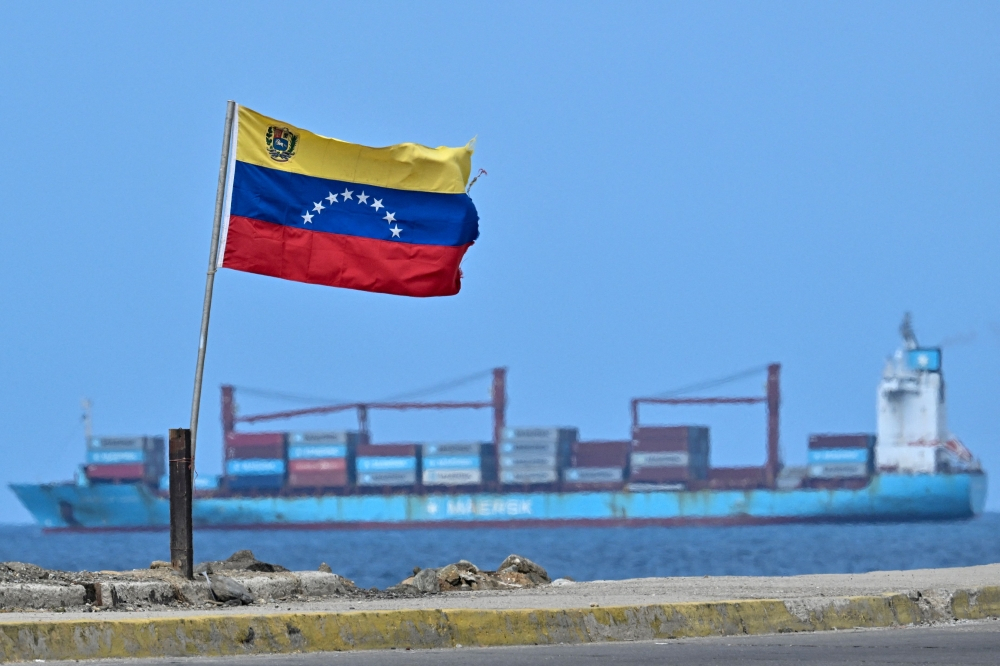
A Venezuelan flag flies as the US and Venezuela negotiate a major oil deal that President Donald Trump said would give the United States majority control of 65 billion barrels of proven petroleum reserves. — AFP pic
Summary
- President Donald Trump announced a significant oil deal with Venezuela granting the U.S. majority control over 65 billion barrels of proven petroleum reserves, which he termed as "the biggest oil deal in world history." This agreement is expected to bring nearly $100 billion in private investment to Venezuela, potentially revitalizing its economy while more than doubling U.S. oil reserves.
- Secretary of State Marco Rubio highlighted that this strategic move aligns with Trump's "America First" policy by securing stable reserves and lowering gas prices.
- However, the deal awaits confirmation from the Venezuelan government.
First Published: Saturday, 29 Aug 2026 8:49 AM MYT
WASHINGTON, Aug 29 — President Donald Trump said Friday his administration has reached a huge oil deal with Venezuela that gives the United States majority control of 65 billion barrels of proven petroleum reserves.
The deal – which Trump proclaimed as “the biggest oil deal in world history” – will bring nearly US$100 billion (RM402.6 billion) in private investment to Venezuela, US Secretary of State Marco Rubio said.
Venezuela has the world’s largest proven oil reserves. Its government has operated under intense pressure and close scrutiny from the Trump administration since the US ousted and captured long time ruler Nicolas Maduro in January. It allowed his then vice president, Delcy Rodriguez, to stay on and serve as interim leader so long as she toes the US line.
Trump has made no secret of his desire to secure Venezuelan oil for the US, and in his post announcing the deal on his Truth Social platform, he said it will more than double US oil reserves.
There was no immediate confirmation of the arrangement from the Venezuelan government.
Trump said Secretary of State Marco Rubio and Defense Secretary Pete Hegseth had reached the deal with Rodriguez “through a partnership with private business.”
“This Transaction will greatly strengthen the already growing relationship between Venezuela and the United States!” Trump wrote.
Rubio said the deal demonstrated how “President Trump’s bold foreign policy is driving America First wins: securing stable reserves and low-cost oil in our Hemisphere and lowering gas prices here at home.”
“For the Venezuelan people, this deal will bring nearly US$100 billion (RM402.6 billion) in private investment, support thousands of high-paying jobs, and drive the reconstruction of Venezuela’s economy,” the top US diplomat wrote on X, without providing further details.
The news site Axios reported Thursday the two countries were in talks on a dozen productive oil fields with 90 billion barrels of proven reserves — about a third of Venezuela’s total proven reserves of 300 billion barrels. Axios quoted two US officials.
In return for a US ownership stake, private companies, including American firms, would develop the fields and return more oil revenue to Venezuela, according to Axios.
As Fei-Lo (up North) would say "Lanjiao" 😂😂😂
Axios also said the deal would more than double US oil reserves at a time when the US strategic petroleum reserve is at a 40-year low.
Trump also insisted the deal will lower gasoline prices for Americans – a major issue as his approval ratings fall ahead of November midterm elections after launching a war on Iran that has disrupted global oil supplies.
The Trump administration has been urging US companies to invest in Venezuela, but they remain wary due to dilapidated infrastructure and past appropriation of assets of foreign investors by the government in Caracas.
Chevron, the only US oil company that was still operating in Venezuela when Maduro was ousted, said in July that it had raised its daily crude production to 280,000 barrels and plans to increase output by 50 per cent by the end of 2028. — AFP


What Goes Around Comes Around.
ReplyDeleteUS Assets Nationalized by Venezuela and loss of income since 2007.....total in the tens of Billions. In today's value $100B sounds fair.
During the 2007 wave of oil industry nationalization under President Hugo Chávez, Venezuela expropriated major U.S. oil assets, leading to global legal claims from American firms that total between $20 billion and $40 billion.
The primary U.S. companies affected and their respective asset claims include:
Major Asset Seizures and Claims
ConocoPhillips: Seeks $10 billion to $12 billion in compensation. An international arbitration court upheld an $8.5 billion award for the seizure of its Hamaca and Petrozuata projects, which Venezuela has historically failed to pay.
ExxonMobil: Initially sought up to $12 billion to $16.6 billion for the nationalization of its Cerro Negro and La Ceiba projects. Tribunals have ordered various payouts, including a $1.6 billion World Bank award and a $908 million International Chamber of Commerce award, though ExxonMobil notes its assets have been effectively seized twice (dating back to the 1970s).
Other U.S. Firms: Companies like Chevron, total, and non-U.S. entities chose to restructure and accept minority stakes under state-run PDVSA rather than face full expropriation. Smaller gas infrastructure assets from companies like Williams Cos Inc. and Exterran Holdings were also nationalized for around $420 million.
Overall, while tribunals have ordered Venezuela to pay roughly $60 billion globally for various nationalizations, the specific share tied strictly to U.S. oil companies represents a combined asset value loss and legal claim of over $20 billion.
mfer, u should have double checked yr fart of 'What Goes Around Comes Around'!!!!
Delete“The United States is close to a deal for more than a dozen Venezuelan oil fields, holding roughly 90 billion barrels of proven reserves. Marco Rubio is running it. Venezuela's acting president is on the other side of the table.
ReplyDeleteThat oil is heavy and sour. So is Alberta's. They feed the same Gulf Coast refineries.
TD Economics figures the immediate damage is limited, because only about 400,000 barrels a day of Canadian crude reaches the Gulf.
But if Venezuelan barrels keep landing there, TD says the discount on Western Canada Select could widen by two to three dollars a barrel. That wipes out what Trans Mountain gained us.
Alberta spent fifteen years being told a pipeline to tidewater was unnecessary.
Now the customer has options and we still only have the one.”
https://x.com/slk55again/status/2093465647481057655?s=20