
Malaysia's #1 Content Aggregator
Billions on Track, Accountability Off Course: The Real Cost of Malaysia’s LRT3 Debate
8 Jul 2026 • 7:00 AM MYT

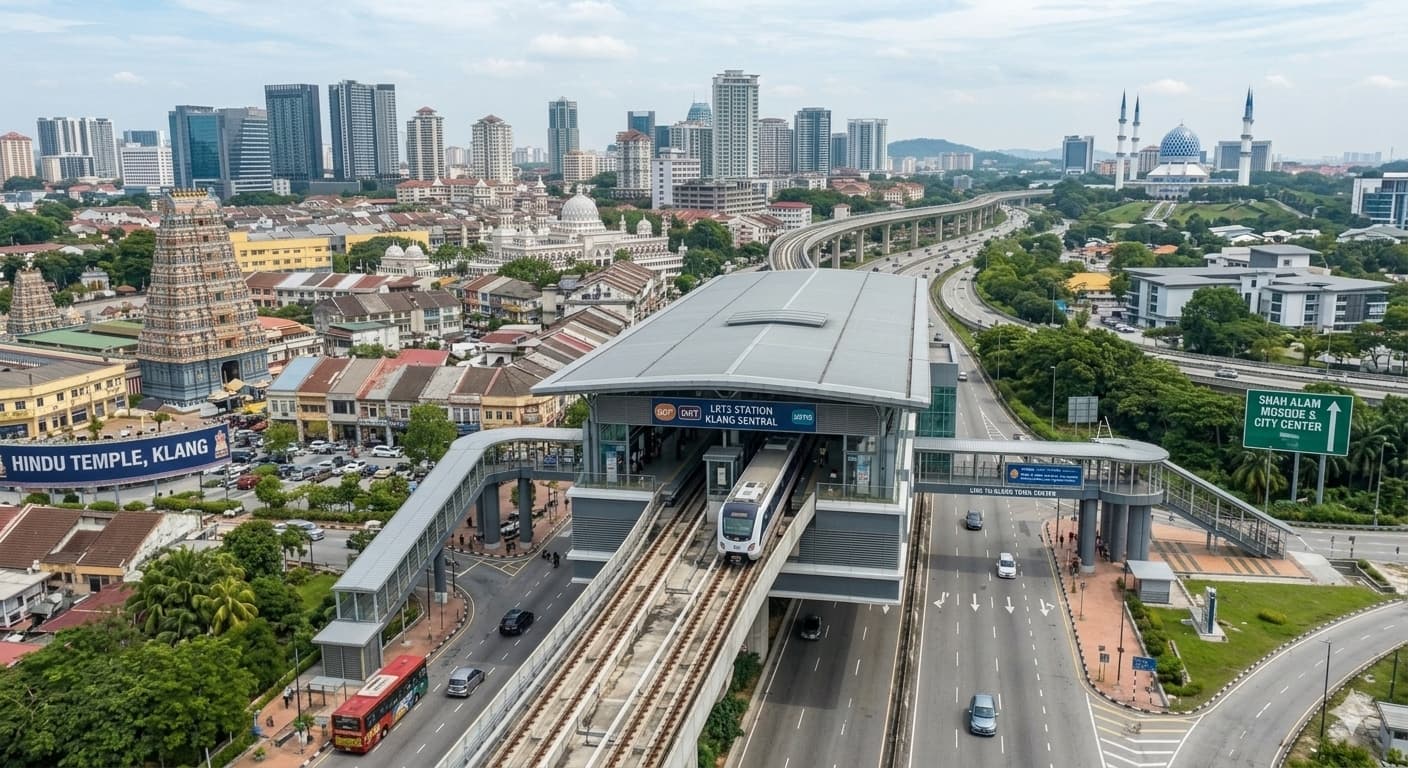
Bridging Heritage & Modernity: The LRT3 transit line seamlessly connects the cultural landmarks and urban landscapes of Klang and Shah Alam. Visual created Gemini prompt by Annan Vaithegi
There is an old saying among accountants that rarely finds its way into political speeches: revenue is vanity, profit is sanity, but cash flow is reality. The same philosophy applies to governments. Grand announcements, billion-ringgit infrastructure projects and impressive artist impressions may dominate newspaper headlines, but the true test of leadership lies elsewhere. It lies in the discipline to ask a simple but uncomfortable question before committing public funds: Can this project deliver the same public value at a lower cost?
The controversy surrounding the LRT3 project has evolved far beyond a debate over railway stations or train capacity. It has exposed a deeper weakness in Malaysia's political culture our tendency to equate higher expenditure with better governance. Too often, we instinctively assume that a more expensive project must be a better project, while any attempt to reduce costs is interpreted as sacrificing quality or delaying progress. That assumption deserves closer examination because economics teaches us something very different.
Every economy operates under one unavoidable reality: resources are finite while public demands are unlimited. Governments do not possess unlimited financial resources, even though political promises often create that illusion. Every ringgit allocated to one project is a ringgit unavailable for another. Economists describe this as opportunity cost, perhaps one of the most important yet least discussed principles in public policy. When billions are committed to a transport project, those same billions cannot simultaneously finance flood mitigation, schools, hospitals, rural infrastructure, digital connectivity or debt reduction. Public investment is therefore never simply about building something desirable; it is about determining whether scarce national resources are being allocated in the most productive manner.
This is precisely why every responsible Ministry of Finance in the world scrutinises large infrastructure projects. Cost reviews are not acts of sabotage. They are exercises in fiscal stewardship. Governments have a duty to distinguish between genuine engineering requirements and inflated expenditure arising from procurement inefficiencies, unnecessary specifications or overly ambitious designs. Asking whether a project can be delivered more efficiently should never be mistaken for opposition to development. It is, in fact, one of the fundamental responsibilities of public financial management.
Critics of the LRT3 review argue that reducing train capacity, deferring several stations and redesigning elements of the project contributed to delays and diminished service quality. These concerns should not be dismissed lightly. Public transport must be planned not only for today's commuters but also for tomorrow's population growth. Underinvestment can create capacity constraints that become more expensive to rectify in the future. Infrastructure economists have long cautioned against designing systems that quickly become obsolete because demand outpaces supply.
However, responsible policy analysis requires examining both sides of the ledger rather than only one. At the time the project was reviewed, Malaysia was confronting mounting fiscal pressures, rising public debt and substantial contingent liabilities. Every additional billion borrowed to finance infrastructure carried long-term consequences extending far beyond the construction period. Borrowing does not merely increase today's expenditure; it commits future taxpayers to decades of debt servicing through interest payments that can ultimately exceed the original capital cost itself.
This distinction is often overlooked in public debate. Many people focus exclusively on construction costs while ignoring financing costs. Yet from a fiscal perspective, both are inseparable. Reducing a project's capital expenditure by several billion ringgit does not simply lower the initial budget. It also reduces future borrowing requirements, decreases interest obligations and strengthens the government's long-term fiscal position. In macroeconomic terms, these savings improve fiscal sustainability by preserving borrowing capacity for future national priorities and reducing pressure on future government budgets.
Consider how every successful business operates. Whether it is a multinational corporation in Kuala Lumpur, a family-owned hardware shop in Ipoh or an Anneh Curry restaurant in Penang, financial discipline remains non-negotiable. No responsible entrepreneur celebrates unnecessary expenditure. Before expanding operations, purchasing equipment or opening new branches, prudent business owners negotiate prices, compare quotations and analyse projected returns. Cost optimisation is not viewed as evidence of weak ambition. It is regarded as evidence of competent management.
Imagine a contractor telling his bank manager, "I intentionally ignored every opportunity to reduce costs because spending more shows confidence." The loan application would likely end before the coffee on the table became cold. Financial institutions reward borrowers who demonstrate discipline, not extravagance. Yet in politics, we sometimes reverse this logic, criticising those who seek efficiency while applauding those who announce ever larger budgets.
Malaysia's own corporate history provides valuable lessons. Proton did not struggle because Malaysians lacked affection for the national car. The company struggled because long-term competitiveness requires more than patriotic sentiment. It demands operational efficiency, technological innovation, sound governance and prudent capital allocation. Strategic restructuring, improved management practices and greater commercial discipline ultimately contributed more to Proton's recovery than simply injecting additional money into the business.
Malaysia Airlines tells a similar story. Over several decades, substantial public resources have been committed to preserving the national carrier. Yet repeated financial support alone did not guarantee sustainable profitability. Every restructuring exercise reinforced a lesson familiar to economists across the world: financial assistance without structural reform rarely produces lasting success. Money can temporarily relieve pressure, but it cannot permanently substitute for efficient management and sound commercial decisions.
These examples illustrate a principle that extends well beyond corporate boardrooms. Governments, like businesses, must constantly evaluate whether public expenditure generates sufficient economic and social returns. Bigger budgets do not automatically produce better outcomes. In infrastructure planning, value for money is often a more meaningful measure of success than the absolute size of investment.
This does not imply that cost reduction should become an ideology in itself. Excessive cost-cutting can be just as damaging as excessive spending. Infrastructure must remain safe, functional, resilient and capable of supporting long-term economic growth. Economists recognise this balance through the concept of lifecycle costing, which evaluates not only construction expenditure but also maintenance costs, operating efficiency, future expansion requirements and long-term economic benefits. An apparently cheaper project may become more expensive if poor planning necessitates major upgrades shortly after completion. Likewise, an initially expensive project may prove economically justified if its additional benefits substantially exceed its additional costs. Good governance therefore lies neither in spending the most nor in spending the least, but in spending wisely.
Perhaps the most overlooked issue in the LRT3 debate is not engineering or politics but incentives. If public officials who successfully negotiate lower costs are consistently criticised while those who approve increasingly expensive projects receive political praise, what message does this send to future decision-makers? Rational incentives matter. A political culture that rewards higher expenditure regardless of efficiency risks encouraging governments to prioritise spectacle over stewardship.
Malaysia's fiscal future will not be determined solely by economic growth. It will also depend upon how intelligently public resources are managed. A nation burdened by rising debt cannot afford to treat financial discipline as an inconvenience. Every unnecessary billion borrowed today becomes tomorrow's repayment obligation, carried not by current politicians but by future generations of taxpayers.
Ultimately, the LRT3 controversy should not be remembered as a dispute between political personalities or competing party narratives. It should encourage a broader national conversation about what Malaysians expect from public finance. Should governments be applauded simply for approving larger projects, or should they be judged by their ability to maximise public value while safeguarding fiscal sustainability? That question extends far beyond one railway line. It reaches to the very heart of responsible governance.
History suggests that prosperous nations are rarely those that spend without restraint. They are the nations that understand an enduring economic truth: every public ringgit is entrusted by the people, and every public ringgit carries an obligation to deliver the greatest possible benefit. The measure of leadership is therefore not the size of the budget it commands, but the wisdom with which that budget is managed.
Annan Vaithegi writes, "Economic prosperity is built not merely by investing more, but by investing wisely. Fiscal discipline is not the enemy of development; it is the foundation upon which sustainable development depends."
The controversy surrounding the LRT3 project has evolved far beyond a debate over railway stations or train capacity. It has exposed a deeper weakness in Malaysia's political culture our tendency to equate higher expenditure with better governance. Too often, we instinctively assume that a more expensive project must be a better project, while any attempt to reduce costs is interpreted as sacrificing quality or delaying progress. That assumption deserves closer examination because economics teaches us something very different.
Every economy operates under one unavoidable reality: resources are finite while public demands are unlimited. Governments do not possess unlimited financial resources, even though political promises often create that illusion. Every ringgit allocated to one project is a ringgit unavailable for another. Economists describe this as opportunity cost, perhaps one of the most important yet least discussed principles in public policy. When billions are committed to a transport project, those same billions cannot simultaneously finance flood mitigation, schools, hospitals, rural infrastructure, digital connectivity or debt reduction. Public investment is therefore never simply about building something desirable; it is about determining whether scarce national resources are being allocated in the most productive manner.
This is precisely why every responsible Ministry of Finance in the world scrutinises large infrastructure projects. Cost reviews are not acts of sabotage. They are exercises in fiscal stewardship. Governments have a duty to distinguish between genuine engineering requirements and inflated expenditure arising from procurement inefficiencies, unnecessary specifications or overly ambitious designs. Asking whether a project can be delivered more efficiently should never be mistaken for opposition to development. It is, in fact, one of the fundamental responsibilities of public financial management.
Critics of the LRT3 review argue that reducing train capacity, deferring several stations and redesigning elements of the project contributed to delays and diminished service quality. These concerns should not be dismissed lightly. Public transport must be planned not only for today's commuters but also for tomorrow's population growth. Underinvestment can create capacity constraints that become more expensive to rectify in the future. Infrastructure economists have long cautioned against designing systems that quickly become obsolete because demand outpaces supply.
However, responsible policy analysis requires examining both sides of the ledger rather than only one. At the time the project was reviewed, Malaysia was confronting mounting fiscal pressures, rising public debt and substantial contingent liabilities. Every additional billion borrowed to finance infrastructure carried long-term consequences extending far beyond the construction period. Borrowing does not merely increase today's expenditure; it commits future taxpayers to decades of debt servicing through interest payments that can ultimately exceed the original capital cost itself.
This distinction is often overlooked in public debate. Many people focus exclusively on construction costs while ignoring financing costs. Yet from a fiscal perspective, both are inseparable. Reducing a project's capital expenditure by several billion ringgit does not simply lower the initial budget. It also reduces future borrowing requirements, decreases interest obligations and strengthens the government's long-term fiscal position. In macroeconomic terms, these savings improve fiscal sustainability by preserving borrowing capacity for future national priorities and reducing pressure on future government budgets.
Consider how every successful business operates. Whether it is a multinational corporation in Kuala Lumpur, a family-owned hardware shop in Ipoh or an Anneh Curry restaurant in Penang, financial discipline remains non-negotiable. No responsible entrepreneur celebrates unnecessary expenditure. Before expanding operations, purchasing equipment or opening new branches, prudent business owners negotiate prices, compare quotations and analyse projected returns. Cost optimisation is not viewed as evidence of weak ambition. It is regarded as evidence of competent management.
Imagine a contractor telling his bank manager, "I intentionally ignored every opportunity to reduce costs because spending more shows confidence." The loan application would likely end before the coffee on the table became cold. Financial institutions reward borrowers who demonstrate discipline, not extravagance. Yet in politics, we sometimes reverse this logic, criticising those who seek efficiency while applauding those who announce ever larger budgets.
Malaysia's own corporate history provides valuable lessons. Proton did not struggle because Malaysians lacked affection for the national car. The company struggled because long-term competitiveness requires more than patriotic sentiment. It demands operational efficiency, technological innovation, sound governance and prudent capital allocation. Strategic restructuring, improved management practices and greater commercial discipline ultimately contributed more to Proton's recovery than simply injecting additional money into the business.
Malaysia Airlines tells a similar story. Over several decades, substantial public resources have been committed to preserving the national carrier. Yet repeated financial support alone did not guarantee sustainable profitability. Every restructuring exercise reinforced a lesson familiar to economists across the world: financial assistance without structural reform rarely produces lasting success. Money can temporarily relieve pressure, but it cannot permanently substitute for efficient management and sound commercial decisions.
These examples illustrate a principle that extends well beyond corporate boardrooms. Governments, like businesses, must constantly evaluate whether public expenditure generates sufficient economic and social returns. Bigger budgets do not automatically produce better outcomes. In infrastructure planning, value for money is often a more meaningful measure of success than the absolute size of investment.
This does not imply that cost reduction should become an ideology in itself. Excessive cost-cutting can be just as damaging as excessive spending. Infrastructure must remain safe, functional, resilient and capable of supporting long-term economic growth. Economists recognise this balance through the concept of lifecycle costing, which evaluates not only construction expenditure but also maintenance costs, operating efficiency, future expansion requirements and long-term economic benefits. An apparently cheaper project may become more expensive if poor planning necessitates major upgrades shortly after completion. Likewise, an initially expensive project may prove economically justified if its additional benefits substantially exceed its additional costs. Good governance therefore lies neither in spending the most nor in spending the least, but in spending wisely.
Perhaps the most overlooked issue in the LRT3 debate is not engineering or politics but incentives. If public officials who successfully negotiate lower costs are consistently criticised while those who approve increasingly expensive projects receive political praise, what message does this send to future decision-makers? Rational incentives matter. A political culture that rewards higher expenditure regardless of efficiency risks encouraging governments to prioritise spectacle over stewardship.
Malaysia's fiscal future will not be determined solely by economic growth. It will also depend upon how intelligently public resources are managed. A nation burdened by rising debt cannot afford to treat financial discipline as an inconvenience. Every unnecessary billion borrowed today becomes tomorrow's repayment obligation, carried not by current politicians but by future generations of taxpayers.
Ultimately, the LRT3 controversy should not be remembered as a dispute between political personalities or competing party narratives. It should encourage a broader national conversation about what Malaysians expect from public finance. Should governments be applauded simply for approving larger projects, or should they be judged by their ability to maximise public value while safeguarding fiscal sustainability? That question extends far beyond one railway line. It reaches to the very heart of responsible governance.
History suggests that prosperous nations are rarely those that spend without restraint. They are the nations that understand an enduring economic truth: every public ringgit is entrusted by the people, and every public ringgit carries an obligation to deliver the greatest possible benefit. The measure of leadership is therefore not the size of the budget it commands, but the wisdom with which that budget is managed.
Annan Vaithegi writes, "Economic prosperity is built not merely by investing more, but by investing wisely. Fiscal discipline is not the enemy of development; it is the foundation upon which sustainable development depends."


What can you say when no less than the Selangor Sultan publicly ripped apart the officials who carried out cost saving decisions on the original LRT3 project.
ReplyDeleteObviously S*tan has the mentality money falls from the sky..... which for him is kind of true, but not for ordinarybl Rakyat.