
Iran reopens Strait of Hormuz as Trump says US blockade will continue until deal is made
Summary
Iran's foreign minister says the Strait of Hormuz is "completely open" to commercial ships for the remainder of the ceasefire
"THANK YOU!" Donald Trump posts on Truth Social - moments later, he says the US naval blockade of Iranian ports will continue until a peace deal is agreed
Oil prices drop after Iran's announcement - why does the strait matter so much?
Earlier, a 10-day ceasefire between Israel and Lebanon began, with celebrations and fireworks in Beirut - here's what we know about the truce
More than 2,000 people in Lebanon have been killed in the six-week conflict, with one in five people displaced; Israel says two of its civilians and 13 soldiers have been killed
The ceasefire is very fragile - our security correspondent Frank Gardner explains why
Oliver Smith
Senior business producerEarly indications are that commercial ships in and around the Gulf won’t be in any rush to travel through the Strait of Hormuz, despite the Iranian foreign minister’s declaration that it is “completely open”.
One oil and gas tanker operator, which did want to be named, told the BBC the Iranian statement “doesn’t change anything” for now.
“We don’t feel like we need to be taking unnecessary risks, and our company approach is that we won’t be the first to go through the strait,” it said.
Another company, Stena Bulk, which operates oil tankers in the region says it is “monitoring developments closely.”
It says: “The safety of our crew and vessels governs every routing decision, and we will not transit until we are satisfied it is safe to do so.”
International Maritime Organization 'currently verifying' Iranian announcement
Jonathan Josephs
Business reporterThe head of the International Maritime Organization (IMO) is trying to understand the details behind Iran’s commitment to reopening the Strait of Hormuz.
Even with the fighting on pause there is significant US and Iranian military presence in the area, and as tensions remain heightened there is an ongoing risk to the safety of ships and their crews.
The IMO’s secretary general Arsenio Dominguez has been at the UK - France summit in Paris and has been looking at how to reopen the important shipping route.
He has posted on X saying: “We are currently verifying the recent announcement related to the reopening of the Strait of Hormuz, in terms of its compliance with freedom of navigation for all merchant vessels and secure passage using the IMO established traffic separation scheme.”


Hormuz situation still murky
Frank Gardner
Security correspondentThe situation in the Strait of Hormuz and the wider Gulf region is still murky and messy, despite the well-received announcement by Iran’s foreign minister that it is "fully open for commercial traffic while the ceasefire lasts".
We are not back to where we were on 27 February, before the US and Israel began this latest conflict.
Will Iran still insist that ships follow its newly designated route to the north of the pre-existing tanker lanes?
This is a route called the Traffic Separation Scheme (TSS) that has been functioning smoothly for everyone since it was first ratified by the International Maritime Organisation (IMO) in 1968.
Will Iran still demand military inspections of shipping by IRGC officials? Its announcement also mentions only commercial shipping.
The US Navy’s Fifth Fleet is headquartered in Bahrain - inside the Gulf and therefore past the Strait of Hormuz. So, the US is not likely to accept having its naval warships locked out of the Gulf.
Meanwhile it is far from clear if the Islamic Republic will accept the proposed long-term multinational force for the Strait of Hormuz when Iran wants to “exercise its right of sovereignty” over the waterway.
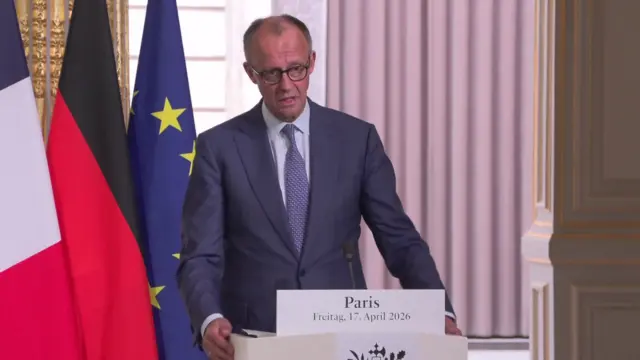
US participation in strait mission 'desirable' - Merz
Finally, German Chancellor Friedrich Merz says it is in the “immediate interests” of the parties to increase efforts towards peace.
He says Germany supports the ongoing efforts to achieve “a quick diplomatic agreement” between the US and Iran and also hails the "historic opportunity" for Hezbollah and Israel to make efforts towards a lasting peace.
Merz repeats calls for Iran to open the Strait of Hormuz fully in a way that is lasting, secure and “toll free”, and says despite the recent “good news” on this front, there must be no restrictions on its opening.
Germany is willing to contribute to the mission to promote freedom of navigation through the strait, he says, including the possible participation of its armed forces and activity such as mine clearing.
Such a plan would need to be approved by the UN and Germany’s parliament, he says, adding that US participation would be “desirable.”
The news conference has now concluded.



No comments:
Post a Comment