
New explosions near port cities, Iranian state media report, as Tehran hits UAE tankers in strait
Summary
Explosions are heard near two Iranian port cities, Bandar Abbas and Bushehr, state media reports - here's where they are on a map
It comes after another night of strikes between the US and Iran, with Iran's Islamic Revolutionary Guard Corps saying it hit two UAE tankers in the Strait of Hormuz and targeted US facilities in Jordan and Bahrain
The UAE called the attack "brazen", adding that an Indian crew member was killed and eight others were injured
Meanwhile, the US military says it completed strikes on targets aimed at degrading "Iran's ability to attack commercial shipping" - Iranian state media reports three people were killed
Oil prices continue to rise, with benchmark Brent crude up more than 3% at $86.07 (£64.34) a barrel
On Monday, President Donald Trump said the US was reinstating a naval blockade of Iranian ports and would impose a 20% charge on all cargo shipped through Hormuz - what we know so far
Escalation of rhetoric and pressure around conflict - UK foreign secretary
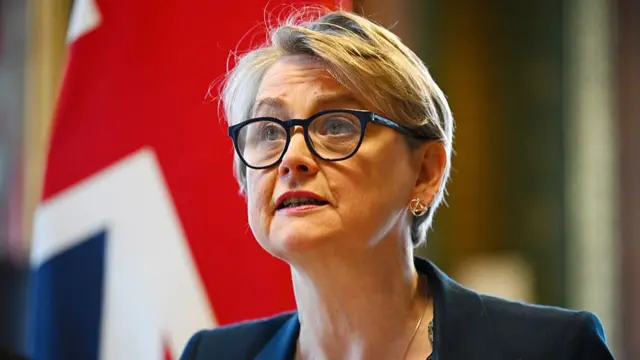
Getty ImagesUK Foreign Secretary Yvette Cooper has said she's spoken with US colleagues over the UK's opposition to tolls in the Strait of Hormuz.
Speaking to the Foreign Affairs Committee, Cooper said the "discussion" took place during the Nato summit last week.
"We were talking about that we could not end up with tolls and with a system on the Strait of Hormuz that would undermine the freedom of navigation and the law of the sea."
She added she felt there's currently an "escalation of rhetoric around the conflict itself and the putting on of pressure".
Cooper also blamed Iran for "an increasing of pressure on all sides" by attacking commercial shipping in the southern shipping route in Omani waters, saying the move "totally undermines the law of the sea".
Iran to loom over Trump's meeting with the Iraqi PM
Bernd Debusmann Jr
White House reporterUS President Donald Trump is scheduled to meet with new Iraqi Prime Minister Ali al-Zaidi at the White House in a few hour's time - a meeting in which the issue of Iran is likely to dominate discussions.
Trump publicly supported al-Zaidi to become Iraq's new PM after months of political deadlock following the country's parliamentary elections last year, and in April posted that his success was the "beginning of a tremendous new chapter" in US-Iraqi relations.
The US president is likely to use the meeting to push al-Zaidi to move to disarm Iranian-backed and affiliated militia groups.
While Iraq's government has given non-state armed groups until September to give up their weapons, several of them have said they won't, and experts have warned that government operations against them could lead to fighting.
According to US officials, these groups have attacked US diplomatic and military personnel and facilities more than 600 times, including drone attacks on the American embassy and military airfields.
This, in turn, has prompted US retaliatory operations against militia leaders and bases.

Netanyahu warns that Israel's response to any Iranian attacks will be 'much more powerful'
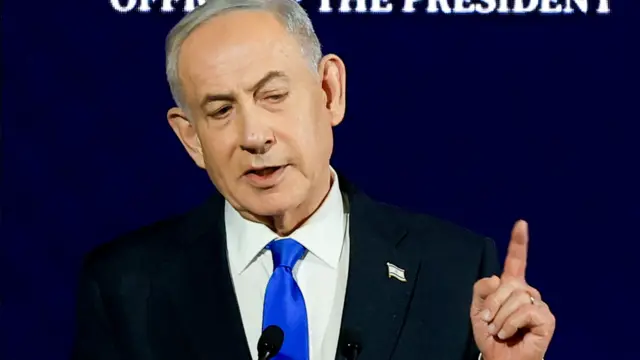
ReutersIsrael's Prime Minister Benjamin Netanyahu says Israeli retaliation against Iran will be "much more powerful" if it is attacked first.
"I will say it to the leaders of Iran: Do not count on things remaining quiet if you attack us," he says in a video published on his social media.
He warns that Israel's response will not be the same at the last time it was attacked by Iran, even though that was "already powerful enough".
"The days are over when someone strikes us and we don't strike them back twofold," he adds.
"We did this to the Axis of Evil in Iran, and we will continue to do so to anyone who harms us. That is what we do."
Resumption in hostilities has knock-on financial impact
Nick Edser
Business reporterWhile higher oil prices might be the most visible impact on the financial markets from the resumption in hostilities in the Middle East, there are other knock-on effects too.
The cost of borrowing for governments has been rising on worries that higher energy costs will increase inflation, which will lead central banks to raise interest rates to keep price rises under control.
In the UK, government borrowing costs have risen above 5% for the first time since May.
The 10-year bond yield - effectively the interest rate charged to the UK government for a 10-year loan - hit 5.04% on Tuesday morning before slipping back. In May, the rate had peaked at 5.17%, which was the highest level since 2008.
The UK is not alone in seeing higher borrowing costs, as bond yields for other European countries have also risen. However, the UK has often seen a bigger impact than elsewhere, which analysts put down to a more inflation-prone economy, together with speculation earlier this year over the leadership of the government.
The trend could be a problem for Andy Burnham, who is set to replace Sir Keir Starmer as prime minister on 20 July. Rising yields on bonds mean the government will have to spend more on interest payments.


No comments:
Post a Comment