
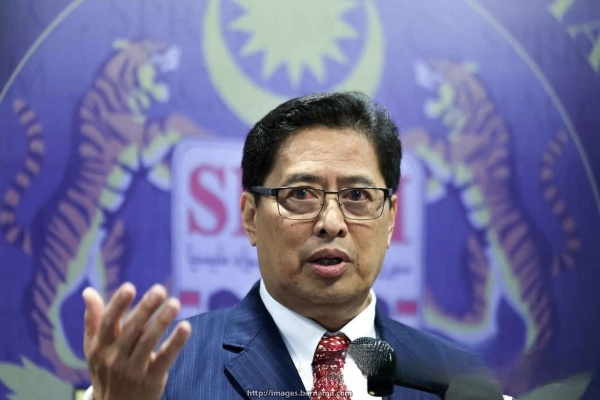
 Accountability or political crossfire? The sudden chorus against MACC chief Azam Baki raises deeper questions. - Bernama file pic, February 25, 2026
Is the push to remove Azam Baki about accountability or something deeper? – T. Vignesh
The sudden outcry for the removal of MACC chief Tan Sri Azam Baki following a Bloomberg report raises questions about whether the controversy is truly about transparency or whether powerful interests are seeking to derail ongoing high-profile corruption investigations

T. Vignesh
Updated 18 hours ago
25 February, 2026
11:18 AM MYT
THE sudden chorus calling for the head of Malaysian Anti Corruption Agency (MACC) Tan Sri Azam Baki raises a legitimate question: are these demands truly about accountability, or is there more beneath the surface?
Azam recently found himself back in the spotlight following a Bloomberg report published on February 10 titled “Malaysian Anti-Graft Chief Returns to Stocks After Outcry.” The article alleged that he held 17.7 million shares in a financial firm and had failed to publicly declare his assets, revisiting controversies first raised in 2021.
These claims triggered an immediate political reaction, with critics demanding explanations and some even calling for his removal.
Azam, however, did not remain silent. He responded by filing a RM100 million defamation suit against Bloomberg, accusing the news agency of publishing a misleading report that damaged his reputation. That move alone suggests he is prepared to defend himself in court rather than retreat quietly under pressure.
What is troubling is what followed. Several politicians began calling for Azam’s immediate removal even before he could present his explanation to the special committee tasked with reviewing the matter.
The rush to judgment is striking, especially when due process has yet to run its course.
This leads to an uncomfortable but necessary question: is Azam Baki truly the main target here, or is he simply standing in the way of something much bigger?
For a foreign media to suddenly revive a story surrounding Azam is not altogether surprising when viewed in context. Over the past two to three years, Azam and his officers at the Malaysian Anti-Corruption Commission have been knocking on the doors of the country’s most powerful figures, from former prime ministers to prolific businessmen.
These are not symbolic investigations. They involve massive sums of money, political influence, and networks that have long operated with a sense of impunity.
Just yesterday, Scoop published an article titled “From ‘Ikan Bilis’ to Big Fish: MACC’s high-profile corruption cases from 2023 to 2026.”
The report highlighted how the commission has shifted from targeting low-level offenders to pursuing senior politicians, corporate figures, and former holders of high office. It reinforced a perception that the MACC has, at least recently, been more willing to go after the “big fish”.
It is therefore possible that the MACC has hit a nerve. Someone under investigation, or fearing exposure, may feel threatened enough to strike back, not in court, but in the court of public opinion.
If that is the case, it would not be far-fetched to believe that such individuals or networks could have the influence to shape narratives through foreign media outlets.
We cannot, of course, point fingers at any specific individual or group at this stage. The MACC has accumulated many enemies over the years, and not without reason.
Anti-corruption agencies rarely make friends when they are doing their job properly. Every raid, every arrest, and every charge in court creates resentment among those who once believed themselves untouchable.
Another factor that cannot be ignored is timing, as Azam Baki is approaching the end of his tenure as MACC chief.
Under ordinary circumstances, this would be a period of transition. But the sudden intensity of calls for his removal raises another question: are some parties fearful that his contract could be renewed?
If Azam is allowed to complete his tenure or worse, secure an extension as it would give him and his team more time to pursue ongoing investigations and possibly open new ones.
For those who believe they may be next in line, the prospect of a renewal may be far more worrying than the Bloomberg report itself.
This could explain the urgency to remove him now rather than allow him to finish his term and potentially continue his campaign against corruption.
The political context also matters. Since Prime Minister Datuk Seri Anwar Ibrahim took office, the MACC has been working around the clock to pursue corruption cases that had long been dormant.
This renewed energy has unsettled the old order. For those accustomed to protection and privilege, an aggressive MACC is not a symbol of reform so much as it is a threat.
However, none of this is to suggest that Azam Baki should be beyond scrutiny. Transparency and accountability must apply to everyone, especially the country’s top anti-graft official.
There is, however, a crucial difference between scrutiny and a public lynching before due process is allowed to take its course.
Forcing him out before he has even explained himself to the special committee risks undermining the very principles of justice many claim to defend.
Perhaps the real question is not whether Azam Baki owns shares, but who benefits most if he is removed before his time is up. — February 25, 2026
T. Vignesh is the Executive Editor of Scoop.my


No comments:
Post a Comment