
After helping workers, Steven Sim now focused on helping business owners and SMEs thrive
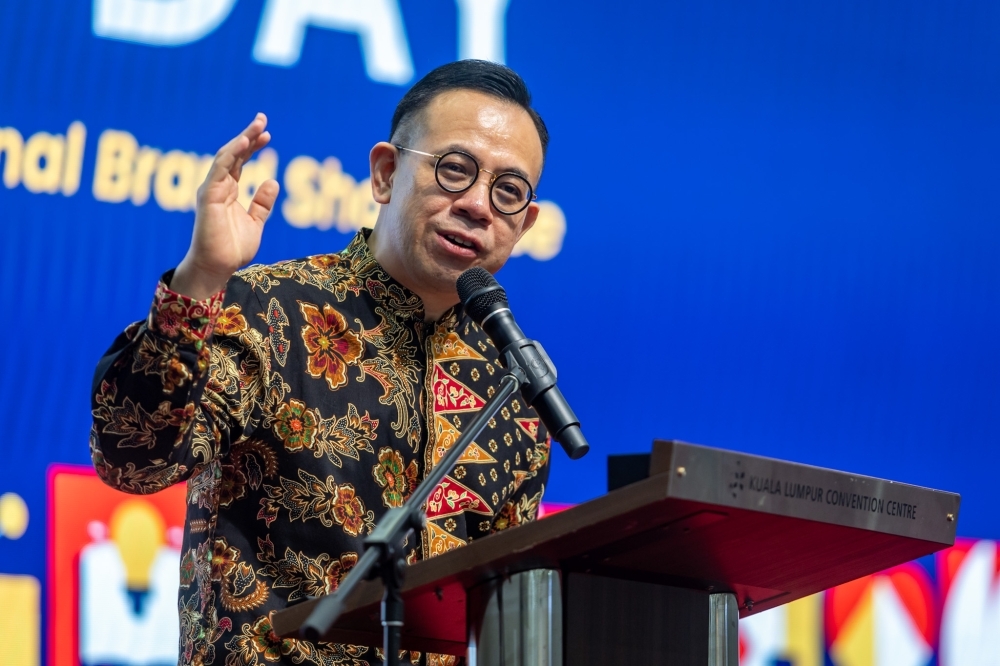
Entrepreneur Development and Cooperatives Minister Steven Sim speaks at the launch of Malaysia Brand Day at the Kuala Lumpur Convention Centre in Kuala Lumpur January 8, 2026. — Picture by Firdaus Latif.
Thursday, 08 Jan 2026 1:17 PM MYT
KUALA LUMPUR, Jan 8 — Steven Sim, in his first public address as Minister of Entrepreneur Development and Cooperatives, today signalled a shift in government focus towards helping businesses survive and grow after a series of labour reforms aimed at strengthening worker protections.
Speaking at the inaugural Malaysia Brand Day, which also marked his first official public event in the role, Sim said the Prime Minister had given him a new mandate following recent measures such as minimum wage increases of between 10 and 15 per cent, the first-ever rise in median monthly wages above RM3,000, and the introduction of protections for gig workers.
Sim said he had previously introduced himself as a “minister of workers”, having spent the past two years helming the Human Resource Ministry, before being tasked by Prime Minister Anwar Ibrahim with a new mission under the Entrepreneur Development and Cooperatives portfolio.
“After we jaga pekerja, the next mandate is to jaga the owners,” he said, using the Malay word meaning “to take care of”.
Sim warned that Malaysian businesses are facing twin geo-economic pressures, including direct global competition and rising protectionism, cautioning that maintaining the status quo could place firms at risk.
“Business as usual means businesses going out of business,” he said, adding that the current environment made reform both urgent and necessary.
The inaugural Malaysia Brand Day is Malaysia’s first-ever national brand showcase.
It is held to showcase local brands and encourage Malaysians to buy locally produced, manufactured and marketed products.
Sim said these challenges were raised directly by the business community, noting that he met around 30 businessmen representing more than 10 SME associations at his office a day earlier, many of whom voiced concerns over shrinking margins and intensifying foreign competition.
He said some local firms were struggling as overseas producers increasingly sell directly into the Malaysian market, bypassing domestic intermediaries, adding that Malaysia must be cautious about tariff-style responses given its position as a smaller economy.
Outlining his ministry’s priorities, Sim said the government will focus on four key areas — productivity, bureaucracy, capital access and market development — which he described as the core strategy moving forward.
Under the productivity pillar, he said small and medium enterprises, which make up more than 90 per cent of businesses, must improve efficiency through greater digitalisation, automation and skills development.
On bureaucracy, Sim said entrepreneurs had made it clear that government processes must not become a burden to business growth.
“Businessmen told me, don’t give money never mind — just don’t kacau,” he said, adding that simplifying procedures would be a key focus so the government does not become an obstacle.
Sim acknowledged that access to financing remains a major bottleneck, particularly for SMEs with viable products, brands and customers but limited cash flow following the pandemic.
“Expansion needs money, and capital accessibility is something we must fix,” he said.
He added that developing market access would be the fourth focus area, urging large corporations and government-linked companies to source more from local SMEs alongside efforts to expand into export markets.
Sim said Malaysia must also rethink its long-standing reliance on cost-based incentives for foreign investors as global economic realignments reshape trade and manufacturing.
“For decades, we competed as a cost centre. Going forward, we must become a value centre,” he said.
He cited Malaysian brands such as Jimmy Choo, Eu Yan Sang and Ghee Hiang as examples of local companies that have successfully gone global, adding that Malaysia’s geography, talent pool and openness to trade remain strong advantages.
Sim said the renewed emphasis on entrepreneurship and branding aligns with the Prime Minister’s broader push to strengthen SMEs, citing measures announced in the recent policy address including RM2.5 billion in financing.
Half of the allocation, he said, is channelled to SMEs that have never received funding, alongside tax refunds to improve cash flow, rental support and reductions in indirect taxes.
“This is about sending a clear signal that we want to get things right. We want Malaysian businesses not just to survive, but to succeed.”
Malaysia Brand Day is being held at the Kuala Lumpur Convention Centre from today until Friday, from 10am to 6pm.


Most SME owners work as hard or harder than any worker.
ReplyDeleteMany SMEs are financially marginal. They would have gone under if not for the drive and grit of their owners.
That's why Chinese Malaysians form the backbone of Malaysia's SMEs.
, but now under threat from China corporations muscling in to the local market, with much deeper wallets.