Thanks 'MF' for "Beijing rhetoric post Maduro is much stronger than usual, coming from keen observers, familiar with language coming out from official circle."
This post has been inspired by that statement:

China condemns Maduro capture but some see it as a chance to assert its global position
Story by Janis Mackey Frayer

Qiu Xiaoqi, China’s special envoy for Latin America, and Venezuelan President Nicolás Maduro in Caracas on Friday. (Marcelo Garcia/Miraflores Palace / via Reuters)© Marcelo Garcia/Miraflores Palace
BEIJING — An attack on a country after a military buildup and embargo at sea. A leader deposed by a superpower that views them as illegitimate.
While some are drawing parallels between the United States’ dramatic action in Venezuela and China’s ambitions for Taiwan, experts say Beijing is less concerned about the self-ruled island’s sovereignty and instead views the attack as an opportunity to undermine America’s global leadership.
As the Trump administration withdraws from global institutions and upends long-standing norms, Beijing has sought to cast itself as the true champion of the rules-based international order. Chinese state media commentaries on the Venezuela attack argue that the U.S. is now one of the biggest threats to that order, and that its actions have undermined its credibility in Latin America.
“This is a country which just behaved like a hegemon, right?” said Wu Xinbo, dean of the Institute of International Studies at Fudan University in Shanghai. “How can you trust a country that would deal with its weak neighbors this way?”
China has strongly condemned the U.S. capture of Venezuelan President Nicolás Maduro, saying it violated international law and threatens peace and security in Latin America. It said the U.S. should immediately release Maduro and his wife, Cilia Flores, who are set to appear Monday in a New York court on drug trafficking and other charges.
On Monday, Chinese leader Xi Jinping appeared to refer to the attack on one of his country’s main South American allies, saying the world was experiencing turbulence and that “unilateral bullying seriously impacts the international order.”
“All countries should respect the development path independently chosen by other peoples, abide by international law and the purposes and principles of the U.N. Charter, and major countries should take the lead,” he said during a meeting in Beijing with Irish Prime Minister Micheál Martin, without mentioning the U.S. by name.

Chinese leader Xi Jinping appeared to criticize the U.S. attack on Venezuela, saying “unilateral bullying seriously impacts the international order.” (Andy Wong / AFP via Getty Images)© Andy Wong
His comments came a day after Chinese Foreign Minister Wang Yi said no country “can play the role of world policeman, nor do we agree that any country can claim itself to be an international judge.”
China has long served as an economic lifeline for the heavily sanctioned Venezuela, accounting for the majority of its crude oil exports. It has expressed support for Venezuela in recent months amid President Donald Trump’s military buildup, though it has no security commitments to the country and experts say it has avoided more concrete action in part to preserve the U.S.-China trade truce.
Maduro was seized hours after he met in Caracas with Qiu Xiaoqi, Beijing’s special envoy for Latin American affairs, in his last publicly reported official meeting.

Maduro being escorted by DEA agents at Stewart Airport in New Windsor, N.Y., on Saturday. (Obtained by NBC News)© Obtained by NBC News
It is unclear whether Qiu and the rest of his delegation are still in Venezuela. A Chinese Foreign Ministry spokesperson said Monday that there were “no reports of Chinese personnel in Venezuela being affected by U.S. airstrikes.”
In a caption accompanying photos and videos posted on his Instagram account, Maduro described the meeting as “a fraternal encounter that reaffirms the strong ties of brotherhood and friendship between China and Venezuela.”
China, which is already South America’s top trading partner, is seeking to expand its influence in the region, even as Trump has put it at the center of his national security agenda. Though Beijing has emphasized economic ties and nonintervention in its approach to Latin America, there was a greater focus on military and law enforcement cooperation in the policy paper it released last month.
“All the countries in the region have more or less healthy relations with China,” said Bárbara Fernández Melleda, an assistant professor of Latin American studies at the University of Hong Kong. “And if the United States becomes hostile against China through Latin American countries, that’s a new scenario.”
The U.S. attack on Venezuela, where Chinese companies have invested billions, has raised alarm in China, Wu said.
Latin American countries may feel pressured “to be more cautious in dealing with China on the economic front in the future,” he told NBC News in an interview. “And also for the Chinese business community, they see not just uncertainty but rising risk from this region.”
'Two different issues'
The U.S. attack on Venezuela has also raised fears that it could embolden China to move against Taiwan, the self-ruling island democracy that Beijing claims as its territory and has vowed to bring under its control, by force if necessary.
And for some users on China’s heavily censored social media, Trump’s assertion that the U.S. was “in charge” after Maduro was captured was a source of inspiration.
“The arrest of the Venezuelan president set a good example for us. Taiwan’s William Lai must be trembling in fear now!” read one comment on the Chinese social media platform Weibo, referring to Lai Ching-te, the president of Taiwan.
But Venezuela and Taiwan are “two different issues,” according to Wu at Fudan University. “Venezuela is an independent sovereign state, and Taiwan is part of China,” he said, adding that China prefers “a peaceful solution to the Taiwan issue.”
The events in Venezuela will not “dramatically alter Beijing’s calculus on Taiwan,” said Ryan Hass, director of Brookings’ John L. Thornton China Center, adding that China will focus on protecting its interests in Latin America.
“Privately,” he said on X, “I expect Beijing will emphasize to Washington it expects to be given the same latitude for great power exemptions to international law that the U.S. takes for itself” — particularly in the South China Sea, a strategically vital shipping route that China claims virtually in its entirety.
The Taiwanese government has yet to comment publicly on Maduro’s capture.
The island has been under growing pressure from Beijing, which encircled it last week in a large-scale military exercise that simulated a blockade. The live-fire drills followed the announcement of an $11.1 billion arms package for Taiwan by the U.S., the island’s biggest weapons supplier.
The U.S. strike in Venezuela could slow down China’s timetable for an attack on Taiwan, “but may give ammunition to U.S. skeptics” on the island who worry that Washington won’t come to its defense, said Wen-Ti Sung, a nonresident fellow with the Atlantic Council’s Global China Hub who is based in Taiwan's capital, Taipei.
The U.S. military’s ability to carry out a Maduro-style “decapitation strike,” especially against Venezuela’s largely Chinese defense systems, could make Beijing think twice about testing its military against Washington’s, Sung said via a messaging app.
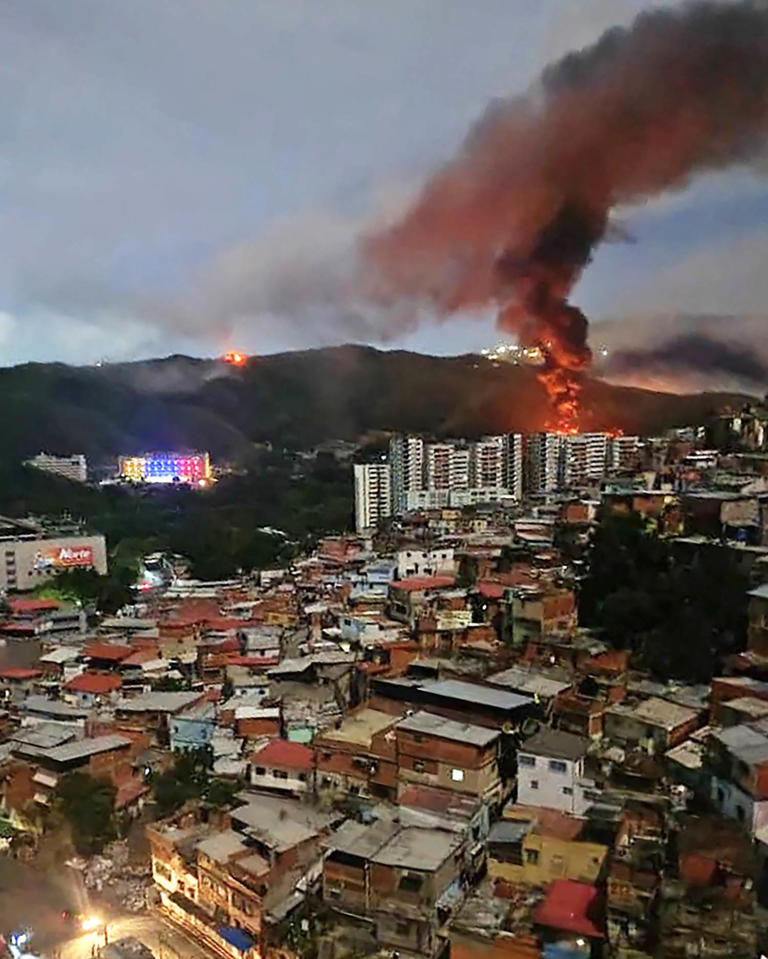
A fire at Fuerte Tiuna, Venezuela’s largest military complex, after a series of explosions in Caracas on Saturday. (STR / AFP via Getty Images)© STR
But the strike also reinforces the view that the U.S. is “preoccupied with the Western Hemisphere, and skeptics will wonder in whose sphere of influence Taiwan falls within this Monroe Doctrine 2.0,” he said, referring to Trump’s twist on the 19th-century U.S. foreign policy.
Others say China has refrained from attacking Taiwan not because it lacks global permission, but because it is simply not ready.
“China has never lacked hostile intent toward Taiwan; what it truly lacks is the ability to carry it out,” Wang Ting-yu, a senior lawmaker from Taiwan’s governing Democratic Progressive Party, said Sunday in a post on Facebook.
“China is not the United States, and Taiwan is certainly not Venezuela. If China could really do it, it would have acted long ago!”
Janis Mackey Frayer reported from Beijing and Jennifer Jett from Hong Kong.


For info.
ReplyDeletehttps://x.com/i/status/2009262732726472851
DESPERATE GLOBALISTS:
TRUMP DISMANTLES THE SYSTEM
He announced it—and he is doing it. Donald Trump is rapidly dismantling a large part of the globalist system, which was built on a network of supranational organizations and which, in practice, relied in many contexts on NGOs—non-governmental organizations. Many of these NGOs were in reality financed by states, first and foremost by the United States, and therefore were in fact governmental.
Just a few hours ago, the U.S. president signed an executive order for the withdrawal of the United States from 66 international organizations that are “contrary to the interests of the United States”: 35 non-UN organizations and 31 UN organizations.
And on Tuesday—news ignored by the European press—Secretary of State Marco Rubio announced that Washington will no longer use NGOs for foreign aid, citing the health sector as an example. Foreign aid will instead be managed directly by the U.S. government in cooperation with the government of the receiving country.
A devastating one-two punch to a system that is already wavering. In a few days, a third blow may arrive. Trump will go to the World Economic Forum in Davos, right into the heart of the globalist elite. To do what? He will likely use this opportunity to put the world’s elites before a radical choice: either stand with Trump—saying goodbye to the globalist plans implemented over the last 30 years—or stand against him, setting themselves on a collision course with the United States.
Why? Because the new world must once again be based on sovereign states, much to the dismay of many distraught and inconsolable globalists such as Macron, Starmer, Merz, and Ursula von der Leyen. The old world is being reborn; it is no longer their world. And Italy, too, will soon have to choose.
https://x.com/i/status/2010378251705721217
Delete🔥SPECULATION: What @potus may present in Davos and how this impacts Crypto and investing forever.
🎯The Target: The "British Imperial System" is historically built on debt traps, lending to nations and then seizing their assets when they can't pay (the IMF/World Bank model). Trump’s withdrawal from globalist bodies suggests he is preparing to exit this debt-based multilateralism.
🔥The Move at Davos: Trump’s economists present a plan for a "New Bretton Woods" that is bilateral, not multilateral. He declares that the US will no longer enforce IMF conditionalities or World Bank debts for nations that align with the US "Zone of Prosperity." He might float the idea of backing the US Dollar with a "basket of commodities" (including the newly secured hemispheric oil) $BTC $XRP $GOLD rather than just "faith and credit."
⚔️The Challenge: This is a direct declaration of war on the central banking model (the Bank of England/Federal Reserve fiat loop). By linking the dollar to hard assets and refusing to act as the enforcer for globalist debt collection, he strips the "Empire" of its primary weapon of control: the ability to bankrupt sovereign nations.
For the farts on that 'Venezuela’s largely Chinese defense systems', the Wikipedia has its takes:
ReplyDeletehttps://en.wikipedia.org/wiki/List_of_equipment_of_the_Venezuelan_Armed_Forces
There r NO Chinese arsenal unde the List of equipment of the Venezuelan Armed Forces!
even if there was, they would have been switched off in the 'Delcy' betrayal
DeleteCCP says "unilateral bullying seriously impacts the international order"....
ReplyDeleteHohohoho..
Has there ever been a blacker pot calling a kettle black ?
wakakaka… yr kind of mfering usage of blacker pot calling a kettle black!
Delete