Dennis Ignatius
~ Provoking discussion, dissent & debate on politics, diplomacy, human rights & civil society.
Haze: An unfriendly act, a spineless response
12MondayOct 2026
Tags
Anwar Ibrahim, ASEAN, Indonesia, pollution, President Prabowo, trans-boundary haze, Zahid Hamidi
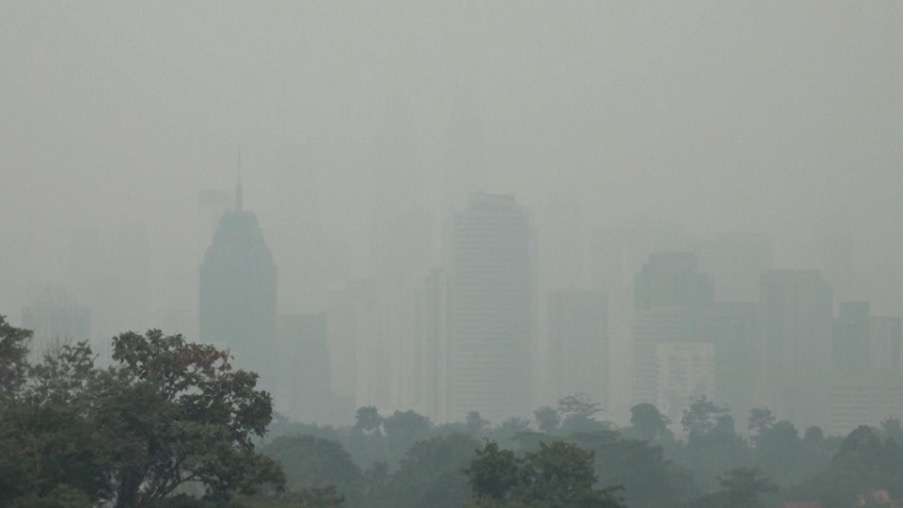
[1] For more than two months, Malaysians have been breathing toxic fumes. In Sarawak, readings in Serian hit a hazardous 376 and an emergency was declared;¹ across much of the peninsula, the air has been stuck in the unhealthy range for weeks. Schools across Johor, Negeri Sembilan, Melaka and the Klang Valley are being disrupted by the haze.
[2] This is no seasonal inconvenience. It is arguably the most serious public health challenge the nation has faced since Covid-19. At the Health Ministry’s sentinel clinics alone, weekly upper respiratory infections climbed from 1,637 in mid-August to over 7,000 by early September. Asthma cases jumped 259 per cent in a single week.² ³ The fine particulates now lodged in the lungs of our children, our elderly and the chronically ill will take their toll for years to come.
[3] And what has the government done? On 17 September, Deputy Prime Minister Ahmad Zahid Hamidi announced in Jakarta that Malaysia had offered its Bombardier water bomber.⁴ Two days later, he declared that Indonesia had given the green light.⁵ Yet on 7 October, the foreign minister admitted that the operational arrangements, even where our team would be based, were still being negotiated.⁶ Weeks on, the plane sits idle while Jakarta drags its feet and Putrajaya waits politely. On 11 October, Zahid conceded there had been no reply, adding: “We take a positive view that perhaps they do not require our assistance.”⁷ Trust a politician to take a positive view when people on the streets are choking.
[4] Then came the phone call. On 8 October, the prime minister announced: “I personally contacted President Prabowo, and he agreed to take the necessary steps.”⁸ What steps? By when? We are not told. The environment minister warns against finger-pointing and assigning blame, and promises stronger ASEAN action – next year.⁹ Fahmi Fadzil, the government spokesman, offered this: “We pray that the haze situation will become increasingly under control.”¹⁰ Let me be blunt: we didn’t elect you guys and give you all those perks to pray and pontificate; what we want from you is meaningful action.
[5] Let’s face it: this is a failure of diplomacy masquerading as good neighbourliness. ASEAN has a haze agreement ratified by every member and a roadmap promising a haze-free region by 2030.¹¹ But like so much of what ASEAN does, it is all talk. For all the professions of close collaboration among ASEAN leaders, when push comes to shove, they amount to little.
[6] Nor does Jakarta deserve any sympathy. Some 202,000 hectares had already burned between January and July.¹² Only in late August did President Prabowo fly in to chair a coordination meeting and order arrests.¹³ On 7 October, more than 1,200 hotspots were still burning.¹⁴ This is not resolve; it is damage control, a feeble response to pressure. Clearly, Jakarta still does not take seriously the damage it is doing to its neighbours.
[7] Equally galling is the attitude. During an earlier crisis, Indonesia’s then forestry minister complained that neighbours never thanked Indonesia for the oxygen its forests provided – as if Indonesia were the only nation in the world with forests.¹⁵ Now, with Malaysian schools shut and clinics overflowing, Indonesia’s government communications chief offers this gem: “When there is no smoke, we send oxygen.”¹⁶ What an extraordinarily obtuse thing to say.
[8] Let us call it what it is. A state that knowingly allows fires on its territory to poison its neighbours year after year, offering excuses and condescension in place of results, is behaving irresponsibly; worse, it is committing an unfriendly act. It’s time for Malaysia to stop being so deferential to Indonesia and start calling Jakarta out for its callousness and insensitivity.
[9] So what should Putrajaya do?
First, plain speaking. Malaysia should tell Jakarta, publicly and firmly, that its failure to stop the burning is unacceptable. It should summon the Indonesian ambassador to receive a strong protest and insist that the urgent ASEAN ministerial meeting the prime minister belatedly sought on 8 October convenes within days, not weeks.¹⁷ It should demand a timetable, not assurances.
Second, get the Bombardier airborne now. Insist on operational clearance immediately, for the plane and for our firefighters on the ground.
Third, internationalise the firefighting effort. Last month, Jakarta requested and accepted three Japanese Chinook helicopters, yet it still cannot answer our offer.¹⁸ Malaysia should lead a coordinated ASEAN deployment and press partners such as Japan and Australia to commit aircraft.
Fourth, put our own house in order. Asked whether Malaysian firms were among the companies facing action in Indonesia, Zahid said no information had been provided and that the firms were Indonesian-registered.⁵ That is a dodge. Find out who they are, then name and shame them.
[10] Jakarta sets the fires and sends us its smoke, then lectures us about oxygen. Putrajaya answers with prayers and phone calls. Between a neighbour that will not act and a government that dare not push it, ordinary Malaysians are left to choke. They deserve better from both.
[Dennis Ignatius | Kuala Lumpur | 12 October 2026]
***
Let me give an analogy, one on how Australia interacts with the wankees. Once (former) PM Paul Keating described such an interaction by asking "How does one interact with a 500 lb gorilla when in the same cage?"
So, how does a nation like Malaysia (and Sing) interact with a 500 lb oranghutan?


Hari Ini Dalam Sejarah….Bali bombing.
ReplyDeleteYindonesia should not have released the Bomb Maker Umar Patek for the Bali Bombings after serving only 10 years in prison.
Aussies (& others) ask why he was spared the gallows, after killing 200.
Today marks the 24th anniversary of the Bali Bombing - one of the most brutal jihadist massacres in modern history.
88 Australians were murdered. At least 200 people were killed overall, about 150 of whom burned to death in a hellish inferno.
Hundreds more received third degree thermal burns, with dozens receiving burns over 30–60% of their total body surface area.
The attack was deliberately engineered as a suicide double-tap. A suicide bomber detonated a small backpack device inside Paddy's Pub first, driving panicked tourists out into the street where a van sat outside the Sari Club packed with roughly a tonne of explosives. The first suicide bomb effectively herded victims into the kill zone of the second.
People in the immediate blast radius immediately disintegrated into human shrapnel. Shards of bone, teeth and skin were recovered embedded in the bodies of victims further away, and in the bamboo and timber of the building.
The bamboo structure of the Sari Club fed a raging inferno that reached temperatures that incinerated everything in its path. Witness accounts describe people clawing at the bamboo walls trying to break through. They clawed at the walls but could not scream because the inferno reached temperatures that scalded the airways with every breath. Even taking a single breath in the superheated interior of the club was enough to guarantee an excruciating death over hours - airway tissue would swell shut, suffocating victims already covered in third degree burns. Survivors who made it to the street were sometimes not recognisably human. Skin melted off in sheets, shirts and clothing melted into burns and fused with the tissue underneath.
Bodies recovered from the Sari Club's interior were almost universally unrecognisable. They typically presented as partial skeletal frames, no recognisable faces, no fingerprints, no skin, no soft tissue identifiers, no hair. Only teeth and dental work remained largely intact. Incinerated bodies and limbs carried in from outside by the blasts fused together and intermixed with structural debris, broken glass, melted plastic, twisted metal.
The AFP and Australian Society of Forensic Odontology had to work tirelessly for nearly five months to identify missing Australian victims by their teeth. That was the only way most victims could be identified. Some Indonesian and other foreign victims were never positively identified at all.
Indonesia recently released the jihadist who mixed the bombs behind the massacre after determining that he had been “rehabilitated.”
Umar Patek now owns his own coffee shop in Surabaya called Coffee RAMU 1966 with the tag line "Once, I concocted bombs, and now I concoct coffee."
If Australia was a serious country, our government would hunt down Umar Patek and take revenge against him. If an Australian did what he did against Indonesians, of course their government would demand his death. But we are sadly a cucked nation. Many mainstream Australian progressives - including Labor MPs and Ministers - campaigned against the death penalty for the Bali Bombing terrorists.
The horror, the horror.
https://x.com/drewpavlou/status/2109838747651223561?s=46&t=8K6fzabO3g6uaj4KxwSSjg
https://en.wikipedia.org/wiki/Umar_Patek