
The New York Times says US Commerce Secretary Howard Lutnick's former firm continues its business dealings with a Singapore company that is developing the A201 data centre, which houses hundreds of millions of dollars' worth of Nvidia servers
MalaysiaNow
November 16, 2026 2:13 PM
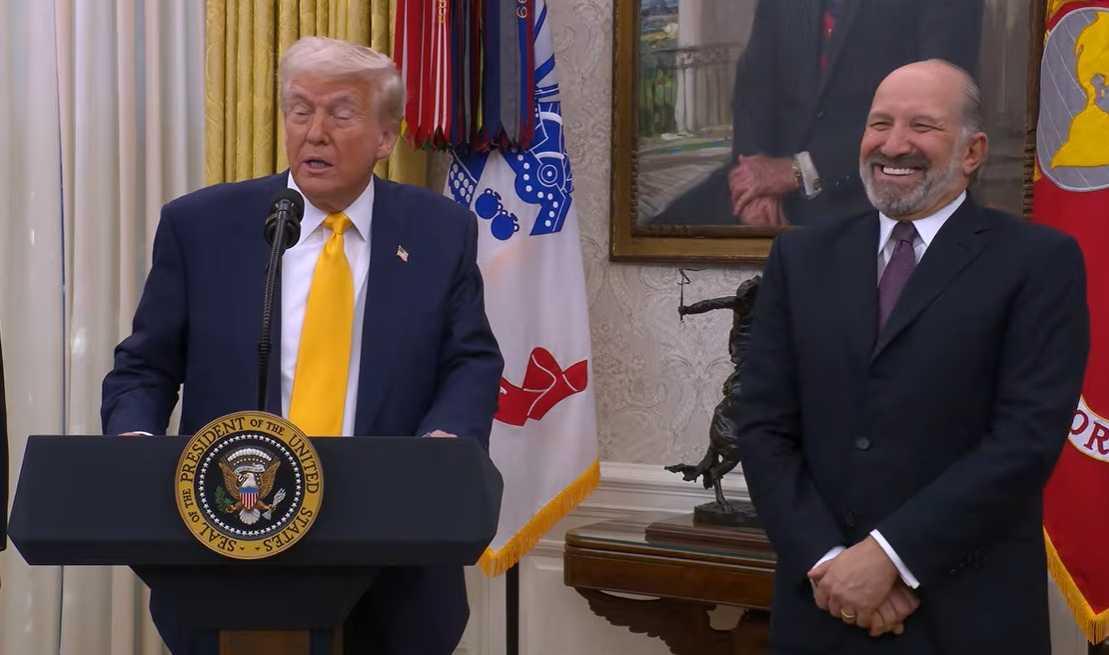
Donald Trump's commerce secretary Howard Lutnick (right), the man overseeing US regulations to control advanced chip exports, is said to be trying to soften the export restrictions involving Malaysia, Singapore, Thailand and Indonesia.
The government's move to allow the mushrooming of data centres, a controversial policy facing growing local resistance in recent months, may have hit a snag following the storm over the Nvidia scandal, with a new report revealing a conflict of interest involving President Donald Trump's commerce secretary, Howard Lutnick.
The New York Times (NYT) revealed that a planned data centre in Johor, known as A201, is expected to house hundreds of millions of dollars' worth of Nvidia's most advanced AI servers, providing computing power to Chinese technology giant Tencent in violation of a US ban on the export of such chips to China.
The facility is being developed by Singapore-based Bitdeer, which has financial dealings with Cantor Fitzgerald, an investment firm formerly headed by Lutnick, the same person who oversees US regulations governing advanced chip exports.
According to Datacenters.com, which maps data centres worldwide to help technology companies with their business decisions, Bitdeer's A201 data centre is located in Johor Bahru. However, the site is unable to provide its size or details on its power.
According to NYT, Lutnick transferred control of Cantor Fitzgerald to his sons after joining the Trump administration, but the firm continued to have business dealings with data centre operators in Southeast Asia that stand to benefit from access to advanced Nvidia chips.
NYT said Cantor Fitzgerald acted as an agent for Bitdeer's share offering of up to US$1 billion this year.
The US has restricted the direct sale of its most advanced AI chips to China over concerns that the technology could strengthen Beijing's military and intelligence capabilities.
But Chinese companies could circumvent these restrictions by renting data centres in Malaysia, prompting Washington to impose tighter controls on overseas data centres serving Chinese customers.
NYT reported that Lutnick has been trying to soften the proposed controls, which would apply to selected countries including Malaysia, Singapore, Thailand and Indonesia, rather than impose broader restrictions globally.
The renewed focus on data centres comes in the wake of revelations involving Nvidia's co-founder and former CEO Jensen Huang and his relationship with Alice Huang, a Chinese national whom US intelligence officials suspect is a spy.
Huang admitted to an extramarital affair with Alice Huang, who previously headed Megaspeed, a cloud computing company operating data centres across Southeast Asia. On Nov 12, he stepped down as Nvidia's CEO.
But it fuelled scrutiny of Megaspeed over suspicions that it may have been involved in diverting restricted Nvidia chips to Chinese companies.
This is because Megaspeed's Malaysian affiliate, Speedmatrix Sdn Bhd, bought at least US$4.8 billion worth of equipment containing Nvidia chips between June 2024 and February 2026.
The US opened an investigation in 2024 into whether those chips were meant for China.
This in turn casts attention on Malaysia's data centre sector over the possibility that the country could become a platform for Chinese companies to access advanced US technology.
 It comes at a time when Prime Minister Anwar Ibrahim's government has portrayed the data centre sector as a major contributor to Malaysia's economy, despite growing resistance over the high consumption of electricity and water, land use and environmental consequences.
Just last week, rising concerns prompted the Queen and Permaisuri of Johor, Raja Zarith Sofiah, to speak up about problems posed by data centres to local residents, urging authorities to study the negative impact.
Since 2021, Malaysia has approved RM385.7 billion in data centre-related investments, but critics say they contribute almost nothing in terms of technology transfer or job creation, unlike IT-related investments in the past.
Data centres, AI and Nvidia
AI technology runs on an advanced computer chip called a GPU, and the best of these are manufactured by Nvidia. Thousands of these chips are wired together in a single building, called a data centre.
These chips power programmes such as ChatGPT, but can also be used for weapons and spying, which is why the US tries to limit who buys them.
The US Bureau of Industry and Security (BIS), part of the Department of Commerce headed by Lutnick, is tasked with controlling the export of such chips, including specifying what American companies can sell abroad.
One such rule is that Nvidia’s chips cannot be sold or shipped to China.
China has found an effective way to circumvent these rules: it can use the chips through a data centre run by a non-Chinese firm in Malaysia, which stores the chips legally.
According to the Wall Street Journal, ByteDance, the Chinese company that owns TikTok, arranged to use 36,000 Nvidia chips owned by a Singapore-based data centre company.
The government's move to allow the mushrooming of data centres, a controversial policy facing growing local resistance in recent months, may have hit a snag following the storm over the Nvidia scandal, with a new report revealing a conflict of interest involving President Donald Trump's commerce secretary, Howard Lutnick.
The New York Times (NYT) revealed that a planned data centre in Johor, known as A201, is expected to house hundreds of millions of dollars' worth of Nvidia's most advanced AI servers, providing computing power to Chinese technology giant Tencent in violation of a US ban on the export of such chips to China.
The facility is being developed by Singapore-based Bitdeer, which has financial dealings with Cantor Fitzgerald, an investment firm formerly headed by Lutnick, the same person who oversees US regulations governing advanced chip exports.
According to Datacenters.com, which maps data centres worldwide to help technology companies with their business decisions, Bitdeer's A201 data centre is located in Johor Bahru. However, the site is unable to provide its size or details on its power.
According to NYT, Lutnick transferred control of Cantor Fitzgerald to his sons after joining the Trump administration, but the firm continued to have business dealings with data centre operators in Southeast Asia that stand to benefit from access to advanced Nvidia chips.
NYT said Cantor Fitzgerald acted as an agent for Bitdeer's share offering of up to US$1 billion this year.
The US has restricted the direct sale of its most advanced AI chips to China over concerns that the technology could strengthen Beijing's military and intelligence capabilities.
But Chinese companies could circumvent these restrictions by renting data centres in Malaysia, prompting Washington to impose tighter controls on overseas data centres serving Chinese customers.
NYT reported that Lutnick has been trying to soften the proposed controls, which would apply to selected countries including Malaysia, Singapore, Thailand and Indonesia, rather than impose broader restrictions globally.
The renewed focus on data centres comes in the wake of revelations involving Nvidia's co-founder and former CEO Jensen Huang and his relationship with Alice Huang, a Chinese national whom US intelligence officials suspect is a spy.
Huang admitted to an extramarital affair with Alice Huang, who previously headed Megaspeed, a cloud computing company operating data centres across Southeast Asia. On Nov 12, he stepped down as Nvidia's CEO.
But it fuelled scrutiny of Megaspeed over suspicions that it may have been involved in diverting restricted Nvidia chips to Chinese companies.
This is because Megaspeed's Malaysian affiliate, Speedmatrix Sdn Bhd, bought at least US$4.8 billion worth of equipment containing Nvidia chips between June 2024 and February 2026.
The US opened an investigation in 2024 into whether those chips were meant for China.
This in turn casts attention on Malaysia's data centre sector over the possibility that the country could become a platform for Chinese companies to access advanced US technology.
It comes at a time when Prime Minister Anwar Ibrahim's government has portrayed the data centre sector as a major contributor to Malaysia's economy, despite growing resistance over the high consumption of electricity and water, land use and environmental consequences.Just last week, rising concerns prompted the Queen and Permaisuri of Johor, Raja Zarith Sofiah, to speak up about problems posed by data centres to local residents, urging authorities to study the negative impact.
Since 2021, Malaysia has approved RM385.7 billion in data centre-related investments, but critics say they contribute almost nothing in terms of technology transfer or job creation, unlike IT-related investments in the past.
Data centres, AI and Nvidia
AI technology runs on an advanced computer chip called a GPU, and the best of these are manufactured by Nvidia. Thousands of these chips are wired together in a single building, called a data centre.
These chips power programmes such as ChatGPT, but can also be used for weapons and spying, which is why the US tries to limit who buys them.
The US Bureau of Industry and Security (BIS), part of the Department of Commerce headed by Lutnick, is tasked with controlling the export of such chips, including specifying what American companies can sell abroad.
One such rule is that Nvidia’s chips cannot be sold or shipped to China.
China has found an effective way to circumvent these rules: it can use the chips through a data centre run by a non-Chinese firm in Malaysia, which stores the chips legally.
According to the Wall Street Journal, ByteDance, the Chinese company that owns TikTok, arranged to use 36,000 Nvidia chips owned by a Singapore-based data centre company.


No comments:
Post a Comment