
Murray Hunter
Is UMNO the bad kid on the block?
Destabilising Madani, Sideling Partners, with the Arrogance of Entitlement
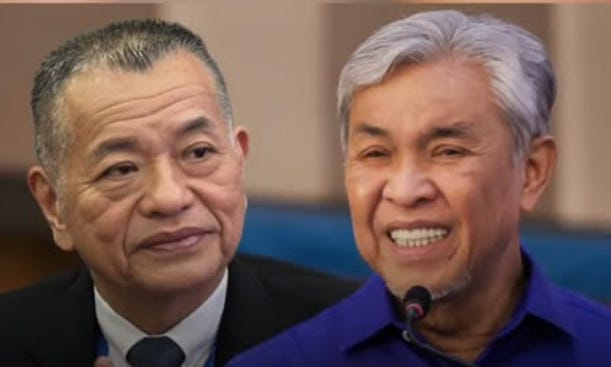
UMNO is once again showing its true colours as the disruptive force within Malaysian politics. What was once the dominant partner in Barisan Nasional has, under Datuk Seri Ahmad Zahid Hamidi’s chairmanship, increasingly behaved like the coalition’s internal saboteur, prioritising self-preservation and elite interests over institutional stability, coalition discipline, or any coherent national ethic.
This pattern has been consistent consistent since the end of 2022, when Anwar Ibrahim became prime minister.
UMNO has repeatedly tested and strained the Madani government from within, extracting concessions while publicly posturing as a responsible partner. The relentless push to secure preferential treatment for Datuk Seri Najib Razak, culminating in the optics of house arrest is the clearest recent example.
This is not merely a legal or political manoeuvre, it is a profound symbolic failure. In a country where ordinary citizens are expected to accept the full weight of the law, the spectacle of elite accommodation reeks of hypocrisy. It signals that loyalty to the system is for the rakyat, while the connected operate under a different set of rules.
The Madani administration’s willingness to accommodate these pressures has left it looking weakened and compromised, less a government of principle than a temporary arrangement held together by necessity and calculation.
This same entitlement has now spilled into the Melaka state election.
On Saturday night at the Melaka International Trade Centre, BN announced candidates for 21 of the 28 seats it intends to contest on 14 November. MCA was allocated just two seats, Machap Jaya’s Datuk Ngwe Hee Sem and Klebang’s Datuk Lim Ban Hong.
The Chinese-based party, which contested seven seats in the 2021 Melaka polls, was neither properly consulted nor given prior notice that the event would include candidate announcements. MCA president Datuk Seri Dr Wee Ka Siong and his leaders walked out before Zahid’s keynote. Outside the hall, Wee was blunt, without the party’s top leadership signing off, MCA would not recognise the candidates. Announcing them unilaterally, he said, was unacceptable, especially when seats previously contested by MCA had apparently been reallocated.
Wee’s position is straightforward and institutionally sound. Political parties operate through their own nomination processes and central leaderships. Treating a long-standing partner as a junior appendage whose consent can be assumed, or whose dignity can be ignored, is pure arrogance.
The MCA has been UMNO’s partner for decades. Reducing its stake so sharply without finalised negotiations and then springing the announcement under the guise of an “election machinery launch” is not coalition management, it is dominance theatre. Wee has called on BN’s central leadership to intervene and resolve the dispute fairly.
Several days remain before nomination, and he has left the door open to a settlement. Whether that door stays open depends on whether UMNO is capable of treating partners as equals rather than subordinates.
The broader pattern is not confined to Melaka. Accusations that UMNO elements have attempted to engineer and legitimise irregular monarchical outcomes in Negeri Sembilan fit the same logic of power-over-process.
When a party that once defined itself as the guardian of constitutional order begins treating institutions, coalition agreements, party SOPs, even the symbolism of the rule of law as disposable instruments, it ceases to be a stabilising force and becomes the source of instability.
Malaysia’s multi-ethnic political compact has always been fragile. It rested, imperfectly, on negotiated power-sharing and at least a pretence of mutual respect among partners. UMNO’s current behaviour suggests that pretence is fraying.
The party appears more focused on securing its own position, protecting its convicted former leader, and maximising short-term electoral control than on building durable governance or restoring public trust. The Madani government, by tolerating or enabling these dynamics, risks being remembered less as a reformist interlude than as a vessel that allowed a saboteur without national ethics to operate from inside.
The Melaka episode is small in scale but revealing in character. If MCA’s dignity can be casually overridden, if candidate announcements can be sprung without consent, and if the optics of elite exceptionalism around Najib can be prioritised over equal application of the law, then the “bad kid on the block” label is not rhetorical excess. It is a description of conduct. Malaysian politics has long suffered from elite impunity and coalition bullying. UMNO’s latest contributions simply make the pattern harder to ignore.


No comments:
Post a Comment