Consortium News
Volume 31, Number 223— Monday, August 17, 2026
A Tale of Two Genocides: Cambodia & Israel
Where Cambodia chose the difficult, winding road of national healing, Israel spurred a suicidal treadmill of retribution in the Middle East, writes Laurent Evrard
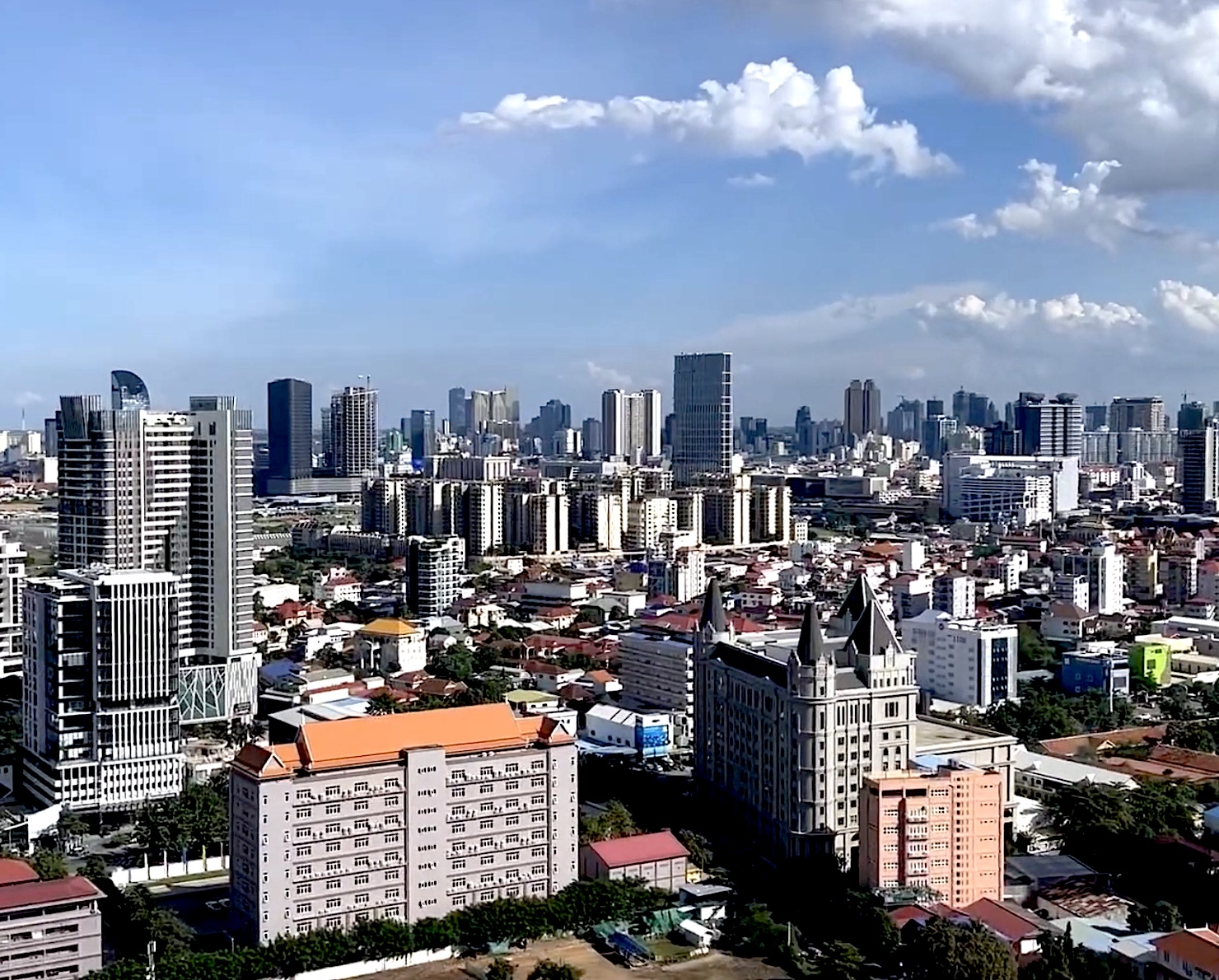
Phnom Penh Skyline from the Toul Kork area. (Looppty /Wikimedia Commons/CC BY-SA 4.0)
By Laurent Evrard
in Phnom Penh
Special to Consortium News

History is written in blood, but it is redeemed by choice. Across the theater of human suffering, few nations have stared into the abyss of total annihilation quite like Cambodia.
Under the psychotic agrarian utopia of Pol Pot and the Khmer Rouge, nearly a quarter of the country’s population of eight million people was systematically starved, worked to death, or executed in the Killing Fields. It was a mechanized madness intended to reset human civilization to year zero.
Yet, out of those pulverized skulls and mass graves emerged something miraculous: a profound, defiant capacity for resilience and reconciliation.
Compare this monumental human triumph with the tragic, blood-drenched labyrinth of the Middle East — specifically the ongoing devastation in Gaza, the West Bank and the wider web of hostilities involving Israel and its Arab and Iranian neighbors.
Where Cambodia chose the difficult, winding road of national healing, Israel spurred a suicidal treadmill of retribution in the Middle East, proving that while war is easy to start, vengeance is an eternity that devours its own children.
While Cambodians forgave their killers, the Israelis have exacted revenge — not against their executioners — but against an innocent people whom Israel victimized by ethnically cleansing and seizing their land to create the settler colony of Israel.
The Cambodian Miracle: Forgiveness as a Revolutionary Act
Under the psychotic agrarian utopia of Pol Pot and the Khmer Rouge, nearly a quarter of the country’s population of eight million people was systematically starved, worked to death, or executed in the Killing Fields. It was a mechanized madness intended to reset human civilization to year zero.
Yet, out of those pulverized skulls and mass graves emerged something miraculous: a profound, defiant capacity for resilience and reconciliation.
Compare this monumental human triumph with the tragic, blood-drenched labyrinth of the Middle East — specifically the ongoing devastation in Gaza, the West Bank and the wider web of hostilities involving Israel and its Arab and Iranian neighbors.
Where Cambodia chose the difficult, winding road of national healing, Israel spurred a suicidal treadmill of retribution in the Middle East, proving that while war is easy to start, vengeance is an eternity that devours its own children.
While Cambodians forgave their killers, the Israelis have exacted revenge — not against their executioners — but against an innocent people whom Israel victimized by ethnically cleansing and seizing their land to create the settler colony of Israel.
The Cambodian Miracle: Forgiveness as a Revolutionary Act
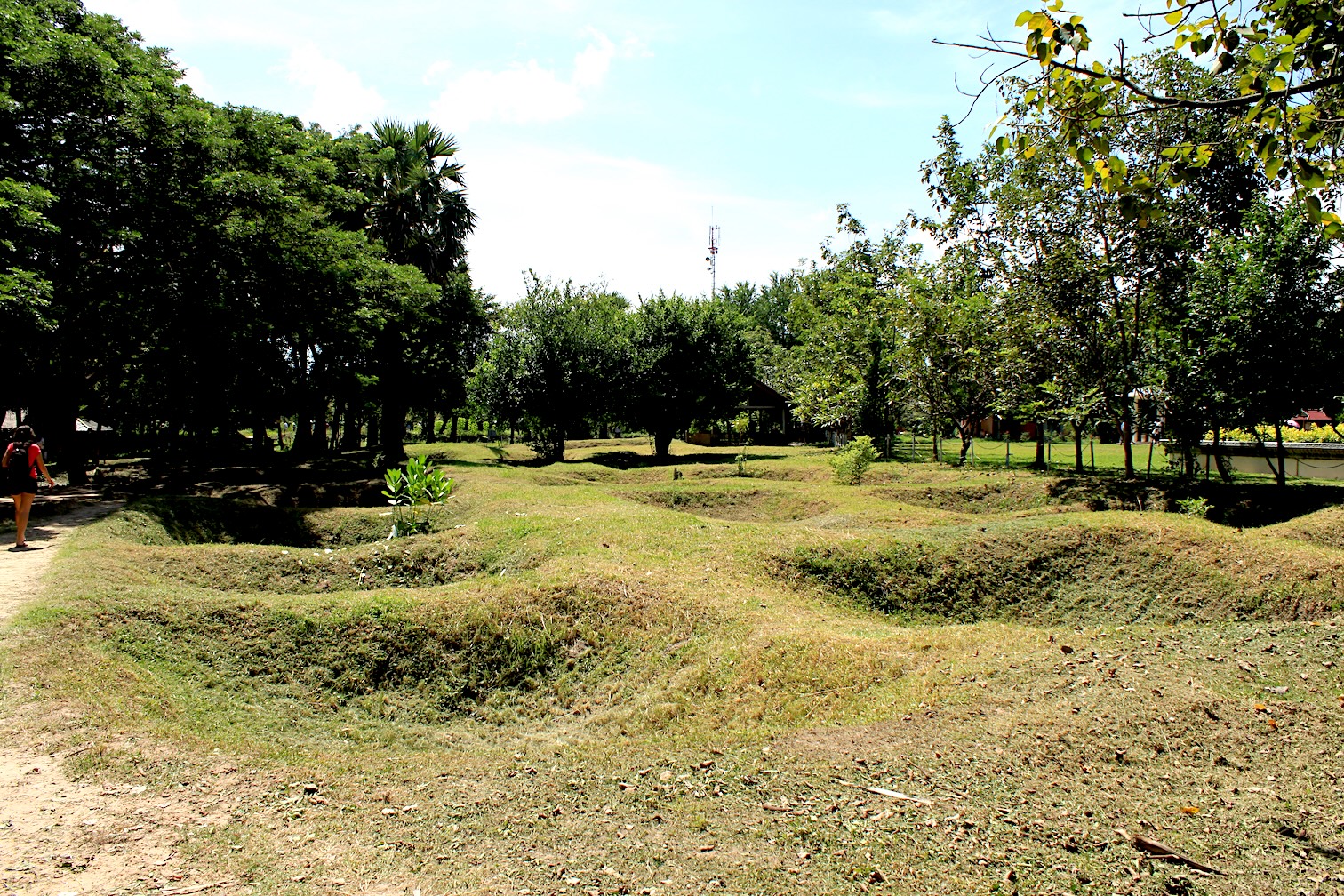
Memorial stupa at the Choeung Ek Killing Fields Genocidal Center in Phnom Penh. (Joe Lauria)
How does a society rebuild when neighbor killed neighbor and children were brainwashed to turn on their own parents?
Instead of plunging into an endless cycle of multi-generational blood feuds, Cambodia engineered a masterpiece of pragmatic peace. Through a combination of legal accountability — symbolized by the hybrid tribunal that brought surviving architects of the Khmer Rouge regime to justice — and the visionary Win-Win Policy, the Cambodian people achieved the impossible.
The state chose national integration over eternal ostracization. Former combatants and even lower-level cadres were folded back into society, stripped of their weapons but granted dignity, land, and a future.
The Khmer spirit recognized a harrowing truth: if you live by the shovel of the mass grave, you will eventually bury your entire nation. By choosing coexistence over total extermination, Cambodia transformed fields of bones into foundations of a booming, peaceful society. They stopped counting bodies and started counting tomorrows.
Wisdom of the Lotus
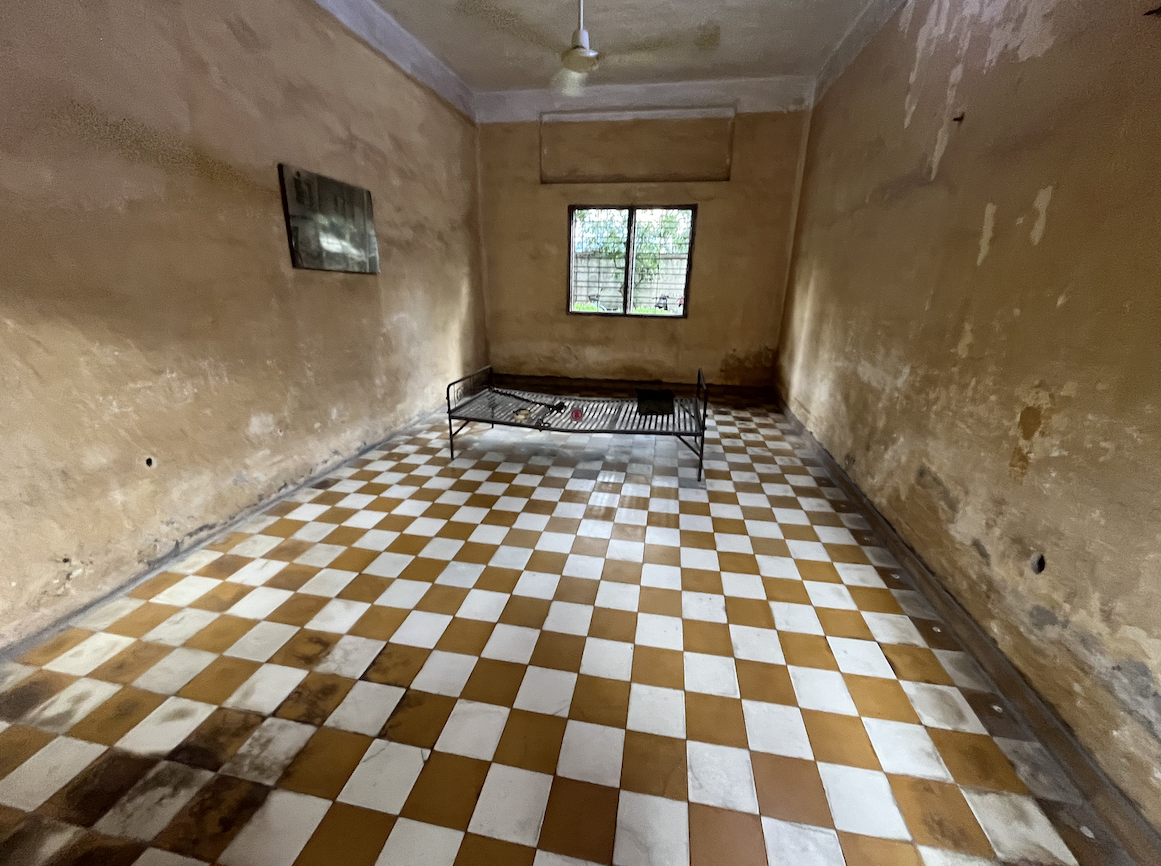
A cell at the Tuol Sleng Genocide Museum in Phnom Penh, an extermination camp in a former high school where as many as 20,000 people were tortured and killed. There were only 12 known survivors. (Joe Lauria)
To understand Cambodia’s miracle of reconciliation, one must look to its spiritual bedrock: Theravada Buddhism.
Unlike the rigid, legalistic retributive justice encoded in ancient Abrahamic traditions — exemplified by the Mosaic law of Lex Talionis (“an eye for an eye, a tooth for a tooth”) — Buddhist philosophy teaches radical impermanence (Anicca), non-harming (Ahimsa) and the total liberation from the poisons of hatred.
Where a warrior-like ethos demands proportional vengeance and keeps historical trauma alive through sacred memory and divine scorekeeping, Buddhism offers a profound humanism: hatred ceases not by hatred, but by love alone.
This philosophical divergence carries a heavy historical cost. The relentless eye-for-an-eye paradigm — deeply embedded in the cultural and geopolitical survival mechanisms of modern Israel — has blinded its leadership to the universal suffering of others.
By adopting the very mechanisms of disproportionate destruction that once sought to annihilate them, the moral credit and universal compassion earned by the Jewish people during the unspeakable horrors of the Holocaust have been tragically squandered on the smoking ruins of Gaza.
Geometry of Absolute Destruction

Gaza under Israeli attack, 2023-2025. (Jaber Jehad Badwan /Wikimedia Commons/ CC BY-SA 4.0)
Turn your gaze westward, and the contrast is as blinding as it is heartbreaking. In Gaza and the West Bank, the landscape is once again choked with the dust of collapsed apartment blocks and the silent grief of parents holding lifeless infants.
Israel’s military doctrine — driven by an existential trauma that demands absolute security through absolute dominance — has devolved into a murderous frenzy. In flattening Gaza and suffocating the West Bank, it treats entire civilian populations as acceptable collateral damage.
But physical walls, blockades and iron domes cannot quarantine a people from the blowback of despair. Every child buried under concrete in Gaza is a seedbed for tomorrow’s resistance, ensuring that the trauma of today becomes the terrorism of tomorrow.
Simultaneously, the surrounding Arab dynamics and regional proxy wars have long treated the Palestinian cause not as a human reality to be rescued, but as a perpetual political currency.
This is the architecture of eternal hatred. Israel pounds populations into submission under the illusion of “crushing” an enemy, oblivious to the fact that you cannot bomb a people into loving you or securing your borders.
The Palestinians and regional actors, trapped in a fatalistic script of perpetual victimhood and resistance, too often romanticize struggle without a horizon of coexistence. It is a symmetrical dance of death where both sides believe that if they just kill enough of the “other,” peace will magically appear on the smoking ruins.
The Lesson of the Century
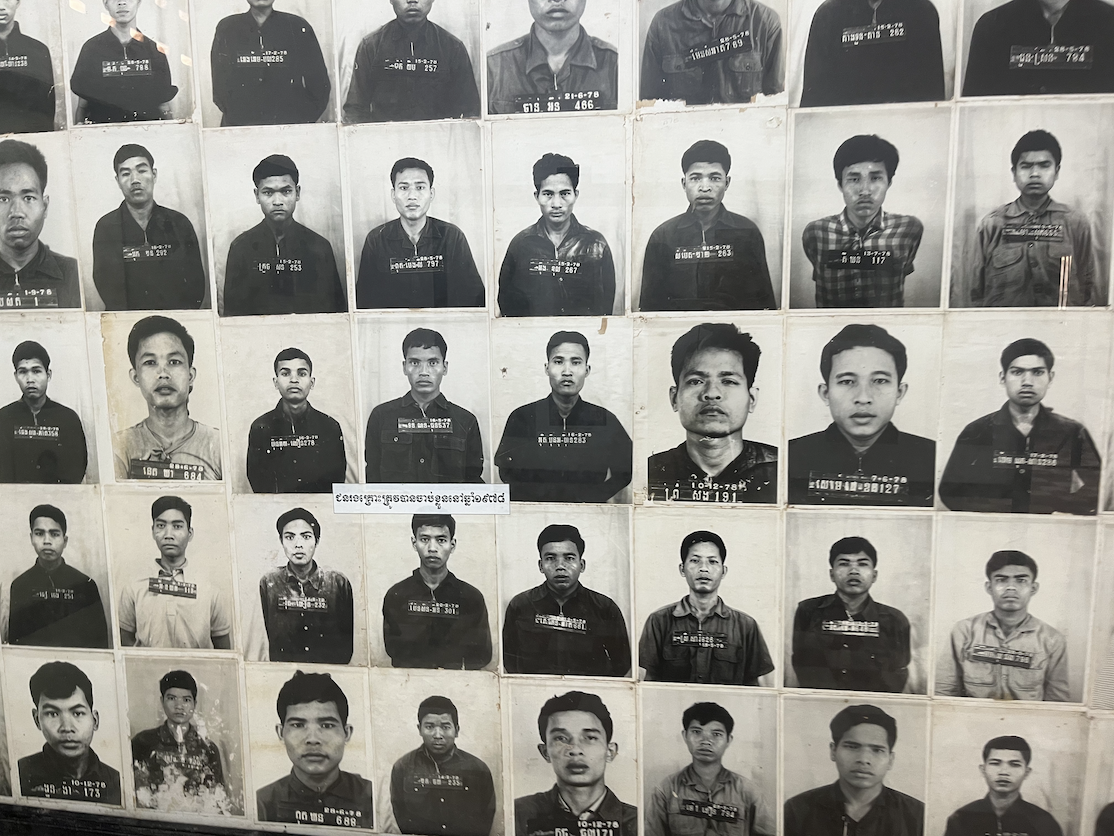
The Khmer Rogue kept meticulous records of their victims at the Tuol Sleng extermination camp. (Joe Lauria)
The juxtaposition of Cambodia and the Middle East lays bare a stark moral lesson for humanity: Genocide and mass violence can either be treated as a terminal disease or a catalyst for profound reinvention.
The Khmer people proved that humanity can metabolize even the most horrific industrial-scale trauma, look the executioner in the eye and decide that the chain of blood must break here. They understood that true victory is not the eradication of the enemy, but the eradication of enmity itself.
Until leaders in Tel Aviv, Gaza, and across the Middle East look at the ruins of their own making and realize that absolute military victory is a delusion — and that collective punishment only breeds collective doom — they will remain prisoners of their own history.
Cambodia rose from the ashes because it chose the courage of pardon. The Middle East continues to burn to the ground because it insists on the cowardice of endless revenge.
Mass graves at Killing Fields of Choeung Ek in Cambodia, 2011. (Jwslubbock / Wikimedia Commons/CC BY-SA 4.0)
Laurent Evrard is a Belgian finance and wealth management professional with 30 years of experience in the Luxembourg financial sector (1991–2021). Currently based in Phnom Penh, Cambodia, he divides his time between managing hospitality ventures, lecturing on financial analysis and international strategy at the university level, and writing on global financial and strategic matters


No comments:
Post a Comment