Murray Hunter
Does Saudi believe it’s under an existential threat?
Murray Hunter
Jul 29, 2026
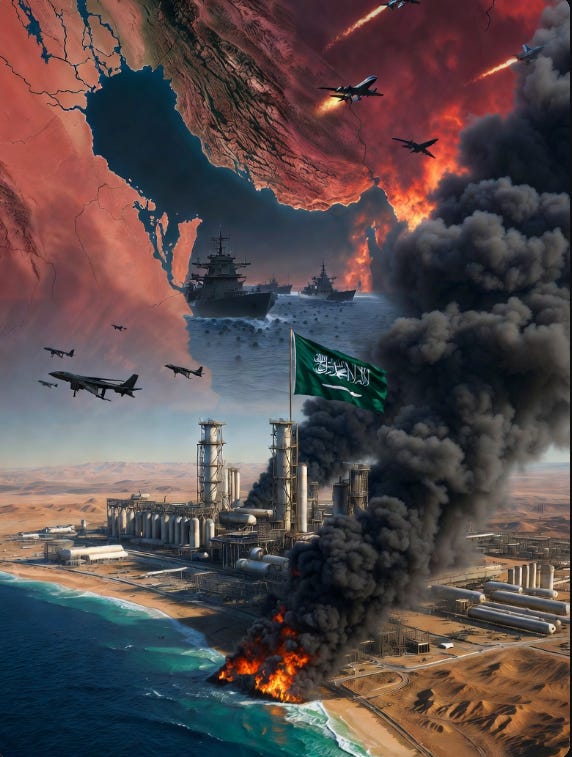
In the swirling chaos of the latest Middle Eastern escalations, Saudi Arabia appears to have crossed a Rubicon. What on the surface looks like a high-risk alignment with the United States against the so-called Axis of Resistance may, upon closer examination, reflect a kingdom that perceives itself as facing an existential threat to its economic lifeline and regime stability.
The recent Houthi attacks on Aramco facilities in Yanbu and Jizan, combined with a declared naval blockade disrupting Red Sea exports to Asia, and the effective closure of the Strait of Hormuz, have squeezed Saudi Arabia’s oil-dependent economy in ways that strike at the heart of its Vision 2030 ambitions and royal legitimacy.
Yemen’s Iran-backed Houthis claimed responsibility for missile and drone strikes on these Red Sea coastal sites, critical for bypassing the Hormuz chokepoint. Yanbu, in particular, serves as the primary western export terminal.
These actions follow the breakdown of a fragile truce and retaliatory Saudi-linked strikes, including on Houthi-held positions around Hodeidah. With roughly 5% of global oil production potentially at risk through direct hits and rerouting impossibilities, Riyadh confronts not just revenue loss but a direct challenge to the petro-rentier social contract that underpins Al Saud rule.
This pressure culminated in joint US-Saudi strikes on Iran-linked militias in eastern Iraq on July 28, 2026, targeting sites from which drones had menaced Saudi energy infrastructure. The operation followed Iranian-directed attempts on US forces, including actions linked to Jordan. For a kingdom long wary of direct confrontation, this represents a notable shift. Saudi Arabia is no longer content with proxy containment or quiet diplomacy; it is actively participating in kinetic responses.
Compounding the sense of encirclement is the recent US-Saudi nuclear cooperation agreement. Signed in the last couple of weeks, this deal grants Riyadh pathways toward civilian nuclear capabilities, potentially including domestic enrichment.
While framed as energy diversification, it signals hedging against Iran’s own nuclear advances and cements strategic alignment with Washington. Yet it also risks inflaming regional grievances, positioning Saudi Arabia as hypocritical in the eyes of Tehran’s allies while accelerating a potential arms race.
Internal cohesion and external posturing add layers of complexity
Reports suggest Pakistani forces in the kingdom may be standing down, limiting one layer of conventional deterrence. Riyadh’s stance throughout the broader US-Israeli-Iranian conflict has been deliberately opaque, balancing normalization talks, OPEC+ interests, and domestic reform narratives.
The strike on Yemeni targets and joint Iraq operation now place it more firmly in the anti-Iran camp. Speculation about internal dissent with friction between branches of the sprawling Al Saud family, tribal interests, or elements acting without full buy-in from King Salman or Crown Prince Mohammed bin Salman (MBS) remains plausible but unconfirmed.
In Saudi Arabia’s centralized system, major military moves rarely occur without apex approval, suggesting calculated risk rather than rogue adventurism.
From a broader regional lens, Saudi actions risk deepening a bipolar Gulf dynamic, with Iran consolidating influence through proxies while Riyadh bets on US security guarantees and economic resilience. This pits long-term Saudi ambitions for Gulf primacy against Iranian resilience and asymmetric capabilities.
Israeli interests may align tactically against Iran but diverge on Palestinian issues and broader Arab-Israeli integration. US policy gains a key partner but inherits entanglement in Saudi vulnerabilities.
Ultimately, Saudi Arabia’s moves suggest a leadership convinced that inaction poses a greater existential danger than escalation. The kingdom’s oil economy, social modernization project, and monarchical continuity all depend on secure export routes and deterrence credibility.
With Hormuz contested, Red Sea routes menaced, and proxies probing defenses, Riyadh calculates that aligning firepower with Washington today preserves the breathing room needed for tomorrow’s transformations. Whether this proves prescient or precipitates wider conflagration remains the region’s defining uncertainty. In a Middle East where perceptions of threat often drive reality, Saudi Arabia is acting as if its survival depends on it.


Pay close attention because you don’t have to be too intelligent to get this.
ReplyDeleteYou don’t have to be a mathematician to make sense of it.
You say Israel dropped 200,000 bombs on Gaza and you use that as proof of genocide.
So far so good? Great.
You also say that Israel killed over 70,000 innocent Gazans.
Correct? Ok.
Do I have to spell it out for you?
If Israel was trying to commit genocide, please explain to me how, according to YOUR numbers, 200,000 bombs only killed 70,000.
I’m gonna wait and let you think about that for a second.
Unless you think that each one of those bombs dropped by Israel didn’t have the ability to kill at least one person, and unless you agree that Israel did more than any army in history to minimize civilian death, how do 200,000 bombs equal 70,000 dead?
Let’s just say that each one of those bombs killed only five people. That’s a million dead Gazans.
Even you don’t think Israel killed a million Gazans.
So make it make sense.
Speaking of apartheid, and now you are going to need to do some math, please spend a few minutes calculating the total number of Jews in Arab states.
ReplyDeleteHere, I’ll help you out because I’m nice like that.
How many Jews live in Algeria, Libya, Syria, Yemen, Jordan, Saudi Arabia, Sudan, Somalia, Mauritania, Djibouti, and Comoros, Iraq, Egypt, and Lebanon cumulatively?
Need a second? It’s complicated math, I know.
The answer is a whopping 0. That’s a zero.
Zero Jews live in all of these Arab countries.
Zero. Not one.
Want to know something even crazier than that?
In 1948, the main Arab countries + Iran held roughly 850,000 to 1 million Jews.
Now, tell me again who is guilty of ethnic cleansing: Israel, where millions of Arabs live with total freedom and achieve high levels of success, or the Arab world that has actively kicked all Jews out of their countries?
If Israel is a colonialist state looking to steal land, why is Israel still smaller than Perak, half of it Negev Desert?
ReplyDeleteSo now that we’ve established that there’s no genocide, no apartheid, no colonialism, and no ethnic cleansing, let’s debunk another one of the ridiculous accusations against Israel.
ReplyDeleteIsrael steals American money by taking billions of foreign aid from the American taxpayer?
Wow, billions of dollars? That sounds like so much money…
And now let’s put that in perspective, shall we?
First of all, 92% of the U.S. Foreign Military Financing (FMF) provided to Israel must be spent in the United States on American products and services.
Did you catch that? 92% of the aid that goes to Israel is then put back into the American economy.
But that’s not even the best part.
Approximately 0.2% of the U.S. GDP is spent on foreign aid. That is about two-tenths of one percent.
In dollar terms, that’s roughly $60 billion to $70 billion per year in recent years, while U.S. GDP is about $30 trillion.
Ok, but how much of that $60 billion to $70 billion goes to Israel? Probably all of it, right?
You’re cute.
Well, if I was judging by the amount of pushback that aid to Israel gets, I’d assume it was 100% of it or close.
So I get where you’re coming from…
So get this. Out of the $60 billion to $70 billion in U.S. foreign aid, $3.3 billion went to Israel last year.
So Israel received about 5% to 6% of U.S. foreign aid.
So again, 0.2% of America’s GDP goes to foreign aid, and out of that, approximately 5% goes to Israel, and 92% of that aid is then poured back into the American economy.
Compare that to Ukraine, for example.
In fiscal year 2025, the United States disbursed approximately $6.7 billion in foreign assistance for Ukraine.
That’s about double the amount sent to Israel.
Remind me again how many bills were passed in Congress to try and stop funding to Ukraine?
Remind me how many organizations have tried to force America to stop sending foreign aid to any country besides Israel?
Now why would there be so much noise surrounding American foreign aid to Israel and absolutely zero noise about foreign aid to any other country?
The truth is Israel is a beacon of light in a very dark world.
ReplyDeleteThe truth is that Israel enhanced your life significantly.
Israel built the chip of the device you are currently looking at.
The truth is that Israel leads the world in cancer research and is first on the scene when there’s a natural disaster anywhere in the world, including in countries that are hostile towards Israel.
The truth is that Jews make up 0.2% of the global population and have been awarded over 20% of Nobel Prizes.
The truth is Israel wants peace. Peace is all Israel ever wanted.
The truth is Israel has proven time and time again that it’s willing to pay a very steep price to achieve peace.
The truth is that Israel leads the world in innovation across all sectors.
The truth is Israel is a breathtakingly beautiful country. No, literally—it’ll take your breath away.
The truth is that Israelis are some of the happiest people on earth.
The truth is that if you’ve spent the better part of your adult life trashing Israel and the Jews and you finally saw the light, Israel would welcome you with open arms to experience the modern-day miracle that is the State of Israel.
The truth is, if all that doesn’t convince you, then consider this:
Throughout generations, throughout history, endless empires—world-leading empires—came after the Jews.
Without exception, every single one of them went extinct.
They went extinct while this tiny little nation called the Jews is here, thriving, flourishing, and showing no signs of slowing down.
So if you don’t side with the Jews because of morality, side with the Jews because we are the winning team, and let’s be honest, no one likes to be a loser.
And to you people out there who hate the Jews no matter what, I have five words for you:
Am Yisrael Chai, you fool!
The nation of Israel lives, and you, sir/ma’am, will end up a footnote in a history book where you’ll join the esteemed group of members that includes the empires of ancient Egypt, Assyria, Babylon, Persia, Greece, Rome, Spain, Soviet, and Germany, to name a few.
WAKAKAKAKAKAKAKA WHAT UTTER KERBAU
Delete