Murray Hunter
Jun 08, 2026
Xi’s Pyongyang Pilgrimage: A Ritual of Resilience in a Shifting Northeast Asian Chessboard
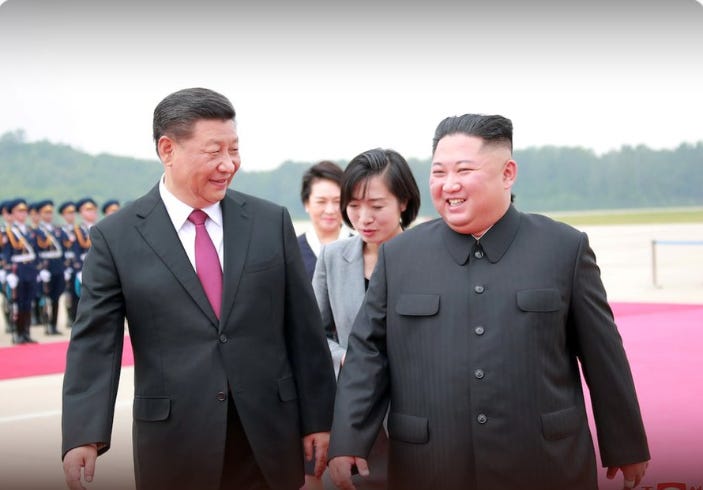
In the opaque theater of Northeast Asian power politics, symbolism often outweighs substance. The Chinese President Xi Jinping’s decision to travel to Pyongyang for a two-day state visit, his first in nearly seven years represents more than a routine diplomatic exchange between “lips and teeth” allies. It is a carefully staged reaffirmation of a relationship strained by sanctions, pandemic isolation, and Pyongyang’s opportunistic pivot toward Moscow.
One must peel back the ceremonial layers to see the deeper strategic undercurrents: dependency, leverage, and the quiet recalibration of influence in a multipolar world where old alliances are being tested by new realities.
Echoes of 2019 turning into the realities of 2026
Xi Jinping last visited Pyongyang in 2019, while Kim was in Beijing last September, joining Russian President Vladimir Putin at a military parade commemorating the 80th anniversary of Imperial Japan’s defeat in World War II. The trip comes weeks after Xi hosted Putin and US President Donald Trump in Beijing in separate high-level meetings.
The timing is telling. Back in 2019, Kim was under intense pressure from maximum-pressure sanctions and collapsing denuclearization talks. China played the role of indispensable patron, offering economic lifelines while urging restraint. Today, the dynamics have inverted in subtle but significant ways. North Korea has weathered isolation through sanctions evasion, deepened military-technical cooperation with Russia which includes troop deployments and arms exports that have reportedly boosted its economy, and enhanced its nuclear and missile programs with defiance. Kim arrives at this summit emboldened, not desperate.
Xi Jinping has just played host to both Putin (May 19-20) and Trump (May 14-15). The contrast in those Beijing summits was stark. With Putin, there were over 40 cooperation agreements spanning trade, technology, and media, talk of ties at “the highest level in history,” and an extension of the 2001 friendship treaty. With Trump, the optics were grand but the deliverables more transactional and understated. They included Boeing aircraft purchases, verbal pledges on soybeans, and relatively muted state media fanfare. These meetings underscored China’s dual-track diplomacy—deepening strategic alignment with Russia while managing a volatile but economically vital relationship with the United States.
Now Xi Jinping is in Pyongyang. This is not just neighborhood maintenance; it is Beijing signaling that it will not cede ground in its traditional sphere, even as North Korea tests the limits of that patronage.
The Enduring “Blood Alliance” and Its Limits
China and North Korea have maintained close party and state ties since the Korean War. Beijing remains Pyongyang’s main economic partner and has repeatedly called for dialogue on the Korean Peninsula, while opposing unilateral sanctions and military pressure.
This relationship is foundational yet asymmetrical and often frustrating for Beijing. China provides the economic oxygen with trade, fuel, and diplomatic cover, that keeps the DPRK afloat. In return, Pyongyang offers a strategic buffer against US-aligned forces in South Korea and Japan, and a persistent thorn in Washington’s side that diverts American attention and resources.
Yet Kim’s regime has never been a pliable client. Its survivalist paranoia, nuclear ambitions, and willingness to play Russia and China off each other have long complicated Beijing’s preference for stability on the peninsula.
Xi Jinping’s visit occurs against a backdrop of North Korean economic stirrings fueled partly by Russian dealings and continued missile advancements. Beijing likely seeks to reassert some measure of influence, perhaps moderating provocations, encouraging dialogue channels, or securing assurances on border stability and refugee flows, while projecting unbreakable socialist solidarity. For Kim, the summit offers legitimacy, potential economic sweeteners, and a hedge against over-reliance on Moscow.
Broader Geopolitical Ripples
This visit cannot be separated from the wider regional mosaic.
The China-Russia-North Korea axis, while not a formal bloc, creates a de facto alignment that complicates US strategy in the Indo-Pacific. Extended friendship treaties, joint military parades, and economic interdependencies form a counterweight to alliances like the US-Japan-South Korea trilateral. Yet beneath the pageantry, fractures exist.
North Korea’s growing autonomy challenges China’s traditional dominance. Economic dependence on Beijing persists, but diversified partnerships reduce leverage. Xi must navigate this without pushing Pyongyang further into Moscow’s embrace or triggering destabilizing escalations.
However, in the grand scheme, Xi Jinping’s Pyongyang journey is classic great-power diplomacy: part nostalgia for revolutionary brotherhood, part pragmatic power balancing, and part theater for domestic and international audiences. It underscores a core truth in regional geopolitics, ideological affinity and historical memory provide the glue, but raw interests and shifting capabilities dictate the dance.
Expect warm embraces at Kim Il Sung Square, toasts to eternal friendship, and vague joint statements on peace and cooperation. The real test will come in follow-through: whether this resets the patron-client equilibrium or merely papers over diverging trajectories in an era of great-power competition.
Northeast Asia remains a powder keg where symbolism buys time, but underlying tectonic shifts, nuclear proliferation, alliance realignments, and economic survivability will shape the next chapter. Xi Jinping’s visit is a pause for recalibration, not a resolution. The peninsula’s volatility endures.
It is a move US President Trump has no answer to.


No comments:
Post a Comment