Murray Hunter
May 31, 2026
North Korea see the QUAD as an existential threat
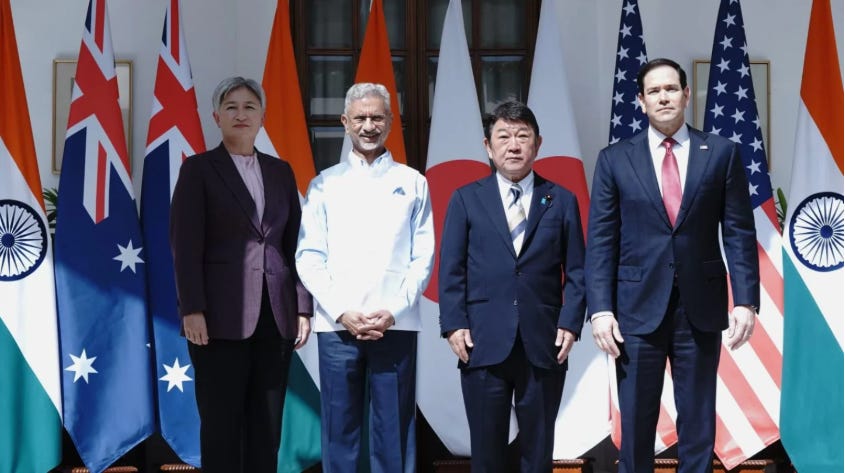
The recent QUAD foreign ministers’ meeting in New Delhi on May 26, 2026, once again highlighted the deepening fault lines across the Asia-Pacific region. While the grouping comprising the United States, Japan, Australia, and India framed its outcomes in the narrative of “peace, stability, and prosperity,” North Korea’s swift response through its Foreign Ministry spokesperson painted a starkly different picture. In Pyongyang’s calculus, the QUAD is not a benign forum for cooperation but a thinly veiled instrument of U.S.-led containment and confrontation.
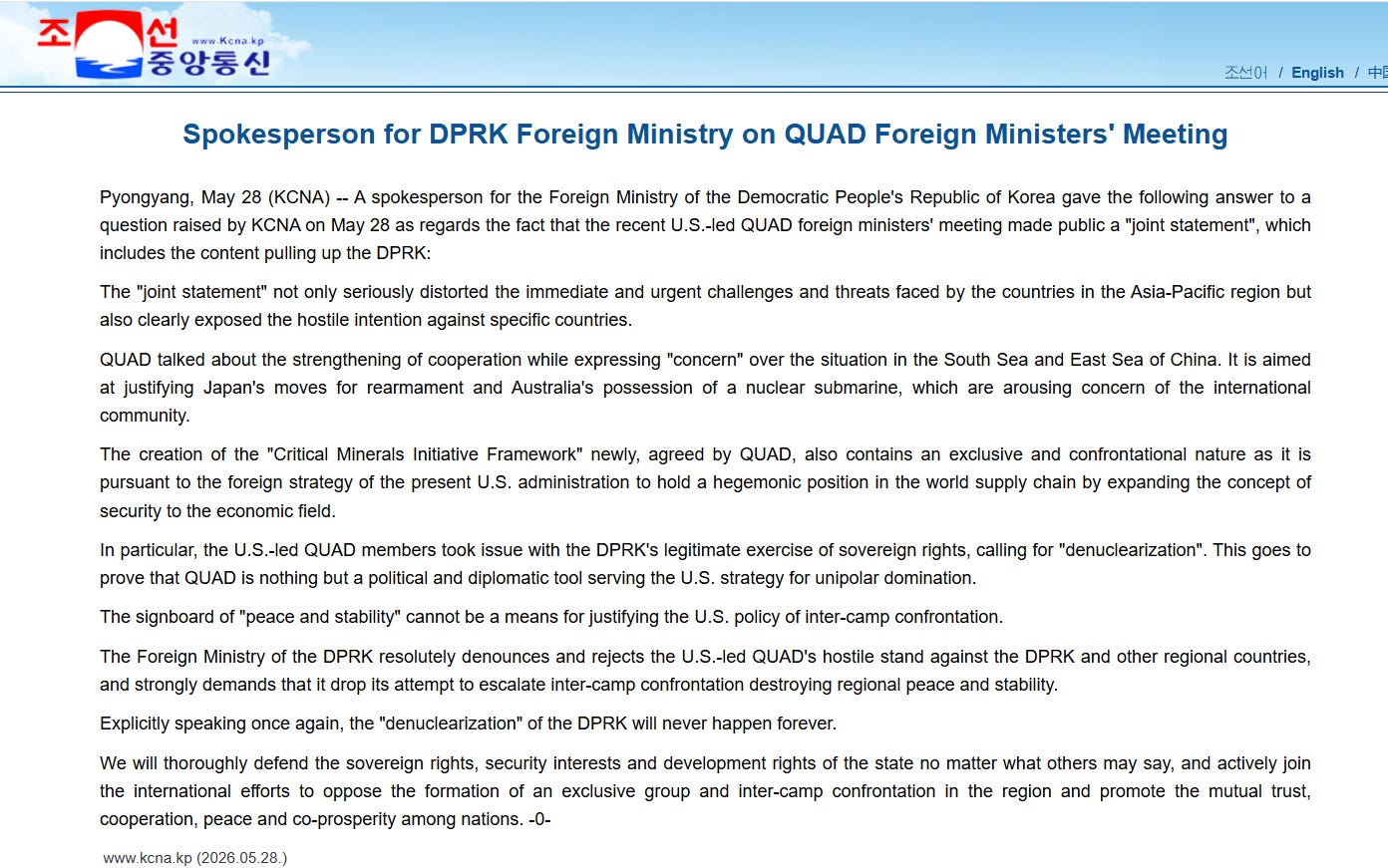
The DPRK’s statement, issued on May 28 via KCNA, minced no words. It accused the QUAD’s joint statement of distorting regional challenges while exposing “hostile intentions” against specific countries. Pyongyang zeroed in on several elements. Firstly, expressions of concern over the South China Sea and East Sea (Yellow Sea), where it sees as cover for Japan’s rearmament and Australia’s nuclear submarine ambitions under AUKUS. The newly announced “Critical Minerals Initiative Framework” drew particular ire as an extension of Washington’s strategy to dominate global supply chains by securitizing economic domains.
Most pointedly, North Korea rejected the QUAD’s calls for its “denuclearization,” viewing this as proof that the forum serves as a diplomatic tool for U.S. unipolar ambitions. “The ‘denuclearization’ of the DPRK will never happen forever,” the spokesperson declared, reaffirming Pyongyang’s commitment to defending its sovereign rights, security, and development interests. The statement positioned the QUAD as an escalator of “inter-camp confrontation,” undermining regional peace under the false banner of stability.
This reaction fits a consistent pattern in North Korean strategic thinking. Isolated and heavily sanctioned, the DPRK perceives any multilateral security architecture not involving it – especially one anchored by its primary adversaries – as inherently aggressive. The QUAD’s growing focus on maritime security, technology, and critical minerals is interpreted not as defensive hedging against broader uncertainties, but as direct pressure on the “axis of resistance” that includes Pyongyang, Beijing, and Moscow.
From an analytical standpoint, Pyongyang’s rhetoric serves multiple purposes. It signals resolve to its domestic audience and allies, while attempting to drive wedges within the region by appealing to those wary of exclusive blocs. In a multipolar Asia, where ASEAN nations often prefer hedging over alignment, North Korea positions itself as a defender of sovereignty against great-power maneuvering.
Yet the QUAD’s evolution reflects genuine anxieties about North Korean missile tests, nuclear advancements, and deepening ties with Russia. The grouping’s initiatives, while framed inclusively, inevitably sharpen geopolitical divides. For Pyongyang, this is existential: any strengthening of the QUAD reinforces the encirclement narrative that justifies its own hardline posture.
As the Indo-Pacific becomes more contested, North Korea’s vocal opposition underscores a core tension. Alliances that enhance deterrence for some are viewed as provocation by others. Whether the QUAD can deliver tangible stability without fueling the very confrontations it seeks to manage remains an open question, especially for Australia. Should Australia engage in such international arrangements that lead to heightening regional tensions? This comes just after AUKUS announced collaborating on building underwater drones for regional defence.
Pyongyang has made its position crystal clear: it will not yield on its core capabilities and stands ready to resist what it sees as a new form of bloc politics. In this volatile theater, perception often drives reality as much as capability does.
***
Motherland was once a leader of the Non-Aligned Bloc, but alas, today she is just a shailok-MAGA acolyte or balls-carrier


No comments:
Post a Comment