
12 hours ago
Bernd Debusmann Jr
White House reporter
Getty Images
US President Donald Trump was swift to declare victory after the second crew member of a F-15 fighter jet downed over Iran was recovered, claiming that the dramatic and successful rescue in Iranian territory "proves, once again, that we have achieved overwhelming air dominance and superiority".
Observers, however, paint a more complicated picture of what this means for the US in Iran.
While the mission was a success, the events of the last few days - in which two aircraft were downed and at least one helicopter was hit by gunfire - highlight that threats to US aircraft and personnel remain even after weeks of heavy US and Israeli strikes against Iran's military infrastructure and boasts from the president that Tehran had "no anti-aircraft equipment" left.
Trump issues expletive-laden threat to Iran over Hormuz Strait blockage
Several Washington sources who spoke to the BBC speculated that the loss of aircraft and the complexity of the operation to recover the pilots could potentially dissuade Trump from any ground operation to take control of Iran's key oil export terminal at Kharg Island and other sites in the Gulf, or to seize highly enriched uranium buried deep underground in Iran.
These operations – scoped by military planners and presented to the president as options – are deeply complex and risk exposing US forces to lingering Iranian capabilities, including difficult-to-find man portable air defence systems, known as Manpads, which are shoulder-launched missiles most effective against low-flying aircraft.
US President Donald Trump was swift to declare victory after the second crew member of a F-15 fighter jet downed over Iran was recovered, claiming that the dramatic and successful rescue in Iranian territory "proves, once again, that we have achieved overwhelming air dominance and superiority".
Observers, however, paint a more complicated picture of what this means for the US in Iran.
While the mission was a success, the events of the last few days - in which two aircraft were downed and at least one helicopter was hit by gunfire - highlight that threats to US aircraft and personnel remain even after weeks of heavy US and Israeli strikes against Iran's military infrastructure and boasts from the president that Tehran had "no anti-aircraft equipment" left.
Trump issues expletive-laden threat to Iran over Hormuz Strait blockage
Several Washington sources who spoke to the BBC speculated that the loss of aircraft and the complexity of the operation to recover the pilots could potentially dissuade Trump from any ground operation to take control of Iran's key oil export terminal at Kharg Island and other sites in the Gulf, or to seize highly enriched uranium buried deep underground in Iran.
These operations – scoped by military planners and presented to the president as options – are deeply complex and risk exposing US forces to lingering Iranian capabilities, including difficult-to-find man portable air defence systems, known as Manpads, which are shoulder-launched missiles most effective against low-flying aircraft.
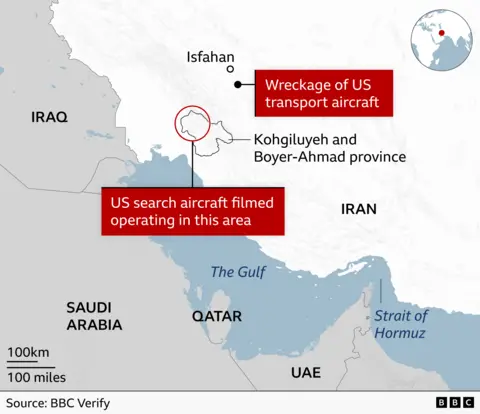
On the other hand, the fact that US troops were able to enter a contested environment, and set up a forward airfield and refuelling point under the nose of the Iranians - then hold it for hours while two stuck aircraft were destroyed and replacements sent - might embolden him.
It could convince the administration that an airborne or amphibious operation against targets in Iran stands a good chance of success.
That message is one that would be heard, loud and clear, by US service members flying over Iranian skies as the conflict goes on, and by those preparing for a potential deployment.
Trump has also has sent mixed messages about the path forward, telling reporters in a series of phone calls on Sunday that he believes a "deal" with Iran could be just around the corner.
If that fails, he has said repeatedly on Truth Social, the clock is ticking on a self-imposed deadline to begin striking Iranian power plants and bridges.
If the Strait of Hormuz was not opened, he posted in an expletive-laden message on Sunday to the Iranian regime, they would be "living in Hell". In a brief phone interview with Fox, Trump also suggested he might move to "take" Iran's oil, without providing further details.
Getty Images
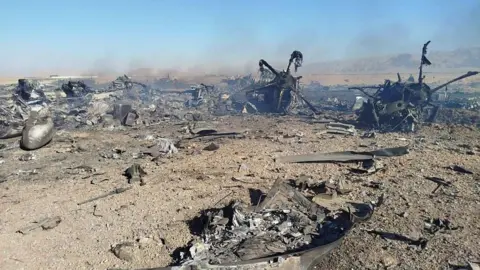
Iranian authorities have claimed a US military helicopter crashed during a mission to rescue the missing crew member
An expanded campaign against Iranian infrastructure and energy targets would represent an escalation, with human rights groups warning of the impact on civilians and potential war crimes.
The president's critics are likely to take it as a sign of Trump's frustration that the US has been unable to secure freedom of navigation in the Strait of Hormuz, a vital global corridor for oil and other commodities.
So far, the president's supporters have rallied behind the administration and its effort to rescue the crew members.
For Trump, the rescue represents a "win" both in the eyes of the public and those inside the US military.
The rescue served to reinforce the administration's willingness to put other Americans in harm's way in an effort to abide by the ethos in the Soldier's Creed that no US service member would be abandoned.
But some - even fervent Maga supporters - have already grown uncomfortable with the prospect of an expensive, messy war with an unclear endgame which could lead to US casualties.
However, the recovery of the two pilots robbed Iran of what would have amounted to a massive propaganda victory.
The sight of US military personnel in Iranian captivity would have very likely become the primary war-related story in the US and hijacked Trump's narrative of a quick, clean victory.
Trump's comments over the weekend stand in contrast to several he made last week, including a televised address on 1 April, in which he suggested that the US had already created the conditions necessary for other countries to engage in the Strait. "Take it, protect it, use it for yourselves," he told allies.
Trump had also recently suggested that he was willing to "leave" Iran even if a deal eluded him.
But he now appears to have shifted course in the hopes that doubling down on the threat of devastating attacks on the country's core infrastructure can prompt Tehran's leadership to come to the table.
An expanded campaign against Iranian infrastructure and energy targets would represent an escalation, with human rights groups warning of the impact on civilians and potential war crimes.
The president's critics are likely to take it as a sign of Trump's frustration that the US has been unable to secure freedom of navigation in the Strait of Hormuz, a vital global corridor for oil and other commodities.
So far, the president's supporters have rallied behind the administration and its effort to rescue the crew members.
For Trump, the rescue represents a "win" both in the eyes of the public and those inside the US military.
The rescue served to reinforce the administration's willingness to put other Americans in harm's way in an effort to abide by the ethos in the Soldier's Creed that no US service member would be abandoned.
But some - even fervent Maga supporters - have already grown uncomfortable with the prospect of an expensive, messy war with an unclear endgame which could lead to US casualties.
However, the recovery of the two pilots robbed Iran of what would have amounted to a massive propaganda victory.
The sight of US military personnel in Iranian captivity would have very likely become the primary war-related story in the US and hijacked Trump's narrative of a quick, clean victory.
Trump's comments over the weekend stand in contrast to several he made last week, including a televised address on 1 April, in which he suggested that the US had already created the conditions necessary for other countries to engage in the Strait. "Take it, protect it, use it for yourselves," he told allies.
Trump had also recently suggested that he was willing to "leave" Iran even if a deal eluded him.
But he now appears to have shifted course in the hopes that doubling down on the threat of devastating attacks on the country's core infrastructure can prompt Tehran's leadership to come to the table.
***
A SAR ops would NOT have involved two special mission C-130s and approx 100 personnel (or more). SAR ops, even combat SAR ops usually require a long range chopper (or even 2, which is unusual) with approx 2 to 3 fighters as cover for the choppers, and involve pinpointing the pilot's location followed by a quick extraction and cabut for home. While landing a C130 at a forward rough airstrip is possible, it would not usually be required for combat SAR, particularly of ONLY one pilot, and in fact would be unduly cumbersome and operationally bothersome.
That's why the wanks frigged up so many aircraft, unbelievably for the supposed rescue of 1 pilot.
I am more inclined to believe the C130s and 100 men (or more) were there to seize the enriched uranium at Isfahan, where the wreckage of the American C130 aircraft are at.


Just declare victory and leave.
ReplyDeleteIn the Vietnam era rescue depicted in the movie BAT 21, eight aircraft were downed and 11 men died in the operation. Over 800 air missions were flown , mainly to neutralise NVA forces who were trying to close in to capture Lieutenant Colonel Iceal Hambleton.
ReplyDeleteA whole battalion (some 800 men)of South Vietnamese forces mounted an offensive towards the area to divert the attention of NVA units.
Years ago I had paid special attention to the story as the movie had been filmed on location in Malaysia.
Movie!
DeletePropaganda tool par excellent