
Survey finds most Malaysian manufacturers favour GST, saying SST’s cascading taxes raise costs and erode competitiveness
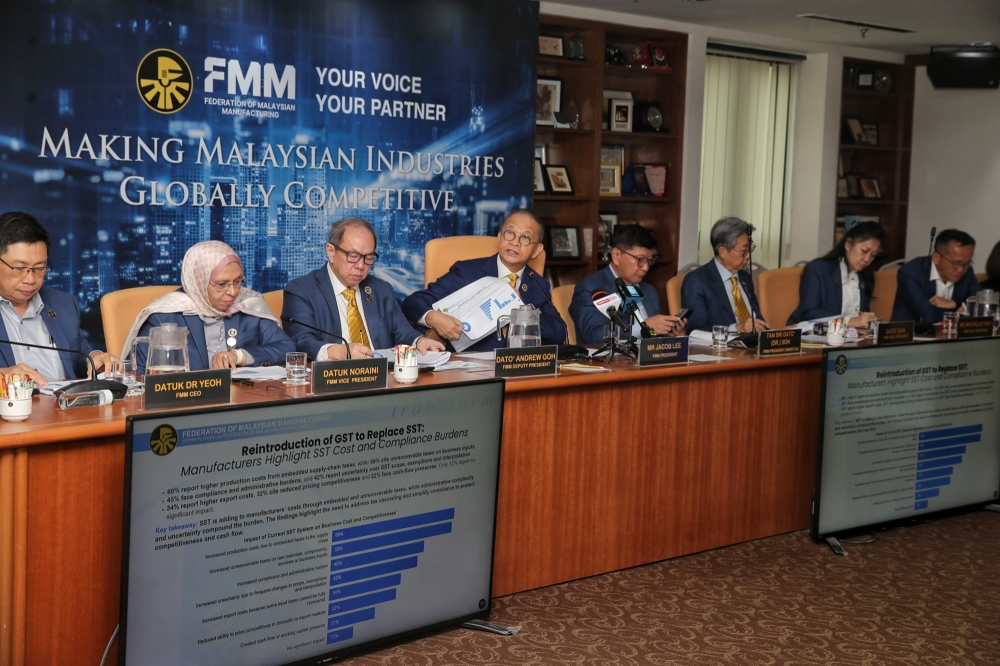
Federation of Malaysian Manufacturers (FMM) president Jacob Lee Chor Kok briefs the media on the survey at Wisma FMM, Bandar Sri Damansara September 3, 2026. — Picture by Choo Choy May
Summary
- A survey by the Federation of Malaysian Manufacturers shows 61% of local manufacturers support returning to GST due to dissatisfaction with the SST system.
- Manufacturers cite embedded taxes and higher production costs under SST as reasons for preferring GST, which offers input tax credit benefits.
- Respondents prefer a GST rate of five per cent or below, with the majority highlighting GST's transparency and administrative advantages over SST.
By Milad Hassandarvish
First Published: Thursday, 03 Sep 2026 2:16 PM MYT
Last Modified: Thursday, 03 Sep 2026 4:18 PM MYT
KUALA LUMPUR, Sept 3 — A new survey by the Federation of Malaysian Manufacturers (FMM) has revealed that a significant majority of local manufacturers are calling for a return to the Goods and Services Tax (GST) system, citing deep-seated concerns over the current Sales and Service Tax (SST) framework.
The findings, released today at Wisma FMM, showed that 61 per cent of respondents back the reintroduction of the GST to replace the existing SST.
The shift in sentiment is driven largely by frustrations over “tax cascading” — a phenomenon where unrecoverable taxes on raw materials and business inputs become embedded in final production costs, ultimately hurting competitiveness.
According to the FMM survey, 60 per cent of manufacturers pointed to higher production costs caused by embedded taxes in the supply chain, while 59 per cent highlighted the issue of unrecoverable taxes on business inputs.
“These findings point to concerns not only over the tax burden but also over the predictability and administrative complexity of the existing system,” said FMM president Jacob Lee.
Compliance and administrative burdens were flagged by 45 per cent of respondents, while 42 per cent reported greater uncertainty due to frequent changes in tax scope, exemptions and interpretation.
According to the findings, the preference for GST appears to be rooted in its design rather than just the tax rate itself.
Some 65 per cent of manufacturers highlighted the GST’s input tax credit mechanism as a major advantage, noting that the current SST structure leaves many businesses with unrecoverable input costs.
Additionally, 52 per cent argued that the GST offers greater transparency than the current system.
On the GST rate, 68 per cent of respondents favoured a rate of five per cent or below, with 41 per cent selecting three per cent as their preferred rate.
Only a small fraction (two per cent) indicated they would be comfortable with a rate exceeding six per cent, while 20 per cent remained unsure.
Lee noted that implementing a systematic input tax credit mechanism would be far more effective than relying on the current fragmented approach of category-specific exemptions and reliefs.


No comments:
Post a Comment