Sunday, September 01, 2024

US has no moral standing to broker peace anywhere, says Santiago


FMT:


US has no moral standing to

broker peace anywhere, says

Santiago

-

Former Klang MP says Washington’s foreign policy is heavily influenced by the Jewish lobby.

2
Shares
Total Views: 19
Free Malaysia Today
Former Klang MP Charles Santiago said the US has always done Israel’s bidding, so it was not shocking to see US ambassador to Malaysia Edgard D Kagan talking about ‘Israel’s security’.

PETALING JAYA
The US has no moral standing to broker peace anywhere because its foreign policy is run by the Jewish lobby that has held US presidents ransom in exchange for political support, says former Klang MP Charles Santiago.

Santiago was responding to US ambassador to Malaysia Edgard D Kagan’s recent interview with Malaysiakini, in which he discussed Washington’s approach to the Gaza conflict.

The US has always done Israel’s bidding so it is not shocking to see Kagan talking about ‘Israel’s security’ despite the fact their tanks and artillery continue to kill children, women and civilians.

Maybe the Jewish lobby money speaks a more powerful language than the destruction and deaths,
 Santiago said.

He added that Israel’s occupation of Palestinian territory had always been violent with an International Court of Justice ruling on this. Many nations have also condemned the ongoing onslaught in Gaza and the West Bank, Santiago added in a statement.

“Kagan should know that conversations cannot start with Oct 7, but by looking at decades of massacres by Israeli forces.

What does he have to say about Israel targeting schools and hospitals? Would he deny that too, as well as Israel’s gross violation of humanitarian law?

The former DAP MP said no US President had been willing to stand up to the grotesque atrocities committed against Palestinians.

The US has vetoed resolutions critical of Israel more than any other council member — 45 times as of Dec 18, 2023,
 he said.

During the Thursday interview, Kagan said it was critical that Israel be part of ceasefire negotiations.

“No one is turning to countries that have a terrible relationship with Israel with an expectation that they would somehow help to reach a ceasefire, so I think the relationship we have is critical.

It reflects a long-standing commitment to our shared values. While I appreciate people are critical of it, we believe this is the best way to achieve the objective of trying to maintain stability and peace, and trying to bring a ceasefire in Gaza,
 he told the portal.

PAS might contest coming Sabah election, says Hadi as state members cross 20,000


PAS might contest coming Sabah election, says Hadi as state members cross 20,000


Hadi (third right), Annuar (second right) and Aliakbar (third left) at the launching of Sabah PAS Convention. — Borneo Post pic

Sunday, 01 Sep 2024 9:06 AM MYT


KOTA KINABALU, Sept 1 — Parti Islam Se-Malaysia (PAS) has not yet decided whether to contest in the upcoming State Election (PRN).

Its president, Tan Sri Abdul Hadi Awang, said the party is considering the views of other parties which are friendly with them.


“PAS will look at the needs of whether or not to contest in the Sabah PRN, depending on the discussion with our party friends, and also depending on the strength of the machinery.

“In the last General Election, PAS did not field any candidate to contest, but this time things may change. Maybe this time we will field candidates,” he said after attending the Sabah PAS Convention at Raia Hotel here on Saturday.


Hadi also said Sabah PAS currently has over 20,000 members statewide, where most of them are in Kota Kinabalu, Tawau and Sandakan.


However, he said decision on candidates for PAS does not depend on the number of members in a party but rather on the support for the candidate, with the cooperation of friends from other parties.

Also present at the event were Sabah PAS commissioner Aliakbar Gulasan and Muafakat Nasional president Tan Sri Annuar Musa. — Borneo Post

Wee brushes off view that MCA can’t help BN regain former glory


FMT:


Wee brushes off view that

MCA can’t help BN regain

former glory

-

The MCA president says the party is used to hearing various opinions about MCA and will carry on serving the people.

7
Shares
Total Views: 1,154
wee ka siong
MCA president Wee Ka Siong greeting party members at the Penang MCA convention held at the UTAR campus in Tanjung Bungah. (Facebook pic)

PETALING JAYA
MCA president Wee Ka Siong has dismissed an analyst’s opinion that the party will be unable to help Barisan Nasional regain dominance at the polls.

Ka Siong said MCA is used to hearing various opinions about the party, adding that it is more important for MCA to focus on winning elections, Utusan Malaysia reported.

I don’t want to say much because we respect the right to freedom of speech,
 he said after opening the Penang MCA convention.

He was responding to the views of analyst Lau Zhe Wei that MCA and MIC cannot do much to help BN regain dominance over the next two or three general elections.

It followed remarks by Umno vice-president Johari Ghani last week that the party would need to go through two or three more general elections before restoring its dominance in national politics.

Ka Siong dismissed criticism of his party saying 

even though at times I have been insulted, it was eventually proven that I was right. At least we understand the pulse of the people
.

MCA has two MPs in the Dewan Rakyat and MIC one, while the BN dominant partner Umno has 26.

MCA’s two seats in the Dewan Rakyat are through Ka Siong (Ayer Hitam) and vice-president Wee Jeck Seng (Tanjung Piai).

Ka Siong said he would carry on and would not stop until the people’s issues are resolved.

In his speech at the convention, Ka Siong said MCA needs to prepare more effectively for the coming elections, including identifying potential candidates who are well-received by voters.

Commentary: Malaysia and the South China Sea dispute - a sea change under PM Anwar Ibrahim?


Commentary: Malaysia and the South China Sea dispute - a sea change under PM Anwar Ibrahim?


Malaysia’s position on the South China Sea dispute vis-a-vis China has remained remarkably consistent, says ISEAS-Yusof Ishak Institute’s Ian Storey.


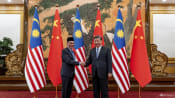
A file photo of Malaysian Prime Minister Anwar Ibrahim. (Photo: Facebook/Anwar Ibrahim)


Ian Storey
31 Aug 2024 06:00AM
(Updated: 31 Aug 2024 06:22AM)


SINGAPORE: According to a recent spate of articles, Malaysian Prime Minister Anwar Ibrahim has recalibrated the country’s foreign policy, giving it a more pro-China and anti-Western slant.

In particular, it has been suggested that Kuala Lumpur has moved closer to China’s position on the South China Sea dispute in stating that the dispute should be resolved among claimant states without the involvement of external parties, and that this could cause problems for Association of Southeast Nations (ASEAN) unity when Malaysia takes over as chairman next year.

In reality, however, the Anwar government’s stance on the maritime dispute remains broadly consistent with that of its predecessors. And for good reason.


BROAD CONSISTENCY SINCE MAHATHIR MOHAMAD


In the early 1990s, under prime minister Mahathir Mohamad, Kuala Lumpur adopted a three-pronged policy towards its overlapping claims with Beijing in the South China Sea.


First, Malaysia seeks to steadfastly assert and defend the country’s territorial claims and sovereign rights inside its exclusive economic zone (EEZ).

Malaysia has deployed military personnel to the five atolls it occupies in the contested Spratly Islands, while the Malaysian navy and coast guard maintain a constant vigil in the country’s EEZ, monitoring, but not challenging, China’s activities. Since 2019, Malaysia has publicly rejected China’s nine-dash line claim, calling it “ridiculous”.

Second, Kuala Lumpur tries hard to decouple the dispute from the country’s vital economic ties with China, its largest trade partner and an important, if sometimes controversial, source of investment.

This is to prevent the dispute from overshadowing bilateral relations - as is currently the case between the Philippines and China - while allowing trade and investment ties to flourish. Malaysia therefore downplays the dispute, remaining quiet about the China Coast Guard’s near-constant presence at Luconia Shoals and its regular harassment of Malaysian drilling rigs and survey ships in its EEZ.

The third prong is to support the ASEAN-China conflict management process - the ongoing negotiations for a Code of Conduct - and promote a peaceful resolution of the dispute through negotiations.

Regarding the latter, Malaysia has consistently dangled the prospect of bilateral talks in front of China, possibly leading to the joint development of hydrocarbons. However, as Kuala Lumpur has exclusive rights to all living and non-living resources within its EEZ, it has never had any serious intention of discussing joint development with Beijing, let alone the sovereignty issue.


Related:


Commentary: The world came dangerously close to full-scale conflict in the South China Sea


Commentary: Malaysia and China mark an important milestone in diplomatic ties


PROTECTING MALAYSIA’S SOVEREIGNTY IN SOUTH CHINA SEA

Since taking office in November 2022, Anwar’s government has adhered to this three-pronged policy.

The Anwar administration has not compromised Malaysia’s territorial claims or sovereign rights in the South China Sea. The state-owned energy company Petronas continues to drill for oil and gas in the country’s EEZ.

On his return from China in April 2023, Anwar told parliament that while Beijing had raised “concerns” about Petronas’ activities, “Malaysia sees the area as Malaysian territory, therefore Petronas will continue its exploration activities there”.

When he added that Malaysia was “open to negotiations” with China, the opposition accused him of being “careless” in his remarks. But as noted earlier, a willingness to hold talks with China over the dispute is a long-standing position, and should be seen as more of a rhetorical device to string Beijing along than a serious commitment to dialogue.

Just in case there was any doubt regarding Malaysia’s position, within days of Anwar’s remark, the foreign ministry quickly followed up with a statement asserting that the government was “unequivocally and firmly committed” to protecting the country’s sovereignty in the South China Sea. In August 2023, China published a new map showing the nine-dash line, which Malaysia roundly rejected.

Nor is there any indication that the Malaysian navy or coast guard has reduced its presence in the country’s waters. Indeed, plans to build a new naval base at Bintulu in Sarawak, facing Petronas’ upstream projects, are proceeding on Anwar’s watch.


Related:


Commentary: How will joining BRICS benefit Malaysia?


Commentary: What one more dash in the South China Sea tells us about China’s game


DOWNPLAYING THE DISPUTE WITH CHINA

In accordance with the second prong, the Anwar administration continues to downplay the dispute with China. In an interview in June, Anwar accused the West of exaggerating tensions in the South China Sea: “Do we have a problem (with China)? Yes. Have we encountered any serious clashes or problems? No.”

In another example, in a recent media interview, the director-general of the National Security Council, Nushirwan bin Zainal Abidin, said that while he would prefer Chinese ships not to loiter in Malaysian waters, their presence should not “colour” bilateral relations and that “We can let sleeping dogs lie”.

A statement by Foreign Minister Mohamad Hasan at the recent ASEAN Ministerial Meeting provoked consternation in some quarters when he said that “issues” within the region should be resolved through dialogue among the countries themselves. His statement was accurate: The Code of Conduct is between ASEAN and China only, and a resolution to the dispute can be achieved only by the disputants themselves. Both China and Malaysia have long agreed on these two points.

Hasan’s comment that any attempt by an ASEAN member to bring in “external influence” to solve its problems will cause “uncertainty” may have been a dig at the Philippines for its tight relationship with the United States.

But Malaysia also has close defence ties with the US and facilitates its military presence in Southeast Asia through regular ship visits and joint exercises, mostly recently in Sabah, which fronts the South China Sea. In contrast, Malaysia’s military ties with China are much thinner.

To be sure, Malaysia has adopted a very different approach to the South China Sea dispute than either Vietnam or the Philippines, and sometimes it appears as if Kuala Lumpur is leaning towards Beijing’s position.

But the three-pronged policy allows Malaysia to maintain close ties with China while asserting its territorial claims and protecting its sovereign rights. Anwar understands this and will not deviate from it.


Ian Storey is a Senior Fellow at ISEAS – Yusof Ishak Institute. This commentary first appeared on the ISEAS-Yusof Ishak Institute's blog, Fulcrum.