Monday, September 02, 2019

With Mahathir there is NO 'new' Malaysia

Makaysiakini:

Rais Hussin is not alone in foretelling Harapan’s downfall

OPINION  |  FRANCIS PAUL SIAH
Published:   |  Modified: 
COMMENT I am amused - very, very amused.
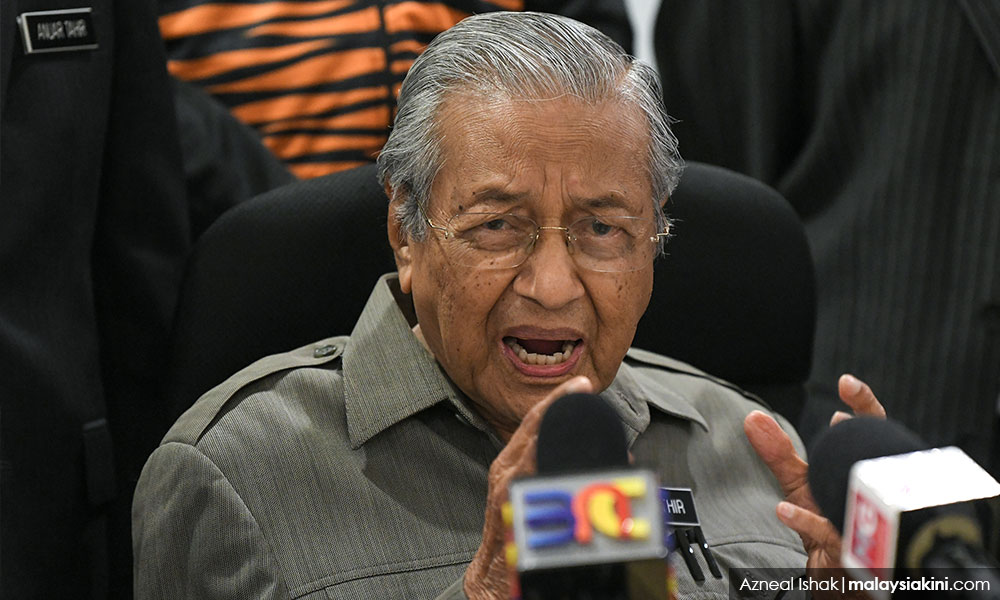
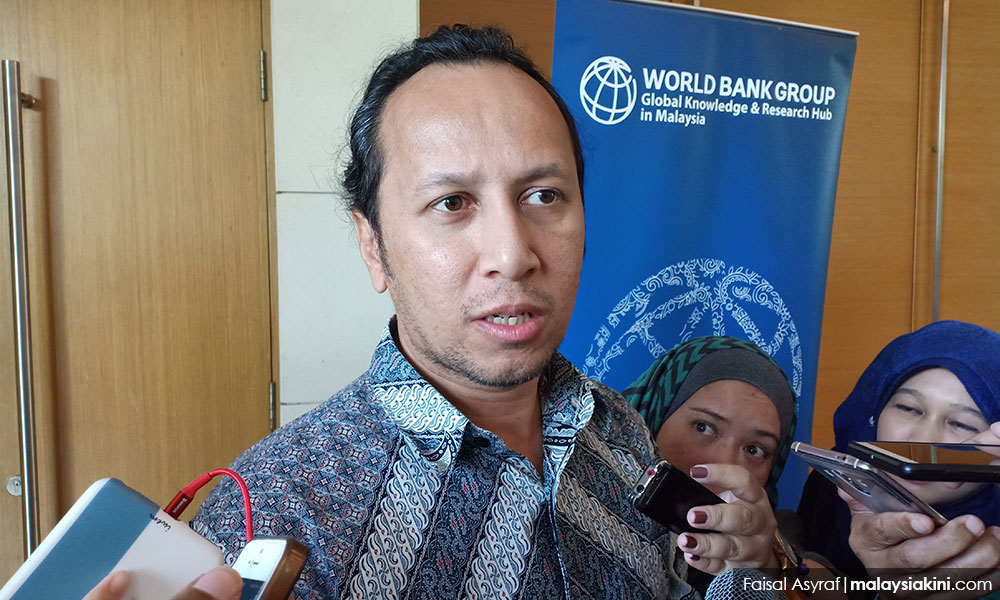
Why? Because our grand old man suddenly turned furious after Rais Hussin (above) commented that Pakatan Harapan would lose if elections were held now.
I find it funny that a simple, harmless remark could have incensed the prime minister in such dramatic fashion that he has to rebuke his party strategist publicly in a room full of reporters.
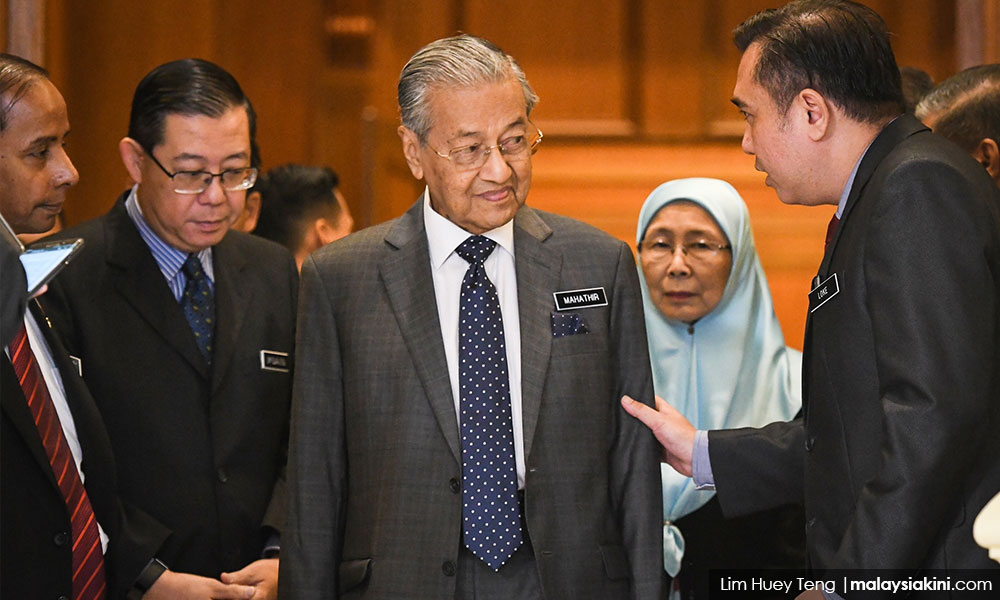
Dr Mahathir Mohamad wanted to rein in Rais, a Bersatu supreme council member, as he felt that party leaders should not talk negatively about the coalition.
Mahathir, the powerful Bersatu boss, said the party would take disciplinary action against Rais for tarnishing the party's image.

What? Is this a joke? I think this is petty and unnecessary. I don’t see how Rais has tarnished the party’s image by saying what he said. Since when is it wrong for someone within Harapan to wake leaders up from their slumber?
Rais is not alone in foretelling Harapan’s downfall. I’ve lost count of DAP veteran Lim Kit Siang’s doomsayer remarks over the past few months.
Other Harapan MPs like PKR's Hassan Abdul Karim and DAP’s Charles Santiago had also waded into the coalition’s problems publicly. But they were never reprimanded.
This is why I find Mahathir’s action funny, even if he was serious about punishing Rais. 
I am amused that Mahathir suddenly noted that his party had not appointed anyone to the post of chief strategist, adding that “this is a self-proclaimed title…there is no such thing."
Rais has been posting his comments regularly with the media quoting him as Bersatu’s chief strategist. Everything was okay previously, until his recent “Harapan will lose” remark.

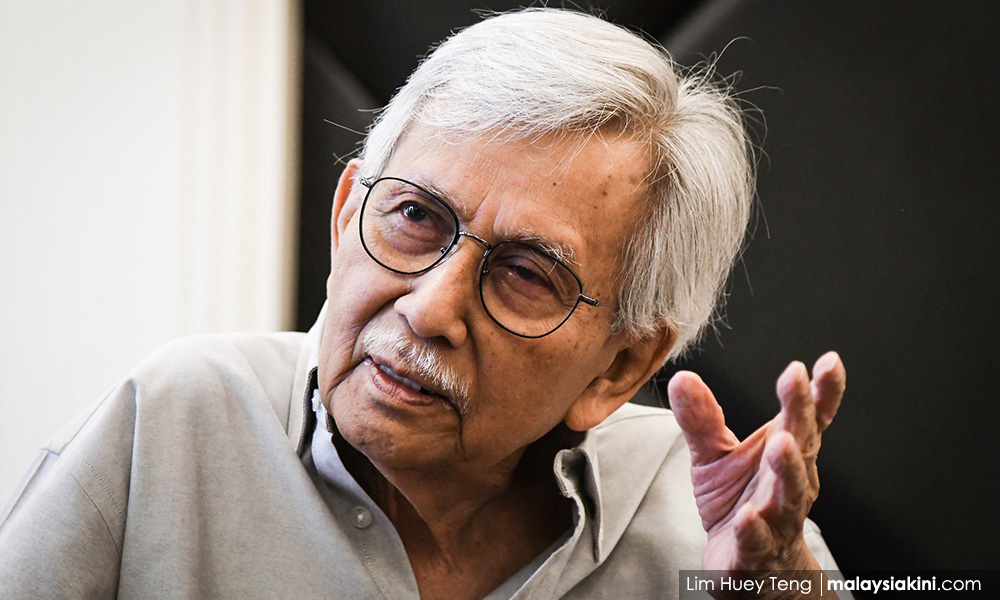
So, is Rais the party’s strategist or not? I must also ask whether Daim Zainuddin (above) is Putrajaya's adviser and whether A Kadir Jasin is Mahathir’s media adviser. Did the prime minister appoint them to such positions?
Or is it because Mahathir had appointed so many people, soon after the euphoric GE14 victory, to positions he cannot remember now?
In Rais’ case, perhaps the Bersatu boss thinks Rais is just an ordinary political consultant whose job is merely to promote the interests of the party and the election of certain candidates.
Mahathir and Rais are probably on different levels with the role of a political strategist. They will have to sort this out, in order to save both men further public embarrassment.
Meantime, Rais should be advised that once you incensed the old man, your political career is as good as kaput.

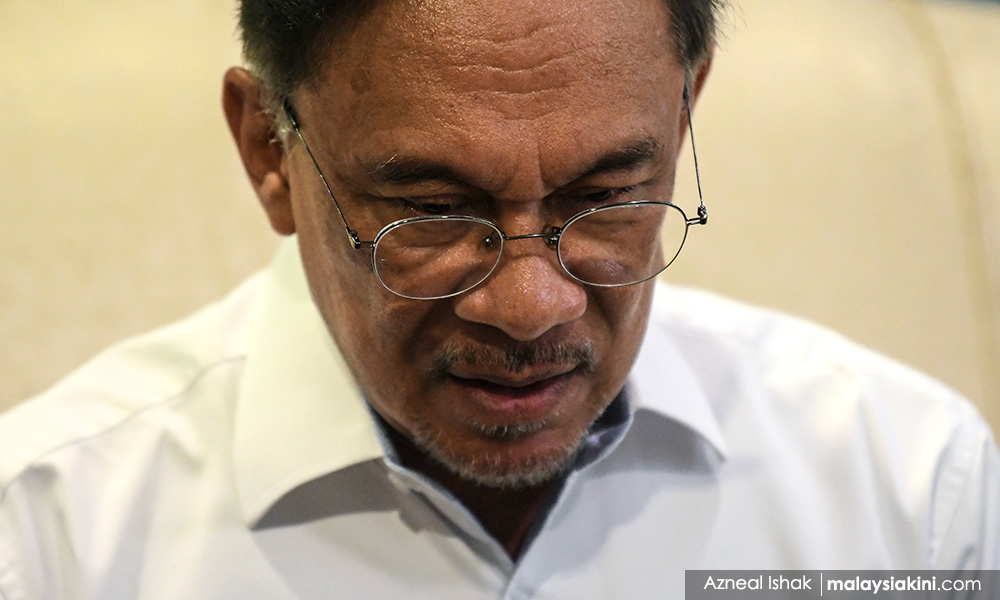
I’m glad PKR president Anwar Ibrahim (above) has declared that his party would not emulate Bersatu in penalising leaders who predict Harapan’s defeat in the next general election.
In fact, I take a little satisfaction in Anwar’s veiled swipe at Mahathir when he said that “in PKR, there is greater democratic space to air views. So no action would be taken against PKR leaders who foretell defeat for Harapan.” Good one, Anwar!
So what about all those doomsayers and their take that Harapan would lose if the elections were held now?
They are not wrong, in my opinion. Signs of a Harapan defeat are pretty glaring. Harapan has made too many missteps.
People will understand if genuine mistakes are made. However, when mistakes are repeated, despite early warning signs, then the situation becomes unbearable. Such mistakes are unforgivable.
Harapan has miscalculated the people’s hopes and aspirations all too often. It seems the people’s support for Harapan in GE14 has been taken for granted. This is the general feeling of Malaysians today.
First, it was about the many unfulfilled promises in the Harapan manifesto. Malaysians were prepared to give the coalition more time to make good on their promises.
As time went by, we found out that Harapan leaders were no different from those we deposed in GE14. They share a similar hobby – politicking.
This is made worse with a former dictator running the show and doing what he has always been most adept at – leading his partners by the nose, suffocating them politically in the process.
Many of his partners and followers choose to keep quiet for fear of losing their exalted positions. Once politicians are in power, what they fear most is losing it. This disease we attempted to cure in GE14 is now back like a plague.
We hear lies and more lies. There is an undermining of public trust in the institution of government and the political process as a whole. Politicians care more for their own respective party in the Harapan coalition than for the people they pledged to serve.
If Harapan leaders are still unable to recognise the disappointment and disillusionment of Malaysians today, then good luck to them.

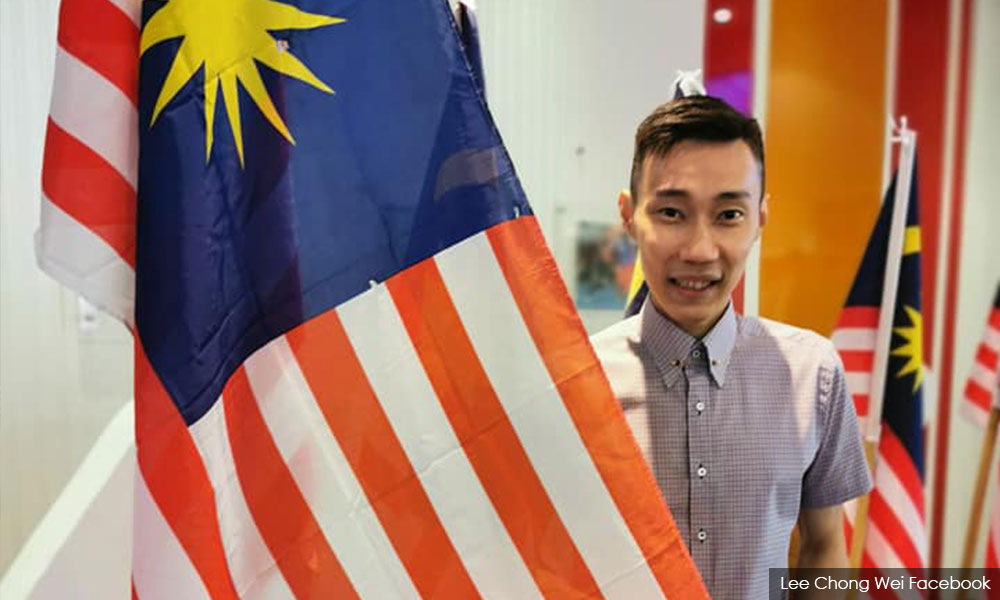
Even retired national shuttler Lee Chong Wei (above) has lamented that “this is not the Malaysia I fought for."
Political parties and coalitions, including Harapan, can lose elections, but the people must always win.
Parties and politicians will come and go, but the interests of the nation and its citizenry must take priority above all other interests.
Every election has to be a people’s victory.
This is the essence of the New Malaysia I envisage. Unfortunately, I have yet to catch a glimpse of it.

FRANCIS PAUL SIAH heads the Movement for Change, Sarawak (MoCS) and can be reached at sirsiah@gmail.com

Econs Minister shows poverty of soul and morality

Malaysiakini:

PM's adviser: Accept reality, poverty is a problem

The prime minister's economic adviser Muhammed Abdul Khalid (above) said it is a fact that the Economic Affairs Ministry's (MEA) yardstick for poverty was outdated.
"We shouldn't feel embarrassed if a new yardstick shows high poverty rates. That is a fact.
"To resolve this problem, we should accept reality. Only then can a solution be conceived," said Muhammed in a commentary published in Sinar Harian today.
The former Khazanah Research Institute director said although the poverty line income (PLI) had reduced from 50 percent since 1957, an absolute measure of poverty can no longer be used.
Muhammed said MEA's adoption of poverty line income (PLI) - defined in absolute terms as a monthly income of RM980 for Peninsular Malaysia, RM1,180 for Sabah and RM1,020 for Sarawak - was unrealistic.
"For comparison, Palestine and Zimbabwe, countries with a GDP size that is one-tenth of Malaysia, has a higher PLI level," said Muhammed.
MEA data also suggested that there are five states (Johor, Malacca, Selangor, Kuala Lumpur and Putrajaya) in Malaysia with zero percent poverty, which Muhammed argued was not true.
"A Unicef and DM Analytics study last year had used the (relative poverty line) which showed that almost every child living in low-cost flats in Kuala Lumpur was in poverty," he said.
Should Malaysia adopt the approach of developed countries - conceiving poverty level, for instance, at 50 percent of median household income - Malaysia's poverty rate would have been 16 percent in 2016, up from 15.6 percent in 2014.


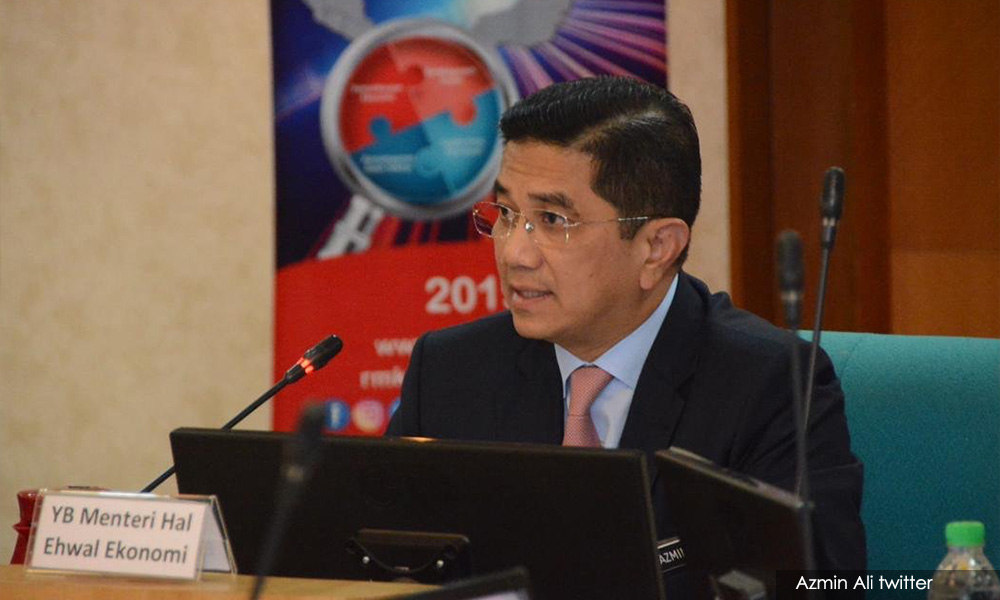
Muhammed was commenting on Economic Affairs Minister Azmin Ali's (above) criticism of claims by UN special rapporteur on extreme poverty and human rights Philip Alston on Malaysia's poverty levels.
Azmin had defended Malaysia's use of PLI to determine poverty levels because it is higher than the USS1.25 (RM5.26) per day PLI targeted by the UN Sustainable Development Goal 1.
He also claimed that Alston's belief that a sizeable portion of Malaysians have limited access to basic needs to be "misconceived" and "lacking empirical evidence".
At a policy level, Muhammed said the government should not only focus on poverty eradication, but address income inequality and social mobility.
"What is important is we face reality - that the yardstick we have been using needs to change.
"If not, we will face poverty of the worst kind - poverty of the soul and morality," he said.

Parti Pribumi - poor imitation of UMNO

Malaysia-Chronicle:

MAHATHIR’S HOUSE OF CARDS STARTS TO TUMBLE : A WINDOW INTO ‘UTTER DISAPPOINTMENT’ BERSATU PRIBUMI – A POOR IMITATION OF UMNO EVEN TO THE MALAYS


When the Parti Pribumi Bersatu Malaysia (BERSATU PRIBUMI) was formed nearly three years ago, many expected that the party will serve as the perfect vehicle for reform-minded politicians to drive the change that is needed to push UMNO out of power. 

While politics along the lines of ethnicity is not everyone’s cup of tea, many Malaysians were willing to compromise the inclusion of BERSATU PRIBUMI into Pakatan Harapan, on the basis that it is comprised of individuals not tainted by the spectre of UMNO.

BERSATU PRIBUMI’s caporegime, Tun Dr Mahathir Mohamad, also proved to be instrumental in garnering the vital support from the Malay hinterlands for Pakatan Harapan.

BERSATU PRIBUMI came into power on the shoulders of Parti Keadilan Rakyat (PKR) and the Democratic Action Party (DAP). Over several months however, they have managed to bolster themselves with party-hoppers and cravens from UMNO, as well as several ministerial portfolios.


Aside from the khat-tastrophic performances of BERSATU PRIBUMI ministers, or lack thereof, many among us also started to notice something.

Today, we see familiar lines and patterns emerging again.

Not more than two weeks ago, news surfaced on the appointment by the Youth and Sports Minister, Syed Saddiq Syed Abdul Rahman, of the 13 members of BERSATU PRIBUMI’s youth wing, ARMADA, as KBS’ state-level officials. Before that, many highlighted the shady structure of his Youth Power Clubs, which is seen by many to only be a vehicle of financing for ARMADA.

Despite positioning himself as the torchbearer of mature politics, it seems that even Syed Saddiq is not entirely devoid of the old UMNO DNA within him.


any difference? 

More importantly, Syed Saddiq mirrors the existence of BERSATU PRIBUMI itself: merely a new packaging of the same old.

Going down a few levels, we also see similar hubris with BERSATU PRIBUMI’s grassroots. Recently, A Kadir Jasin, the staunch mouthpiece of Tun Dr Mahathir Mohamad himself, wrote about how BERSATU PRIBUMI members in Johor should choose their leaders based on his loyalty to the country and BERSATU PRIBUMI’s central command, and not his loyalty to the state he is based in.


Social media was also buzzed recently with an alleged phonecall by BERSATU PRIBUMI Johor’s chairman Mazlan Bujang, who is also the ADUN for Puteri Wangsa, ordering a public official to do his bidding with regards to status of businesses sealed by the state government in Pasir Gudang.

The Osman Sapian debacle that happened not long ago, where BERSATU PRIBUMI and the Johor palace crossed swords over who should be the next Mentri Besar, opened up many windows for us to have a peek into this party.

Within Johor itself, the heartland of Malay politics, BERSATU PRIBUMI make up less than 10 seats in the state assembly. For its members to exhibit such pomposity, with no regards to the local political landscape and the Istana, should remind us of the potential monster we have in our midst.


BERSATU PRIBUMI has repeatedly challenged everyone, from royal families to ordinary Malaysians, when it comes to the way they do things and handle themselves. With Tun Dr Mahathir at its helm, it reeks of the same conceitedness we witnessed during UMNO’s golden days. 

With one exception: it is not nearly as effective and smart as UMNO.


Coming in as a potential replacement to UMNO, BERSATU PRIBUMI unfortunately did not manage to attract the former’s best and brightest into its folds. From people like Mazlan Bujang to the many party hoppers within BERSATU PRIBUMI, we only see arrogant politicians who defected from the status quo when the tides turned.

With many important ministerial portfolios from education to entrepreneurship handed to them, it comes as unsurprising as to why we still have engineering graduates deliver food as their full-time jobs.


On a more personal note, as a Malay voter myself, BERSATU PRIBUMI has been an utter disappointment. Here was the chance for its party members to reform a vital part of the Malay identity, but unfortunately, political survival takes a higher precedence for them over modernising the Malays.

It is high time for this party to realise the thin ice they are treading. It is also high time for us Malaysians to look at BERSATU PRIBUMI for what it really is: a poor imitation of UMNO.

WRITER: Fazrul Muhammad

It's now anarchy in Hong Kong

Star Online:

'How to kill Hong Kong police' and what comes next


Police investigate the scene where an off-duty officer was attacked on Friday night at Kwai Fung MTR station

Photo: Handout/SCMP

I find it deeply troubling that someone just tried to murder a police officer in Hong Kong and hardly anyone seems to be bothered much, as we all move on to the next cycle of news about mass protests and anti-government campaigns.

Three masked men ambushed the 45-year-old officer at Kwai Fong MTR station late on Friday night while he was heading home after work. They knifed him repeatedly in a vicious, cowardly attack, inflicting bone-deep wounds, and fled the scene.


Over more than 12 weeks of relentless guerilla warfare waged against police by rioters, radicals, hooligans, juvenile delinquents and common criminals sheltering under the broader umbrella of a supposedly peaceful people's uprising, frontline officers have been felled by bricks, burned by petrol bombs and acid, beaten unconscious with sticks and metal rods, stabbed with spears, and hit by ball bearings fired from catapults.

But the attempted murder of this policeman takes it to a whole new level. If the perpetrators are indeed part of the protest movement, it's terrifying that they no longer feel the need to be confined by its narrative. No heat-of-the-moment violence here – just calculated, cold-blooded crime.


And if the culprits turn out to be triad gangsters disguised as protesters to settle old scores, the wider implications for law and order are just as terrifying.


None of this should come as a surprise, really. Just look at all the hate forums online, particularly LIHKG, Hong Kong's version of Reddit, with page after page of discussion threads and tutorials on how to maim and kill police officers, when and where to lie in wait for them, what weapons to use. It's all there, in plain sight, and absolutely nothing is being done to muzzle it because any attempt to shut it down feeds right into the mass hysteria about repression and diminishing freedoms here. Our government is too timid to bite the bullet.


Look at every police station and government office across Hong Kong these days, barricaded like Masada under perpetual siege, because they're such magnets for arson attacks and vandalism.

Have you noticed you hardly see police officers around the city any more? That's because they've suspended foot patrols and scaled down regular policing. Can you blame them? Warriors of freedom have been openly discussing plans over the popular messaging app Telegram to ambush officers by luring them into traps with fake emergency calls.


So great is the hatred against the 31,000-strong police force, so deep the animosity, that officers are handing out rape alarms to their children to protect them from bullying and physical assaults when they return to school for the new academic year.

As I write this, I'm watching television footage of our police officers in action right now, battling another rabid mob baying for their blood. Their dinky little shields and batons seem as ineffective as their pepper spray and tear gas against the alarmingly expanding arsenal of makeshift and real weapons that protesters are armed with.


How much longer can police keep this up and hold the line while our government cowers behind them and makes little bleating sounds about not tolerating violence while doing exactly that? After three months of carnage and anarchy, there is no hint of a political solution to a crippling crisis that the government itself started, no whiff of a remedy, only whiny, pathetic rhetoric.

We all know what comes next if our police force is defeated in this great "revolution of our times". Beijing is making no bones about the nuclear option of deploying Chinese troops in the city, and yet the message from the rioters is, "Bring it on."


"If we burn, you burn with us," they keep telling the rest of us. This is going to be one inferno that those shiny, new, police water-cannon trucks will not be able to put out. Talk about a damp squib.


The Merdeka of (and not from) Fear

Malaysiakini:

62nd Merdeka – 'New Malaysia' is a fiction

OPINION  |  S THAYAPARAN
Published:   |  Modified: 
"It was the best of times, it was the worst of times. 
"Mahathir is PM. There's disunity in the nation. People are wary of their future and the economy.
"I'm chugging beers while listening to the Blues Gang sing 'Apo Nak Di Kato' live.
"In 1989 as it is in 2019." 
– An astute Twitter post
COMMENT | Merdeka this year is especially disheartening. You would think that the way Pakatan Harapan political operatives talk about this “New Malaysia”, they would have something to show for it. 
Finance Minister Lim Guan Eng talks about how the greatest challenge facing the Harapan government is the lies and slander perpetuated by its opponents.
“The people have nothing to gain by following those who preach national division through racial and religious extremism,“ he proclaimed while ignoring the reality that the biggest proponents of race and religion-based dialectic is the party with the smallest numbers but which control the levers of power enabled by non-Malay powerbrokers who just want to hold on to power.
Seriously, these kind of lies and slander rhetoric are the stratagems Harapan used when they were the opposition in all its incarnations. Move on. The greatest obstacle to a "New Malaysia" is the reality that Harapan political operatives lack the will, imagination and the cojones to carry out the reforms that they promised their base would “save Malaysia”.
Contrast Lim’s Merdeka message with that of PSM leader S Arutchelvan’s piece on wage inequality. What I like about the piece is that it is about the rakyat or at least that demographic of the rakyat which nobody seems interested in. It was not about maintaining political power but rather about how a certain section of Malaysians live. We often forget about that. If this isn't a great way to acknowledge Merdeka, I do not know what is.
"New Malaysia" is a fiction. A lie created by political operatives who have no interest in genuine reform but who coast on the propaganda that they need more time. If you are someone who rejects racial and religious politics, you are someone who has no time. The demographics and social policies are against you.


Forget about the backtracking, the lies, the racial and religious provocations (carried out by this regime), the substandard ministers, the inept policies, the rhetoric designed to mislead the rakyat, the cowardice of the non-Malay political wing, the mendacity of the Malay wing, or the hubris of the main power players in Harapan.
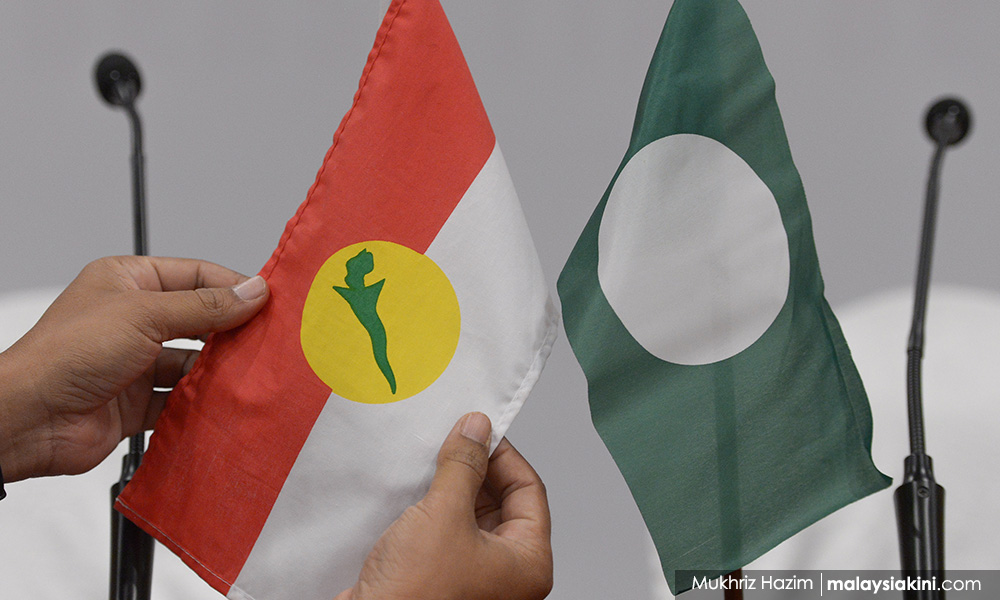
Forget about all that and just think about how the base is expected to fall into line because Umno/PAS may come back to power. This is what Merdeka is about this year - fear.
Fear that the Umno/PAS combo will return. Fear that if we push out the Harapan government even though they were carrying out the agenda of Umno/PAS, we will regret the day we decided to abandon Harapan. Fear that the lies and slanders will destroy the coalition because the reality that lack of political will is what is destroying Harapan isverboten in this "New Malaysia" doublespeak.
Fear that Mahathir, the grand poobah, is attempting to destroy DAP and Harapan when the reality is that political operatives in Harapan are not carrying out their duties and more importantly, their campaign promise to constrain the political power of the prime minister when it comes to policy and the direction of this country.
The only people who are not afraid are the racial and religious far right. What have they got to be afraid about? 
They have the machinations of Harapan political operatives which would keep the racial and religious ideological foundations of this country intact. They have non-Malay political operatives who are afraid to stand up for issues that are a threat to national security and policies which would ensure that we remain a competitive and a viable economy in this fast-changing geopolitical landscape.
For them, Merdeka this year is pretty awesome. They lost power but they are in a far better position because the ruling government is mired in internecine conflicts and has no genuine political will to carry out reforms which would diminish their social, religious and political power. This is truly a great Merdeka for them.
But if you are someone who has not drunk the Kool-Aid or at least someone who is white-knuckling it after swearing off the Kool-Aid, you may have come to the realisation that these people who promised you – us – a new deal, really want to give you back the old deal without the Najib family. 


The old maverick is wondering why Umno is still around. Really? Isn’t Bersatu merely an echo of our past attempting to take form as Sauron after his fall? 
I spoke to an MCA political operative the other day who funnily enough had some sympathy for DAP. “Now they understand what it is like being in the federal government,” he said over a cup of coffee in a shabby part of Kuala Lumpur. The kind of place that was something back in the go-go days of the first Mahathir era. It was oddly disconcerting to have this conversation because it seemed like deja vu.
“I am out of the game now, Thaya. It will be interesting to see how long they last but I think they should put up a fight. The problem is that we (the MCA) laid everything at the old man’s doorstep. We should have fought because that is what the Chinese voted us in for. I don’t mean this in a racial way but rather we should have fought for everyone who believed in a secular Malaysia. Look, even Malay leaders understand that race-based policies lead nowhere.”
I told him that he could still fight the good fight but he said that there are young people who should do the resisting now.
Make no mistake about it. I do not find it hard to love this country. Contrary to what people think, I think that this is a great place to live in. But I am old so when I define this country, I define it in terms of lost opportunities. I hope young Malaysians still define this country as to what is possible.
Maybe Merdeka this year is for the young people. The people who could really save this country we all love. You see, we never really needed a "new Malaysia". All we needed was a Malaysia whose political operatives - and the people who voted for them - learnt from past mistakes.
Happy Merdeka, Malaysia - whoever you are.

Sunday, September 01, 2019

Mahathir's Ketuanan Melayu shaped by adverse U-experience & self pity?

Malaysiakini:

Something going amiss as nation celebrates 62nd Merdeka

Dr Boo Cheng Hau  |  Published: 
LETTER | Why should non-Malays feel uptight about the introduction of khat or Jawi calligraphy in the vernacular schools? On the other hand, why should Malays feel offended by the crosses hanging out at churches? There is something going amiss even in the eve of celebrating 62nd National Day. 
There seems to be little trust, by non-Malays including not only Chinese and Indian Malaysian, but also East Malaysian non-Muslim natives, in a Malay dominant administration that is based upon Malay supremacy propagated by Biro Tata Negara, a governmental body that functions with an unconstitutional, Malay Muslim-dominant ideology founded during Mahathir's first tenure as the country’s premier in the 1980s while civic education emphasising citizen’s rights and duties was literally scrapped from the school syllabus.
For nationalism to be progressive and productive, it has to be outward-looking and progressing with times. There would never be true national unity if a single-race dominance is a foundation for multiethnic Malaysia.
A single-race dominance has been proven failed to unite any multiethnic countries, including a state ideology based on nativism or bumiputeraism of a single race that is not necessarily the first settlers but developed the first “civilised government” (the term coined by white apartheid regime) or the first “definitive government” (the term coined by Dr Mahathir Mohamad in The Malay Dilemma), meaning a single- dominant “race” has the absolute power to dictate others’ citizenry status as to who is native and who is not. In other words, Orang Asli have no constitutional position to be considered natives or bumiputera.
Today at the eve of 62nd National Day, this unconstitutional ideology of dividing citizenry into native and non-native still divides and rules the country of many ethnic groups.
Just how similarly all these terms in the name of a single race-dominant nationalisms coincide with one and another in propagating racial dominance and “privileged”. Racial dominance is lacking any moral consistency. But, how does one, who believes in Malay-Islamic supremacy or Ketuanan Melayu in administering Malaysia or Tanah Melayu (Malay’s Homeland), respond with a moral consistency in regards to Thai dominance in resolving minority Malay Muslims rights in Southern “Thai-land”?
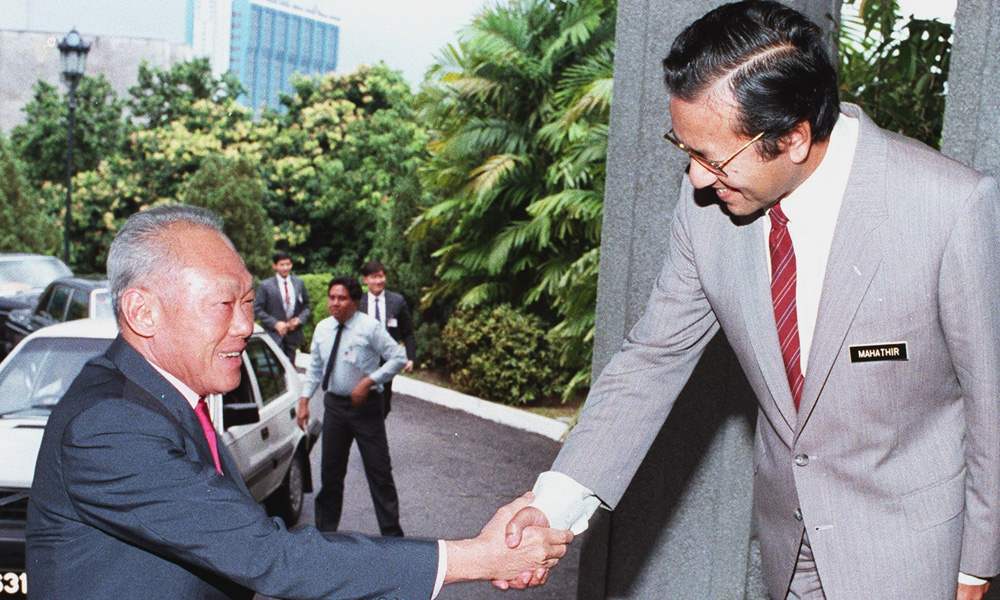
Similarly, Lee Kuan Yew provided narratives, in a very much self-pity gesture, for Singapore’s separation from Malaysia. He described Singapore, to the effect, like a little ship being swamped by a sea of Malay Muslims. Forgetting his narrative of Malaysian Malaysia, Lee came close to equating Singapore with Israel that was mainly for the political expediency of creating a new “Singapore Nation”, according to Michael D Barr, that was pretty much based on Lee’s personal racial view of Chinese (East Asian) cultural superiority. Contradictorily, Lee was more an observer of Anglo-Saxon superiority that was common among the immediate post-colonial leaders of the third world.
As Lee and Mahathir had been known for their opposing views in terms of Malaysian nation-building when they were parliamentarians in Malaysian parliament, one might have been surprised that Lee was quoted to have agreed with “three-quarters” of what Mahathir’s analysis in The Malay Dilemma pertaining to Malay’s cultural and genetic inferiority along the “racial hierarchy”. 
Mahathir’s Malay supremacism is also based on pretty much of self-pity and erroneous, unscientific analysis, leading to Malay supremacist nationalism. His brand of Malay supremacist nationalism is regressive and faulty, but it has only been for a single purpose in which Malay ruling elites could claim almost absolute commands over the Malay masses who often had to pledge total loyalty to their leaders even though their leaders committed wrongs.
Malays’ tolerance towards corrupted leaders has been cultivated under this mindset to maintain the “Malay sovereignty”. If not for the rhetoric of maintaining the “Malay sovereignty and dominance” in government, from 2008 until 2018 general elections, Malay voters have voted in a typical bell-shaped curve pattern, which is quite reflective of how ordinary voting pattern would be in a mature democracy. 
We should thank the reform movement brought about by Anwar Ibrahim and PKR, which has been a successful Malay-majority multicultural political party to the envies of many. It also represents the true hope for the future hope of democracy in the majority rule but a big no to both racial dominance by either the majority or a minority.
Isn’t it a sort of Stockholm Syndrome?
Isn’t it a sort of Stockholm Syndrome in believing that there would not have been any change of government without Mahathir’s leadership and race-based Bersatu  in 2018 general elections? As the longest-serving prime minister, Mahathir had spread his influence throughout three to four generations of Malaysians, and his world views have lied down the deeply ingrained political culture and racially addictive policies of “Malay sovereignty and dominance”. After 62 years of independence, it seems we have no better dose of medicine than the addiction of Malay supremacism.
Like Lee who actually admired “three-quarters“ of Mahathir’s unscientific and negative assessment of Malays themselves explicitly expressed in The Malay Dilemma, both Lee and Mahathir, whose yesteryears’ political animosity has actually been more of complementary to each nation’s political expediency, had wrongfully adopted Charles Murray and Richard Herrnstein's bell-shaped curve theory, that reflects the normal distribution of racial hierarchy and intelligence within a race/society, to justify their elitist rule whereas the smartest know the best for their more inferior community.

Generalising all Malays of lower competence in business and professional fields not only has been proven wrong, but it has been used as rhetoric to consolidate the Malay elite ruling class’ power and to further sustain an oligarchy economy.
In real-time, an ethnic group and a people’s socio-economic status advances in relation greatly to the availability of education, effective public and private administrations, social justice and social mobility. The majority of Malays have progressed not due to the reserved ‘privileges’ in getting government contracts and GLC posts for the few elitists, but the general policies of industrialisation, urbanisation and uplifting of education standards. 
This is evidenced by the similar ratio of Malay to non-Malay average household income has stood the same before and after the implementation of the NEP. The same ratio is also applied to Malay and non-Malay in Singapore city-state. Nonetheless, the income disparity widened when most Malays used to live in rural areas, and the income gaps have narrowed when more Malays move, live and work in the urban areas.
Malay nationalist economy, cronyism, nepotism and corruption
The Malay-centric New Economic Policy was once carried out in a noble mission to restructure the socioeconomic disparity and eradicate poverty. Nonetheless, its shortcomings had appeared, but they were carried on with the New National Policy that also created an acute disparity in wealth distribution and new class conflicts between rich and poor Malaysians, of which Malays are no exception to this. 
The Malay Nationalist Economic model under the National Economic Policy by privatising government assets and operations to elitists by which it has cultivated cronyism, nepotism and corruption. Among many unresolved scandals, the 1MDB scandal was just the tip of the iceberg of an ailing race-based nationalist economic model.
Even after Pakatan Harapan’s takeover of the government, the old regime remains pretty much intact.
A preferential socio-economic policy could be either the need-based affirmative action or the race-based apartheid. Affirmative action was never meant to be race-based, as Martin Luther King Jr articulated that it was for all poor Americans regardless of their colour. 
And US Supreme Court has over the years rendered race-based quotas as unconstitutional whereas merits must precede racial categorisation. That means besides disadvantaged ethnic minorities, disadvantaged white Americans have too benefited from affirmative action.
The African-American scholar Orlando Patterson concludes recently that the benefits of affirmative action (in university admissions) “promote (if indirectly) a heterogeneous professional elite” and “in conjunction with anti-discrimination laws, it has directly fostered the growth of an African-American and Latino middle class”. 
Nonetheless, the non-racial labour law, anti-discrimination law, availability and upgrading of vocational education, creation of job opportunities, accessibility to social security and housing are far more effective in uplifting the socio-economic status of any community. Unlike apartheid and NEP, Affirmative action was never meant to cultivate the crony elite class of a particular race.
In the Malaysian context, it must be alarmed that affirmative action is never based on race, native status nor racial supremacy or racial hierarchy. Any preferential socio-economic policies based on race, ancestry or bumiputera/native status could draw similar justifications for Afrikaner’s apartheid to Mahathir’s Malay supremacy despite the fact that it is unconstitutional under the Federal Constitution.
Mahathir has admitted to his own personal unpleasant racial treatment in Singapore as a medical student. But one’s own adverse experience with racism does not justify the repercussion with institutionalised racism, that has been engineered by Mahathir and practiced by Umno-dominant BN to the present Bersatu. 
Many has chosen to blindfold the fact that Bersatu and Mahathir made it clear that its mission is to “save Malays and Umno”. It seems more natural that Umno and Bersatu will remerge for their common propaganda in great contrast to all the other component parties of DAP, PKR and Amanah, which propagate New Malaysia of one nation and one people than separate nationalisms under the umbrella of Malay nationalist dominance.

Pakatan Harapan leaders are pretty much in denial of the true reasons for many U-turns they have made since their victory at GE-14. Harapan is like a cart pulled by three horses going in a single forward direction with an old warhorse keep turning on its right to make U-turns. 
Its own unnatural combination of contrasting ideological values between Bersatu and other component parties threatens not only the survival of Harapan but bleak the actual creation of bi-coalition democracy in Malaysia. 
The weird composition of Harapan has practically destroyed than achieved a genuine bi-coalition democracy. The actual threat to the creation New Malaysia lies in the Harapan’s own closet- that is the undying single-race supremacist ideology not only has failed to unite our nation and to create a New Malaysia, but it would also potentially create more problems by breaking the nation apart.


Interestingly, some Malays view themselves as the “Englishmen of the East”, a sort of Anglo-Saxon – like superiority among themselves in governing the Federation of Malaysia with the Malay majority dominant nationalism. 
The dominant English nationalism, that has ruled Great Britain for centuries, has almost come to the verge of a total break-up following the passage of a referendum on Brexit. Had there been a predominantly Anglo-Saxon nationalist movement to leave the EU, likewise, there would be reciprocal Scottish, Irish and Welsh nationalisms.
Similarly, a single-race dominant Malay nationalism has been the actual threat to a genuine Malaysian unity as reciprocal, separate Chinese, Indian, Sabah and Sarawak nationalisms will rise and break the nation apart. 
The culprits are none but the Malay supremacists. The solution is none but lies in a common belief in all-Malaysian nationalism whereas all Malaysians are born, raised and treated equally by the state.
Happy National Day and the upcoming Malaysia Day.

Dr Boo Cheng Hau is the former assemblyperson for Skudai
Lynas - Mahathir sucking up to Japan?

TMI:


Is it worth having Lynas in Malaysia?


Is it worth having Lynas in Malaysia?

According to one of the chief defenders of the Lynas facility, Minister of Entrepreneur Development Mohd Redzuan Yusof, of flying car fame, he commented that Lynas’s investment was “too big to ignore”.


Malaysian flying car "... made in Japan"?

wakakaka


It is unfortunate then that a minister, catapulted into power by the people no less, is willing to prostitute the health and safety of Malaysians in the name of money.

For Redzuan, nothing is sacred – he is even willing to bring in the race card to defend Lynas, stating that there is “already significant Bumiputera participation in rare earth processing through Lynas, where more than 90% of the staff are Malays”.

Even Prime Minister Dr Mahathir Mohamad is fiercely defensive towards the continued operation of the facility.

Despite increased public outcry, Dr Mahathir dismissed the concerns about Lynas – going as far to compare it to the Chernobyl disaster of 1989 – stating that the dangers posed by the facilities far dwarfs those posed by the infamous nuclear incident.

Suddenly, it seems everything is at risk when it comes to Lynas, from good relations with Australia and Japan, the billions in supposed new investments and the Bumiputera agenda.

Unfortunately, isn’t the first time that Malaysia – and Dr Mahathir himself – has faced a problem with radioactive rare earth.

The Asia Rare Earth Sdn Bhd (ARE, a company owned by Mitsubishi Chemicals) incident in Bukit Merah, Perak, during the 1980s, which involved rare earth and radioactive waste is surprisingly rarely mentioned.


when once Malaysia had sucked up to Japan 

The aftereffects of the ARE facility are still felt today, despite more than RM300 million spent cleaning up its waste.

It is estimated that Bukit Merah community will have one case of leukaemia every three years as a result of radioactivity.


So why is Lynas so important for the Pakatan Harapan government?

Environmental concerns notwithstanding, the Lynas plant plays a crucial role in the global rare earths supply chain – an important resource for everyday electronics such as smartphones and lightbulbs.

With China possessing a near-monopoly on global rare earth processing capacity, you might assume that Dr Mahathir is attempting to raise Malaysia’s international standing.

Japan, which is one of the world’s key importers of rare earth materials, is a major financial backer of Lynas (given the recent announcement that Lynas would supply Japan 7,200 tonnes of rare earths a year until 2038) and is also seen as being actively involved in lobbying for the corporation.


Surely it cannot be pure coincidence that Dr Mahathir gave his unconditional support for Lynas to continue to operate in Malaysia during a recent visit to Tokyo.

However, this is not worth the 50,000 to 70,000 lives that may be affected if any environmental catastrophe occurs at the Lynas facility.

Aside from serving as a chess piece in the game of global powers, what actual benefits does this facility provide the government?

Will foreign governments suddenly see Malaysia as a key player in global politics – just because we are willing to let foreign countries store waste that even the most developed countries refuse to take up?

If we are really serious about foreign investment, surely there are better initiatives that are worth considering? How about Iskandar Malaysia and Forest City?


Its economic benefits are also considerable, and at least do not deal with toxic waste.

There is a significant presence of foreign companies, with Singapore being the largest investor in Iskandar Malaysia followed by the United States, Spain, Japan and China.

It also potentially will serve as a key growth region for the state, and through Forest City – it already provides jobs for more than 1,350 local families and is set to provide more than 220,000 job opportunities in 2035.

The government cannot afford to compromise on the issue of toxic waste. This is the chance for the government to prove that it can put vested interests aside for the sake of the health and safety of the Malaysian people.

There is no need for another Pasir Gudang.


* Shafiq Abdullah reads The Malaysian Insight


racists and Lynas