
Murray Hunter
The Coming General Election Is Really Just a Hobson’s Choice
13 hours ago
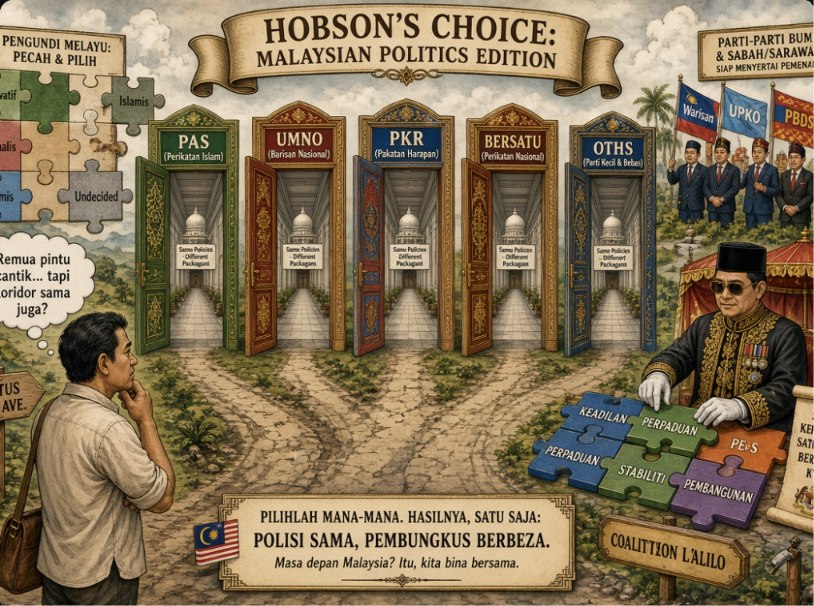
A Hobson’s choice is a free choice in which only one option is actually offered. As a consequence, you take what is presented or you take nothing at all. That is the reality of politics in Malaysia today.
No matter which party or coalition you vote for, a coalition-of-the-unwilling will almost certainly form after the election and continue implementing essentially the same set of policies.
History has repeatedly confirmed this pattern. The forces surrounding power and government in Malaysia ensure that drastic policy shifts remain rare, even if the window dressing changes. The continuity is structural rather than accidental.
On the Peninsula, the Malay vote has polarised into two broad camps, one of which has been repeatedly weakened by internal splits. In the north and on the east coast, PAS functions as far more than a conventional political party. Rather, it is a deep-rooted community movement that absorbs the bulk of Malay support. UMNO, by contrast, has practised a politics of division and infighting that has fractured it into multiple parties—an outcome not unlike the fractures seen in many Malay families.
Former UMNO members now populate PKR, Bersatu, and newer vehicles such as Wawasan. This fragmentation produces hung parliaments in which the Federal Constitution leaves it to the Yang di-Pertuan Agong to help fashion a stable government from among these parties in one configuration or another.
Until now, East Malaysian parties have largely tagged onto the eventual winner and joined the governing coalition.
That is why Malaysian politics remains a Hobson’s choice. Voters may cast their ballots believing their choice can make a decisive difference, yet the probable outcome is clear: a new government that pursues substantially the same policies, merely packaged differently.
There are advantages to this continuity. Economic and foreign policies remain relatively stable, as do the residual frameworks of the New Economic Policy. The disadvantage is equally clear: genuine reformers are systematically constrained in their ability to advance a deeper reformasi agenda.
This is the structural reality of Malaysia today.


No comments:
Post a Comment