
Malaysia's #1 Content Aggregator
OPINION | Mahathir’s Malay Unity Rhetoric: The Man Who Split Malay Politics Now Warns of Malay Collapse?
18 May 2026 • 12:00 PM MYT

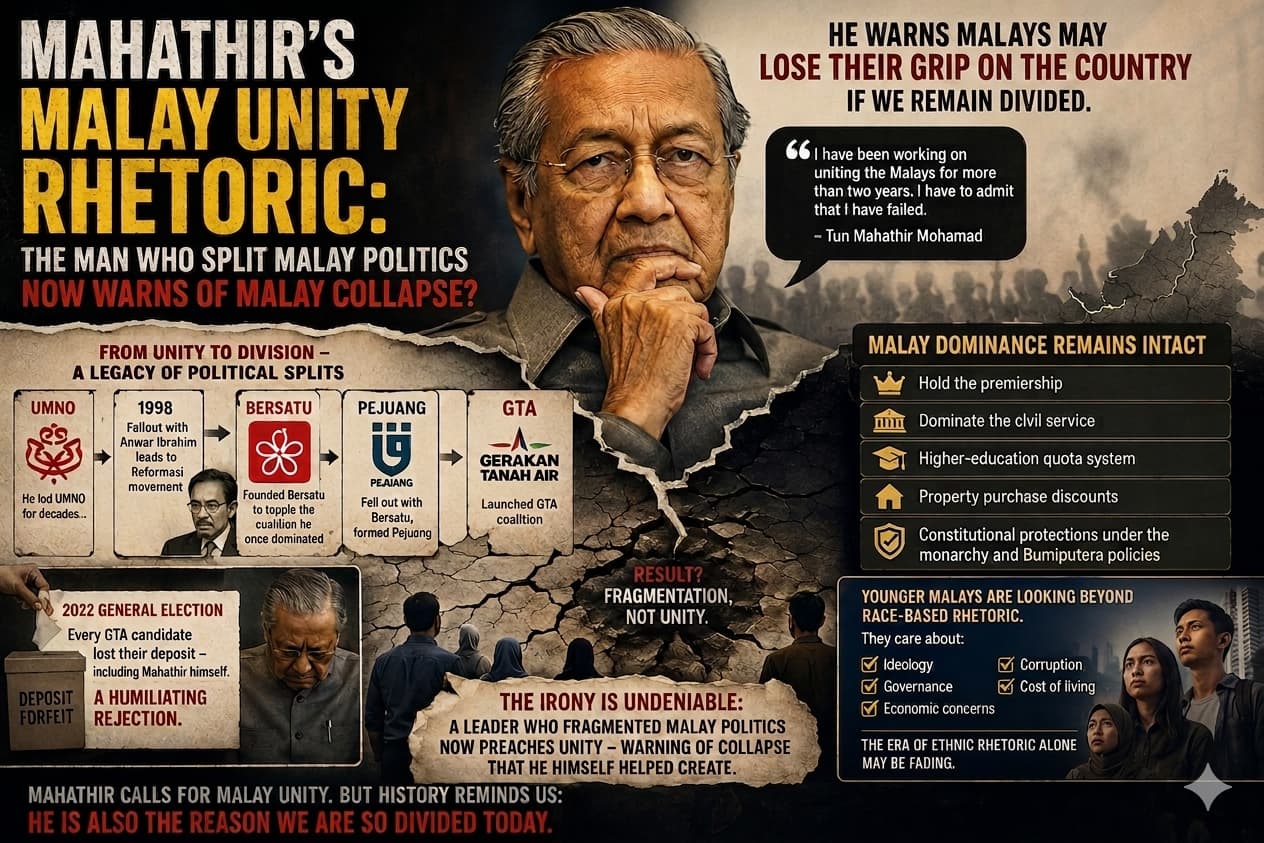
Image Credit: Concept by Chatgpt. Edited by GeminiAi
Former prime minister Tun Mahathir Mohamad is once again sounding the alarm over the future of the Malays, warning that the community risks “losing grip” on the country if they remain divided.
The warning carries a deep irony: the very man now preaching Malay unity is widely seen as one of the architects of modern Malay political fragmentation.
Mahathir recently admitted that his years-long effort to unite the Malays had failed. In a social media post, he lamented that Malays were prioritising political leaders over “race, country and religion,” claiming such disunity could eventually erase Malay dominance and even Malay history itself.
But from a historical perspective, Mahathir’s political legacy tells a very different story.
For decades, Mahathir was not merely a participant in Malay political rivalries - he was often at the centre of them. From his dramatic split with former deputy Anwar Ibrahim in 1998 that gave birth to the Reformasi movement, to his later fallout with successive Umno leaders, Mahathir repeatedly reshaped the Malay political landscape through conflict and factionalism.
Ironically, many of today’s fractured Malay political blocs were either directly or indirectly born from Mahathir’s own political manoeuvres.
He once led United Malays National Organisation (Umno) before turning against it. He later founded Parti Pribumi Bersatu Malaysia (Bersatu) to topple the very coalition he once dominated. After falling out with Bersatu, he formed yet another Malay-based vehicle, Pejuang, followed by the Gerakan Tanah Air (GTA) coalition.
Instead of consolidating Malay political strength, these repeated splinters arguably accelerated the fragmentation Mahathir now condemns.
The results have been politically brutal. In the 2022 general election, every GTA candidate lost their deposit - including Mahathir himself, marking the first electoral defeat of his long political career. It was a humiliating rejection not only of GTA but perhaps also of Mahathir’s continued attempt to position himself as the ultimate guardian of Malay unity.
Many would agree that Mahathir’s warnings often rely heavily on fear-based narratives - the idea that Malays are under existential threat unless they unite politically under a Malay-centric agenda. Yet Malaysia’s demographic, constitutional, and institutional realities remain firmly anchored in Malay political dominance. Malays continue to hold the premiership, dominate the civil service and the higher-education quota system, receive property purchase discounts, and enjoy constitutional protections under the monarchy and Bumiputera policies.
This raises another uncomfortable question: Is the issue truly Malay disunity, or simply the inability of aging political elites to maintain influence over a changing electorate?
Younger Malays today appear increasingly divided not by race alone, but by ideology, governance standards, economic concerns, corruption issues, and cost-of-living pressures. The era where ethnic rhetoric alone could automatically unite Malay voters may be fading.
Mahathir himself acknowledged recently that the proliferation of Malay parties had weakened the community. Yet many would argue that no individual contributed more to that proliferation than Mahathir himself through decades of political feuds, party breakaways, and leadership rivalries.
The irony is difficult to ignore. A leader once celebrated as the towering figure of Malay political power now finds himself warning about the collapse of the very unity that his own political battles helped fracture.
Whether Malaysians view Mahathir’s latest remarks as sincere concern or political revisionism, one reality is undeniable: the man now calling for Malay unity is also inseparable from the story of how Malay politics became so divided in the first place.
By: Kpost
The warning carries a deep irony: the very man now preaching Malay unity is widely seen as one of the architects of modern Malay political fragmentation.
Mahathir recently admitted that his years-long effort to unite the Malays had failed. In a social media post, he lamented that Malays were prioritising political leaders over “race, country and religion,” claiming such disunity could eventually erase Malay dominance and even Malay history itself.
But from a historical perspective, Mahathir’s political legacy tells a very different story.
For decades, Mahathir was not merely a participant in Malay political rivalries - he was often at the centre of them. From his dramatic split with former deputy Anwar Ibrahim in 1998 that gave birth to the Reformasi movement, to his later fallout with successive Umno leaders, Mahathir repeatedly reshaped the Malay political landscape through conflict and factionalism.
Ironically, many of today’s fractured Malay political blocs were either directly or indirectly born from Mahathir’s own political manoeuvres.
He once led United Malays National Organisation (Umno) before turning against it. He later founded Parti Pribumi Bersatu Malaysia (Bersatu) to topple the very coalition he once dominated. After falling out with Bersatu, he formed yet another Malay-based vehicle, Pejuang, followed by the Gerakan Tanah Air (GTA) coalition.
Instead of consolidating Malay political strength, these repeated splinters arguably accelerated the fragmentation Mahathir now condemns.
The results have been politically brutal. In the 2022 general election, every GTA candidate lost their deposit - including Mahathir himself, marking the first electoral defeat of his long political career. It was a humiliating rejection not only of GTA but perhaps also of Mahathir’s continued attempt to position himself as the ultimate guardian of Malay unity.
Many would agree that Mahathir’s warnings often rely heavily on fear-based narratives - the idea that Malays are under existential threat unless they unite politically under a Malay-centric agenda. Yet Malaysia’s demographic, constitutional, and institutional realities remain firmly anchored in Malay political dominance. Malays continue to hold the premiership, dominate the civil service and the higher-education quota system, receive property purchase discounts, and enjoy constitutional protections under the monarchy and Bumiputera policies.
This raises another uncomfortable question: Is the issue truly Malay disunity, or simply the inability of aging political elites to maintain influence over a changing electorate?
Younger Malays today appear increasingly divided not by race alone, but by ideology, governance standards, economic concerns, corruption issues, and cost-of-living pressures. The era where ethnic rhetoric alone could automatically unite Malay voters may be fading.
Mahathir himself acknowledged recently that the proliferation of Malay parties had weakened the community. Yet many would argue that no individual contributed more to that proliferation than Mahathir himself through decades of political feuds, party breakaways, and leadership rivalries.
The irony is difficult to ignore. A leader once celebrated as the towering figure of Malay political power now finds himself warning about the collapse of the very unity that his own political battles helped fracture.
Whether Malaysians view Mahathir’s latest remarks as sincere concern or political revisionism, one reality is undeniable: the man now calling for Malay unity is also inseparable from the story of how Malay politics became so divided in the first place.
By: Kpost
***
I want to show my respect to/for him, he being a very senior citizen and former PM, but he has made my intention more and more difficult each and every time he sounds the siren call for Malay unity, because in those rallying calls to the Malays, he invariably divides Malaysian society again and again, pitting Malays against the so-called avaricious predatory 'pendatang', mainly the Chinese.
In the end, when we analyse his intentions for those rallying calls for Malay Unity, they have been desperate attempts to marshal the Malays under his personal banner, to give him the power he wants (for whatever purpose he has in mind)


No comments:
Post a Comment