The High Court orders blogger Wan Azri Wan Deris to pay RM5,000 in costs to the nation’s top cop
The trial of IGP Razarudin Husain’s RM3 million defamation lawsuit against blogger Wan Azri Wan Deris is scheduled to begin on Dec 28, 2026.
KUALA LUMPUR: Blogger Wan Azri Wan Deris today avoided being sanctioned for contempt of court by apologising for publishing two derogatory social media postings about Inspector-General of Police Razarudin Husain earlier this year.
Wan Azri, also known as Papagomo, decided to purge his contempt just before proceedings before Judicial Commissioner Gan Techiong began.
In a statement read in court, Wan Azri, a former cop, expressed his unreserved and unconditional regret for using demeaning words when referring to Razarudin in a social media posting on Jan 14.
He also apologised for publishing a doctored photo of Razarudin on the same media platform the following day.
“I also undertake not to use demeaning words against the plaintiff (Razarudin),” he said.
Gan said Wan Azri will post his statement of apology on YouTube, Telegram, X and TikTok today which must remain on the social media platforms for at least seven days.
He directed Wan Azri to remove the postings made on Jan 14 and 15, which were the subject matter of the contempt of court proceedings.
Gan also ordered Wan Azri to pay RM5,000 in costs.
The case was fixed for a four-day trial beginning Dec 28, 2026.
Lawyers S Raam Kumar and Norleena Jamal represented Razarudin while counsel Rafique Rashid Ali and Nurmustanir Nor appeared for Wan Azri.
On Feb 10, Razarudin obtained the High Court’s permission to initiate committal proceedings against Wan Azri for failing to comply with a court order.
Razarudin, who filed the application on Jan 24, wanted Wan Azri imprisoned or fined for contempt of court after failing to comply with an injunction order issued on Jan 10.
The court issued an injunction prohibiting Wan Azri or his agents from publishing or disseminating defamatory statements against Razarudin on any social media platform until the defamation suit is resolved.
The court also barred him and his representatives from causing the republication of statements, videos, statuses, comments, or any references to the plaintiff.
These materials relate to Razarudin’s position as IGP and in his personal capacity, whether in writing, verbally, online or via instant messaging platforms such as Telegram and WhatsApp.
Wan Azri was also ordered to retract, remove and delete video postings on his YouTube, TikTok, Facebook, Telegram, and X accounts dated Dec 14, 15, 20 and 22 last year, which contained the alleged defamatory statements against Razarudin.
On Dec 26 last year, Razarudin filed a RM3 million lawsuit against Wan Azri over alleged defamation, which also involved Prime Minister Anwar Ibrahim.
Puad Zarkashi urges MCA to stay committed to BN, saying their frustration is understandable but misplaced.
MCA should focus on regaining public support through performance in states where it holds power rather than blaming BN or sulking over setbacks, the Umno leader adds.
He defends the BN-Harapan cooperation, stating it was not the cause of MCA or Umno’s electoral struggles.
Umno supreme council member Puad Zarkashi has urged MCA to remain a loyal partner within BN, saying that frustrations voiced by its leadership should not lead to misplaced blame or withdrawal from the coalition.
This came after MCA secretary general Chong Sin Woon expressed party members’ uncertainty and disappointment with BN’s direction.
Responding to this, Puad said the concerns are understandable but misdirected.
“We sympathise with MCA, but they should not blame BN.
“MCA must ask itself why Chinese support for the party has declined. Why did they only win two seats in the 15th general election?” the veteran politician said in a statement.
Puad stressed that MCA’s poor electoral performance had no connection to BN’s cooperation with Pakatan Harapan, as BN had contested GE15 independently.
He also criticised Johor MCA Youth chief Heng Zhi Li’s claim that the BN-Harapan partnership had jeopardised Umno’s future, calling the comment “shallow”.
“Umno was severely affected when BN lost GE14, not because of BN-Harapan cooperation. But Umno did not blame BN – instead, we rose again.
“If you want to say Umno is declining, just look at the three by-elections in Nenggiri, Mahkota, and Ayer Kuning,” he said.
Focus on gaining support
Puad reminded MCA not to "sulk", pointing to their absence in the 2023 state elections in Kedah, Kelantan, Selangor, Negeri Sembilan, and Penang as counterproductive.
Instead, he urged the party to focus on its roles and positions in Johor, Malacca, Perak, and Pahang, saying that success in governance would help win back public support.
“Umno will continue to defend BN. MCA, MIC, and the friends of BN are still our loyal allies. The BN-Harapan cooperation is for the people’s well-being and to ensure a stable government,” he added.
BN, he said, must continue to heed the advice of the Malay rulers and remain committed to moderation - “that is our clear direction.”
BN won Ayer Kuning after legitimising DAP alliance, says Hadi
PAS president Abdul Hadi Awang says the Umno-DAP pact seeks to ‘purify’ DAP, which he claims has ‘openly taken anti-Islam stances’
PAS president Abdul Hadi Awang said political currents are naturally fluid and dynamic, often shifting in directions inconsistent with Islamic values. (Bernama pic)
PETALING JAYA: PAS president Abdul Hadi Awang today played down Barisan Nasional’s (BN) victory in the Ayer Kuning by-election last weekend, saying it does not necessarily signal any significant impact on future general or state elections.
In a post on X, Hadi said political currents are naturally fluid and dynamic, often shifting in directions inconsistent with Islamic values.
The Marang MP said BN candidate Yusri Bakir’s victory in the by-election stemmed from the Umno-DAP alliance, commonly referred to as “UmDAP”, which he claimed sought to “purify” DAP – a party which he said had “openly taken anti-Islam stances”.
“This includes efforts to ‘cleanse’ DAP and Pakatan Harapan (PH) of blame in controversies such as illegal pig farming in predominantly Malay-Muslim areas,” he said.
He said many Malay-Muslim voters in Ayer Kuning rejected the idea of a “progressive and liberal Islam” and UmDAP’s efforts to cleanse DAP’s image, as these were against Islamic principles – especially in light of the health and environmental risks linked to pig farming.
Hadi also claimed that UmDAP had led some of Umno’s supporters to embrace the secular principle of “the end justifies the means” and other liberal ideologies.
“They remain in government to obtain positions of power, including as menteris besar and state executive councillors, as well as to gain access to projects and selective judicial outcomes – often to protect allies against allegations of crime and corruption.
“Meanwhile, opponents are dragged to court over both real and fabricated charges, with cases manufactured against anyone who resists,” he claimed.
Yusri was declared the winner with a 5,006-vote majority – more than double the 2,213-vote majority obtained in 2022 by Ishsam Shahruddin, whose death on Feb 22 triggered the by-election for the state assembly seat.
Yusri defeated Perikatan Nasional’s (PN) candidate Abd Muhaimin Malek, who garnered 6,059 votes, and Parti Sosialis Malaysia’s KS Bawani, who obtained 1,106 votes.
The issue of pig farms was a central campaign point for PN, with concerns raised over their presence in a predominantly Malay area. The government repeatedly denied the claims, saying the existing pig farms were operating above board.
FMT previously quoted political analyst Awang Azman Pawi as saying that PN’s over-reliance on PAS and the rhetoric of championing Malay issues might have contributed to the opposition’s loss at the Ayer Kuning polls.
Awang Azman said the PN strategy had less effect on the moderate Malays and Ayer Kuning’s multiethnic demographic.
However, he said the voting pattern showed that many BN-PH supporters might have abstained.
He said PN’s voters, on the other hand, had come out in full force as the opposition coalition suffered only a mild loss of around 800 votes compared to the 2022 election, despite the voter turnout dropping from 74% to 58%.
US President Donald Trump delivers a speech at Macomb County Community College Sports Expo Center in Warren, Michigan, on April 29, 2025. — AFP pic
Wednesday, 30 Apr 2025 12:03 PM MYT
Chinese factory activity fell in April at its fastest pace since 2023, underlining the growing impact of the US-China trade war. Asian markets were mixed as investors digested weak Chinese data and awaited key US economic releases. Economists warn that while tariff rates may have peaked, the uncertainty surrounding trade policies is likely to further hurt global growth.
HONG KONG, April 30 — Stocks opened flat on Wednesday as investors struggled to mirror Wall Street’s rally, with fresh data showing Chinese factory activity contracted this month at its fastest pace in nearly two years, reflecting the growing impact of Donald Trump’s trade war.
While markets have recovered some ground since the US president’s “Liberation Day” tariff announcement on April 2, uncertainty continues to dominate as countries seek trade deals to avoid the full brunt of Washington’s penalties.
China has notably refrained from sending delegations to the United States to negotiate reductions in the steep tariffs of up to 145 per cent on its goods, instead imposing retaliatory duties of 125 per cent.
The effects of these measures became more evident in April, with data on Wednesday showing manufacturing activity shrank at its sharpest pace since July 2023, just a month after expanding at its fastest in a year.
This contraction followed a more than 12 per cent surge in Chinese exports last month, as companies rushed to ship goods ahead of the new tariffs.
Observers warn that the situation could deteriorate further.
“The weak manufacturing PMI in April is driven by the trade war,” said Zhiwei Zhang, president and chief economist at Pinpoint Asset Management. “The macro data in China and the US will weaken further... as the trade policy uncertainty delays business decisions,” he added.
Shares declined in Hong Kong and Shanghai, as well as in Seoul, Wellington and Jakarta.
Tokyo bucked the trend, buoyed by a surge in Sony shares after reports that the company is considering spinning off its chip division, raising expectations that such a move would unlock value.
Markets in Sydney, Singapore, Taipei and Manila edged higher.
Equities have clawed back much of the steep losses from earlier this month, helped by signs of flexibility from Trump on certain issues and ongoing negotiations between governments and Washington.
US Commerce Secretary Howard Lutnick said he had reached an agreement with one country, though he did not name it, while Treasury Secretary Scott Bessent noted progress with India, South Korea and Japan.
However, Saxo’s chief investment strategist Charu Chanana warned that more economic trouble lies ahead.
“We’ve probably seen peak tariff rates, but not peak tariff uncertainty,” she said. “The hard data still reflects the impact of front-loaded demand, as companies and consumers rushed to buy goods ahead of expected tariff increases.
“We haven’t yet seen the real data showing the drag from sustained uncertainty and elevated tariff costs. As that uncertainty filters through business decisions, we expect a more meaningful slowdown in real economic activity – in production, hiring, and investment.
“In short, the rate shock may be behind us, but the real growth damage is just starting to unfold.”
Investors are now awaiting key US inflation and economic growth data due later today, with job figures expected on Friday.
This week also sees earnings reports from major Wall Street firms including Microsoft, Apple, Meta and Amazon, which investors hope will offer insights into how US corporations are coping with the tariff crisis and what lies ahead. — AFP
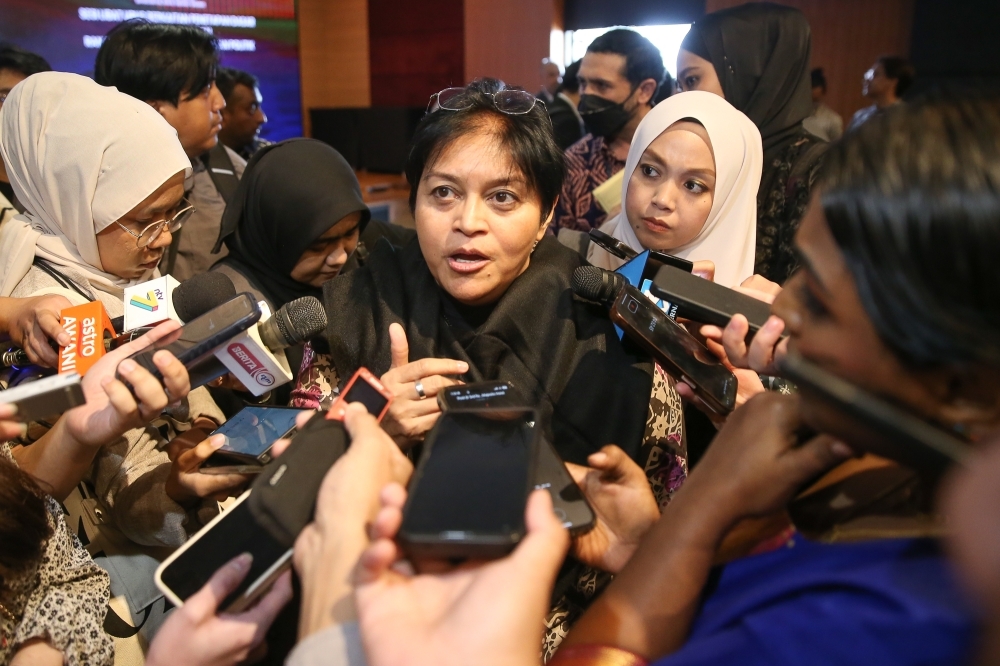
Minister in the Prime Minister's Department (Law and Institutional Reform) Datuk Seri Azalina Othman Said speaks to reporters during the Political Funding Bill briefing at the Asian International Arbitration Centre (AIAC) in Kuala Lumpur March 6, 2025. — Picture by Yusof Mat Isa
Wednesday, 30 Apr 2025 12:22 PM MYT
KUALA LUMPUR, April 30 — The next proceedings in the case involving the Sulu group’s claim are scheduled to be heard at the Paris Court of Appeal on July 7, said Minister in the Prime Minister’s Department (Law and Institutional Reform) Datuk Seri Azalina Othman Said.
She said the hearing would see the French judiciary examine the validity of the arbitration award imposed on Malaysia as well as various related legal aspects.
“Malaysia will continue to exhaust all efforts, rights and available resources to protect the country’s sovereign immunity and interests, and to bring to a close the baseless fraud case by the Sulu group.
“Several recent rulings in Malaysia’s favour have significantly strengthened Malaysia’s legal position and sovereignty as an independent nation,” she said in a statement today.
She added that among these decisions were the French Court of Cassation’s cancellation of the recognition of the preliminary award, the Dutch Supreme Court’s rejection of the final award, and the French Court of Appeal’s criminal conviction of arbitrator Gonzalo Stampa for contempt of court.
Azalina said the Sulu group’s claim had challenged the limits of Malaysia’s sovereign immunity, exposing how third-party funding was misused to prolong baseless claims against Malaysia through highly deceptive means, while also revealing attempts by private arbitration tribunals to seize government assets.
Currently on a working visit to Europe, Azalina also met with the legal team representing Malaysia in Paris to continue strategising and receive updates on the ongoing Sulu claim case.
Previously, eight Filipino nationals claiming to be heirs of the now-defunct Sulu Sultanate filed arbitration proceedings in Spain to demand billions of US dollars from Malaysia over issues involving Sabah. In March 2019, a court in Madrid appointed Stampa as the arbitrator for the case.
On Feb 28, 2022, Stampa ruled in favour of the group and issued a Final Award of USD14.9 billion through an unlawful arbitration process, despite his appointment having already been annulled by a Spanish court.
Malaysia has since secured a series of legal victories in the case, including in November last year, when the French Supreme Court fully rejected the group’s legal challenge.
That historic win for Malaysia meant the original basis for the Final Award — which required Malaysia to pay USD14.9 billion in compensation — was not recognised under French law. — Bernama
Minister of Women, Family and Community Development Datuk Seri Nancy Shukri urged Malaysians to speak out against sexual harassment, following a viral video regarding an e-hailing driver asking a 15-year-old girl to remove her headscarf. — Bernama pic
Wednesday, 30 Apr 2025 1:30 PM MYT
KUCHING, April 30 — Minister of Women, Family and Community Development, Datuk Seri Nancy Shukri today called on all parties to be brave in speaking up against sexual harassment to defend the dignity and safety of the community.
She said this following a video that went viral recently involving an e-hailing driver asking a 15-year-old teenage girl to remove her headscarf while using the service to return home.
“To the teenagers out there, do not remain silent. You have the right to act for your safety and dignity. At the same time, I am committed to strengthening justice through the full implementation of the Tribunal under the Sexual Harassment Act,” she said in a statement today.
She understood that the victim’s father had filed a police report regarding the incident and this reflected the increasing public awareness of the issue of sexual harassment which should not be taken lightly.
“When a case of sexual harassment occurs, the public can place full trust in the police to act fairly and promptly,” she said. — Bernama
A general view of the site of the explosion and gas pipeline fire in Putra Heights on April 30, 2025. — Picture by Firdaus Latif.
Wednesday, 30 Apr 2025 2:50 PM MYT
SHAH ALAM, April 30 — The government has today agreed to set up a National Disaster Relief Housing Fund for the purpose of refurbishing and rebuilding houses that were affected by the Putra Heights gas pipeline fire last month.
Minister of Housing and Local Government Nga Kor Ming said the Cabinet decided that this RM40 million fund is a strategic collaboration with the private sector to repair and rebuild the affected houses.
“The Madani government, through the fund, will allocate RM40 million for repairs and reconstruction of the affected Putra Heights houses.
“Those who contribute to this fund will be given tax exemptions as an incentive for more parties to come forward to lend a helping hand,” Nga told a press conference at the Selangor State Secretariat building here.
According to Nga, this is an unprecedented and most comprehensive repairs and reconstruction work ever carried out by the federal government.
There will be three categories of repairs and reconstruction works carried out on the affected houses:Houses that have damages exceeded 40 per cent and require reconstruction — the ceiling construction cost is set at RM300,000 per unit Houses that have damages exceeding 40 per cent but do not require reconstruction — the ceiling repair cost is set at RM150,000 Houses that have damages less than 40 per cent — the ceiling repair cost is set at RM30,000
“We would like to also thank Sime Darby Property for stepping up as a responsible corporate body to help with repairs and reconstruction works for the Taman Putra Harmoni affected homes.
“In-line with this, the Syarikat Perumahan Negara Berhad (SPNB) will focus on repairs and reconstruction works for the affected houses in Kamping Kuala Sungai Baru,” added Nga.
From tomorrow, the relevant parties will access the housing areas — starting with works on housing units that are located within a 100-metre radius from the gas pipeline fire site.
“The estimated time for completion of construction works is 24 months,” he said.
At the same time, he said the government has allocated an additional RM6 million for road and infrastructure repairs done through the Subang Jaya City Council, local council department and the National Landscape Department.
The fire, which broke out at 8.10am on April 1 — the second day of Hari Raya Aidilfitri — was fully extinguished by 3.45pm.
As of the Selangor state government’s latest count, the fire had affected some 455 victims, while destroying 219 houses with 81 suffering total loss and 138 substantial damages.
Published on: Wednesday, April 30, 2025 By: FMT Reporters
Former law minister Zaid Ibrahim said Bersatu’s Wan Fayhsal Wan Ahmad Kamal should ‘stop dreaming’ about Malaysia’s prospects of being an ‘Asian Tiger’.
PETALING JAYA: Former law minister Zaid Ibrahim today responded to the claim by a Bersatu man that Malaysia could still achieve “Asian Tiger” status if led by a visionary prime minister, saying the country could not be compared with “real tigers” such as China, South Korea, or Singapore.
Bersatu Supreme Council member Wan Ahmad Fayhsal Wan Ahmad Kamal had said in an exclusive interview with FMT that such a prime minister should have the “vision to rally all Malaysians transcending race and religion”.
However, Zaid said that Wan Fayhsal should “stop dreaming”.
In a post on X, he said even Prime Minister Anwar Ibrahim, whom he had previously thought to be a visionary, was unwilling to dismantle current policies.
“Stop comparing us with the real tigers. Our politicians and civil service are not the best, and our education and economic policies are archaic. The corrupt and rent seekers are protected.
“We give preferences to selected groups, but they are not to be questioned.
“We are a feudal oligarchy cemented by a religious bureaucracy the Renaissance man himself dared not recalibrate and reform,” he said in what was believed to be a veiled reference to Anwar.
The term “Asian Tigers” was used in the 1980s and 1990s to describe the fast-growing, now high-income economies of Taiwan, South Korea, Singapore and Hong Kong.
Malaysia was tipped to be the fifth “Asian Tiger”, but its economic growth was derailed by the 1997 Asian financial crisis.
Wan Fayhsal nevertheless said Malaysia checked all the boxes to achieve high-income status, pointing to its strategic location at the heart of Asean, its relative immunity to major natural disasters, and its diverse cultures and traditions.
“All of these ‘ingredients’ must be ‘cooked’ by a prime minister with the vision to rally all Malaysians transcending race and religion,” he said.
***
Reminder:
Malaysia was NEVER an Asian Tiger in the likes of Taiwan, South Korea, Singapore and Hong Kong.
Fifty years after the war, Vietnam faces a new US threat: tariffs
7 hours ago Rupert Wingfield-Hayes
Reporting from Ho Chi Minh City
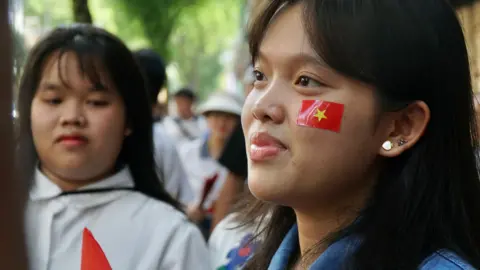
BBC/ Lulu Luo Tung Linh, a 20-year-old Vietnamese college student, says she is excited for Vietnam's future
On a searing afternoon in Vietnam, Tung Linh declared she "basically knows nothing" about the bloody, decades-long war that pitted her country's Communist-run North against the United States-backed South.
"My grandparents fought in the war and because of that today we can look at the sky and see an airplane and we don't feel scared, like they did," says the 20-year-old college student.
Stuck to her right cheek was a little yellow star on a red rectangle - the Vietnamese flag. Like her, Ho Chi Minh City, where she lived, was gearing up to celebrate the 50th anniversary of the end of the war, when the Communists triumphed.
Today's Vietnam is a remarkably different country than the one American troops withdrew from in defeat – it's enterprising, it's growing fast and it's getting richer.
Its authoritarian Communist leadership has embraced capitalism. They aspire to follow in China's footsteps, and have ploughed money and effort into becoming a reliable manufacturing hub, even an alternative to China.
But that is a risky ambition during US President Donald Trump's trade war – it's partly why he is threatening a 46% levy against the South East Asian nation. That could shatter the country's economic potential.
Vietnam was a French colony, a Chinese vassal and for 20 years, the proxy battlefield in America's bloody struggle to stop China spreading communism across South East Asia.
But it cannot escape its geography. Nestled beneath China's wide rump, it is once again on the frontline in a new American battle –which hopes to stem Beijing's rise as an economic superpower.
Vietnam is a young country in a hurry. The median age is 33, considerably younger than Thailand or China (40), and far younger than Japan (50).
"I want to do a job that will bring more success to Vietnam," said Linh in fluent English. She is studying economics and marketing. "And yes, success for me too," she admits, with a smile, when prodded.
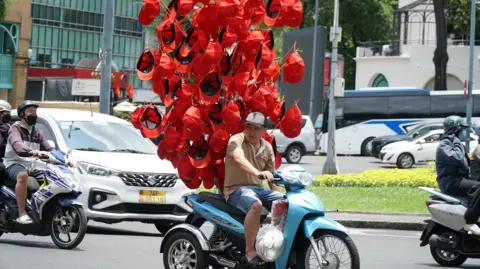
It's a dream that suits her bustling city – now a sprawling metropolis of 10 million people, Ho Chi Minh City has the same choking traffic, glass-clad skyscrapers, five-star hotels, restaurants and seedy massage parlours as any Asian mega city.
You would be hard put to find traces of the socialist ideology that led to the city's capture in 1975, when it was the capital of South Vietnam. The victors renamed it city Ho Chi Minh, after the revolutionary father of North Vietnam. But to locals, it is still Saigon.
And when it fell on this day 50 years ago, South Vietnam ceased to exist as North Vietnamese tanks smashed through the tall iron gates of the presidential compound and raised the red flag with a yellow star over the presidential palace.
America's ally, the southern regime, was vanquished. Its last president had fled the previous day. More than two decades of bitter conflict was over.
The victory had come at an enormous cost. An estimated three million dead and millions more injured. Between 1968 and 1975, a greater tonnage of bombs was dropped on this slender piece of land than in all theatres in World War Two. Advertisement
BBC/ Lulu Luo Vietnam's Ho Chi Minh City...
BBC/ Lulu Luo ...is a sign of the country's ambitious economic agenda Advertisement
But few here want to talk about the war even as they celebrate the anniversary of their "reunification".
Linh and her friends screamed in delight as a truck carrying soldiers drove past. The shy idols waved back – they were on their way to the barracks after rehearsals for the anniversary parade.
"I am excited because this is the day when we reunited, when we became one country again," Linh said.
Her answer sounded a little rehearsed, not least because of the government-appointed minder who accompanied the BBC throughout. But her enthusiasm for her future – and her country's - is not uncommon.
A little further down the road, 18-year-old Minh, who did not want to share her last name, told us she was studying to be a lawyer so she could "become successful". With a laugh, she added: "And rich!"
When we asked about how young people feel about Americans, the minder winced visibly and tried to stop her answering.
"We're not angry," she says. "We don't hate them. That was the past. Now we want to trade with America. You know globalisation? We want to learn from America."
Vietnam's new leaders appear to have the same ambition. In January the country's new Communist party chief, To Lam, embarked on a program to slash bureaucracy that could impress Elon Musk, who has been overseeing the Trump administration's controversial cost-cutting team.
The country's 63 provinces and municipalities are being reduced to 34, and government ministries and agencies cut from 30 to 17. This year, 100,000 government employees are being laid off, according to official estimates.
BBC/ Lulu Luo Vietnam's ambitions are mirrored in its young people, like 18-year-old Minh
The ambition is huge. So far only one country in South East Asia, Singapore, has managed to escape the "middle-income trap", where economic growth slows before countries become rich. Vietnam, whose economy is growing at a steady 5%, intends to be the second. It has flung its doors wide open to investment – and is welcoming back those it once drove from its shores.
After the 1975 victory around two million southern Vietnamese fled the country. Many were ethnic Chinese. They packed on to flimsy boats and set out across the South China Sea. They became known as "the boat people". Today their descendants make up a diaspora of nearly six million stretching from the United States and Canada to France, Germany, Japan and Taiwan.
"Since 2017, I have promoted many Taiwanese companies to invest in Vietnam, and I myself am an advisor to several large electronics companies that I brought here," said Lisa Wu, who was born in Saigon but spent three decades in Taiwan. Now she is back.
"The most attractive thing is that the Vietnamese government is very supportive. The electronics industry is expanding out of China and a lot will choose Vietnam."
It's no coincidence this shift began around 2018, when Trump declared his first trade war against China.
Two young businesswomen from southern China, who did not want to share their names, tell us they have spent the last two years setting up a shoe factory here: "Now it's ready to go."
They plan to export to the US. They are concerned about the possibility of higher tariffs for Vietnam - it currently faces a 10% levy, like most of the world – but "it's a lot better here than China", they say with a laugh. Chinese imports to the US face a range of tariffs that go up to 245% for some goods.
BBC/ Lulu Luo Vietnam is celebraring 50 years of independence, and of the end of the war
Still, Vietnam is feeling the impact, Ms Wu said. "I had several factories preparing to begin operations here this May. But because of the policy change, all have stopped and everyone is waiting."
Vietnam is again being asked to choose – America or China. But it's not a choice it can or will make because it needs both.
Less than two weeks ago, they rolled out the red carpet to welcome Chinese leader Xi Jinping in the capital Hanoi. Warm words were spoken of fraternal friendship and support. But relations with their big neighbour are trickier than they may appear. For years, Vietnam has walked a tightrope between Washington and Beijing – the latter's expansive ambitions can be a threat to neighbours, especially growing economies that are keen to woo US businesses.
As Vietnam insists on "looking forward", it appears to have almost forgotten the men and women who fought in the jungles and through the hell of American bombs.
But even they say there must be no return to the past. "I used to have a scar here," says Le Thanh Gian, pointing to his right hand, where a bullet had once lodged.
"There are still some pieces of shrapnel in my body that couldn't be removed. There were battles where it seemed like we would all be killed. But some of us survived while others fell."
But he says he bears no anger anymore.
"We must have peace. We have already made a lot of progress. People's lives are more prosperous and fulfilled. Now we must work together with the Americans for the future."
Fall of Saigon: Children of Vietnam’s war refugees reconcile a painful past
A younger generation of Vietnamese make peace with history and identity on the 50th anniversary of war ending in Vietnam.
47:38
Vietnam: 50 Years of Forgetting - fixed version
By Hai Dang
Published On 29 Apr 202529 Apr 2025
Hanoi/Ho Chi Minh City, Vietnam – Although a child of war refugees, Victoria Ngo got to learn more about her Vietnamese identity only during her college years in the United States in the 1990s.
The eldest daughter in a refugee family with a Vietnamese father of Chinese descent, Ngo grew up in a Chinese-speaking community in the US and for a while thought of herself essentially as just Chinese.
As an inquisitive schoolgirl, Ngo had noticed the differences, though, between her experience as Vietnamese and those of the Chinese people she grew up with.
Curiosity about her identity increased over the years, partly because questions she asked about Vietnam went unanswered by her parents and other relatives.
“I lived with people who only spoke Chinese. My siblings and I went to Chinese school on the weekends,” she told Al Jazeera.
“I also speak Vietnamese, and my name is a Vietnamese name. My experience is very much a Vietnamese experience in the sense that I came as a refugee and came during the wave of the Vietnamese refugee,” she said.
But Vietnam was just not spoken about. And certainly not the war that ended 50 years ago when South Vietnam’s then-capital, Saigon, fell to North Vietnamese forces and their leaders in Hanoi.
Victorious North Vietnamese soldiers take up positions outside Independence Palace in Saigon on April 30, 1975, the day the South Vietnamese government surrendered, ending the war in Vietnam. Communist flags fly from the palace and the tank [Yves Billy/AP]
Trying to fill in the missing pieces of her family’s past, Ngo recounted how she signed up to attend a conference about the war in Vietnam at her college, “thinking that my father would be proud of me”.
His response was stark and unexpected.
“He said, ‘If you go to that conference, you are not my daughter!’” Ngo recounted.
“And I was like, ‘Wow, I thought I was just learning about our history,’ to which he responds: ‘That is not our history.'”
Ngo’s experience is not uncommon among Vietnamese families who fled their country as refugees after Saigon fell on April 30, 1975.
The fall of Saigon ended the war and marked the reunification of North and South with Hanoi as the new capital of post-war Vietnam.
But many of those who worked under the US-aligned government of the Republic of Vietnam, or South Vietnam as it was then known – its civil servants, soldiers, businesspeople – chose exile over unification and living in a communist Vietnam.
Too many lives had been lost. Too much blood had been spilled – North and South – that many, like Ngo’s father, could never forgive nor live with their wartime foes in peacetime.
For others, exile as refugees would be a choice taken to stay with relatives who feared persecution – or so they believed – if they stayed in Vietnam after the war.
South Vietnamese civilians scale the wall of the US embassy in Saigon on April 29, 1975, trying to reach evacuation helicopters as the last Americans depart from Vietnam as the Southern capital was about to fall to North Vietnamese forces [AP Photo]
‘There is this void in our history that doesn’t get talked about’
The US-backed wars in the three countries of Indochina left huge losses in their wake. Laos and Cambodia suffered an estimated 1.45 million deaths under US bombings.
In Vietnam, there were an estimated 1.1 million military deaths on the communist North’s side alone and more than 254,000 on the side of the South Vietnamese republic. Compounded with civilian deaths, the estimated death toll from the war in Vietnam stands conservatively at 3.1 million people.
For the victorious communist forces, they were left with a country in ruin. The northern part of the country was subjected to heavy US bombings. The railroads were inoperable. Most of the major roads were bombed into cratered tracks. Its economy was shattered. The northern population had also witnessed decades of conflict after the onset of French colonial rule in the late 19th century.
Southern Vietnam’s urban infrastructure was less damaged by the war. The countryside was in ruins as rural areas had become the front lines in the guerrilla warfare that marked most of the fighting in the South.
A napalm strike erupts in a fireball near US soldiers on patrol in South Vietnam in 1966 during the war [File: AP Photo]
Croplands and forests had been poisoned by the US use of defoliant, better known as Agent Orange, the highly toxic chemical compound that was sprayed from the air to deny communist fighters on the ground the cover of trees and other concealing foliage.
Millions of Vietnamese people were affected by the use of Agent Orange, including at least 150,000 children who would be born with severe physical, mental and developmental defects, and others are still being affected to this day because the soil remains poisoned.
Unexploded bombs – in the many hundreds of thousands of tonnes – still “contaminate” up to 20 percent of Vietnam’s territory due to the millions of tonnes of ordnance used in the war, according to the Vietnam National Mine Action Center.
2:41
Now Playing
02:41
Fall of Saigon: 50 years on – Vietnam still battling deadly legacy of war
Next
47:38
Vietnam: 50 Years of Forgetting - fixed version
09:25
US-Iran nuclear talks explained | Start Here
02:31
Mexico bans US immigration advert, citing discrimination
25:19
Infowars: Chinese AI memes and US media barbs
While their April 30, 1975, victory marked an end to the war for the North Vietnamese, for the defeated US-backed government and people of the South, the war’s end was for many the start of lengthy separation from family in “reeducation camps” or permanent exile to Western countries, such as the US, Australia, Germany and Canada.
Before the fall of Saigon, Ngo’s father was a high school principal in South Vietnam. After April 30, 1975, he was placed in reeducation camps twice before he made a desperate decision to take his family out of the country on a rickety, overcrowded boat in 1978.
The family would spend half a year in a refugee camp in the Philippines before being accepted by the US as refugees.
By the time of their arrival in the US in the early 1980s, Ngo’s extended family had lost everything. Her immediate family, two aunts and uncles, and a grandmother and her relatives shared a two-storey, 30sq-metre (323sq-ft) subsidised housing unit in Los Angeles.
Her father could not teach in the US and ended up becoming a deep ocean fisherman as well as doing odd jobs to put food on the table.
The Vietnam they fled became a bad memory to be forgotten, Ngo said.
“There is this void in our history that doesn’t get talked about. You don’t know about what’s happened in the past,” she told Al Jazeera
A profound sense of loss is a narrative shared by many Vietnamese refugee families – deep pain from the past that is felt across generations.
Within some families, any mention of the war risks evoking strong emotions and triggering past griefs. The sensitivity is such that silence about the past is sometimes preferred.
Displaced Vietnamese disembark from a plane at Nha Trang Air Base in South Vietnam on March 27, 1975, as a US-financed airlift relocates thousands of former residents of Hue in central Vietnam to the south [Nick Ut/AP]
‘Deep pain from her past’
Cat Nguyen, a young American Vietnamese poet, experienced similar evasiveness when it came to family experiences of the war.
Now based in Ho Chi Minh City – the name given to Saigon after the war in honour of the founding father of the Vietnamese Communist Party – Cat Nguyen said little was shared about their family’s past before coming to the US.
“My family, in particular my grandma, harboured deep pain from her past,” Cat Nguyen told Al Jazeera.
Cat Nguyen’s family also has a complicated political history.
While a maternal grandfather was an active revolutionary who supported anticolonial efforts against the French in pre-independence Vietnam, a paternal grandfather served in the government of South Vietnam and a maternal grandmother was the principal of an American-English school in Saigon.
But in 1975, Cat Nguyen’s family on both sides, and its political divide, left Vietnam.
Cat Nguyen’s father was just 10 years old and mother was 13 when they left Vietnam. They were “uprooted from their native land in the blink of an eye” for a new life in the US, Cat Nguyen said.
“The first few years in the US were filled with sadness for them: difficulties adjusting to a strange land, a language they were not fluent in, a people who did not understand the world they [the Vietnamese refugees] were coming from,” Cat Nguyen said
The trauma of fleeing Vietnam was also compounded by official accounts that cast the refugees and Vietnamese diaspora as abandoning their country in its hour of much-needed national reconstruction.
This year’s 50th anniversary of the fall of Saigon will be celebrated by the Communist Party of Vietnam as a day of unification and also “liberation of the south”.
Decorations for April 30th celebrations marking the 50th anniversary of the end of the U.S. war in Vietnam, seen in Hanoi’s Ba Dinh neighbourhood, on April 26, 2025 [Chris Trinh/Al Jazeera]
That message speaks to the aspirations of millions of Vietnamese in the north and south who made great sacrifices during the war, but the party’s official history is inevitably limited.
To this day, the experiences of many in southern Vietnam and their perspectives on the war – what motivated them to resist North Vietnam’s political leadership, including Ho Chi Minh – remain absent from the celebratory narratives.
In this fateful historical showdown, southerners who fled overseas as refugees are cast in the role of puppets or traitors, lured and manipulated by the enemy’s luxuries and propaganda into abandoning their own people.
Seeing their experiences erased and delegitimised after the war added to the pain of displacement for Vietnam’s diaspora communities. It also explains the anger still harboured towards Vietnam’s leadership by an older generation of refugees, such as Ngo’s father.
This is a multigenerational resentment that still rears its head when refugee parents believe their children are being exposed to positive narratives about bustling, economically thriving Vietnam five decades after the war – which they brand as “the North’s propaganda
‘You crossed an ocean for me to cross another’
It is not only contemporary Vietnam’s official version of history that is problematic.
Cat Nguyen realised there were also gaps when turning to American high school textbooks to learn about the war in Vietnam.
In those schoolbooks, Washington’s decades-long military involvement in Vietnam, which left millions of people dead and millions scattered across the world as refugees, only “a small paragraph” was devoted to “how the US fought against communism in Vietnam”, Cat Nguyen said.
Although supposedly sympathetic to their former South Vietnamese “allies”, Cat Nguyen told of a US-centric perspective that still subjects Vietnamese refugees to an “Americanised gaze”.
“An Americanised gaze of refugees, meaning that Americans viewed all Vietnamese as either dangerous, threatening communists or as helpless, infantilised refugees,” Cat Nguyen said.
Such narratives had helped to justify US intervention and military occupation of Vietnam to “save” the Vietnamese from themselves and communism.
US helicopters fly in formation over a landing zone in South Vietnam during the war [File: AP Photo]
“While it is true that Vietnamese refugees suffered greatly, this gaze strips human beings of their own agency and humanhood, displacing them into a framework that upholds the system of white supremacy,” said Cat Nguyen, who has called Vietnam home for more than two years.
Vietnamese American writer Viet Thanh Nguyen noted in his book Nothing Ever Dies that Vietnamese refugees were able to find in the US – in whatever limited space that was available to them – opportunities to tell their immigrant stories, to “insert themselves into the American dream”.
But it was precisely that “dream” that Cat Nguyen would eventually grow disenchanted with along with its “capitalist propaganda”.
The “American dream” has erased “the history of the US’s genocide of Indigenous populations, enslavement of Black and racialised peoples, and violent colonial and imperial projects”, they said.
It is not that Cat Nguyen never had tried to fit into US society. Rather, from a young age, Cat Nguyen told of constantly being made to feel different in a society that “never sees them as American enough”.
“Throughout my life, I watched as the Vietnamese parts of me slowly eroded. It wasn’t until the passing of my grandmother – the person who taught me the most about where I come from – that I began desperately searching for a physical, mental, emotional and spiritual return to my ancestral homeland and my humanity,” Cat Nguyen said.
Seeking to reconnect, Cat Nguyen has become involved in art projects in the form of poetry, performance and filmmaking that experiment with a range of elements in Vietnamese folklore and traditional musical instruments to “unapologetically” recommit to “the fight against colonisation, imperialism and capitalism”.
Drawn to identify with Vietnamese revolutionary fighters from “the other side”, Cat Nguyen spoke of finding a source of personal strength in their wisdom and dying for their cause.
Current Time 0:00
/
Duration 25:05
Loaded: 2.63%
1x
That conviction has not led to a dismissal of Cat Nguyen’s own family’s suffering as refugees in the US, but the acknowledgement of the coexistence of intergenerational trauma that Vietnam’s official history fails to include
One of Cat Nguyen’s poems pays homage to their late grandmother: “You crossed / an ocean / for me / to cross / another and then you crossed / a world / before I / could follow.”
Ngo never did attend the university conference on the war in Vietnam that her father had threatened to disown her over all those years ago.
That was out of respect for her father’s wishes. Since then, she has gradually come to see events in Vietnam during the war years and after from the North’s perspective – albeit with critical eyes.
“I definitely see that when anything is too centralised and too authoritarian, you have corruption. But if the leadership is very strong and competent, things can move very efficiently,” said Ngo, who relocated to Vietnam more than 20 years ago.
Like Cat Nguyen, Ngo understands the trauma her family members from the South suffered.
It inspired her to pursue a career in psychology and public health focused on underserved communities. She became an associate professor of community health and social sciences at City University of New York’s Graduate School of Public Health and Health Policy.
“One of the reasons why I work with marginalised populations and vulnerable populations is because I also understand that experience having grown up as a refugee and in the early years not having very much,” Ngo said.
Victoria Ngo (right) during her participation in Project Dep, a collaboration with CUNY Graduate School of Public Health and Health Policy to assess depression care and treatment in primary care clinics in Vietnam [Courtesy of Victoria Ngo]
After more than two decades in Vietnam, Ngo has focused on equipping primary care clinics with the capacity to take care of poor people who suffer from mental health problems but lack access to care
“I feel like my experience as a refugee has really made me think a lot about the human condition and what kinds of social resources and economic resources we need to put in place to help people in transition and who are marginalised, to help people who are displaced in one way or another,” she said.
For both Ngo and Cat Nguyen, being part of the Vietnamese diaspora and its painful past has given them a nuanced perspective on Vietnam’s history that is not readily found in the competing narratives of North and South.
Divided by the flag
Kevin D Pham said there was a recurring story he was told while growing up in a Vietnamese refugee family in San Jose, California.
“I was told by my high school teachers and especially my family that communists were bad, essentially,” said Pham, an assistant professor of political theory at the University of Amsterdam.
Pham’s paternal grandfather was imprisoned by communist Viet Minh forces in the 1950s, and his maternal grandfather was imprisoned in a reeducation camp after 1975 and died there from malnutrition.
From a young age, Pham was taught to be proud of his Republic of Vietnam family heritage. Although he appreciates this perspective, he did not uncritically accept what he was taught. After graduating from university, he lived in Vietnam for eight months and, there, came to learn about and sympathise with perspectives from the “other side”.
But growing up in the US, he told of listening to his uncle, who was a pilot, as he recounted the glory of his younger days when he fought “the communists” during the war
Pham’s father, on the other hand, was only 16 years old when he was forced to leave Vietnam and did not have much direct experience of warfare. Still, his patriotism for the vanquished US-backed Southern government was still unwavering.
Pham recounts how, during his youth, older Vietnamese men would stop and salute as he and his father cruised down the streets of San Jose in his father’s bright yellow Ford Mustang, which had three horizontal red stripes painted on the bonnet to represent the flag of South Vietnam.
Kevin Pham’s father next to his car, which he had custom painted to resemble the southern Vietnamese flag, in San Jose, California, USA [Courtesy of Kevin Pham]
In Vietnam to this day, the South Vietnamese flag is still taboo.
Among staunch Vietnamese nationalists, the south’s “three-stripes”, or “ba que”, flag has become a popular slur, symbolising betrayal of the nation, defeat and humiliation. Any association with the former government’s flag, however remote, has also been used to denounce and alienate.
In early 2023, Hanni Pham, an Australian-Vietnamese singer with the Korean band New Jeans, got caught up in the flag controversy and was subjected to an online campaign, which started when online activists spotted a South Vietnamese flag in a video recording made when she visited her grandparents’ home.
The only public place where you can still find an actual three-stripe flag in Vietnam is in Hanoi at the newly built Vietnam Military History Museum, where one is displayed as a historical artefact.
Members of the Vietnamese community wave flags of South Vietnam as they attend a ceremony on the USS Midway as the ship commemorates the 40th anniversary of the fall of Saigon in San Diego, California, on April 26, 2015 [Mike Blake/Reuters]
Yet attempts to reconcile Vietnam’s fractious past date back decades
In 1993, under Vietnam’s then-prime minister, Vo Van Kiet, the Communist Party’s Politburo issued a resolution that marked the first official attempt at reconciliation by encouraging the country to “respect differences, join hands in dismantling prejudices, shame, hatred, and look forward to the future”.
Kiet was sensitive to the plight of Vietnamese refugees, something that he witnessed within his own family. In a well known interview in 2005 that drew both praise and criticism, he described April 30, 1975, as a “great victory” but one that left “millions happy, millions in sorrow”.
“It is a scar that needs healing rather than left to bleed,” he said.
In November, then-president and incumbent general secretary of the Communist Party of Vietnam, To Lam, made a historic appearance at Columbia University in the US with Lien-Hang Nguyen, the daughter of a refugee family who became the first director of Vietnamese studies at the university and who has worked on building bridges between the diaspora and Vietnam.
Their meeting reflected a broader spirit of unity and healing emerging among Vietnamese people long divided by the scars of war and political differences.
Kevin D Pham said he noticed how those who have strong views on the historical North-South divide in Vietnam commonly use the word “puppets” as a slur, whether referring to supporters of the South Vietnamese government as “puppets” of the Americans or the North’s supporters as “puppets” of the Soviet Union and China.
Kevin Pham, a Vietnamese-American professor at the University of Amsterdam. He is the author of “The Architects of Dignity: Vietnamese Visions of Decolonization” and co-host of Nam Phong Dialogues, a podcast on Vietnamese history [Courtesy of Kevin Pham]
“There is this tendency on both sides of seeing the other side as puppets who cannot think for themselves,” Pham said, adding that it indicates a “lack of curiosity” about the other side’s perspective and has become “an obstacle to true reconciliation”.
“What I encourage instead is the ability to understand multiple perspectives,” he said.
For Cat Nguyen, what is fascinating is that the current national flag of Vietnam – a yellow, five-pointed star on a red background – which once brought painful memories to family members still in the US, is now a source of comradery throughout Vietnam.
Vietnamese football fans celebrate their team’s win against Syria at My Dinh Stadium in Hanoi in 2016 [File: Reuters]
This was experienced firsthand when the Vietnamese national football team won the 2024 ASEAN championship in January. Cat Nguyen described flag-waving crowds storming onto streets across the country in celebration of a sporting, not a political, event.
“I am empathetic to the suffering from both sides despite which flags they identify with, either the three-stripe or the red flag with yellow star,” Cat Nguyen said.
“Everyone experienced so much violence, and ultimately I assign the most blame to US imperialism.”
Cat Nguyen is a Vietnamese-American poet based in Saigon [Chris Trinh/Al Jazeera]
Additional reporting by Duy-Minh Nguyen in Ho Chi Minh City




















![Decorations for April 30th celebrations marking the 50th anniversary of the end of the US war in Vietnam, seen in Hanoi's Ba Dinh neighbourhood, on April 26, 2025 [Chris Trinh/Al Jazeera]](https://www.aljazeera.com/wp-content/uploads/2025/04/Hanoi_01-1745921401.jpg?w=770&resize=770%2C514&quality=80)


