
Hadi calls for abolition of ‘colonial laws’ to make Syariah rule supreme in Malaysia
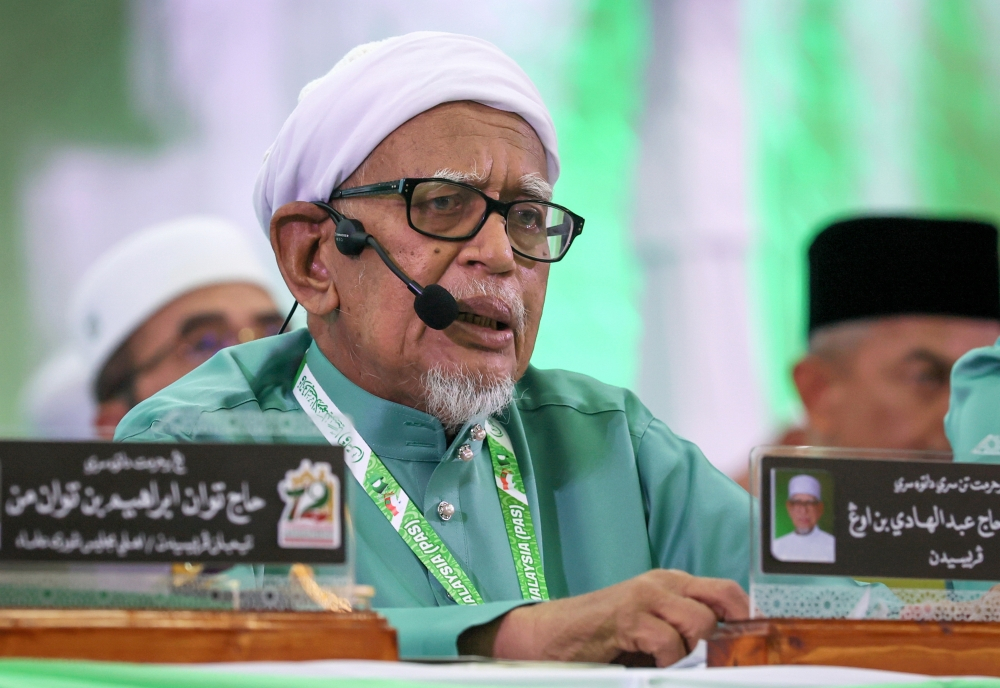
PAS President Tan Sri Abdul Hadi Awang speaks during the winding-up session at the 72nd PAS Annual National Muktamar at the Kelantan Islamic Tarbiyah Centre (PUTIK) in Kota Bharu on September 5, 2026. — Bernama pic
Summary
- PAS president Abdul Hadi Awang has called for the removal of colonial-era laws in Malaysia, arguing that they hinder the comprehensive implementation of Syariah law and true independence.
- He criticized specific statutes, such as the Syariah Courts (Criminal Jurisdiction) Act, which limits court sentencing, and called for a broader interpretation of Article 3(1) of the Federal Constitution to reflect an all-encompassing Islamic way of life.
- Hadi also accused the DAP of obstructing further Islamization of the legal system, highlighting the party's adherence to a secular interpretation of the constitution and criticizing former coalition partners for failing to challenge this stance.
By Malay Mail
First Published: Wednesday, 09 Sep 2026 3:17 PM MYT
Last Modified: Wednesday, 09 Sep 2026 3:17 PM MYT
KUALA LUMPUR, Sept 9 — PAS president Tan Sri Abdul Hadi Awang has called for the abolition of laws he described as colonial legacies, alleging that these were obstacles to the unfettered implementation of Syariah law in Malaysia.
In the statement, titled “Merdeka: Hapus Undang-Undang Penjajah Yang Sekat Pelaksanaan Islam” (”Independence: Abolish Colonial Laws That Obstruct the Implementation of Islam”), the Marang MP argued that true independence cannot be realised while laws inherited from British rule continue to limit Islam’s position above man-made legislation.
“Colonial-legacy laws must be abolished to ensure the true meaning of independence can be fully realised,” Hadi said in the statement.
“In particular, laws that prevent Islam from occupying its noble position above man-made laws not sanctioned by Allah SWT, due to their many weaknesses that spread wrongdoing, must be removed.”
Hadi singled out several statutes for criticism, chief among them the Syariah Courts (Criminal Jurisdiction) Act 1965 (Act 355), which caps Syariah court sentencing at three years’ jail, a RM5,000 fine and six strokes of whipping — a limit known as the “3:5:6” formula introduced in a 1984 amendment.
He also referenced the Civil Law Act 1956 and the division of powers under the Ninth Schedule of the Federal Constitution, which restricts state legislatures to enacting only religious offences under the State List while criminal law generally falls under the Federal List.
The PAS president argued these constraints prevent state Syariah courts from imposing punishments he described as consistent with Islamic legal tradition, and that overlapping jurisdiction between state and federal criminal law has repeatedly led to state Islamic enactments being challenged in court.
To bolster his argument, Hadi invoked the late Islamic law scholar Ahmad Ibrahim, citing his call for Article 3(1) of the Federal Constitution to be interpreted broadly — encompassing law, politics and economics as al-din, or a complete way of life, rather than a narrow, ritual-bound “religion of the Federation.”
Hadi said this position was shared by several former judicial figures, including ex-Chief Justice Tun Salleh Abas and Tun Ahmad Fairuz.
The statement also traced the historical debate over Islam’s constitutional status back to the 1956 Reid Commission, which drafted Malaysia’s independence constitution.
Hadi noted that an early draft had included language affirming Malaya would remain a “secular state” alongside recognising Islam as the federation’s religion — wording that was ultimately dropped following objections from the Malay Rulers and, later, PAS itself, which argued the eventual compromise in Article 3 was merely “ornamental.”
Much of the statement was also devoted to criticising the DAP, which Hadi accused of blocking further Islamisation of the legal system. He cited the DAP’s party constitution, which describes the 1957 Federal Constitution as a “secular” document, and noted that secretary-general Anthony Loke has said the party will not amend this founding position.
Hadi accused the DAP of leading opposition to Hadi’s own past private member’s bill to raise Act 355’s sentencing limits — a proposal that, in earlier iterations, sought to raise the caps to 30 years’ imprisonment, a RM100,000 fine and 100 strokes of whipping.
He further claimed PAS’s former coalition partners, PKR and Amanah, had failed to defend the Islamic position against DAP on the issue.
Hadi’s statement went further to declare that PAS considers the matter one of religious principle rather than ordinary politics, saying the party has severed political cooperation (tahaluf siyasi) with parties it says challenge Islam’s constitutional standing.


No comments:
Post a Comment