
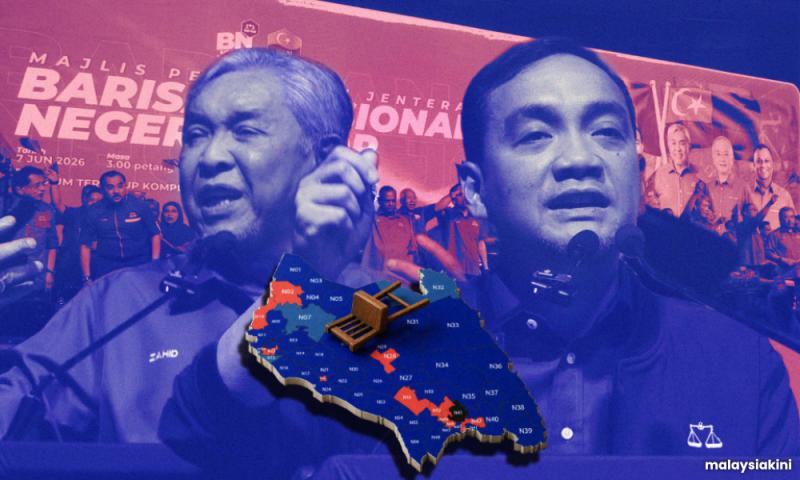

Behind the narrative: Why 25 Johor BN seats are actually at risk
Zarrah Morden & Zikri Kamarulzaman
Published: Jun 26, 2026 7:00 AM
Updated: 10:28 AM
BN and Umno's narrative going into the Johor polls is that the coalition is strong because it won a supermajority during the last state election in March 2022.
However, the reality is quite different. An analysis of election data showed that if the Johor state polls had occurred concurrently with the 15th general election in November 2022, BN would not even be in the state government.
This analysis, based on data from electiondata.my, shows that 25 seats that BN holds are at risk.
Published: Jun 26, 2026 7:00 AM
Updated: 10:28 AM
BN and Umno's narrative going into the Johor polls is that the coalition is strong because it won a supermajority during the last state election in March 2022.
However, the reality is quite different. An analysis of election data showed that if the Johor state polls had occurred concurrently with the 15th general election in November 2022, BN would not even be in the state government.
This analysis, based on data from electiondata.my, shows that 25 seats that BN holds are at risk.
What if?
Of these seats, 16 would have been won by Pakatan Harapan if voters voted the same way they did during GE15.
The seats that BN won but would have been bagged by Harapan in the November polls were: Kemelah, Tenang, Bekok, Gambir, Serom, Bukit Naning, Yong Peng, Parit Yaani, Senggarang, Layang-Layang, Mahkota, Permas, Larkin, Kempas, Kota Iskandar, and Bukit Permai.
Additionally, Harapan would have also won Maharani instead of Perikatan Nasional.
This would have given Harapan and Muda 30 seats in the 56-seat state legislature, meaning they would have formed the state government, not BN.
As for PN, despite losing Maharani, it would have bagged another five seats that BN currently holds for a total of seven.
These potential additional seats are: Bukit Pasir, Sungai Balang, Parit Raja, Rengit, and Tiram.
The losses to both Harapan and PN would have left BN with just 19 seats.
Swing seats
Meanwhile, another four BN seats would have been won with slim leads of around five percentage points or less compared to the runners-up.
These marginal seats are: Pemanis, Sri Medan, Pasir Raja, and Pulai Sebatang.
Pulai Sebatang would have been one of the closest races, with BN leading with just 0.34 percentage points, or 114 votes.
Of these seats, 16 would have been won by Pakatan Harapan if voters voted the same way they did during GE15.
The seats that BN won but would have been bagged by Harapan in the November polls were: Kemelah, Tenang, Bekok, Gambir, Serom, Bukit Naning, Yong Peng, Parit Yaani, Senggarang, Layang-Layang, Mahkota, Permas, Larkin, Kempas, Kota Iskandar, and Bukit Permai.
Additionally, Harapan would have also won Maharani instead of Perikatan Nasional.
This would have given Harapan and Muda 30 seats in the 56-seat state legislature, meaning they would have formed the state government, not BN.
As for PN, despite losing Maharani, it would have bagged another five seats that BN currently holds for a total of seven.
These potential additional seats are: Bukit Pasir, Sungai Balang, Parit Raja, Rengit, and Tiram.
The losses to both Harapan and PN would have left BN with just 19 seats.
Swing seats
Meanwhile, another four BN seats would have been won with slim leads of around five percentage points or less compared to the runners-up.
These marginal seats are: Pemanis, Sri Medan, Pasir Raja, and Pulai Sebatang.
Pulai Sebatang would have been one of the closest races, with BN leading with just 0.34 percentage points, or 114 votes.
It should be noted that not all seats that would have flipped in a GE15-based scenario were sure wins either, as the contests for Gambir, Bukit Naning, Sungai Balang, Parit Raja, Rengit, and Layang-Layang would have also ended with slim margins.
The difference between Harapan and BN in Layang-Layang, based on GE15 votes, was just 81 ballots.
Meanwhile, the seats of Buloh Kasap, Semerah, Tenggaroh, and Panti are also expected to be highly competitive, with the difference between first place and second being fewer than 2,000 votes.
Another seat that may change hands is Puteri Wangsa - which was won by Muda in the last state election thanks to a partnership with Harapan.
However, both Harapan and Bersama are now seeking to bag the urban mixed seat, with Muda likely on the back foot.
Bersama factor
Past election data alone is not sufficient to predict the outcome of the upcoming state election.
For one, achieving results similar to GE15 voting patterns would require a high turnout rate.
But political sentiment has changed since November 2022, especially among Harapan supporters who are believed to be increasingly disenchanted with the coalition and its chief, Anwar Ibrahim.

Expectations are high that Bersama, co-led by ex-PKR leaders Rafizi Ramli and Nik Nazmi Nik Ahmad, will have an impact on the 15 seats they are contesting - all of which were either previously won or would have been won by Harapan in a GE15-based scenario.
Most of these seats have a significant number of non-Malay voters. If the “kancil” party can sway them, it could either win or spoil Harapan’s chances for victory.
One factor that may dampen support for Bersama is the fear of PN, or PAS in particular.
However, PN is itself in disarray, with PAS and Bersatu split.

Nomination day for the Johor polls is this Saturday, with polling set on July 11.


No comments:
Post a Comment