
OPINION | Malay Unity or Political Mirage? Why Calls for a Single Malay Front May Be Doomed to Fail
4 Apr 2026 • 12:00 PM MYT

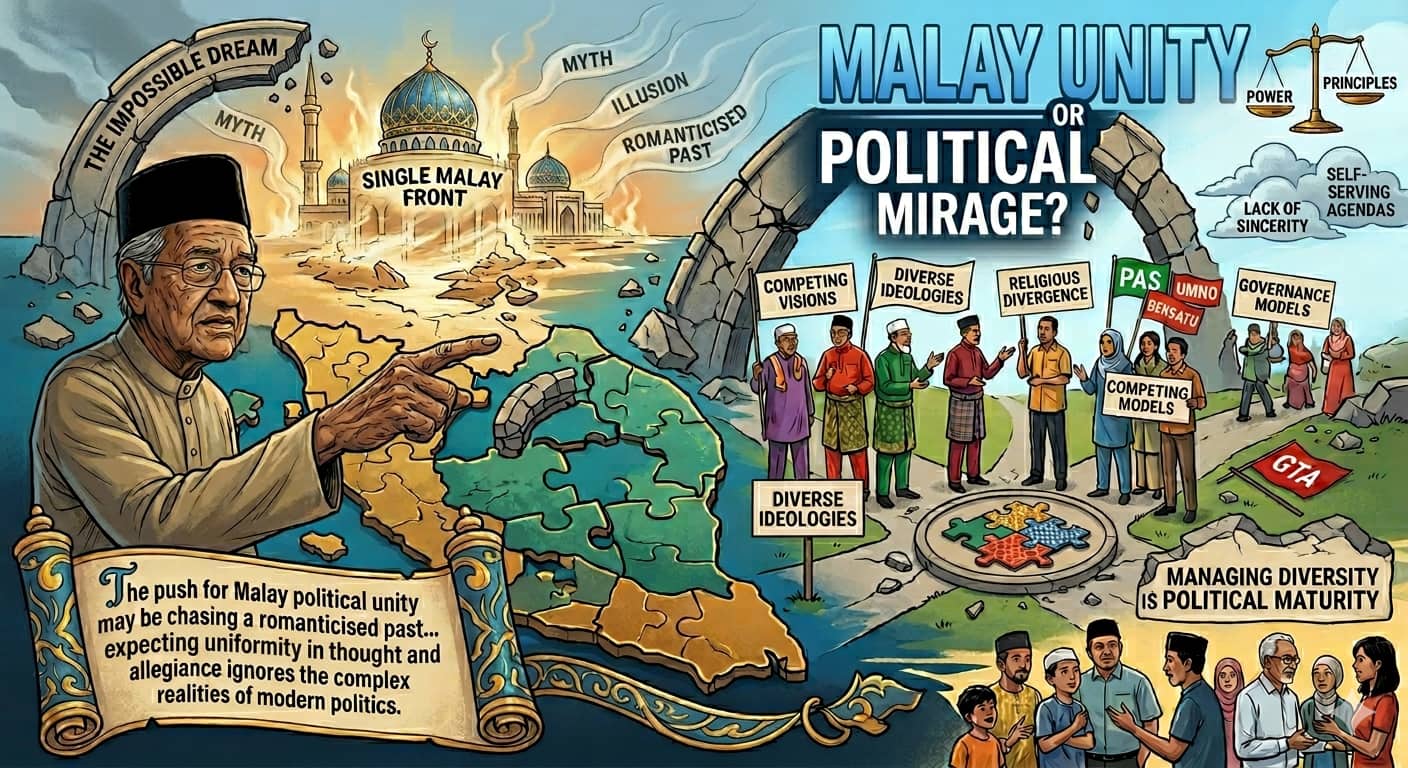
Image Credit: Graphic by GeminiAi
The latest push by Tun Mahathir Mohamad for Malay political unity has once again stirred debate - but analysts argue the idea may be more illusion than reality.
In a political landscape shaped by decades of fragmentation, the notion of uniting Malays under one political banner appears increasingly detached from historical and present-day truths.
Political analyst Syaza Shukri of International Islamic University Malaysia has dismissed the idea as unrealistic, pointing out that Malay political unity has been fractured long before independence. The formation of Parti Islam Se-Malaysia (PAS) in the 1950s - following a split from United Malays National Organisation - marked the beginning of ideological divergence among Malay leaders. Since then, competing visions of governance, religion, and national identity have made political cohesion elusive.
Syaza’s critique goes deeper than mere political practicality. She argues that framing Malay unity as a prerequisite for leadership risks reducing a diverse community into a monolithic bloc. “It’s as though we’re children who cannot function when there are differences in opinion,” she remarked, highlighting the patronising undertone behind such calls. In reality, political plurality among Malays reflects a mature and dynamic electorate, not a weakness.
Mahathir’s repeated attempts to forge unity - through coalitions like Gerakan Tanah Air - have yielded little success. The coalition’s poor showing in the 2022 general election, where even Mahathir lost his deposit, highlighted the limits of nostalgia-driven politics. His subsequent efforts to revive a Malay unity alliance have also struggled to gain traction, with key figures such as Tan Sri Muhyiddin Yassin and Dato' Sri Hamzah Zainudin reportedly at odds over direction and leadership.
Even the Muafakat Nasional alliance between UMNO and PAS, formed to forge Malay unity, failed to endure due to a lack of sincerity and self-serving agendas in the competition for power.
Meanwhile, voices within PAS, such as deputy president Tuan Ibrahim Tuan Man, maintain that unity is achievable - but only if parties abandon personal ambitions. Yet, such idealism clashes with the realities of political competition, where power, ideology, and influence rarely align seamlessly.
Adding another layer to the debate, analyst Mazlan Ali of Universiti Teknologi Malaysia expressed skepticism over whether emerging leaders like Dato' Seri Ahmad Samsuri Mokhtar possess the national and international stature to fulfill Mahathir’s vision of a unifying figure.
Ultimately, the push for Malay political unity may be chasing a romanticised past that never truly existed. Malaysia’s strength lies in its diversity - not just across ethnic lines, but within them. Expecting uniformity in thought and allegiance ignores the complex realities of modern politics.
Rather than forcing unity, perhaps the more honest question is this: should unity even be the goal, or is managing diversity the true mark of political maturity?
By: Kpost
The latest push by Tun Mahathir Mohamad for Malay political unity has once again stirred debate - but analysts argue the idea may be more illusion than reality.
In a political landscape shaped by decades of fragmentation, the notion of uniting Malays under one political banner appears increasingly detached from historical and present-day truths.
Political analyst Syaza Shukri of International Islamic University Malaysia has dismissed the idea as unrealistic, pointing out that Malay political unity has been fractured long before independence. The formation of Parti Islam Se-Malaysia (PAS) in the 1950s - following a split from United Malays National Organisation - marked the beginning of ideological divergence among Malay leaders. Since then, competing visions of governance, religion, and national identity have made political cohesion elusive.
Syaza’s critique goes deeper than mere political practicality. She argues that framing Malay unity as a prerequisite for leadership risks reducing a diverse community into a monolithic bloc. “It’s as though we’re children who cannot function when there are differences in opinion,” she remarked, highlighting the patronising undertone behind such calls. In reality, political plurality among Malays reflects a mature and dynamic electorate, not a weakness.
Mahathir’s repeated attempts to forge unity - through coalitions like Gerakan Tanah Air - have yielded little success. The coalition’s poor showing in the 2022 general election, where even Mahathir lost his deposit, highlighted the limits of nostalgia-driven politics. His subsequent efforts to revive a Malay unity alliance have also struggled to gain traction, with key figures such as Tan Sri Muhyiddin Yassin and Dato' Sri Hamzah Zainudin reportedly at odds over direction and leadership.
Even the Muafakat Nasional alliance between UMNO and PAS, formed to forge Malay unity, failed to endure due to a lack of sincerity and self-serving agendas in the competition for power.
Meanwhile, voices within PAS, such as deputy president Tuan Ibrahim Tuan Man, maintain that unity is achievable - but only if parties abandon personal ambitions. Yet, such idealism clashes with the realities of political competition, where power, ideology, and influence rarely align seamlessly.
Adding another layer to the debate, analyst Mazlan Ali of Universiti Teknologi Malaysia expressed skepticism over whether emerging leaders like Dato' Seri Ahmad Samsuri Mokhtar possess the national and international stature to fulfill Mahathir’s vision of a unifying figure.
Ultimately, the push for Malay political unity may be chasing a romanticised past that never truly existed. Malaysia’s strength lies in its diversity - not just across ethnic lines, but within them. Expecting uniformity in thought and allegiance ignores the complex realities of modern politics.
Rather than forcing unity, perhaps the more honest question is this: should unity even be the goal, or is managing diversity the true mark of political maturity?
By: Kpost


No comments:
Post a Comment