
Tariffs Fail – China’s Trade Surplus Hit Record $1 Trillion
December 9th, 2025 by financetwitter
Donald Trump proudly told Americans that his tariffs would “Make America Great Again”, promising a manufacturing boom just like the post-World War II “Golden Age”(1948-1973). It really happens – in China. As the U.S. continues dreaming, Chinese industrial production broke records this year as its factories churned out more cars, machinery and chemicals than ever before.
Despite the U.S. president’s tariff meant to disrupt China’s ambition, the Chinese continues to march ahead – setting trade surplus above US$1 trillion in November for the first time ever. In the first 11 months this year, China’s overall exports grew 5.4% compared to the same period in 2024 while imports fell 0.6%, pushing its trade surplus to US$1.076 trillion this year as of November, up 21.6% year on year.
The best part is the red dragon’s exports kept growing even as China’s U.S.-bound goods fell for an eighth straight month of double-digit declines – plunged 28.6% in November alone. China continues to rely less on selling stuff to the U.S., whilst at the same time grows its shipments to Asia, Europe, Latin America and Africa to offset a steep drop in exports to the U.S.

How did China achieve such success? Chinese companies that built their business around low trade barriers to sell into the U.S. have adapted, and in some cases are bouncing back. For example, in May, Chinese-owned e-commerce giant Temu’s business model of selling affordable household goods, beauty products and clothes to American consumers appeared game over.
In addition to the Trump’s tariffs, the White House had tried to kill off Temu’s business by introducing new regulations which ended a loophole that allowed the company to send small packages to the U.S. tariff-free. Today, not only Temu is still alive and kicking, the Chinese online marketplace is once again among the most downloaded apps in the U.S., and business is booming.
With manufacturing output in the first 10 months of the year up 7% compared with the same period in 2024, Chinese manufacturing shows little sign of slowing. Strip out imports of energy, food and raw materials, and China is on track this year to record a surplus in manufactured goods of around US$2 trillion, a huge sum that is on a par with the annual national income of Russia or Italy.
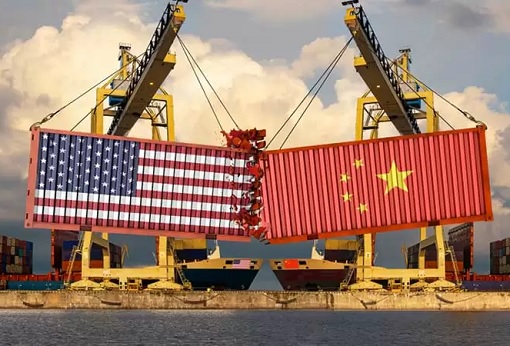
That is twice the surplus in manufactured goods that China reported at the end of Trump’s first term in early 2020, and that was only the manufacturing sector. That means the U.S. efforts to contain China’s economic and strategic ambitions and weaken its grip on essential global supply chains have failed spectacularly. Worse,Trump’s tariff war could backfire.
Despite the temporary trade truce, Chinese policymakers conclude they need to dominate more industries to shield their economy from U.S. pressure and give them more chokepoints they can exploit to further their own political and economic aims. China’s latest exports number defies expectations of a slowdown when Trump returned to the White House and signaled his lan to raise tariffs on China.
The data show direct exports to the U.S. did take a hit from tariffs, falling about 19% over the same period. But the decline was more than made up for by sales to other regions, with exports to Southeast Asia up 14%, exports to the European Union up 8%, exports to Latin America up 7% and exports to Africa jumping by more than 25%.
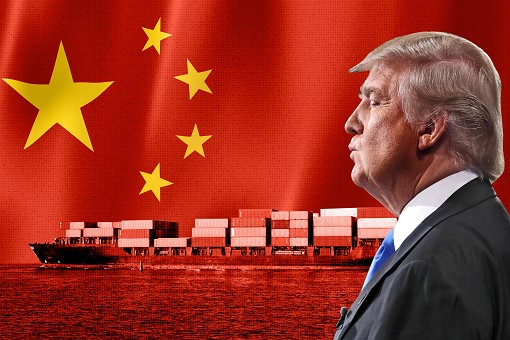
But that doesn’t mean the Chinese goods have failed completely in entering the U.S. due to the tariffs. China still is able to indirectly get its goods to American ports through other nations such as Vietnam, which has a lower tariff rate. Some of those exports found their way to the U.S., either as parts or components simply by being rebadged as non-Chinese to avoid tariffs.
China’s surprising export strength has also been aided by factories cutting prices and a weak currency, not to mention low interest rates and lack of inflation. The weakness of China’s currency, the renminbi or yuan, is not the only reason prices are low in China. A persistent decline in housing has erased much of the savings of Chinese households, leaving them reluctant to spend.
It takes about 7.1 renminbi to buy a single dollar these days. That weakness has powered China’s exports to remarkable heights. It does not take a rocket scientist to tell that Beijing deliberately weakens the currency to help create millions of jobs at Chinese export factories. However, some economists say that from the perspective of purchasing power parity, the exchange rate isn’t 1 to 7 – it might be 1 to 5 or even 1 to 4.
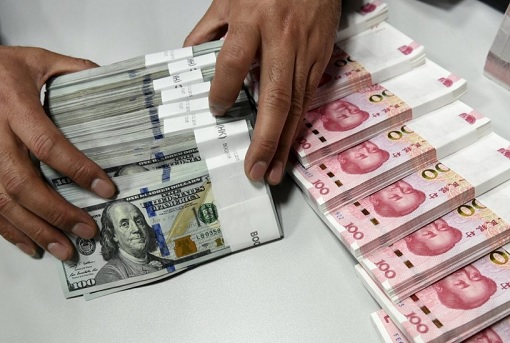
If the renminbi were to strengthen significantly past 5 to the dollar, China would surpass the United States as having the world’s largest economy when measured in dollars. Some have calculated that if the exchange rate truly reflected purchasing power parity, one dollar would exchange for only about 3.5 yuan. But stronger local currency isn’t something Beijing desires.
China’s weak currency saw how the number of Chinese tourists flocking to Europe has halved since 2019 as they choose far less expensive trips at home instead. It also encourages companies to move production to China. The weakness of the renminbi has helped fuel a sixteenfold increase in Chinese car exports to the European Union over the past five years.
Of course, Trump’s flip-flopping tariff policy has also added fuel to boost China’s booming manufacturing. His decision to target all trading partners with tariffs has, for some manufacturers, reduced the incentive to shift production out of China, especially now that tariffs on Chinese imports have fallen back from earlier highs of 145% on some products.
Average tariffs on Chinese imports are currently around 37%, according to the Tax Policy Center, compared with a rate of about 20% on Vietnamese imports. As tariffs on China came down over the year, Chinese manufacturers decided to stop moving production to Vietnam and keep China as his main production base. Besides, the small difference in tariff rates can’t compensate for the efficiency of Chinese manufacturing.
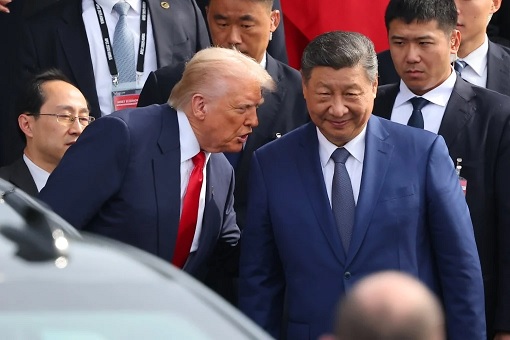
When President Donald Trump and President Xi Jinping reached a truce on trade at a meeting in South Korea, one of the biggest winners was Temu. The company’s huge base of efficient Chinese factory suppliers allowed it to continue to offer cut-rate shoes, bags and makeup at cheaper prices than many competitors. While they’re definitely not as cheap as they were 12 months ago, they’re still cheap enough for Temu to be a good-enough deal.
But China isn’t done yet. Xi Jinping has revealed a new five-year plan to prioritise supporting cutting-edge manufacturing and ensuring Chinese technological dominance and self-reliance in key industries such as semiconductors and artificial intelligence. As it pushes deeper into advanced manufacturing, China also remains the global hub for producing lower-value goods such as toys, clothes and furniture.

Having overtaken Japan to become the world’s biggest car exporter, China is set to export well over 6 million cars in 2025, with a trajectory to export around 8 million in 2026. While China still lags behind U.S. companies such as Nvidia in advanced semiconductor technology, it is fast becoming a dominant force in “legacy chips” – less advanced chips typically used in a range of products such as cars, household appliances and medical devices.
Semiconductor exports grew 24.7% in the first 11 months. In shipbuilding too, China’s ascent up the technology ladder has given it dominance in global markets. Exports of ships grew 26.8% in the first 11 months. These gains in global market share are being repeated elsewhere, as Chinese manufacturers offer cutting-edge technologies at a sharp discount to their competitors in the West.


Chinese in Malaysia are delusional if they go around celebrating China's massive global trade surplus, just because they think they also Han Chinese.
ReplyDeleteThey are not, they are just Malaysians who speak Chinese.
China overproduction is just as much killing Malaysian Manufacturers in the consumer area and , more importantly , Malaysian retail businesses, of which a LOT of Chinese depend for their business and jobs.
mfer, DON'T u forget that Malaysians who speak Chinese have roots. Not like u lah!
ReplyDeleteChina overproduction?
Mfer, do u think the Chinese manufacturers r ur kind of f*cked know-nothing heirloom inheritor?
No demands on one area, then divert the products to new markets. That's supply & demand of a marketing economy.
Overproduction is just cheap excuse for been non competitive!
So easy - likening u & yr idolized western economies of living on past pirated loots!