
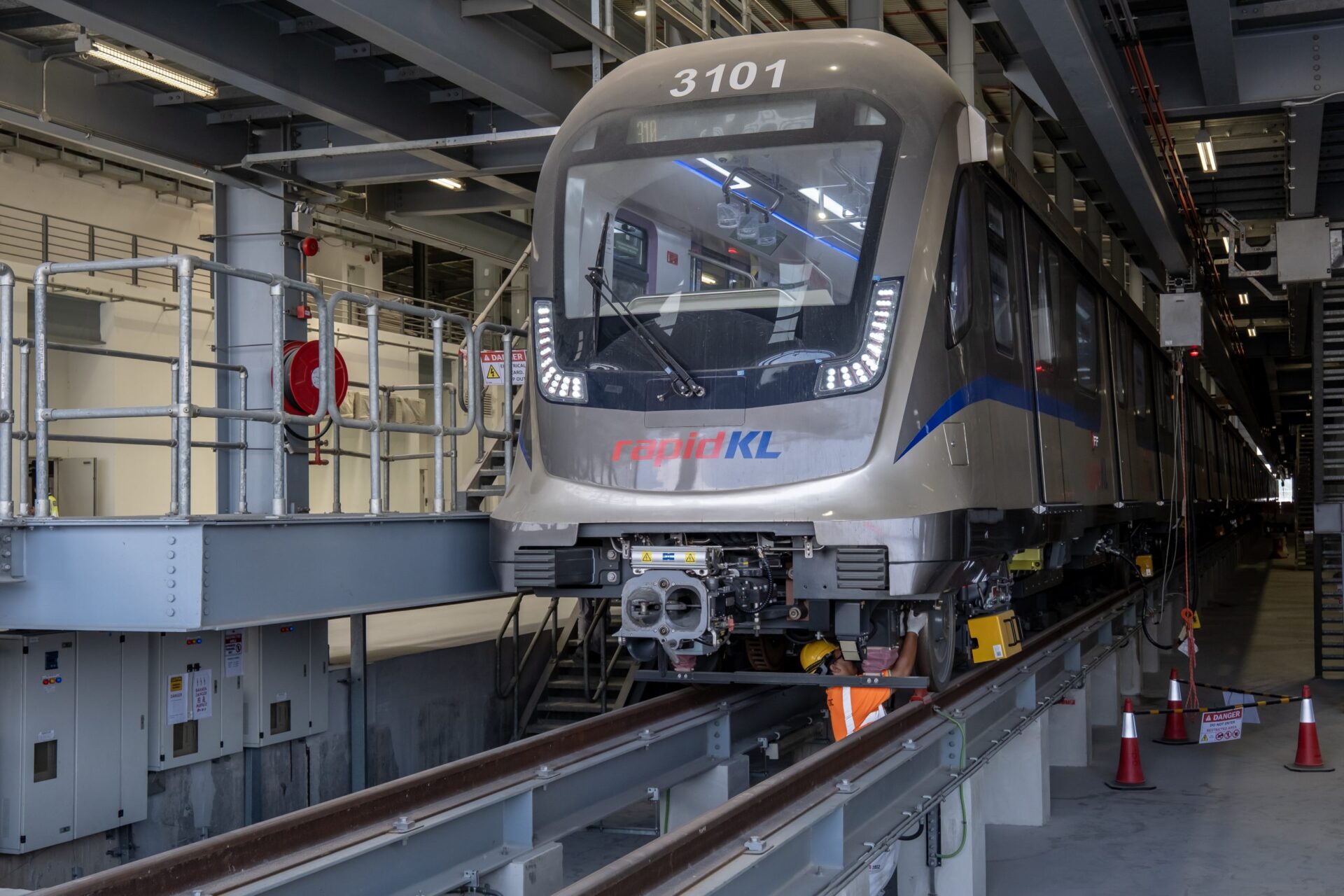
A likely decision to delay the Shah Alam Light Rail Transit (LRT3) line’s December 31 opening is based on the need to extend final testing and commissioning. - Scoop file pic, December 9, 2025
Better safe than sorry: Software setbacks put LRT3 timeline under pressure despite physical infrastructure readiness
Siemens signalling software delays and slow corrective patch releases force extended 4,000km fault-free trials, pushing back launch despite civil works completion
A. Azim Idris
Updated 10 seconds ago
9 December, 2025
9:59 PM MYT
Better safe than sorry: Software setbacks put LRT3 timeline under pressure despite physical infrastructure readiness
Siemens signalling software delays and slow corrective patch releases force extended 4,000km fault-free trials, pushing back launch despite civil works completion
A. Azim Idris
Updated 10 seconds ago
9 December, 2025
9:59 PM MYT
KUALA LUMPUR – A likely decision to delay the Shah Alam Light Rail Transit (LRT3) line’s December 31 opening is based on the need to extend final testing and commissioning, ensuring the system is fully reliable, safe, and ready for passenger service from day one.
Behind the scenes, progress has been hampered by delays in the delivery and stabilisation of the line’s signalling software, supplied by multinational tech conglomerate Siemens.
An industry source familiar with the matter said the delay stems from “repeated technical problems experienced by several train services in Malaysia in the past”, prompting authorities to impose a more stringent and prolonged stress-testing regime across all LRT3 systems.
“The delay in the launch of the service has also been impacted by long delays in the release of the Signalling software by Siemens, and the very slow turnaround of Signalling software patches by them to fix issues that were discovered during Testing and the Fault Free Runs,” the source said.
“This has resulted in the decision to undertake much longer testing and ‘running in time’ of the software to ensure no additional teething problems and to ensure stability.”
“In light of the problems with other rail lines in the country, a decision was taken to focus on a much longer and a more rigorous stress testing of all systems, safety and the functionality of all the trains, pushing them harder than normal and for a much longer period to weed out any potential problems early, to prevent issues occurring later after the line is opened to the public.”
Software delays affecting commissioning
Sources say the slow release of software packages and corrective patches has affected the pacing of the mandatory 4,000km fault-free test for each of the 22 trainsets, forcing teams to extend trial operations to verify the software’s performance under continuous, real-world conditions.
Despite Siemens’ global reputation in rail signalling, the line’s Grade of Automation 4 (GoA4) driverless system requires precise integration between signalling, rolling stock, communication, and electrification systems, raising the bar for testing and documentation.
“The public deserves a system that is not only modern and efficient, but also reliable, safe and fully compliant with global best practices, and therefore must not be rushed into operation solely to meet a targeted date.”
Berita Harian recently reported a source as saying that the delay in launching the service was also influenced by the lengthy period required for Siemens to release the signalling software, as well as the very slow response time in issuing software fixes to resolve issues identified during interference-free testing.
4,000km fault-free requirement proving demanding
Under the testing regime, all trainsets must complete a minimum of 4,000km of fault-free operation in all modes before the Land Public Transport Agency (Apad) grants safety certification.
“If any failure occurs in any function, even a minor one, the test will be repeated until the train achieves 4,000km of disruption-free operation to pass,” the source said.
Industry experts note that achieving these metrics is particularly challenging given the GoA4 driverless specification, which requires seamless integration across multiple systems.
Authorities prioritise safety
Prasarana Malaysia Bhd, the line’s owner, and Rapid Rail Sdn Bhd, its operator, support the extended timeline, emphasising that safety and reliability take precedence over meeting the original launch date.
“The LRT3 will only be opened to the public once all technical assessments, safety checks and stress tests are completed without interruption,” the source said, adding that the goal is for the line to become “a source of national pride, a system that demonstrates excellence, safety and long-term reliability.”
Transport Minister Anthony Loke had previously said that the project was in its final testing phase ahead of the December 31 target, stressing that the opening would depend on the outcome of ongoing assessments.
The delay mirrors the Putrajaya MRT line, which was postponed by six months to allow for comprehensive systems testing.
Contractor ready but integration remains critical
Setia Utama LRT3 Sdn Bhd (SULRT3), a subsidiary of Malaysian Resources Corporation Bhd (MRCB) and the main contractor, has completed most civil and systems works. SULRT3 took over from MRCB George Kent Sdn Bhd following the exit of George Kent.
Sources indicate that the current bottleneck lies in systems integration, documentation, and meeting fault-free benchmarks necessary for regulatory approval.
The Shah Alam LRT line, spanning Bandar Utama to Johan Setia, is expected to offer an alternative for Klang Valley commuters affected by KTM Komuter service disruptions caused by the Klang Valley Double Track Rehabilitation project.
Testing is expected to reach the second quarter of 2026, according to early industry estimates. Prasarana and SULRT3 will hold a joint media briefing at Stesen Stadium Shah Alam (STN 10) at 10am tomorrow to update the public on the project’s progress. – December 9, 2025


The Siemens software and China train hardware are not properly integrated, and need another intermediate layer to coordinate and transfer signals.
ReplyDeleteSome control responses that need fast and precise action end up delayed by just a fraction of a second, but enough to cause problems e.g. precise train station stopping positions, commands
to start moving, emergency stopping
Some of the discovered problems are deeply embedded, not sure if they are solvable.