Saturday, September 02, 2023


10 reasons why PAS will likely topple PH in the Simpang Jeram state by-election

10 reasons why PAS will likely topple PH in the Simpang Jeram state by-election
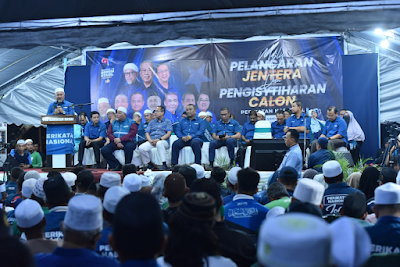
A SECULAR-MINDED retired DAP supremo Tan Sri Lim Kit Siang has rallied voters of the Pulai and Simpang Jeram by-elections on Sept 9 to ensure that Johor must refrain from joining the rank of Kelantan whose GDP (gross domestic product) per capita has dropped to less than one third of Malaysian average after over three decades under the PAS government.
But will that economic concern appeal to ordinary folks in the Pulai parliamentary and Simpang Jeram state constituencies amid rife speculation that PAS will most likely inflict defeat on the incumbent Pakatan Harapan (PH) especially in the contest for the state seat?
This sense of uncertainty comes as researcher Associate Prof Dr Mazlan Ali from Universiti Teknologi Malaysia (UTM) has predicted a form of rejection among Malay voters against the unity government stemming from their dissatisfaction with the current economic situation.
Concurring with Mazlan, Ilham Center executive director Hisomuddin Bakar has described PH’s position in Simpang Jeram as being “quite critical” with the coalition potentially losing the seat based on the voter trend of the 18 to 25 age group towards Perikatan Nasional (PN).

Dr Mohd. Mazri Yahya
Hisomuddin has contended that such rejection stemmed from the appointment of individuals implicated with corruption as national leaders in addition to the failure of the unity government did to win the hearts of young voters.
Apart from the observations by Mazlan and Hisomuddin, former senior lecturer in the Creative Technology and Heritage Faculty at Universiti Malaysia Kelantan Mukhtaruddin Musa has earmarked a further eight reasons why PAS candidate Dr Mohd. Mazri Yahya is able to inflict a surprise blow on his Amanah counterpart Nazri Abdul Rahman in Simpang Jeram.
Reason #1: Nothing worrisome for voters to make changes in Simpang Jeram because the integrity of the Johor State Government is still intact with a more than two-third majority. The two-third majority cut-off for the Johor State Assembly is 37, of which the ruling Barisan Nasional (BN) administration controls 40 out of 56 seats.
Reason #2: The need to defend PH does not exist in Johor. All that exists is the BN government.
Reason #3: The BN-rule Johor state government is lacks a balance check function as there are only four so-called opposition state assemblymen – three from PN and one from MUDA. Therefore, it makes valid sense if the opposition representatives in the Johor state assembly is added.
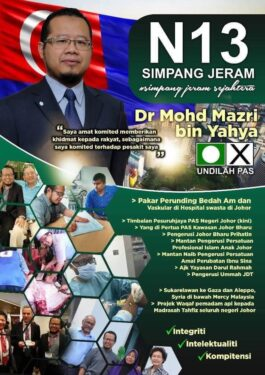
Reason #4: PAS won in Simpang Jeram (previously Sungai Abong) during the 12th General Election (GE12) on March 8, 2008 and the 13th General Election (GE13) on April 10, 2013 through its candidate Dr Sheikh Ibrahim Salleh who is a doctor medicine.
Reason #5: PAS candidate Dr Mohd. Mazri is a high performing medical specialist in the field of general, vascular and endovascular surgery.
His extensive experience of more than 20 years in the field of blood vessel surgery and fistula site formation has placed him as a leading expert in the field in Malaysia as well as allowing him to publish the book Hemodialysis & Fistula Site Care. If given the space, he is able to contribute to the medical field in Johor and Malaysia.
Reason #6: Dr Mohd. Mazri has never lobbied to be a candidate in any election. His agreement to be a candidate is solely because of his love in serving the community as he has shown thus far, including what can be witnessed through his voluntary service (pro bono) at the government hospital.
Reason #7: A victory for Dr Mohd. Mazri is something good for Johorians as a whole because it will remind the Johor state government on the need to make every BN and PH state assemblymen work harder in providing services and taking care of the people’s welfare.
Reason #8: Dr Mohd. Mazri also has an interesting personality and high leadership talent. He is a clean person in the sense that he does not have any issues or controversies that may cast doubts about him both in terms of his practice and speech. He is also well-liked by non-Malay/non-Muslim voters. – Sept 1, 2023
Hisomuddin has contended that such rejection stemmed from the appointment of individuals implicated with corruption as national leaders in addition to the failure of the unity government did to win the hearts of young voters.
Apart from the observations by Mazlan and Hisomuddin, former senior lecturer in the Creative Technology and Heritage Faculty at Universiti Malaysia Kelantan Mukhtaruddin Musa has earmarked a further eight reasons why PAS candidate Dr Mohd. Mazri Yahya is able to inflict a surprise blow on his Amanah counterpart Nazri Abdul Rahman in Simpang Jeram.
Reason #1: Nothing worrisome for voters to make changes in Simpang Jeram because the integrity of the Johor State Government is still intact with a more than two-third majority. The two-third majority cut-off for the Johor State Assembly is 37, of which the ruling Barisan Nasional (BN) administration controls 40 out of 56 seats.
Reason #2: The need to defend PH does not exist in Johor. All that exists is the BN government.
Reason #3: The BN-rule Johor state government is lacks a balance check function as there are only four so-called opposition state assemblymen – three from PN and one from MUDA. Therefore, it makes valid sense if the opposition representatives in the Johor state assembly is added.
Reason #4: PAS won in Simpang Jeram (previously Sungai Abong) during the 12th General Election (GE12) on March 8, 2008 and the 13th General Election (GE13) on April 10, 2013 through its candidate Dr Sheikh Ibrahim Salleh who is a doctor medicine.
Reason #5: PAS candidate Dr Mohd. Mazri is a high performing medical specialist in the field of general, vascular and endovascular surgery.
His extensive experience of more than 20 years in the field of blood vessel surgery and fistula site formation has placed him as a leading expert in the field in Malaysia as well as allowing him to publish the book Hemodialysis & Fistula Site Care. If given the space, he is able to contribute to the medical field in Johor and Malaysia.
Reason #6: Dr Mohd. Mazri has never lobbied to be a candidate in any election. His agreement to be a candidate is solely because of his love in serving the community as he has shown thus far, including what can be witnessed through his voluntary service (pro bono) at the government hospital.
Reason #7: A victory for Dr Mohd. Mazri is something good for Johorians as a whole because it will remind the Johor state government on the need to make every BN and PH state assemblymen work harder in providing services and taking care of the people’s welfare.
Reason #8: Dr Mohd. Mazri also has an interesting personality and high leadership talent. He is a clean person in the sense that he does not have any issues or controversies that may cast doubts about him both in terms of his practice and speech. He is also well-liked by non-Malay/non-Muslim voters. – Sept 1, 2023
DAP’s ‘Malaysian Malaysia’ confusing

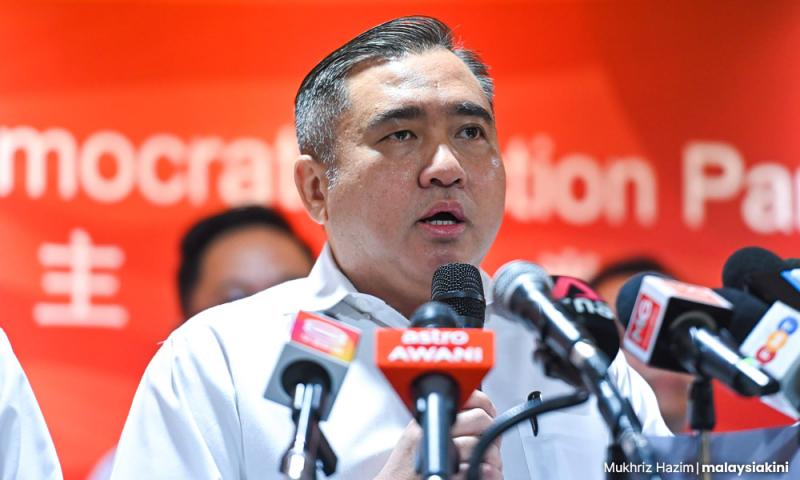
Letter by Ti Lian Ker
Dear Anthony Loke,
I feel saddened when I read your response to the concerns by Malaysians on the allegation that DAP’s concept of “Malaysian Malaysia” which originated from Lee Kuan Yew in the mid-1960s is the cause of the present racial divide and tensions.
This is definitely of grave concern to us as parents and grandparents for the future of our children and grandchildren in this multi-racial, multi-cultural and multi-religious country that we proudly call Malaysia.
You cannot simply dismiss our concerns as MCA’s or Umno’s. We are the founding fathers of this harmonious nation on the basis of the “Social Contract” of recognising the special position of the Malays and recognising Islam as the religion of the federation as entrenched in our Federal Constitution.
Our past prime ministers under the Alliance and BN had pronounced this country as secular but this has changed over the years when DAP chose to question some of the fundamentals and core values established and accepted by our founders Tunku Abdul Rahman, Tan Cheng Lock and V T Sambanthan.
Raising concerns
Dear minister,
You can rest assured that our concern has nothing to do with the by-elections in Pulai and Simpang Jeram. Our concern goes beyond elections. We are very, very concerned for the future of our next generations.
Stop playing the victim. DAP is not the punching bag but the biggest and most dominant party in the government today. As you have correctly pointed out in Sinchew Jit Poh on Sept 1, DAP is bigger than Umno and PKR in terms of representation.
Dear Anthony Loke,
I feel saddened when I read your response to the concerns by Malaysians on the allegation that DAP’s concept of “Malaysian Malaysia” which originated from Lee Kuan Yew in the mid-1960s is the cause of the present racial divide and tensions.
This is definitely of grave concern to us as parents and grandparents for the future of our children and grandchildren in this multi-racial, multi-cultural and multi-religious country that we proudly call Malaysia.
You cannot simply dismiss our concerns as MCA’s or Umno’s. We are the founding fathers of this harmonious nation on the basis of the “Social Contract” of recognising the special position of the Malays and recognising Islam as the religion of the federation as entrenched in our Federal Constitution.
Our past prime ministers under the Alliance and BN had pronounced this country as secular but this has changed over the years when DAP chose to question some of the fundamentals and core values established and accepted by our founders Tunku Abdul Rahman, Tan Cheng Lock and V T Sambanthan.
Raising concerns
Dear minister,
You can rest assured that our concern has nothing to do with the by-elections in Pulai and Simpang Jeram. Our concern goes beyond elections. We are very, very concerned for the future of our next generations.
Stop playing the victim. DAP is not the punching bag but the biggest and most dominant party in the government today. As you have correctly pointed out in Sinchew Jit Poh on Sept 1, DAP is bigger than Umno and PKR in terms of representation.

You won 40 parliamentary seats and have a near absolute win of 98 percent in the recent six state elections. That is no testament that DAP has contributed well to the future of our generations.
It merely shows that you have won in elections by successfully gaining 95 percent of the Chinese votes with your promises of equal rights, doing away with bumiputera and non-bumiputera distinction, quotas and bringing back English as the official language and allowing Chinese and Tamil to be used in state assemblies and in Parliament.
Dear minister,
You and DAP may have successfully won the hearts and minds of most Chinese and Indian voters, but the elephant is still in the room. The majority of the Malays who form the most dominant race in the country are rejecting DAP and those associated with it.
DAP has also admitted that there’s a “Green Wave” whereby the Malays young and old, the government bureaucrats and the police and armed forces are running scared of DAP despite assurances from the party PAS, former prime minister Dr Mahathir and Prime Minister Anwar Ibrahim.
The question is: Are they afraid of your “Malaysian Malaysia”? Will DAP’s recalcitrance of playing extreme politics lead to more extremism as the saying goes, “extremism begets extremism”.
Stop playing victim
Dear minister,
You are not a punching bag, but you are the boxer with the biggest punches. Why are you playing the victim and not standing up to address the issues and political challenges right in front of our eyes? Must we see the coffin, then only we cry?
Please don’t run away from your responsibility as a statesperson. Please don’t play victim but be accountable and transparent to the rakyat. Please be man enough to own up to the mistakes of the past and not sidestep relevant questions and concerns of all Malaysians.
Dear minister,
Let me take you back to the memories of the past for you to see the gravity of the rakyat’s concern instead of mere politics and politicking for elections or by-elections sake.
1. Lee’s “Malaysian Malaysia” had stressed out the late Tunku and caused great anxiety to the Malays, leading to the expulsion of Singapore when the Parliament of Malaysia voted 126-0, with all Singaporean MPs boycotting the vote, in favour of the expulsion on Aug 9, 1965.
2. DAP’s “Malaysian Malaysia” in 1967 promising irrevocably to do away with bumiputrra and quotas in scholarship, public services, etc, helped DAP to gain more than half of MCA’s parliamentary seats successfully in 1969 but also caused the downfall of the Alliance and Tunku (who upheld a multiracial and a secular state) with the emergence of “Ultra Malays” in reaction to DAP’s big election win and success.
Thereafter there was an emergence of a far-right movement over the moderate path taken by the Alliance and Tunku.

3. DAP’s “Malaysian Malaysia” continued to advance when they won 42 parliamentary seats leading to the formation of a new government in 2018. Despite Mahathir’s image as an “ultra Malay”, the Malays continued to fear DAP and Mahathir tried to introduce more bumiputera-friendly policies in trying to buy over the Malays but failed.
The Economy Ministry on Sept 1, 2018, held a ‘Congress on the Future of Bumiputeras and the Nation’ at the Kuala Lumpur Convention Centre.
This is unprecedented as no ministry under the previous government had used government apparatus to organise a race-based convention of this scale.
There goes the failure of DAP’s “Malaysian Malaysia” when in dominant power as the convention was officiated by Mahathir, who also presented the keynote address, to be followed by a dialogue on the future of the bumiputeras and the country.
Elephant in the room
Dear minister,
The above few incidents are sufficient to raise my points of concern for the future generation over the next election or by-elections. I don’t even want to talk about the coffins of May 13th.
Before closing, the rest of the responsible Malaysians and I are genuinely appealing to you as our leader “to do it right”. Don’t sidestep, avoid or ignore the elephant in the room.
Please address the issues raised in the spirit of transparency and accountability to the rakyat that you have promised. Don’t camouflage or shield behind the “unity government” or sensitivity under the “3Rs” as we have matured.
Has DAP forgotten about the competency, accountability, transparency policy?
TI LIAN KER is MCA vice-president.
No need to drop ‘Malaysian Malaysia’, says Loke
FMT:
No need to drop ‘Malaysian Malaysia’, says Loke
DAP secretary-general Loke Siew Fook says the party remains committed to upholding and defending the Federal Constitution.
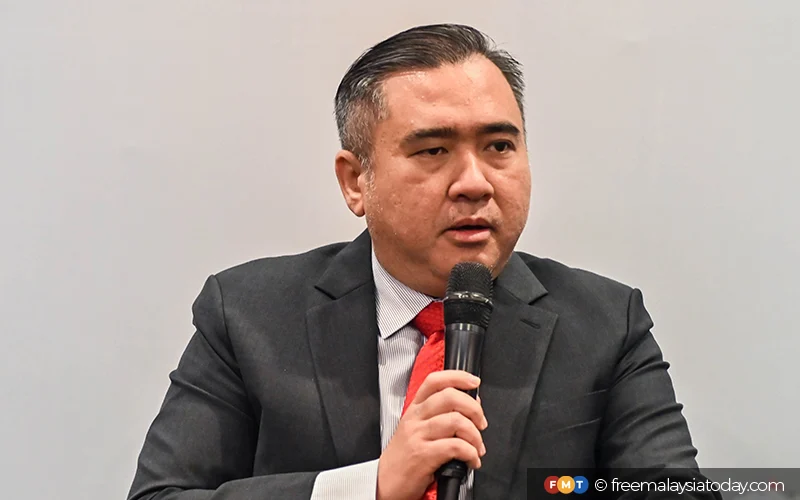
Loke Siew Fook said he had clarified the provisions in DAP’s constitution which had caused concern among Malays before the unity government was formed.
PETALING JAYA: DAP does not need to drop its “Malaysian Malaysia” slogan and secular state agenda, says its party chief.
According to DAP secretary-general Loke Siew Fook, he had clarified the provisions in the party’s constitution which had caused some concern among Malays, following the outcome of the general elections last November, Berita Harian reported.
“Before the unity government was formed, DAP gave its commitment to support the principle of Islam as the official religion of the federation, to respect the sanctity of the Malay language, and to uphold Article 153 of the Federal Constitution,” he said.
“Umno president Ahmad Zahid Hamidi was satisfied with our explanation before Barisan Nasional (BN) joined Pakatan Harapan (PH) to form the unity government.
“What is important today is that we have formed a unity government and are working together on the basis of the most important thing, which is upholding and defending the Federal Constitution,” he said after attending a PH ceramah in Muar last night.
Loke, who is also transport minister, added that prior to the unity government’s formation, all parties agreed not to touch on the principles and constitutions of their new partners.
Earlier this week, Umno Supreme Council member Nur Jazlan Mohamed urged DAP to drop the “Malaysian Malaysia” slogan from its party constitution if it wants to gain the support of Malay voters.
Nur Jazlan claimed that Malays were hesitant to fully support DAP because of its secular state agenda, which “contradicts Islamic and Malay principles”.
In response, Loke said that instead of focusing on such issues, it would be better for the parties in the unity government to work on how to increase its support from Malay voters.
“I must emphasise though, in my constituency the majority of voters are Malay, but I won (the seat in GE15). So there is no issue of DAP not being able to get Malay support,” the Seremban MP said.
“People will judge (parties) not based on their ideologies, but on their work and track record of service in the area.”
In GE15, Loke defended the Seremban parliamentary seat by defeating Perikatan Nasional’s Fadli Che Me with a 30,844-vote majority. Loke first won the seat in 2013.
In the Negeri Sembilan state election last month, Loke successfully defended his Chennah state seat.
PETALING JAYA: DAP does not need to drop its “Malaysian Malaysia” slogan and secular state agenda, says its party chief.
According to DAP secretary-general Loke Siew Fook, he had clarified the provisions in the party’s constitution which had caused some concern among Malays, following the outcome of the general elections last November, Berita Harian reported.
“Before the unity government was formed, DAP gave its commitment to support the principle of Islam as the official religion of the federation, to respect the sanctity of the Malay language, and to uphold Article 153 of the Federal Constitution,” he said.
“Umno president Ahmad Zahid Hamidi was satisfied with our explanation before Barisan Nasional (BN) joined Pakatan Harapan (PH) to form the unity government.
“What is important today is that we have formed a unity government and are working together on the basis of the most important thing, which is upholding and defending the Federal Constitution,” he said after attending a PH ceramah in Muar last night.
Loke, who is also transport minister, added that prior to the unity government’s formation, all parties agreed not to touch on the principles and constitutions of their new partners.
Earlier this week, Umno Supreme Council member Nur Jazlan Mohamed urged DAP to drop the “Malaysian Malaysia” slogan from its party constitution if it wants to gain the support of Malay voters.
Nur Jazlan claimed that Malays were hesitant to fully support DAP because of its secular state agenda, which “contradicts Islamic and Malay principles”.
In response, Loke said that instead of focusing on such issues, it would be better for the parties in the unity government to work on how to increase its support from Malay voters.
“I must emphasise though, in my constituency the majority of voters are Malay, but I won (the seat in GE15). So there is no issue of DAP not being able to get Malay support,” the Seremban MP said.
“People will judge (parties) not based on their ideologies, but on their work and track record of service in the area.”
In GE15, Loke defended the Seremban parliamentary seat by defeating Perikatan Nasional’s Fadli Che Me with a 30,844-vote majority. Loke first won the seat in 2013.
In the Negeri Sembilan state election last month, Loke successfully defended his Chennah state seat.
ALL MUSLIM INTELLECTUALS PLEASE READ CAREFULLY : BLASPHEMY LAWS AND SCHOLARSHIP
Saturday, September 2, 2023
ALL MUSLIM INTELLECTUALS PLEASE READ CAREFULLY : BLASPHEMY LAWS AND SCHOLARSHIP
I have adapted the following (shortened and edited) from this opinion by one Faisal CK who is the Deputy Law Secretary to the Government of Kerala. The original article is here:

Blasphemy protects the religion of the majority and is an anti-democratic concept.
By Faisal CK
By Faisal CK
Aug 16 mobs set ablaze Salvation Church, Saint Paul Church in Pakistan
ransacked and torched homes, leaving 3,000 residents displaced
In Pakistan 2,000 people accused of blasphemy since 1987, 84 killed
In Pakistan 2,000 people accused of blasphemy since 1987, 84 killed
Blasphemy protects religion of dominant groups
majoritarian and anti-democratic concept
“blasphemy” a reality – with deadly consequences – in South Asia.
prosecution of religious criticism and offences
Jamaat-e-Islami unsuccessfully pushed for death penalty for blasphemy
blasphemy allegations led to killings in Bangladesh
2017 Mauritania strengthened blasphemy to include capital punishment
Afghanistan, Iran, Nigeria, Pakistan, Saudi Arabia, Somalia death for blasphemy
Afghanistan, Iran, Nigeria, Pakistan, Saudi Arabia, Somalia death for blasphemy
Blasphemy is rarely religious, more politics and often sex
Gods and kings support each other and demand reverence
Bible enjoins: “You shall not blaspheme God or curse a leader of your people” (Exodus 22:28).
One person’s truth is often another person’s blasphemy.
western countries abolished blasphemy:
Denmark 2017, Canada 2018, New Zealand 2019.
in 1949 English judge Tom Denning said blasphemy was a “dead letter”.
deorum injuriae diis curae – let the gods defend their own honour
presumptuous, impertinent for weak men to defend god.
It is time to stop shedding human blood for god’s vanity
presumptuous, impertinent for weak men to defend god.
It is time to stop shedding human blood for god’s vanity
Faisal CK is Deputy Law Secretary to the Government of Kerala. Views are personal.
My Comments :
This story here is very simple. These are the so called Blasphemy Laws. In other countries they are camouflaged under aqidah laws, shariah enactments, apostasy laws (murtad) etc.
The idea is the same : if any Muslim professes a belief not agreeable to the ruling sectarian orthodoxy or the majority sectarian orthodoxy in that country then such a person can suffer State sanctioned hatred and violence against him. Meaning he can be vilified, arrested, charged in some type of justice system, jailed, fined, whipped or even killed. All done by the State using the enforcement and police powers of the State. Also known as State sanctioned use of violence.
In the Quran there is not a single prescription of any kind of punishment for rejecting belief and becoming a kafir.
Instead the Quran says the following:
Surah 4:137 إِنَّ ٱلَّذِينَ ءَامَنُوا۟ ثُمَّ كَفَرُوا۟ ثُمَّ ءَامَنُوا۟ ثُمَّ كَفَرُوا۟ ثُمَّ ٱزْدَادُوا۟ كُفْرًۭا لَّمْ يَكُنِ ٱللَّهُ لِيَغْفِرَ لَهُمْ وَلَا لِيَهْدِيَهُمْ سَبِيلًۢا
Surah 4:137 Surely those who believe, then disbelieve (kafir), then believe, then disbelieve (kafir) then increase in disbelief (kafir) - Allah will not forgive them nor guide them on the way.
Obviously a person has to be alive to "believe, then kafir, then believe, then kafir, then increase in kafir . . "
If he is to be killed after his first act of kafir or disbelief then the rest of the verse above will be not necessary. But on the contrary the rest of Surah 4:137 is very necessary. Hence in Surah 4:137 above we cannot see any punishment prescribed for a person who leaves belief and becomes a kafir. Allah will not guide such a person or show him the way - a terrible fate indeed.
Blasphemy and scholarship.
The blasphemy laws have a more significant impact on the entire spectrum of Islamic scholarship.
The same blasphemy laws, shariah enactments, aqidah laws, apostasy laws etc that apply to the ordinary Muslim also apply to all Islamic scholars.
Any Islamic scholarship must be bound by whatever sectarian orthodoxy is dominant in that country. Otherwise if an Islamic scholar undertakes research not in keeping with the sectarian orthodoxy that is dominant in his country that scholar suffers the risk of being punished with committing a crime.
For example there was the case of :
"Nasr Abu Zayd case. Zayd's academic work on the Qur'an led to a lawsuit against him by conservative Muslim scholars. The subsequent hisbah trial led to him being declared an apostate (murtad) by an Egyptian court"
Zayd thought he was doing academic research but the rest of the orthodoxy in Egypt said he was a deviant - and legally declared him an apostate.
I have no idea what Nasr Abu Zayd said. The point is that here is a real example where Islamic academic research which did not meet with the approval of the sectarian orthodoxy in Egypt was criminalised. The researcher was taken to Court and declared an apostate.
So it depends on what orthodoxy prevails in your country. Salafism / Wahabism in Saudi Arabia (dont know about now), Shiaism in Iran, Hanafi Sunnism in Pakistan etc. If it does not follow the orthodoxy, even academic research can land the scholars in serious trouble.
So the next question that comes up is how robust is the academic scholarship when the "incorrect" scholarship can make you a criminal? You dont just have to worry about your CGPA but you must toe the line of the orthodoxy very carefully.

Selangor PH to challenge 4 seats won by PN in state polls, says MB
FMT:
Selangor PH to challenge 4 seats won by PN in state polls, says MB
Menteri besar Amirudin Shari says the election petitions to annul the results of the four seats will be filed soon.
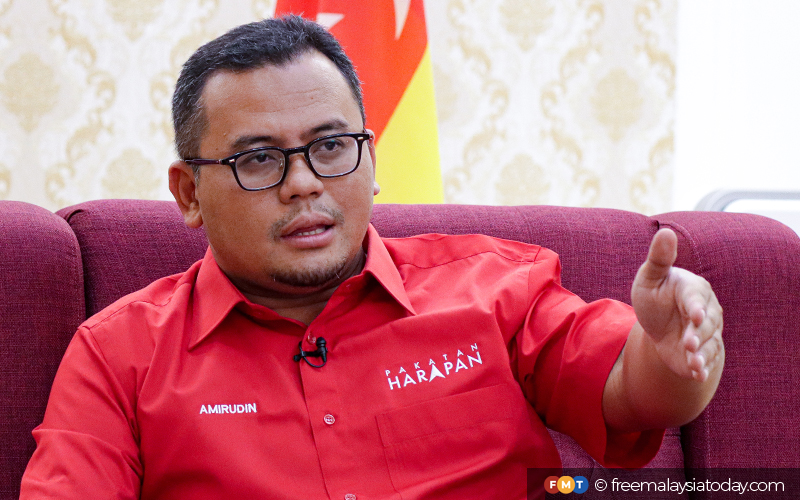
Amirudin Shari said a team of lawyers would be carrying out further research on the cases involving the four seats.
KUALA LANGAT: Election petitions to annul the results of four seats won by Perikatan Nasional (PN) in the Selangor state election last month will be filed soon, says menteri besar Amirudin Shari.
“The petitions are being fine tuned. We have discussed them on behalf of PKR first and we have checked all matters. We will file them soon. We are just waiting for the process of the gazette decision that has been done,” he told reporters after officiating the Selangor-level 2023 Fit Malaysia programme here.
Earlier, the Election Commission (EC) had announced that the results and voting statements after the official tallying of the votes in six state elections were gazetted on Aug 29.
Prior to this, Pakatan Harapan (PH) and Barisan Nasional (BN) were considering filing election petitions to annul the results of the Sungai Kandis, Taman Medan, Gombak Setia and Dengkil state seats, where the victory margins were low.
The results for the four seats saw candidates from either PH or BN lose by 407 votes in Dengkil, Sungai Kandis (167), Gombak Setia (58) and Taman Medan (30).
Amirudin, who is also the Selangor PH Chairman, said the matter had been discussed in a meeting that the political bureau and the state leadership council had with a team of lawyers who would do further research on the cases involving the four seats.
Six states – Kedah, Penang, Selangor, Negeri Sembilan, Terengganu and Kelantan – went to the polls on Aug 12.
KUALA LANGAT: Election petitions to annul the results of four seats won by Perikatan Nasional (PN) in the Selangor state election last month will be filed soon, says menteri besar Amirudin Shari.
“The petitions are being fine tuned. We have discussed them on behalf of PKR first and we have checked all matters. We will file them soon. We are just waiting for the process of the gazette decision that has been done,” he told reporters after officiating the Selangor-level 2023 Fit Malaysia programme here.
Earlier, the Election Commission (EC) had announced that the results and voting statements after the official tallying of the votes in six state elections were gazetted on Aug 29.
Prior to this, Pakatan Harapan (PH) and Barisan Nasional (BN) were considering filing election petitions to annul the results of the Sungai Kandis, Taman Medan, Gombak Setia and Dengkil state seats, where the victory margins were low.
The results for the four seats saw candidates from either PH or BN lose by 407 votes in Dengkil, Sungai Kandis (167), Gombak Setia (58) and Taman Medan (30).
Amirudin, who is also the Selangor PH Chairman, said the matter had been discussed in a meeting that the political bureau and the state leadership council had with a team of lawyers who would do further research on the cases involving the four seats.
Six states – Kedah, Penang, Selangor, Negeri Sembilan, Terengganu and Kelantan – went to the polls on Aug 12.
RoS explains Muda deputy president’s blacklisting
FMT:
RoS explains Muda deputy president’s blacklisting
It says it blacklisted Amira Aisya Abd Aziz from holding office due to the revocation of registration of an NGO on Oct 28, 2022.

Muda deputy president Amira Aisya Abd Aziz has taken the RoS to court for blacklisting her from holding office in registered societies.
PETALING JAYA: The Registrar of Societies (RoS) has confirmed that it blacklisted Muda deputy president Amira Aisya Abd Aziz from holding office in registered societies due to the revocation of registration of an NGO on Oct 28.
Amira has taken the RoS to court for blacklisting her from holding office in registered societies, which the Puteri Wangsa assemblyman claims has no legal basis.
However, she did say the blacklist may have been related to her role as Persatuan Ekonomi Merdeka (PEM) secretary between Aug 3, 2017 and Oct 19 last year.
In a statement, the RoS today said it blacklisted Amira due to the revocation of PEM’s registration on Oct 28, 2022, which was carried out under Section 13(1)(c)(iv) of the Societies Act 1966.
The provision gives the RoS power to revoke the registration of a society if it has wilfully contravened the Act or its related regulations.
“This means she is also bound under Section 49 of the same Act,” said the RoS in a statement.
“The blacklist was issued based on the relevant rules and regulations such as the Societies Act, which grants the agency power to carry out such action.”
Amira is asking the Kuala Lumpur High Court to quash the RoS’s decision to blacklist her and issue a declaration that the Societies Act 1966 does not confer on the regulatory body the power to bar anyone from office.
She filed her application for leave to commence judicial review proceedings on July 13. The application was allowed on Aug 17 after the attorney-general did not object to it. Case management has been fixed on Sept 14.
In her affidavit in support of the application, Amira alleged that she found out about her blacklisting through an email from the RoS dated April 18.
The email was sent to notify her and several other activists of the RoS’s refusal to register another civil society, Persatuan Impak Wanita Malaysia (Malaysian Women Impact Association).
Amira claimed the rejection was because of her nomination as pro tem chairman of the proposed NGO.
Amira also claimed that the RoS had on Oct 19 last year revoked PEM’s registration on the recommendation of the insolvency department. It also directed that she and other committee members furnish documents about the association.
She said they gave their full cooperation to the insolvency department’s Selangor branch despite disagreeing with the cancellation of PEM’s registration.
She alleged that the blacklisting has violated her fundamental right to form an association as guaranteed under Article 10(1)(c) of the Federal Constitution.
Amira said she was prejudiced by the RoS’s actions as the blacklist would prevent her from contesting and holding a position in Muda. It will also prevent her from setting up any association to fight for women’s rights, education and the environment.
PETALING JAYA: The Registrar of Societies (RoS) has confirmed that it blacklisted Muda deputy president Amira Aisya Abd Aziz from holding office in registered societies due to the revocation of registration of an NGO on Oct 28.
Amira has taken the RoS to court for blacklisting her from holding office in registered societies, which the Puteri Wangsa assemblyman claims has no legal basis.
However, she did say the blacklist may have been related to her role as Persatuan Ekonomi Merdeka (PEM) secretary between Aug 3, 2017 and Oct 19 last year.
In a statement, the RoS today said it blacklisted Amira due to the revocation of PEM’s registration on Oct 28, 2022, which was carried out under Section 13(1)(c)(iv) of the Societies Act 1966.
The provision gives the RoS power to revoke the registration of a society if it has wilfully contravened the Act or its related regulations.
“This means she is also bound under Section 49 of the same Act,” said the RoS in a statement.
“The blacklist was issued based on the relevant rules and regulations such as the Societies Act, which grants the agency power to carry out such action.”
Amira is asking the Kuala Lumpur High Court to quash the RoS’s decision to blacklist her and issue a declaration that the Societies Act 1966 does not confer on the regulatory body the power to bar anyone from office.
She filed her application for leave to commence judicial review proceedings on July 13. The application was allowed on Aug 17 after the attorney-general did not object to it. Case management has been fixed on Sept 14.
In her affidavit in support of the application, Amira alleged that she found out about her blacklisting through an email from the RoS dated April 18.
The email was sent to notify her and several other activists of the RoS’s refusal to register another civil society, Persatuan Impak Wanita Malaysia (Malaysian Women Impact Association).
Amira claimed the rejection was because of her nomination as pro tem chairman of the proposed NGO.
Amira also claimed that the RoS had on Oct 19 last year revoked PEM’s registration on the recommendation of the insolvency department. It also directed that she and other committee members furnish documents about the association.
She said they gave their full cooperation to the insolvency department’s Selangor branch despite disagreeing with the cancellation of PEM’s registration.
She alleged that the blacklisting has violated her fundamental right to form an association as guaranteed under Article 10(1)(c) of the Federal Constitution.
Amira said she was prejudiced by the RoS’s actions as the blacklist would prevent her from contesting and holding a position in Muda. It will also prevent her from setting up any association to fight for women’s rights, education and the environment.
Have we become a nation of prudes?

Have we become a nation of prudes?

IN THE last week, netizens were quick to react to a public performance by a group of belly dancers in the popular shopping haven of Bukit Bintang.
The matters seem to have been resolved as the authorities have shut down the shop that commissioned the dancers as they were foreigners who did not have the necessary paperwork to run a business.
But the deeper underlying issue is how this performance have sparked outrage with sensationalist headlines in local media labelling the dancers as being “partially nude”. Many netizens have complained that such a performance was entirely inappropriate for a Muslim country, sparking again the sensitive issue of what is permissible dress code in this country.
While this may be an extreme example, it is this prevailing mood of ultra-sensitiveness that has led to a whole slew of issues.
Ranging from security guards at government complexes acting as moral guardians in determining appropriate skirt lengths to a Kelantanese woman being fined for wearing shorts in her own business premises, the screeching voice of ultra-conservatives have become deafening.
It is this prevalent view that local mores are under attack from undesirable foreign influences that sees the Oscar ceremony being censored as actresses showing too much skin are pixelated, much like the images of the belly dancers were in Sinar Daily’s coverage.
The question is when did Malaysians become such a prudish bunch? While the belly dancing performance may not have been appropriate for such a public domain, it is felt that current prevailing sentiment is allowing conservative elements to have the over-riding say in how Malaysians live.

National gymnast Farah Ann Abdul Hadi knows how to dress moderately when she’s not in action
What next? Female athletes being censured for competing in attire deemed too revealing. Remember the furore over local gymnast Farah Ann Abdul Hadi’s attire a few years back.
Instead of celebrating her success in the sporting arena, focus was on her leotards. Is this the society Malaysians want to be living in where everything is scrutinised under very narrow and dogmatic lens?
Is the Olympics going to be censored next? Or the ladies’ event at Wimbledon which saw Ons Jabeur become the first Muslim player to reach the finals of this prestigious event?
There are far more important bread and butter issues affecting all Malaysians, not least the fragile state of the economy.
Everyone should also be asking how it is possible for foreigners to be operating a business so openly without the necessary documentation instead of harping on them hiring belly dancers to provide some entertainment. – Sept 1, 2023
Friday, September 01, 2023
Addressing Malaysia’s shift to the far right
Cover Story: Addressing Malaysia’s shift to the far right
By Kamarul Azhar / The Edge Malaysia
31 Aug 2023, 02:00 pm

This article first appeared in The Edge Malaysia Weekly on August 21, 2023 - August 27, 2023
Government’s effectiveness crucial in bringing Malaysia back to the centre
The 15th general election (GE15) last November and the just-concluded six state elections show a polarised, diverging Malaysia, divided by race-and-religion “right wing” politics on one side, and more inclusive, multiracial politics on the other.
The results from these elections show that the Malays, who make up the majority of the nation’s population, have largely abandoned Umno and Barisan Nasional (BN), and opted for Parti Islam Se-Malaysia (PAS) and its Perikatan Nasional (PN) coalition partner Parti Pribumi Bersatu Malaysia.
By choosing PAS as their major political platform, the Malays seem to have aligned themselves with the party’s Islamist policies, which some say are too extreme for a multiracial and multireligious country like Malaysia.

Nungsari: The move to extremes is a global phenomenon. The Malay-Muslims here and the white Make-America-Great-Again supporters of former US president Donald Trump have many things in common. (Photo by Suhaimi Yusuf/The Edge)
PAS or its candidates have not been shy about using Islam as a political tool, causing division among the people, especially where Quranic verses and narratives of the Prophet Muhammad were taken out of context just to win votes.
In an episode of former cabinet minister Khairy Jamaluddin and former Umno Youth chief Shahril Hamdan’s “Keluar Sekejap” podcast, Wan Ahmad Fayhsal, the member of parliament for Machang, admitted to having used Islamic scriptures to win in GE15.
“When I was announced as the candidate to contest in Kelantan, I had my mindset ready to become a PAS candidate. I had to recall a lot of things that I had learnt in the university, among them the Quranic chapters, hadiths, and verses that PAS members were using.
“Because I needed to show to the voters in Machang that I was more ‘PAS’ than the PAS members themselves. That’s my winning formula,” he said.
However, while PAS deserves credit for its popularity among the Malays, political analysts and economists believe the Malay move towards the far right is also a result of the failure of successive governments to meet the needs of the people.
“The move to extremes is a global phenomenon. The Malay-Muslims here and the white Make-America-Great-Again supporters of former US president Donald Trump have many things in common,” says economist and political observer Dr Nungsari Radhi.
“Their marginalisation was driven by forces of globalisation externally and policy failures at home,” he adds.

Merdeka Centre’s Ibrahim: Some of the younger voters may have also been influenced by the Islamic image of some parties, over what it really can deliver (Photo by Merdeka Centre)
Government must work for the people
In the US, fiscal conservatives cut budgets, underfunding schools in towns hollowed out by globalisation and at the same time, cut taxes for the rich, says Nungsari.
In Malaysia, the bumiputera policy, which has morphed into a form of rent-seeking platform instead of a national development agenda, has not developed the bumiputeras themselves, he points out.
This has resulted in the community becoming dependent on public institutions — from schools to public service agencies — which have themselves been debilitated by the policy, Nungsari adds.
The bumiputera economic agenda started out as a national policy in 1971 with the formation of the New Economic Policy (NEP) that favours the largely Malay group. While the NEP officially ended in 1990, the bumiputera economic and social agenda continues to this day.
While there have been successes, especially in creating middle-class bumiputeras, critics say the policy has been abused by the political elite to enrich themselves. Meanwhile, the bumiputera masses are still lagging behind the other communities in the country.
The government’s failure to upgrade the livelihoods of the bumiputeras, especially the Malays, even 30 years after the official end of the NEP while a select few continued to enrich themselves, has caused the slow but steady switch of Malay votes from Umno to the other parties.

Ilham Centre’s Hisommudin: The government’s information and communication machinery must be more effective (Photo by Facebook)
“The politics became more about identity — the whites building America and Malay supremacy over here. It’s the same dynamics, in my view,” says Nungsari.
The 1Malaysia Development Bhd (1MDB) scandal marked the moment of political awakening for many Malays, who realised that they could no longer place their faith in Umno to improve their livelihoods.
In 2018, the Malays started to abandon Umno, initially for Bersatu, which was then part of the Pakatan Harapan (PH) coalition, and then PAS, when both parties became part of the same coalition after the Sheraton Move in February 2020.
And now, PN has largely cornered the Malay votes in the country, through their simple messaging that resonates the most with the community — struggle for race and religion. The political messaging spread like wildfire among the younger voters through the coalition’s smart and effective use of short-form video platform TikTok. The strategy proved to be a success, as could be seen from the GE15 results.
Meanwhile, PH employed a more moderate, middle-Malaysia narrative that is against corruption and nepotism. However, after decades of being told that their position in Malaysia is under siege, it is easy to see why the Malays gravitated towards PN.
“Some of the younger voters may have also been influenced by the Islamic image of some parties, over what it really can deliver,” says Ibrahim Suffian, co-founder and programmes director of the Merdeka Centre for Opinion Research.

Universiti Sultan Zainal Abidin’s Wan Rohila says the government must let the people know what it is doing to upgrade their livelihood, in order to draw them back to the centre (Photo by Unisza)
“It is perhaps the result of a decades-long Islamisation process that has moulded Muslim voters to focus on the forms or image of political leadership as opposed to their substantive capacity to improve standards of living, generate economic growth or deliver on better governance,” he says.
Meanwhile, in response to the growing influence of PAS, some members of PH component parties, especially the Democratic Action Party (DAP), also played on the non-Muslims’ fear of a more conservative way of life had PN managed to secure the state government in Penang or Selangor, where the party is dominant. This too had exacerbated the distrust between the communities in Malaysia. While the DAP at the national level advocated for a middle-ground Malaysia, during the campaigning period some of its candidates and even members of the public did not shy away from planting fear among the electorate, especially the non-Muslims, of having PN form the state government in Penang or Selangor.
And with the results of GE15 that led to the formation of a unity government between PH and BN, the trust deficit among the Malays with the latter could have widened further, resulting in them switching en masse to PAS.
While it is the right of the Malays to vote for whomever they feel represents their interests the best, it is concerning for some that many of them voted on the lines of race and religion, more than good governance.
According to political think tank ILHAM Centre, 46% of the voters in Kedah that it surveyed preferred a coalition that prioritises the Malay-Muslim agenda, more than a coalition that promises to provide better services as a government.
This rate is higher in both Terengganu and Kelantan, where 55% and 73% of respondents respectively chose a coalition that prioritises the Malay-Muslim struggle, as opposed to only 45% and 27% that wanted a government that governed well.
At the same time, most voters surveyed by ILHAM Centre in Selangor, Negeri Sembilan and Penang (85%) were looking to choose a coalition that could govern their respective states well.
The survey, conducted from July 29 to Aug 8, involved 2,304 respondents.
“Looking at the studies, 75% of Malay voters in the three PN-ruled states said they were very confident that the coalition (PN) could defend the position of Malays and Islam. In the PH-ruled states, between 53% and 62% of Malay voters felt the same way.
“On the question of priorities of the Malay voters — between good governance and focus on Malay-Muslim agenda — the answers were also clearly divided among respondents of the states,” says Hisommudin Bakar, Ilham Centre’s chief executive.
Nevertheless, Merdeka Centre’s Ibrahim says while it appears that nearly two-thirds of Malay voters chose PN over BN or PH, why they did so cannot be simply generalised.
“One reason is many were disappointed with how the government handled the cost of living issue both in the past couple of years and headed into this year. From another angle, many voters were also influenced by polarising rhetoric that began in 2018 against the multiethnic PH coalition,” he says.
Economic developments equally important
The government’s failure to control the narrative on Islam and governance has led to institutions such as nurseries, schools and even colleges to be hijacked by extremists of all sorts, says Nungsari.
Instead of upholding the constitution and preaching national competitiveness, these institutions, often privately funded, spread parochial and bigoted views of Islam, he adds.
“That didn’t happen overnight. It took decades. We allowed it,” Nungsari says.
According to Dr Wan Rohila Ganti Wan Abdul Ghapar, senior lecturer at the faculty of law and international relations in Universiti Sultan Zainal Abidin, the government must let the people know what it is doing to upgrade their livelihood, in order to draw them back to the centre.
“See how PN fully utilised YouTube advertisements; while watching Korean dramas, there were advertisements on PN and we were ‘forced’ to watch their promo,” says Wan Rohila, adding that the government must also intensify its messaging through mosques and online platforms.
“Knowing that the Malays are close to masjids, attend religious classes and watch live tazkirah (talks on religious topics) delivered by ustaz and ustazah, send as many local preachers to teach Islam and always relate that Islam is not that narrow.
“Reach the mosques, the online medium, as so far, most of the celebrity preachers are inclined towards PAS. Engage with the youth and be creative,” she says.
The unity government must also show commitment to combat corruption, Wan Rohila adds.
Many political analysts point out that one of the reasons for PN’s success in securing 22 seats in Selangor was the voters’ rejection of deputy prime minister and Umno President Datuk Seri Zahid Hamidi. Zahid is facing 47 charges, of which 12 are for criminal breach of trust, eight for corruption and 27 for money laundering. He is accused of embezzling millions of ringgit from Yayasan Akalbudi and accepting bribes for various projects during his tenure as the home minister between 2013 and 2018.
However, Prime Minister Datuk Seri Anwar Ibrahim has often reiterated that the unity government has not interfered in the process of the courts. He has also made it clear that the unity government will not tolerate corruption on any level.
“The government’s information and communication machinery must be more effective. For me now, the information agency has not been effective in informing the people (on government policies and programmes),” says ILHAM Centre’s Hisommudin. “For example, the government’s efforts in reducing the prices of goods, providing higher subsidies to rice farmers, did not reach the people effectively. At the end of the day, negative elements and fake news flooded their digital devices.”
Giving effective information and communication to the people will enable them to sieve through the messaging and make a better choice when it comes to exercising their democratic rights, rather than being influenced by fake news centred on race and religious struggles.
The issue with the government’s communication and information machinery is also echoed by Ibrahim of Merdeka Centre. He says the unity government must also strengthen its grassroots networks to explain its policies better.
Nungsari says the government’s response of introducing many policy initiatives that focus on the poor and marginalised, empowering women in the workplace, promoting civil society and the voluntary sector as the third pillar of society, apart from the public and private, are excellent in themselves.
“There is also an explicit recognition in the Madani framework that our economic security depends on our competitiveness regionally, which opens up the perspective that has been too domestic-oriented. These, to me, are the right responses,” he says.
But at the end of the day, effective communication of the government’s policies, especially on countering divisive messaging, is crucially needed to address the country’s slide towards the far right.
“Some of these people, their leaders, particularly, would do well to recognise that what they are advocating — turning this country inwards and putting it on some racial theocratic platform — would isolate us further, pushing us behind even our neighbours.
“We are already a laggard in the region,” says Nungsari.
Malaysia has a lot of catching up to do to become one of the region’s powerhouses, while at the same time having to address its own issues such as a stubbornly wide fiscal deficit, ballooning government debt and heavy operating expenditure that takes up almost its entire revenue.
There is no time to waste in tackling these problems, especially when the country has had a tumultuous past few years with the Covid-19 pandemic and political turmoil.
Malaysian politicians, be it the government of the day or the opposition waiting to be in power, should understand that no one wants to be the captain of a sinking ship. We need to get our priorities right.
US deports dozens to Haiti despite telling citizens to leave country
al Jazeera:
US deports dozens to Haiti despite telling citizens to leave country
Rights advocate says more than 60 Haitians were sent back to the Caribbean nation struggling with escalating violence.
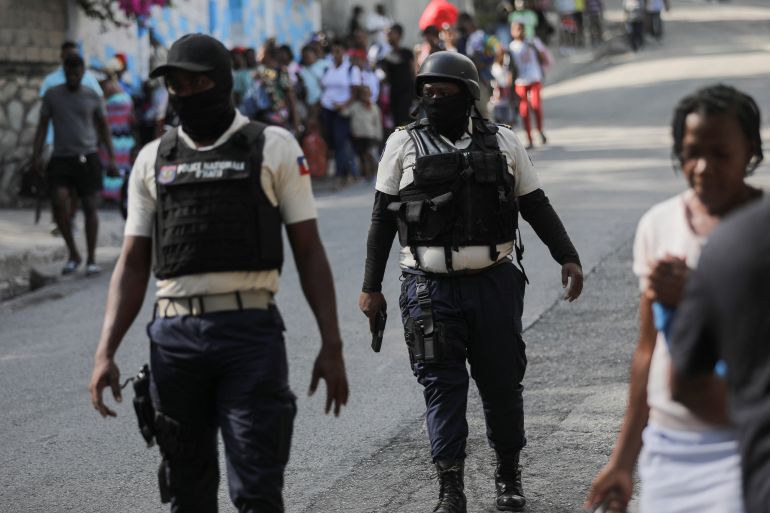
Police patrol the streets of Port-au-Prince, Haiti, on April 24 as residents flee their homes in the wake of gang clashes [File: Ralph Tedy Erol/Reuters]
Published On 31 Aug 2023
Less than 24 hours after the United States urged its citizens to leave Haiti “as soon as possible” due to increased violence, authorities deported dozens of Haitian nationals back to the country, an immigration rights advocate has confirmed.
Published On 31 Aug 2023
Less than 24 hours after the United States urged its citizens to leave Haiti “as soon as possible” due to increased violence, authorities deported dozens of Haitian nationals back to the country, an immigration rights advocate has confirmed.

Guerline Jozef, executive director of the Haitian Bridge Alliance advocacy group, told Al Jazeera she has been in contact with some of the families of the Haitians who were on Thursday’s removal flight from Alexandria, Louisiana, to Port-au-Prince.
US media outlets, including The Hill and the Miami Herald, also reported on the deportation flight, which Jozef said carried more than 60 people. Several flight-tracking websites showed that a plane was set to arrive in the Haitian capital from Alexandria shortly before noon local time.
Resuming deportations to Haiti is “inhumane”, Jozef said, explaining that asylum seekers and migrants are being sent back to the same conditions they fled in the first place, if not worse.
She compared the crisis in Haiti to a raging fire. “You have a burning house, and you have people, including children, in that burning house,” she said. “Instead of sending the firefighters to save the people, you’re dropping people into the fire.”
One of the poorest countries in the world, Haiti has been facing rampant gang violence. It has also suffered from periodic natural disasters and a longstanding political deadlock made worse by the assassination of President Jovenel Moise in July 2021.
Haiti violence: Several killed as gang open fire on protesters
On Wednesday, the US embassy in Haiti called on American citizens to leave the country, citing “the current security situation and infrastructure challenges”.
The announcement went a step further than previous warnings against travelling to Haiti. In July, Washington also ordered the departure of non-emergency government employees from Haiti.
“Do not travel to Haiti due to kidnapping, crime, civil unrest, and poor healthcare infrastructure,” a US State Department travel advisory for Haiti reads.
Last year, US Immigration and Customs Enforcement (ICE) deported 1,532 Haitian citizens, compared with 353 in fiscal year 2021.
But the latest removal flight has left Haitians in the US in disbelief, Jozef said, particularly after the State Department’s recent warnings about security conditions in the country.
“Everybody’s afraid because they don’t know what will happen. They cannot believe this is happening, that there could be deportation to Haiti right now,” she said.
ICE and the State Department did not respond to Al Jazeera’s request for comment by the time of publication.
Asked about US immigration policy more generally during a news briefing on Thursday, White House spokesperson Karine Jean-Pierre said President Joe Biden is seeking to rebuild a “broken” system, highlighting policies designed to stem arrivals across the US-Mexico border.
“The president has done more to secure the border to deal with this issue of immigration than anybody else,” Jean-Pierre said.
Haiti gang violence: 3,100 flee homes in capital within 24 hours
But Jozef said that while Biden has pushed for certain reforms, he kept many policies from his predecessor, former Republican President Donald Trump, including deportations.
Rights advocates have long warned against deporting people back to Haiti.
In April, the United Nations Committee on the Elimination of Racial Discrimination (CERD) called on countries in the Americas to “suspend the forced return of Haitians to their country, taking into account the current situation in Haiti”.
In 2021, Daniel Foote resigned as the US special envoy for Haiti in response to the mass deportations under the Biden administration. Later that year, he told US lawmakers that sending people back to Haiti worsens the situation on the ground.
“Haiti is too dangerous,” Foote said at that time. “Our own diplomats cannot leave our compound in Port-au-Prince without armed guards.”
On Thursday, Jozef also told Al Jazeera that deporting people under the chaotic conditions further destabilises Haiti. “The situation is extremely bad,” she said.
Subscribe to:
Posts (Atom)