
Stay or go? DAP faces catch-22 as crucial congress vote looms

At the upcoming DAP national congress, delegates will decide whether party leaders should leave federal government posts while continuing to support Prime Minister Datuk Seri Anwar Ibrahim in Parliament. — File picture by Hari Anggara
Summary
- At the DAP national congress in Kuala Lumpur, around 4,000 delegates debated whether to remain part of the federal Cabinet or leave while continuing to support Prime Minister Anwar Ibrahim, following recent electoral setbacks.
- The party faces a strategic dilemma, as remaining could signal compromises without sufficient reforms, while exiting might challenge political cohesion before the upcoming general election.
- Despite not withdrawing support for Anwar, the decision could influence DAP's role and how it addresses voter concerns on reform and stability as the next general election approaches.
By Muhammad Yusry
First Published: Saturday, 08 Aug 2026 7:00 AM MYT
KUALA LUMPUR, Aug 8 — DAP delegates will gather on August 16 for the party’s national congress, where they will face a political catch-22 that could shape its strategy heading into the next general election.
Roughly 4,000 delegates are expected to vote on whether DAP leaders should remain in government posts, including the federal Cabinet, or relinquish those positions while continuing to support Prime Minister Datuk Seri Anwar Ibrahim in Parliament.
The decision comes after a difficult 10 months for the party.
DAP lost all eight seats it contested in the Sabah election last November before suffering further setbacks in Johor and Negeri Sembilan.
Among the casualties was its secretary-general Anthony Loke Siew Fook, who lost his Chennah state seat in the Jelebu parliamentary constituency after serving three terms.
The Cabinet dilemma
The setbacks have fuelled frustration among grassroots members who believe governing has cost DAP politically without producing enough reforms to justify the compromises made over the past three and a half years.
Delegates are now weighing two competing risks.

Grassroots frustration has grown over what members see as insufficient reform despite DAP’s compromises during more than three years in government. — File picture by Shafwan Zaidon
Remaining in government could reinforce criticism that the party has compromised too much while reforms have progressed too slowly.
Leaving the Cabinet, meanwhile, could satisfy members demanding a stronger stance but create a different political challenge.
Many voters may not distinguish between leaving the executive and continuing to support the government in Parliament.
Instead, a Cabinet exit could be viewed as a sign that the unity government is losing cohesion before the next general election, which must be held by February 2028.
The competing pressures reflect the different audiences DAP is trying to address.
Grassroots members want the party to acknowledge that recent election setbacks were linked to slower-than-expected reforms while in government.
Many voters, meanwhile, may expect parties in government to complete a full parliamentary term, particularly after stability has been repeatedly presented as essential for economic growth and policy reforms.
A precedent in Melaka
DAP leaders have already ruled out withdrawing parliamentary support for Anwar or leaving Pakatan Harapan.
The proposed arrangement of relinquishing executive positions while remaining politically aligned with the government has a recent, though not exact, parallel in Melaka.
Last month, Melaka DAP withdrew from the state government after objecting to a Bill allowing the appointment of nominated assemblymen.
Its representatives resigned from their state administration posts and its four assemblymen moved to the Opposition bench, although the BN-led state government remained intact as BN retained a two-thirds majority in the assembly.
The August 16 vote will determine whether DAP adopts a similar arrangement at the federal level by remaining part of the governing coalition while stepping out of the executive.
No easy answer
International Islamic University Malaysia political scientist Associate Professor Syaza Shukri said the debate ultimately centres on whether voters believe the government’s reform agenda has delivered meaningful change.
“The biggest concern is the lack of reform and when we say reform we have to understand it’s about reforms that are felt on the ground.
“Meaning that economic reforms that improve lives and ease of doing business. We’re talking about reforms that would not make Malaysians feel marginalised. Things seem to stay the same,” she said.
Syaza said a vote to remain in government would suggest delegates had chosen the more pragmatic course of helping the administration continue implementing its agenda.
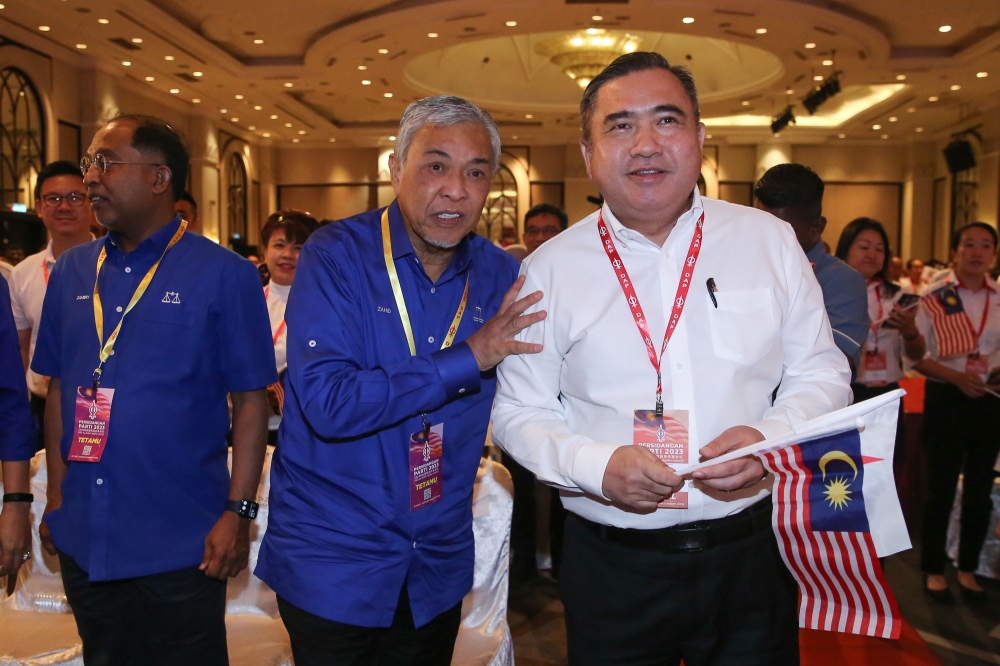
Recent tensions between DAP and Umno surfaced in Negeri Sembilan after Ahmad Zahid Hamidi urged voters to ‘kasi bungkus’ Anthony Loke, highlighting strains between key partners in the unity government. — File picture by Yusof Mat Isa
“But the implication is how can they explain this to the grassroots. Because pragmatism is basically the compromise thus far and we know that’s not very popular.”
She described leaving the Cabinet while maintaining parliamentary support as the clearest middle ground.
“I think this is already the best middle ground, which is leaving the Cabinet but not pulling parliamentary support.
“Pulling parliamentary support would cause the fall of the government. Not doing anything would not solve anything as well,” she said.
Even so, Syaza believes many Malaysians may not appreciate the distinction.
“Average voters may not understand the difference between pulling out of executive versus legislative. So public perception would be that Anwar has lost confidence.”
She said such a perception could weaken Pakatan Harapan heading into the next general election, particularly as Barisan Nasional and Perikatan Nasional appear to have regained political momentum.
Akademi Nusantara senior fellow Azmi Hassan also expects delegates to favour leaving the Cabinet while maintaining support for Anwar.
He said delegates broadly reflect the mood among grassroots members and supporters.
“I think they are more effective as the critical voice of the government. Similar to Umno, they have their Pemuda, which should be very critical of the top leadership. So DAP should be there. I think they are good at that,” he said.
According to Azmi, remaining in government has limited DAP’s ability to champion policies that resonate with its supporters.
“So I think it is best for them to opt out of the government but at the same time support the prime minister so that the stability of the Anwar government remains intact,” he said.
He said the congress provides delegates with an opportunity to reassess the party’s direction after successive election setbacks while keeping Pakatan Harapan intact ahead of GE16.

Leaving the Cabinet could give DAP greater distance from the government, but voters may interpret the move as a sign that Anwar has lost confidence within his coalition. — Bernama file pic
Looking ahead to GE16
Whichever way delegates vote, the political risks remain.
Remaining in government could deepen frustration among members who believe the party needs greater distance from the administration.
Leaving the Cabinet could satisfy those members while inviting questions over the unity government’s cohesion and DAP’s ability to influence policy from outside the executive.
The result is expected to shape DAP’s role in government for the remainder of the parliamentary term, as well as how the party positions itself before Malaysians return to the general polls.


Want to Go, Go Lah.
ReplyDeleteNo need for a To Be or Not To Be Shakespearean drama.