
Malaysia's #1 Content Aggregator
OPINION | Apparently Nothing is Sacred Anymore: When Politics Come for the Palace
26 Sep 2026 • 10:30 AM MYT
.jpg)
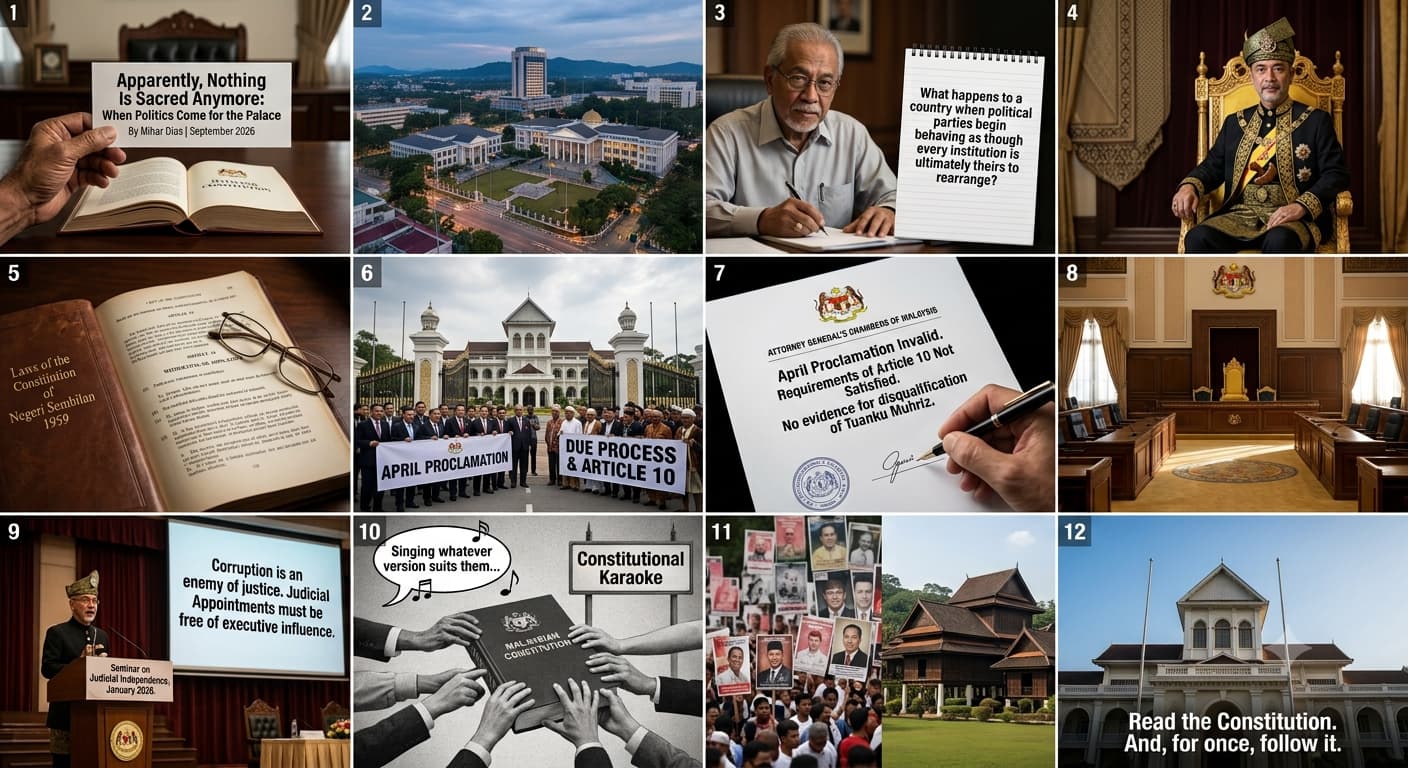
Mihar Dias on Gemini: For Illustration purposes only
By Mihar Dias September 2026
There are moments in the life of a nation when politics becomes so ambitious that it begins to believe there is nothing it cannot touch.
Not the courts.Not the civil service.Not Parliament.Not constitutions.
And apparently, if the events in Negeri Sembilan are anything to go by, not even the institution of the Yang di-Pertuan Besar.
Kalimullah Hassan’s latest column, Anarchy in Negri Sembilan, asks a question that deserves more attention than the personalities involved:
What happens to a country when political parties begin behaving as though every institution is ultimately theirs to rearrange https://www.thevibes.com/articles/opinion/127591/anarchy-in-negeri-sembilan
That is the uncomfortable question.
And it is considerably bigger than Tuanku Muhriz.
Can a political party hold the head accountable?
Let us begin with the obvious.A Menteri Besar can be held accountable.An MP can be held accountable.An ADUN can be held accountable.
A political party can be defeated, replaced, investigated, sued or ridiculed at the next election.
But can a political party decide that the constitutional head of a state should go?
That is an entirely different proposition.
In Negeri Sembilan, the question is particularly sensitive because the institution of the Yang di-Pertuan Besar is not simply a political appointment.
It exists within a constitutional and customary structure that goes back generations and is expressly recognised in the state's constitutional arrangements.
Article 10 of the Laws of the Constitution of Negeri Sembilan 1959 provides for the circumstances and process by which the Undangs may call upon the Yang di-Pertuan Besar to withdraw or abdicate. It is not simply a matter of somebody waking up one morning and announcing that the occupant has displeased them.
Indeed, political leaders themselves have stressed the requirement for a full inquiry under Article 10.
And now comes the extraordinary part.
The Attorney General's Chambers has stated that the April proclamation was invalid because the mandatory requirements of Article 10 had not been satisfied. It also said there was no evidence that any of the disqualifying circumstances in Article 10(1) applied to Tuanku Muhriz.
So perhaps the first question should not be:
Who wants Tuanku Muhriz out?
It should be:
Where is the constitutional process?
Politics is not the Constitution
This distinction seems to have become rather unfashionable.
A political party has interests.A constitution has rules.A political party can change its position.
A constitution cannot be changed simply because somebody's political position has changed.
That is precisely why constitutions exist.
Otherwise, every political crisis becomes an invitation to improvise.
And once political improvisation enters constitutional territory, everybody becomes vulnerable.
Today it may be a ruler.Tomorrow it may be a judge.The day after, an independent commission.
Eventually someone discovers that the institution previously regarded as a safeguard has become an inconvenience.Then the politicians discover a marvellous principle:
The institution is independent — until it disagrees with us.
At which point independence becomes a very expensive word with no practical meaning.
What exactly is the alleged offence?
This is perhaps the most remarkable part of the controversy.
If a constitutional head is to be removed, the public naturally wants to know:
What precisely did he do?
What constitutional provision was breached?
What evidence exists?
Who investigated it?
Was he given an opportunity to respond?
Who made the determination?
What procedure was followed?
These are not unreasonable questions.
They are the very questions upon which constitutional government depends.
The Dewan Keadilan dan Undang has subsequently maintained that Tuanku Muhriz remains the lawful Yang di-Pertuan Besar and that no valid process had removed him. It said there had been no full inquiry and no proper opportunity for him to be heard.
There are therefore competing assertions about what happened.
And that is precisely why due process matters.
A constitutional dispute cannot be settled by volume.
Nor by press conference.
Nor by political arithmetic.
Nor by who has more supporters in a room.
The irony of Tuanku Muhriz
There is another intriguing dimension to this saga.
Tuanku Muhriz has publicly spoken about institutional integrity before.
In January this year, he warned that corruption was an enemy of justice, trust and the nation's future, and expressed disappointment at support for individuals convicted of serious corruption offences.
He has also spoken publicly about judicial independence.
In 2025, he called for reforms to strengthen the independence of the Judicial Appointments Commission, warning about excessive executive influence over the judiciary. https://www.thevibes.com/articles/opinion/127591/anarchy-in-negeri-sembilan
Those are not statements about football or horse racing.
They go to the heart of institutional governance.
One can agree or disagree with a ruler's views.
That is not the point.
The point is whether disagreement with a constitutional head's position on corruption, judicial appointments or other public matters can somehow become a political reason to question the legitimacy of the institution itself.
If that becomes the precedent, Malaysia has created a rather interesting new constitutional doctrine:
Agree with us, Your Highness, or prepare your luggage.
Surely we cannot want that.
What is sacred?
Malaysia has always had certain institutions which were supposed to stand above the daily political brawl.
The Constitution.
The judiciary.
Parliament.
The monarchy.
The public service.
The electoral process.
Independent institutions.
Not because the people occupying those institutions are perfect.
They are not.
No human institution is.
But because the institutions themselves are larger than the individuals temporarily occupying them.
That is the entire point.
A ruler can be criticised.
A judge can be criticised.
A minister can be criticised.
A prime minister can be criticised.
A political party can be criticised.
But there must be rules governing how each institution is challenged, removed or replaced.
Otherwise we are not practising constitutional democracy.
We are practising constitutional karaoke — everyone singing whatever version of the Constitution happens to suit them that evening.
The dangerous precedent
Suppose a political party can exert sufficient pressure to remove a constitutional head.
What happens next?
A state ruler becomes vulnerable to political factions.
The political leadership of the day begins to acquire influence over constitutional appointments.
Traditional institutions become bargaining chips.
The civil service watches carefully.
The judiciary watches carefully.
Investors watch carefully.
And ordinary citizens watch while wondering whether the rules actually mean anything.
This is why the Negeri Sembilan episode matters even to Malaysians who could not locate Seri Menanti on a map.
It is not merely about Negeri Sembilan.
It is about institutional confidence.
If the Constitution says one thing but political power can produce another outcome, citizens eventually stop believing in the Constitution.
And once citizens stop believing in institutions, restoring confidence is considerably harder than destroying it.
The political party is temporary. The institution is not.
UMNO will come and go.
PAS will come and go.
DAP will come and go.
PKR will come and go.
BN, PH and every other coalition will eventually change form.
Politicians who currently dominate the headlines will eventually become photographs on somebody else's office wall.
That is politics.
But the institutions must survive the politicians.
That is constitutional government.
This is why nobody — regardless of party, ideology, race or royal title — should be allowed to treat constitutional institutions as political property.
If there is a legitimate constitutional case against a ruler, then make it.
Put the allegations on the table.
Follow the law.
Conduct the required inquiry.
Give the person concerned due process.
Let the constitutional machinery operate.
And if the law provides a remedy, use it.
But if the process is skipped, the problem becomes bigger than the person being removed.
The process itself becomes the casualty.
And that is where Kalimullah's warning becomes important
Kalimullah asks who is providing the "air cover" for what he describes as an unprecedented challenge to the ruler. https://www.thevibes.com/articles/opinion/127591/anarchy-in-negeri-sembilan
That is a legitimate question for journalists and citizens to ask.
But perhaps there is an even more important question:
Why should anybody require air cover to violate a constitutional process in the first place?
If the case is strong, the Constitution should provide the machinery.
If the evidence is compelling, due process should expose it.
If the offence is grave, the law should be able to deal with it.
If none of those things happens, then Malaysians are entitled to wonder what exactly is going on.
Not because they support one royal personality or another.
But because they support the idea that rules are supposed to rule.
That is the difference between constitutional government and political government.
And perhaps the most frightening thing about the Negeri Sembilan episode is not whether one ruler stays or goes.
It is whether Malaysia is slowly discovering that, in politics, nothing is sacred anymore.
Not even the rules designed to protect everybody from the people who temporarily possess power.
God save Malaysia?
Perhaps.
But before calling upon divine intervention, perhaps we should try something simpler.
Read the Constitution.
And, for once, follow it.
By Mihar Dias September 2026
There are moments in the life of a nation when politics becomes so ambitious that it begins to believe there is nothing it cannot touch.
Not the courts.Not the civil service.Not Parliament.Not constitutions.
And apparently, if the events in Negeri Sembilan are anything to go by, not even the institution of the Yang di-Pertuan Besar.
Kalimullah Hassan’s latest column, Anarchy in Negri Sembilan, asks a question that deserves more attention than the personalities involved:
What happens to a country when political parties begin behaving as though every institution is ultimately theirs to rearrange https://www.thevibes.com/articles/opinion/127591/anarchy-in-negeri-sembilan
That is the uncomfortable question.
And it is considerably bigger than Tuanku Muhriz.
Can a political party hold the head accountable?
Let us begin with the obvious.A Menteri Besar can be held accountable.An MP can be held accountable.An ADUN can be held accountable.
A political party can be defeated, replaced, investigated, sued or ridiculed at the next election.
But can a political party decide that the constitutional head of a state should go?
That is an entirely different proposition.
In Negeri Sembilan, the question is particularly sensitive because the institution of the Yang di-Pertuan Besar is not simply a political appointment.
It exists within a constitutional and customary structure that goes back generations and is expressly recognised in the state's constitutional arrangements.
Article 10 of the Laws of the Constitution of Negeri Sembilan 1959 provides for the circumstances and process by which the Undangs may call upon the Yang di-Pertuan Besar to withdraw or abdicate. It is not simply a matter of somebody waking up one morning and announcing that the occupant has displeased them.
Indeed, political leaders themselves have stressed the requirement for a full inquiry under Article 10.
And now comes the extraordinary part.
The Attorney General's Chambers has stated that the April proclamation was invalid because the mandatory requirements of Article 10 had not been satisfied. It also said there was no evidence that any of the disqualifying circumstances in Article 10(1) applied to Tuanku Muhriz.
So perhaps the first question should not be:
Who wants Tuanku Muhriz out?
It should be:
Where is the constitutional process?
Politics is not the Constitution
This distinction seems to have become rather unfashionable.
A political party has interests.A constitution has rules.A political party can change its position.
A constitution cannot be changed simply because somebody's political position has changed.
That is precisely why constitutions exist.
Otherwise, every political crisis becomes an invitation to improvise.
And once political improvisation enters constitutional territory, everybody becomes vulnerable.
Today it may be a ruler.Tomorrow it may be a judge.The day after, an independent commission.
Eventually someone discovers that the institution previously regarded as a safeguard has become an inconvenience.Then the politicians discover a marvellous principle:
The institution is independent — until it disagrees with us.
At which point independence becomes a very expensive word with no practical meaning.
What exactly is the alleged offence?
This is perhaps the most remarkable part of the controversy.
If a constitutional head is to be removed, the public naturally wants to know:
What precisely did he do?
What constitutional provision was breached?
What evidence exists?
Who investigated it?
Was he given an opportunity to respond?
Who made the determination?
What procedure was followed?
These are not unreasonable questions.
They are the very questions upon which constitutional government depends.
The Dewan Keadilan dan Undang has subsequently maintained that Tuanku Muhriz remains the lawful Yang di-Pertuan Besar and that no valid process had removed him. It said there had been no full inquiry and no proper opportunity for him to be heard.
There are therefore competing assertions about what happened.
And that is precisely why due process matters.
A constitutional dispute cannot be settled by volume.
Nor by press conference.
Nor by political arithmetic.
Nor by who has more supporters in a room.
The irony of Tuanku Muhriz
There is another intriguing dimension to this saga.
Tuanku Muhriz has publicly spoken about institutional integrity before.
In January this year, he warned that corruption was an enemy of justice, trust and the nation's future, and expressed disappointment at support for individuals convicted of serious corruption offences.
He has also spoken publicly about judicial independence.
In 2025, he called for reforms to strengthen the independence of the Judicial Appointments Commission, warning about excessive executive influence over the judiciary. https://www.thevibes.com/articles/opinion/127591/anarchy-in-negeri-sembilan
Those are not statements about football or horse racing.
They go to the heart of institutional governance.
One can agree or disagree with a ruler's views.
That is not the point.
The point is whether disagreement with a constitutional head's position on corruption, judicial appointments or other public matters can somehow become a political reason to question the legitimacy of the institution itself.
If that becomes the precedent, Malaysia has created a rather interesting new constitutional doctrine:
Agree with us, Your Highness, or prepare your luggage.
Surely we cannot want that.
What is sacred?
Malaysia has always had certain institutions which were supposed to stand above the daily political brawl.
The Constitution.
The judiciary.
Parliament.
The monarchy.
The public service.
The electoral process.
Independent institutions.
Not because the people occupying those institutions are perfect.
They are not.
No human institution is.
But because the institutions themselves are larger than the individuals temporarily occupying them.
That is the entire point.
A ruler can be criticised.
A judge can be criticised.
A minister can be criticised.
A prime minister can be criticised.
A political party can be criticised.
But there must be rules governing how each institution is challenged, removed or replaced.
Otherwise we are not practising constitutional democracy.
We are practising constitutional karaoke — everyone singing whatever version of the Constitution happens to suit them that evening.
The dangerous precedent
Suppose a political party can exert sufficient pressure to remove a constitutional head.
What happens next?
A state ruler becomes vulnerable to political factions.
The political leadership of the day begins to acquire influence over constitutional appointments.
Traditional institutions become bargaining chips.
The civil service watches carefully.
The judiciary watches carefully.
Investors watch carefully.
And ordinary citizens watch while wondering whether the rules actually mean anything.
This is why the Negeri Sembilan episode matters even to Malaysians who could not locate Seri Menanti on a map.
It is not merely about Negeri Sembilan.
It is about institutional confidence.
If the Constitution says one thing but political power can produce another outcome, citizens eventually stop believing in the Constitution.
And once citizens stop believing in institutions, restoring confidence is considerably harder than destroying it.
The political party is temporary. The institution is not.
UMNO will come and go.
PAS will come and go.
DAP will come and go.
PKR will come and go.
BN, PH and every other coalition will eventually change form.
Politicians who currently dominate the headlines will eventually become photographs on somebody else's office wall.
That is politics.
But the institutions must survive the politicians.
That is constitutional government.
This is why nobody — regardless of party, ideology, race or royal title — should be allowed to treat constitutional institutions as political property.
If there is a legitimate constitutional case against a ruler, then make it.
Put the allegations on the table.
Follow the law.
Conduct the required inquiry.
Give the person concerned due process.
Let the constitutional machinery operate.
And if the law provides a remedy, use it.
But if the process is skipped, the problem becomes bigger than the person being removed.
The process itself becomes the casualty.
And that is where Kalimullah's warning becomes important
Kalimullah asks who is providing the "air cover" for what he describes as an unprecedented challenge to the ruler. https://www.thevibes.com/articles/opinion/127591/anarchy-in-negeri-sembilan
That is a legitimate question for journalists and citizens to ask.
But perhaps there is an even more important question:
Why should anybody require air cover to violate a constitutional process in the first place?
If the case is strong, the Constitution should provide the machinery.
If the evidence is compelling, due process should expose it.
If the offence is grave, the law should be able to deal with it.
If none of those things happens, then Malaysians are entitled to wonder what exactly is going on.
Not because they support one royal personality or another.
But because they support the idea that rules are supposed to rule.
That is the difference between constitutional government and political government.
And perhaps the most frightening thing about the Negeri Sembilan episode is not whether one ruler stays or goes.
It is whether Malaysia is slowly discovering that, in politics, nothing is sacred anymore.
Not even the rules designed to protect everybody from the people who temporarily possess power.
God save Malaysia?
Perhaps.
But before calling upon divine intervention, perhaps we should try something simpler.
Read the Constitution.
And, for once, follow it.


No comments:
Post a Comment