
War powers legislation talks reignite as Democrats push back on Trump’s justification for ‘preemptive’ strikes on Iran

US President Donald Trump at the White House in Washington, DC [Jim Lo Scalzo/EPA]

By Joseph Stepansky
Published On 3 Mar 2026
Washington, DC – As the US and Israeli militaries expand their strikes on Iran, the administration of US President Donald Trump has alternated its justification for the war between preventing immediate attacks and countering the long-term existential threat of a nuclear Tehran.
This was on full display on Monday, with Trump and Pentagon chief Pete Hegseth appearing to make the case that the culmination of Iran’s regional policies in the 47 years since the Islamic revolution, coupled with the future of its ballistic and nuclear programmes, represented an immediate threat to the US.
US Secretary of State Marco Rubio, meanwhile, argued that Washington’s close ally Israel was planning to attack Iran. In which event, the administration expected Iran to strike US assets, therefore justifying launching a preemptive attack, he said.
To date, the administration has offered little clear evidence to support any of its claims, according to advocates and analysts, as well as Democratic lawmakers who have recently attended classified briefings.
“The reality is, they’ve put forth very little evidence, and that’s a huge problem,” Emma Belcher, the president of Ploughshares, a group that advocates for denuclearisation, told Al Jazeera.
“It says, one: They don’t think they need to [make the case] for the war; that they won’t necessarily be held to account for it,” Belcher said. “But it also says to me that the evidence quite possibly isn’t there, and that they want to avoid particular scrutiny.”
Republicans have largely coalesced around the administration’s messaging, even as Democrats have pledged to force votes on war powers legislation to assert constitutional authority over the president’s military action.
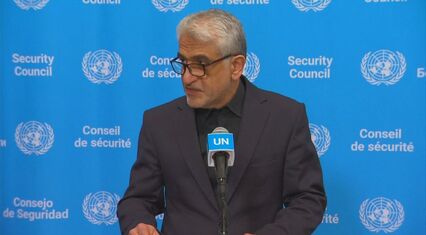
Iran accuses US and Israel of targeting schools and hospitals at UN meeting
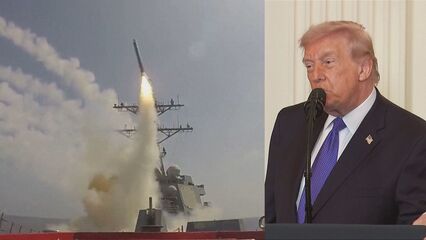
Trump’s Iran war message: President uses evolving justification for attack
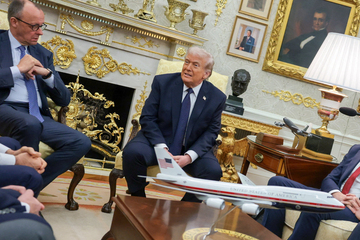
Trump contradicts Rubio, says Israel didn’t force him to launch war
Still, the administration remains in a tenuous political position as Trump’s Republican Party stares down midterm elections in November. Early public polling indicates little outright support from the US public, even as Trump’s Make America Great Again (MAGA) base has been staid in its response.
But the more days that pass, and the more US service members are killed, the more likely that Trump will be confronted with the contradictions to his past anti-interventionist promises.
“The longer it goes on and the more costly it is in terms of lives… the more the lack of evidence becomes an albatross around the neck of the administration – one that it will have to account for come November,” according to Benjamin Radd, a senior fellow at the UCLA Burkle Center’s international relations department.
A kaleidoscope of claims
Speaking from the White House on Monday, Trump praised the “obliteration of Iran’s nuclear programme” in US strikes last June. But moments later, he claimed that efforts to rebuild that programme, coupled with Iran’s ballistic missile programme, represented a menace to the US.
“An Iranian regime armed with long-range missiles and nuclear weapons would be an intolerable threat to the Middle East, but also to the American people,” Trump said. “Our country itself would be under threat, and it was very nearly under threat.”
Trump also said that, if not for US and Israeli attacks, Iran “would soon have had missiles capable of reaching our beautiful America”.
Daryl Kimball, the executive director of the Washington, DC-based Arms Control Association (ACA) said any claims of immediate or middle-term threats posed by Iran in terms of their ballistic and nuclear power are not supported by available evidence.
That is significant, as such “imminent threats” are required for a president justify attacks on foreign countries under both US domestic law and international law, save for approval from Congress.
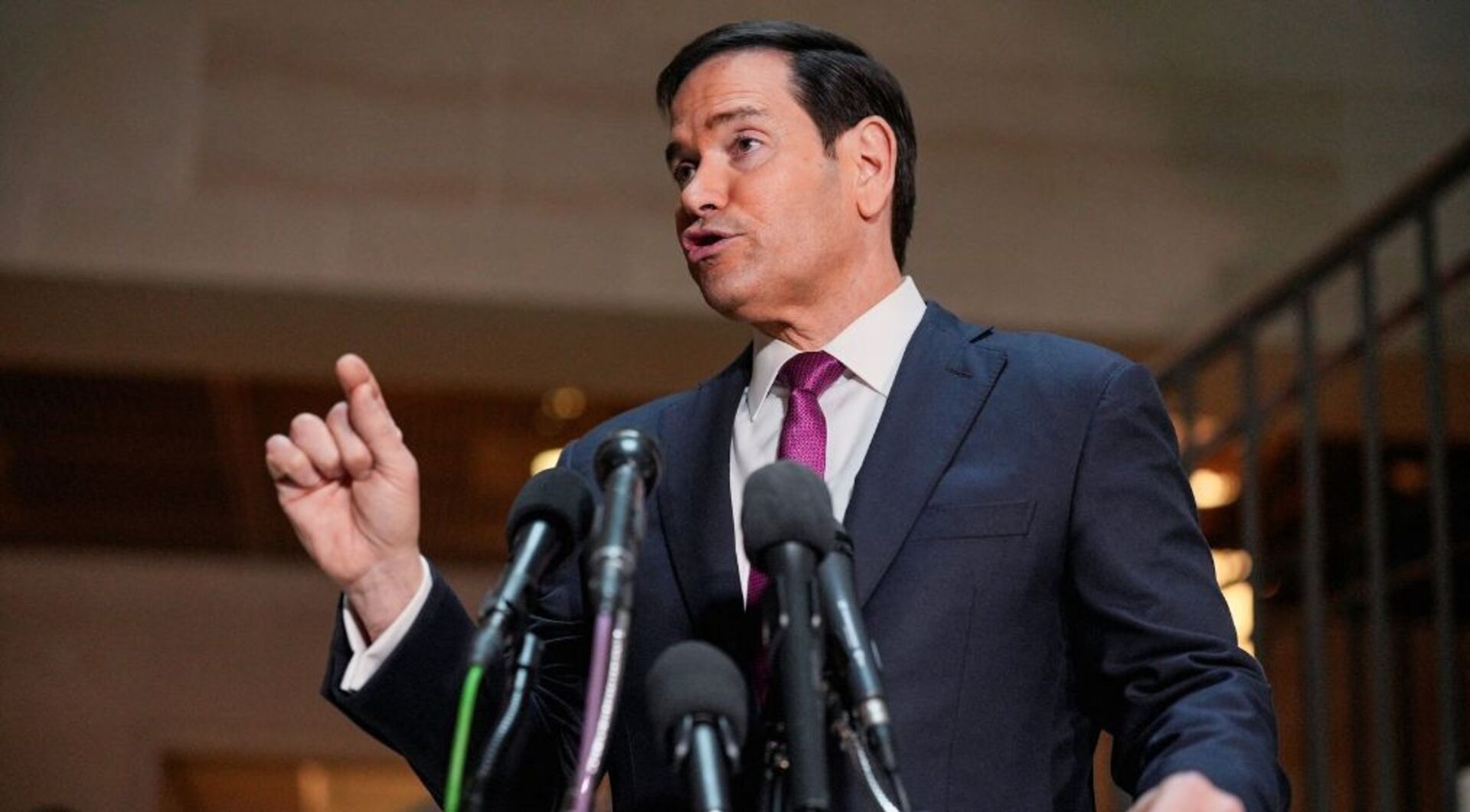
Rubio says US strikes on Iran were pre-emptive and necessary in Capitol Hill briefing
“Iran did not possess, prior to this attack, the capability to quickly enrich its highest uranium to bomb grades, and then to convert that into metal for constructing a bomb,” Kimball told Al Jazeera.
“At the soonest, it might have taken many, many months to do that, but Iran does not have access to its 60 percent highly-enriched uranium. Its conversion facility is damaged and idle. Its major uranium enrichment facilities have been severely damaged by the US strikes in 2025.”
He explained that despite having “significant conventional short and medium range ballistic missile capabilities”, Iran has said it has imposed 2,000km (1,200-mile) limits on its ballistic missile range, and is not near having an intercontinental ballistic missile capability.
The “latest [US intelligence] assessment is that Iran could, if a decision is made, have an ICBM capability by 2035. So Iran is nowhere close to having an ICBM threat that could be called imminent,” he said, referring to intercontinental ballistic missiles, which have a range of at least 5,000km (3,400 miles).
Democrats say no new intelligence
Secretary of State Rubio on Monday said there “absolutely was an imminent threat” presented by Iran.
“We knew that there was going to be an Israeli action,” he said. “We knew that that would precipitate an attack against American forces, and we knew that if we didn’t preemptively go after them before they launched those attacks, we would suffer higher casualties.”
But top Democrats who received classified intelligence briefings in recent days said they had not been provided with evidence to justify the attack.
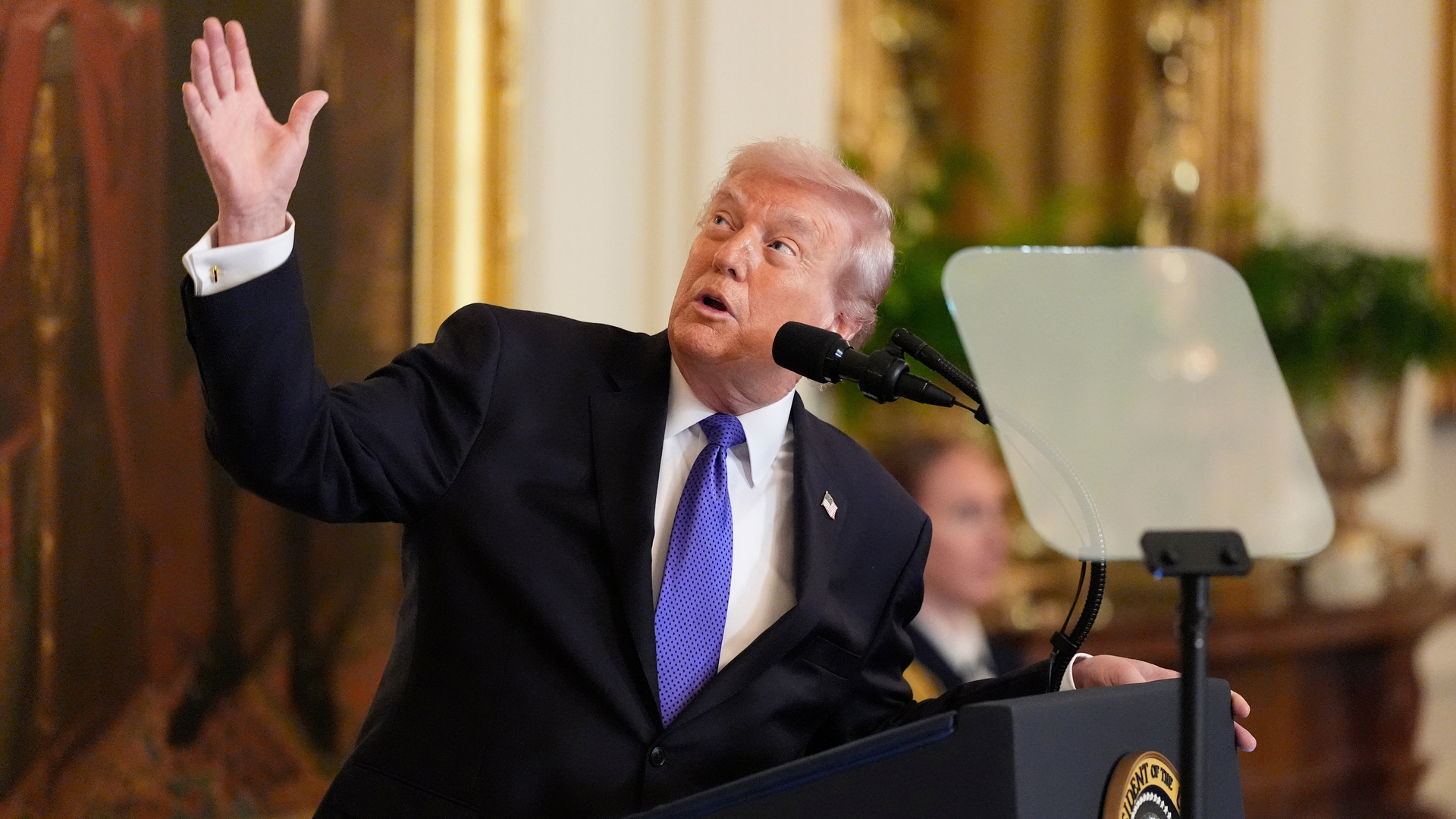
Trump: this was the best chance to strike Iran’s ‘sick and sinister regime’
“I’m on two committees that give me access to a lot of classified information; there was no imminent threat from Iran to the United States that warrants sending our sons and daughters into yet another war in the Middle East,” Senator Tim Kaine, who sits on both the Armed Services Committee and the Foreign Relations Committee, told CNN on Saturday.
Senator Mark Warner, who was briefed on classified intelligence related to Iran last week as part of the “gang of eight”, a collection of the top lawmakers from both parties in Congress, told the network: “I saw no intelligence that Iran was on the verge of launching any kind of preemptive strike against the United States of America”.
Several sources speaking to both the Reuters news agency and the Associated Press, following a closed-door briefing of congressional staff on Sunday, said the administration presented no evidence that Iran was planning a preemptive strike, and had instead focused on a more generalised threat posed by Iran and its allies to US troops and assets in the region.
Trump looking for quick success
All told, the Trump administration appears to be arguing that “Iran has been a national security threat to the United States since 1979… that Iran was responsible for more American lives being killed than any other state or non-state actor; that Iran has never been held to account for this”, according to the Burkle Center’s Radd.
Trump, therefore, appears to be taking the position that given the totality of Iranian actions, including during recent indirect nuclear talks, the US “has no choice but to perceive Iran as an imminent threat”.
Oman’s foreign minister, who mediated the talks, had pushed back on the administration’s characterisation, maintaining that “significant progress” had been made before the US-Israeli attacks.
Radd noted that under the War Powers Act of 1973, a US president has between 60 and 90 days to withdraw forces deployed without congressional approval. Therefore, Trump appears to be saying, “We’re not obliged to prove to Congress any of that if we can conduct and execute this operation within the 60 to 90 day window,” he said.
Meanwhile, Ploughshare’s Belcher said that the administration’s own actions led to the current situation with Iran.
She pointed to Trump’s withdrawal of The Joint Comprehensive Plan of Action (JCPOA) in 2018, which had seen the US impose maximum sanctions on Iran, and Iran, in turn, begin enriching uranium beyond the levels laid out in the agreement. Trump also derailed nuclear talks last year by launching attacks on Iran.
“We’re in this situation precisely because President Trump gave up on an agreement that was negotiated by his predecessor,” Belcher said. “He gave up on diplomacy.”
‘America First’ war?
In his speech on Monday, Hegseth, in particular, appeared to try to frame the war within Trump’s political worldview, pledging to “finish this on America First conditions”.
He drew a contrast with the US invasion of Iraq, describing the attacks on Iran as a “clear, devastating, decisive mission”.
“Destroy the missile threat, destroy the navy – no nukes,” he said.
He also sought to draw a distinction between a “so-called regime-change war” and US attacks that happened to lead to regime change. As of Monday, US strikes had killed Iran’s supreme leader, Ayatollah Ali Khamenei, and several top officials, but the ruling government has remained intact.
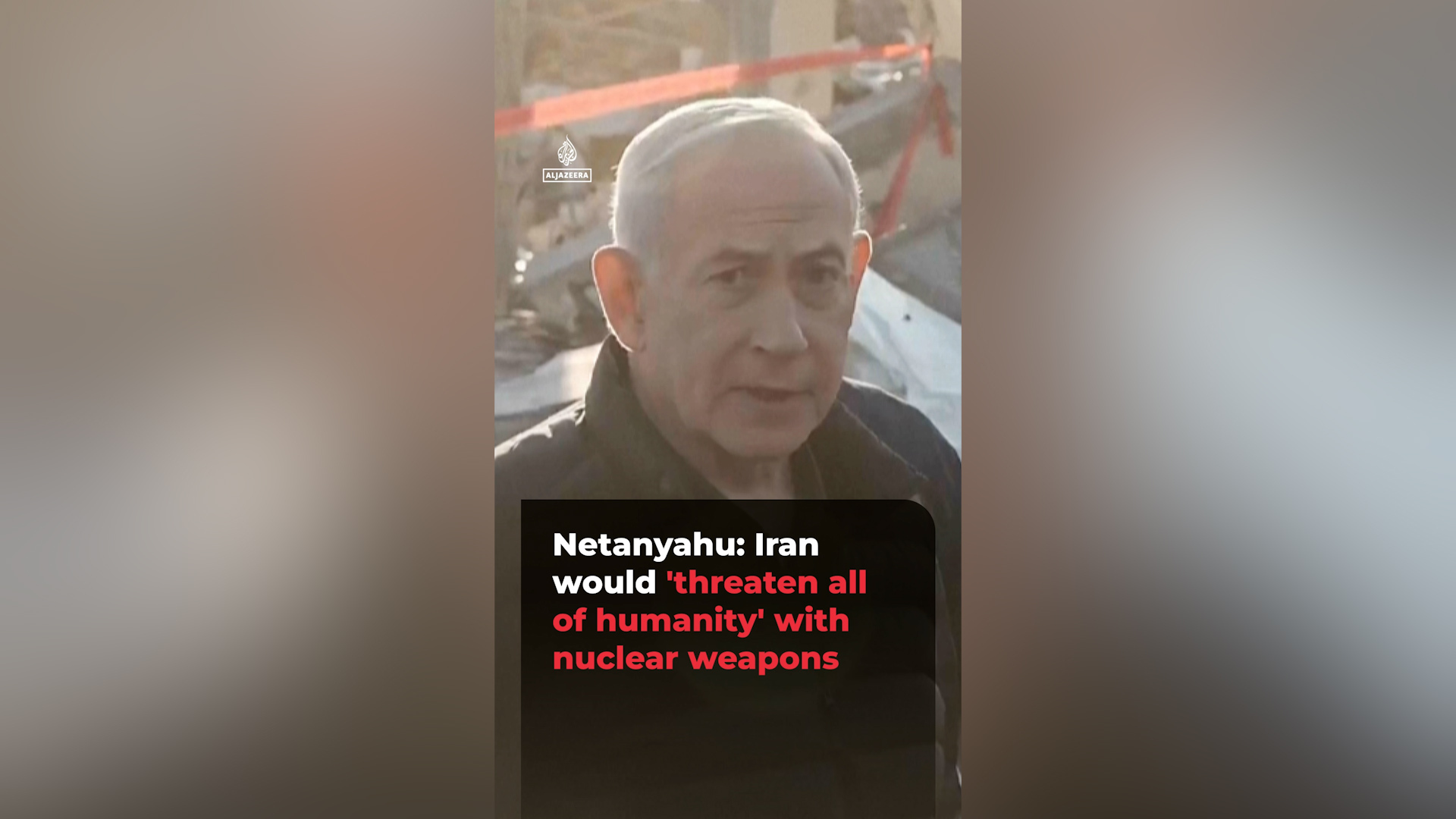
Netanyahu: Iran would 'threaten all of humanity' with nuclear weapon
Hegseth said that the US is unleashing attacks “all on our terms, with maximum authorities, no stupid rules of engagement, no nation-building quagmire, no democracy building exercise, no politically correct wars”.
It remains unclear how the message will resonate with the US public.
A Reuters-Ipsos poll released on Sunday suggested dismal approval for Trump’s strikes, but also indicated that large swaths of Americans were unsure about the conflict.
That could create opportunities for those challenging Trump’s actions and his justification for them.
“I think it does seem as though the narrative is still up for grabs,” Belcher said.


https://x.com/i/status/2028962692292083731
ReplyDeleteThis is a ballsy power play by Trump.
Lloyd's of London was the gold standard for maritime insurance policies until just a day or two ago when they started cancelling policies or jacking them up 3-5X. Others insurers followed. That collapsed commercial shipping traffic through Hormuz, which choked oil shipments out of the Middle East.
Trump doing this means the DFC has the chance to displace Lloyd's as the big dog in this game, when they have been the lock-in player for many years.
It also frees up all the oil that was getting trapped there, heading off shortages and keeping the energy market alive.
And why not? It's the American navy that sunk the Iranian ships that were harassing tankers. And the American Navy -- at least for now -- will keep those tankers safe.
It's a huge reassurance to allies -- both oil producers and oil consumers -- that our campaign in Iran isn't going to sink their economies. And it allows America to be choosy about traffic in the Strait.
It also potentially means billions of dollars in insurance premiums at wartime rates going to America instead of the UK. And those rates are STILL going to be cheaper than what shippers were getting.
- @SteveSkojec
This comment has been removed by a blog administrator.
ReplyDeletesource:
DeleteKosher
@koshercockney
Just opinions of a Jewish dude. Antisemitic abuse on this platform is getting too much. Stand up to the hate. 🙏🏽 עַם יִשְׂרָאֵל
An opinion by Shanaka Anslem Perera
ReplyDeletehttps://x.com/i/status/2028809435272052840
BREAKING: China is pressuring Iran to reopen the Strait of Hormuz.
There is one problem. Iran did not close it.
Seven insurance companies in London did.
China buys 80% of Iran’s shipped oil. Beijing has a $400 billion, 25-year cooperation agreement with Tehran. China is Iran’s economic lifeline. If any country on earth has leverage over Iran, it is China. And China is now using that leverage to demand the Strait reopens.
But the Strait was not closed by a sovereign decision. It was closed by the withdrawal of reinsurance capacity from five to ten firms, mostly in London, backstopping twelve P&I clubs that cover 90% of global tonnage. Iran did not order those firms to withdraw. Iran cannot order them to reinstate. Neither can China.
Even if Tehran capitulates entirely tonight and the IRGC stands down, not a single reinsurer reinstates Gulf war risk coverage on a phone call from Beijing. Reinstatement requires rebuilt risk models, voyage-by-voyage re-underwriting, repriced treaty capacity, and a threat environment that actuaries can quantify. None of that exists while 440.9 kilograms of weapons-grade uranium remains unaccounted for and the IRGC is still launching drones at Oman.
China has leverage over Iran. China has zero leverage over Lloyd’s of London.
This is the part nobody is modelling. The country with the most to lose and the most leverage over the belligerent cannot fix the mechanism that actually closed the Strait. Because the mechanism is not geopolitical. It is actuarial. And actuaries do not take calls from the Politburo.
open.substack.com/pub/shanakaans…
Facts check :
DeleteMore than half of China's crude oil imports come from ME countries that now face the blockage at the Strait of Hormuz.
Chinese refiners buy almost all of the 1.6m barrels of crude oil that Iran exports every day – equivalent to about 13% of China's total seaborne oil imports, according to TD Securities.
Hmmm...no memo was issued?
ReplyDeletehttps://x.com/i/status/2028533903263150172
This is potentially the biggest Iran story nobody is talking about: the global insurance market may be heading toward a systemic crisis. Here’s why…
Most people don’t realize London isn’t just a financial center it’s THE center of global insurance.
Lloyd’s underwrites ~40% of the world’s marine cargo. Ship sinks, port gets bombed, canal gets blocked the bill lands in London.
This is why the UK punches above its weight. Not the Royal Navy. Not diplomacy. Insurance.
Control insurance, control trade.
And London doesn’t just control the 90% of global trade that moves by sea. Lloyd’s and the London market are major insurers of almost everything skyscrapers, factories, ports, satellites, entire supply chains.
You can’t participate in public markets or raise large amounts of capital without insurance.
Now, the normal playbook for war risk is repricing, not cancellation.
Canceling coverage entirely is a massive escalation in underwriting posture. It signals something beyond risk, it signals uncertainty so deep the underwriter can’t even price it.
The question everyone should be asking: why?
Why not just jack up premiums and make a fortune off the crisis like they did in the Black Sea off Ukraine?
To answer that, you have to understand WHY London has maintained a stranglehold on global insurance while losing nearly submarket related to ships.
The answer: better intelligence.
It is no coincidence that MI6 headquarters sits directly across the Thames from the @IMOHQ, the world’s maritime regulator & a short distance from Lloyd’s itself.
I have no proof of a direct pipeline, but it has long been speculated in the industry that intelligence flows from MI6 to Lloyd’s.
Having the best intel in the world would be the single greatest competitive advantage any insurer could possess: the ability to price risk that competitors can only guess at.
Here’s the problem: the majority of MI6’s intel doesn’t come from its own agents. It comes from Five Eyes the alliance comprising the US, UK, Australia, Canada, and New Zealand.
And within 5Eyes, the dominant partner is obvious. The CIA, NSA, NRO, etc generate the lion’s share of intel.
So if Lloyd’s pricing advantage flows from MI6, and MI6’s best intelligence flows from the US… what happens when that data pipeline gets throttled?
All indications are that @Keir_Starmer was blindsided by the size and scope of the US/Israel strikes on Iran this weekend. That alone tells you something about the current state of transatlantic intelligence sharing.
And we know there has been serious anger in Washington over the UK’s decision to sell Diego Garcia, home to America’s most strategically important base in the Indian Ocean, to Mauritius.
It is not a huge leap to conclude that the submarine cables linking Langley to London have gone dark, or at minimum have been significantly throttled.
What this means for UK national security is a question for the Brits. But what it means for EVERY company globally that’s insured through the London market has massive implications for the entire financial system.
Because most large insurers worldwide don’t do independent intelligence work. They index off Lloyd’s rates.
If you’re insuring a skyscraper in Tokyo, a semiconductor fab in Taiwan, or a port in Argentina you get a Lloyd’s quote, then shop that price around.
Other insurers see Lloyd’s number and assume the diligence was done. They price accordingly.
This means if London is suddenly flying blind it’s not just Lloyd’s policyholders at risk. It’s the entire global reinsurance chain.
The cancellation of war risk coverage on ships isn’t the crisis. It’s the canary.
If this hypothesis is correct, we could be looking at a systemic repricing event across global insurance markets…. the kind of cascading uncertainty that defined 2008 and COVID.
Watch Lloyd’s. Watch reinsurance spreads. What Five Eyes. That’s where this story, and possibly Wall Street, breaks.
CC @BillAckman