
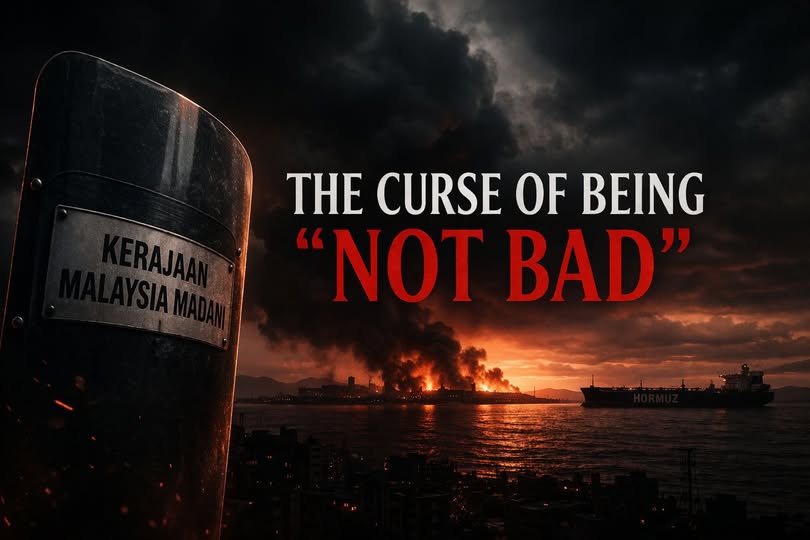
Governments that cushion external shocks risk creating a dangerous illusion: that the storm was never real. - Howard Lee Facebook pic, April 14, 2026
The curse of being “not bad” – Howard Lee
Shielding Malaysians from global disorder is necessary. But unless the truth of the crisis is told plainly, resilience may dissolve into complacency—and opportunists will thrive
Updated 3 hours ago
14 April, 2026
8:37 AM MYT
TRUMP’S move towards a U.S. counter-blockade in Hormuz would once have sounded too reckless even for fiction. Whether it followed the collapse of the Islamabad talks or was part of a predetermined diplomatic plan, or a process already too fragile to hold, the result is the same: the phrase “the worst is yet to come” no longer feels rhetorical. The outline of that worst-case scenario is sharpening by the day.
Here in Malaysia, however, those in business who are exposed to price and supply squeezes, those plugged into the news, and those tracking commodities and trade are beginning to speak with a jitter in their voices. The more this worst-case scenario comes into focus, the more unsettling it feels for me to work, live, and witness lives in Ipoh and Kuala Lumpur carrying on as though nothing is amiss. Traffic jams are as bad as they have always been. Shopping malls and hospitality venues continue to thrive with an eerie sense of normalcy.
Is this the failure of Malaysians to comprehend the severity of what is brewing globally?
Or is it Malaysia’s inability to inform us of the true gravity of the crisis we are already ankle-deep in?
Or are we simply too well shielded?
And that brings me to a peculiar curse in politics.
Outright failure is terrible, but at least it is visible. When a house is burning, people see the flames, smell the smoke, and understand that survival demands discipline, sacrifice and unity. A nation in obvious distress tends to find clarity, however painful.
The harder curse is subtler and more unforgiving.
It is the curse of being “not bad.”
It is when the economy is under pressure, but not broken. When the world beyond your borders is convulsed by shortages, controls and closures, yet your people are shielded just enough for daily life to remain recognisable. Fuel is more expensive, but there is still a subsidy and stations are open. Groceries cost more, but shelves are stocked. Factories are strained, procurement teams are tightening, finance departments are anxious, yet workers have not tipped into panic.
And because the pain is real without becoming catastrophic, a dangerous illusion takes hold: perhaps there is no real storm at all.
That is one of the deepest injustices of governance. If a government fails in crisis, everyone sees it. But if it succeeds in cushioning the blow, buying time and preventing collapse, the evidence of that success dissolves into ordinary life. People feel inconvenience, but not the abyss that was held back.
That matters greatly for Malaysia.
For us, Hormuz is not a distant morality play. It is tied directly to energy costs, shipping routes, industrial inputs and household budgets. If maritime risk rises, freight and insurance costs rise with it. If fuel markets tighten, subsidy pressure and transport costs intensify. If fertiliser and feedstock flows are disrupted, food production becomes more expensive. If supply chains fray, manufacturers face slower inputs, higher costs and weaker margins. What happens there reaches our ports, our factories, our markets and our homes.
In recent weeks, through bilateral engagements, multilateral conversations, industry discussions, and candid exchanges with friends in policy and intelligence circles, including some from the American establishment, one impression keeps returning to me: there are no elegant options left.
There is no neat military solution waiting to be discovered by the next burst of bravado. What is becoming more consistent from the American and Israeli aggressors is not strategy in any credible sense, but a pattern of graver transgressions and deeper madness. The risks are compounding faster than the solutions. Markets are reacting. Trade routes are tightening. Supply chains are fraying. Serious people are no longer asking whether the shock is real, but how much worse it may get, and how quickly.
That is why I keep returning to the political danger of partial protection.
If Malaysians are shielded just enough through subsidies, emergency measures, rerouting and diplomacy, the national mood can drift in exactly the wrong direction: away from seriousness and unity, and back towards complacency and familiar domestic quarrels. The shield works, and because it works, people begin to doubt the danger was ever so great.
That is the trap.
The better a government is at cushioning an external shock, the easier it becomes for cynics to pretend the shock was never serious. And into that space always walks the opportunist.
The opportunist thrives not in total collapse, but in partial stability. He needs enough frustration to weaponise, and enough normalcy to deny the scale of the danger. He calls prudence weakness, trade-offs incompetence, resilience stagnation. He feeds on the gap between what the country has avoided and what the public can still see.
Malaysia’s position, in truth, is an awkward one. We have real capacity to lead regionally, even globally. We matter in fuel, trade, shipping and diplomacy. We can still speak in different rooms without sounding like somebody else’s proxy. We can engage the West without becoming its echo, and speak to the Global South without sounding performative. That credibility is not accidental. It is the product of history, restraint and strategic autonomy.
Yet we remain hampered by a domestic instinct that says, again and again, take care of your own backyard first. There is wisdom in that, up to a point. But there is also a siege mentality that mistakes inwardness for prudence. In a world like this, the backyard is already connected to the shipping lane, the refinery, the fertiliser plant, the exchange rate, the port, the factory floor and the supermarket shelf. To speak as though home is insulated from the world is no longer realism. It is a comforting fiction.
My deeper worry is this: we may succeed just enough in shielding Malaysians from the full force of global disorder that we also shield them from understanding the age we have entered. We may cushion the blow, yet fail to build the seriousness needed for a truly national response. That would be a dangerous success.
Government must therefore do two difficult things at once: shield the people from the storm, and tell them plainly that the storm is still raging outside. Fear of panic is no excuse for withholding the truth. The people have a right to know, and a responsibility to know, so that they may act with the maturity this moment demands, rather than drift through crowded roads, full malls and busy restaurants as if normalcy itself were proof that the danger is not real.
Sometimes the greatest danger is not collapse.
Sometimes it is comfort without understanding.
Shielding Malaysians from global disorder is necessary. But unless the truth of the crisis is told plainly, resilience may dissolve into complacency—and opportunists will thrive
Updated 3 hours ago
14 April, 2026
8:37 AM MYT
TRUMP’S move towards a U.S. counter-blockade in Hormuz would once have sounded too reckless even for fiction. Whether it followed the collapse of the Islamabad talks or was part of a predetermined diplomatic plan, or a process already too fragile to hold, the result is the same: the phrase “the worst is yet to come” no longer feels rhetorical. The outline of that worst-case scenario is sharpening by the day.
Here in Malaysia, however, those in business who are exposed to price and supply squeezes, those plugged into the news, and those tracking commodities and trade are beginning to speak with a jitter in their voices. The more this worst-case scenario comes into focus, the more unsettling it feels for me to work, live, and witness lives in Ipoh and Kuala Lumpur carrying on as though nothing is amiss. Traffic jams are as bad as they have always been. Shopping malls and hospitality venues continue to thrive with an eerie sense of normalcy.
Is this the failure of Malaysians to comprehend the severity of what is brewing globally?
Or is it Malaysia’s inability to inform us of the true gravity of the crisis we are already ankle-deep in?
Or are we simply too well shielded?
And that brings me to a peculiar curse in politics.
Outright failure is terrible, but at least it is visible. When a house is burning, people see the flames, smell the smoke, and understand that survival demands discipline, sacrifice and unity. A nation in obvious distress tends to find clarity, however painful.
The harder curse is subtler and more unforgiving.
It is the curse of being “not bad.”
It is when the economy is under pressure, but not broken. When the world beyond your borders is convulsed by shortages, controls and closures, yet your people are shielded just enough for daily life to remain recognisable. Fuel is more expensive, but there is still a subsidy and stations are open. Groceries cost more, but shelves are stocked. Factories are strained, procurement teams are tightening, finance departments are anxious, yet workers have not tipped into panic.
And because the pain is real without becoming catastrophic, a dangerous illusion takes hold: perhaps there is no real storm at all.
That is one of the deepest injustices of governance. If a government fails in crisis, everyone sees it. But if it succeeds in cushioning the blow, buying time and preventing collapse, the evidence of that success dissolves into ordinary life. People feel inconvenience, but not the abyss that was held back.
That matters greatly for Malaysia.
For us, Hormuz is not a distant morality play. It is tied directly to energy costs, shipping routes, industrial inputs and household budgets. If maritime risk rises, freight and insurance costs rise with it. If fuel markets tighten, subsidy pressure and transport costs intensify. If fertiliser and feedstock flows are disrupted, food production becomes more expensive. If supply chains fray, manufacturers face slower inputs, higher costs and weaker margins. What happens there reaches our ports, our factories, our markets and our homes.
In recent weeks, through bilateral engagements, multilateral conversations, industry discussions, and candid exchanges with friends in policy and intelligence circles, including some from the American establishment, one impression keeps returning to me: there are no elegant options left.
There is no neat military solution waiting to be discovered by the next burst of bravado. What is becoming more consistent from the American and Israeli aggressors is not strategy in any credible sense, but a pattern of graver transgressions and deeper madness. The risks are compounding faster than the solutions. Markets are reacting. Trade routes are tightening. Supply chains are fraying. Serious people are no longer asking whether the shock is real, but how much worse it may get, and how quickly.
That is why I keep returning to the political danger of partial protection.
If Malaysians are shielded just enough through subsidies, emergency measures, rerouting and diplomacy, the national mood can drift in exactly the wrong direction: away from seriousness and unity, and back towards complacency and familiar domestic quarrels. The shield works, and because it works, people begin to doubt the danger was ever so great.
That is the trap.
The better a government is at cushioning an external shock, the easier it becomes for cynics to pretend the shock was never serious. And into that space always walks the opportunist.
The opportunist thrives not in total collapse, but in partial stability. He needs enough frustration to weaponise, and enough normalcy to deny the scale of the danger. He calls prudence weakness, trade-offs incompetence, resilience stagnation. He feeds on the gap between what the country has avoided and what the public can still see.
Malaysia’s position, in truth, is an awkward one. We have real capacity to lead regionally, even globally. We matter in fuel, trade, shipping and diplomacy. We can still speak in different rooms without sounding like somebody else’s proxy. We can engage the West without becoming its echo, and speak to the Global South without sounding performative. That credibility is not accidental. It is the product of history, restraint and strategic autonomy.
Yet we remain hampered by a domestic instinct that says, again and again, take care of your own backyard first. There is wisdom in that, up to a point. But there is also a siege mentality that mistakes inwardness for prudence. In a world like this, the backyard is already connected to the shipping lane, the refinery, the fertiliser plant, the exchange rate, the port, the factory floor and the supermarket shelf. To speak as though home is insulated from the world is no longer realism. It is a comforting fiction.
My deeper worry is this: we may succeed just enough in shielding Malaysians from the full force of global disorder that we also shield them from understanding the age we have entered. We may cushion the blow, yet fail to build the seriousness needed for a truly national response. That would be a dangerous success.
Government must therefore do two difficult things at once: shield the people from the storm, and tell them plainly that the storm is still raging outside. Fear of panic is no excuse for withholding the truth. The people have a right to know, and a responsibility to know, so that they may act with the maturity this moment demands, rather than drift through crowded roads, full malls and busy restaurants as if normalcy itself were proof that the danger is not real.
Sometimes the greatest danger is not collapse.
Sometimes it is comfort without understanding.
Howard Lee Chuan How is the Member of Parliament for Ipoh Timor
Related:


No comments:
Post a Comment