
‘It’s THE Great Satan’: Iran negotiator brands US after children killed at wedding
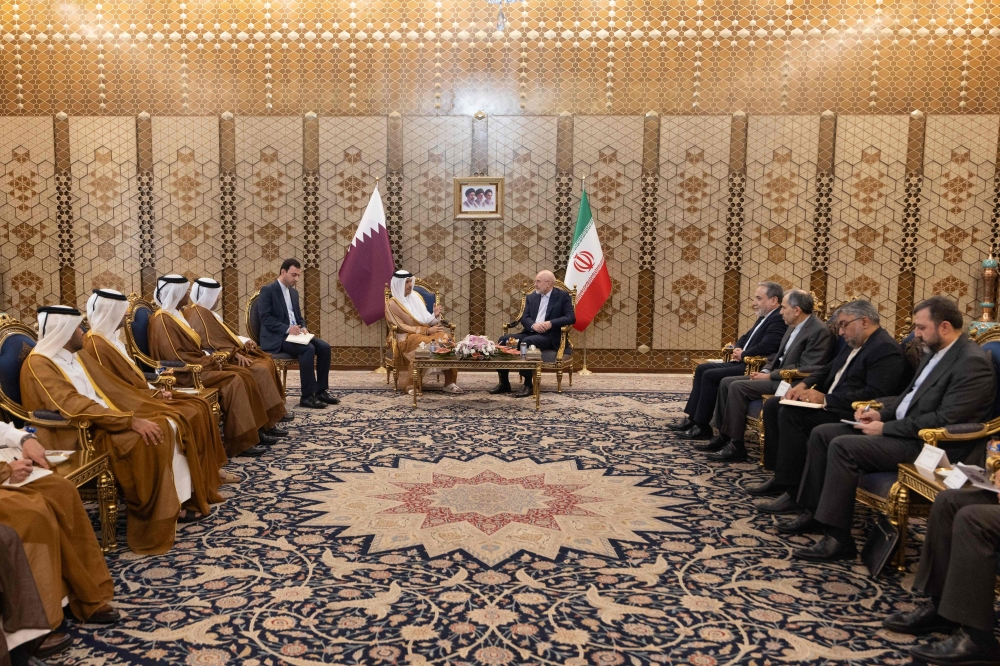
Iran’s Parliament Speaker Mohammad Bagher Ghalibaf (right) meets Qatar’s Prime Minister and Foreign Minister Sheikh Mohammed bin Abdulrahman Al-Thani (left) in Tehran on August 27, 2026. — Qatari Ministry of Foreign Affairs handout pic via AFP
Summary
- In a recent statement, Iran's top negotiator, Mohammad Bagher Ghalibaf, harshly criticized the United States, labeling it as "Satan" following a violent attack on a wedding in southern Iran.
- Highlighting incidents of violence against children in places like Minab, Lamerd, and Kouhestak, Ghalibaf expressed his condemnation and attributed these actions to perceived American interference, further emphasizing the US as the "Great Satan" for supporting similar actions by others.
First Published: Wednesday, 02 Sep 2026 4:06 PM MYT
Last Modified: Wednesday, 02 Sep 2026 4:10 PM MYT
TEHRAN, Sept 2 — Iran’s top negotiator Mohammad Bagher Ghalibaf on Wednesday called the United States “Satan” after an attack on a wedding ceremony in the country’s south.
At least four people were killed and dozens wounded in a late-night strike on the ceremony in Kuhestak in southern Iran, according to Iranian officials.
Ghalibaf said the attack left “children killed with families”, while singling out several deadly incidents in Iran during the initial stages of the Middle East war, including an attack on a school in Minab.
“If a power acts like Satan, picks targets like Satan, and kills like Satan, it’s Satan. Shields a junior Satan that does the same? It’s THE Great Satan,” said Ghalibaf in a post on X, referring to the US and key ally Israel.
The ‘Satan’ term was originally coined by Ruhollah Khomeini, founder of the Islamic Republic, in 1979 and has since been used by successive Iranian leaders to refer to the United States.
Iran responded to the wedding attack by launching drone and missile attacks on US bases across the Middle East, including in Bahrain, Kuwait, the United Arab Emirates and Iraq’s Kurdistan region.
The US military did not address the wedding strike directly.
US Central Command (CentcomE) spokesman Tim Hawkins said “the US military never targets civilians, unlike the IRGC”, referring to Iran’s Revolutionary Guards. — AFP


🚨 The Islamic Republic tried to weaponize the Strait of Hormuz and ended up locking its own oil inside.
ReplyDelete@TankerTrackers August data shows just how badly the gamble has backfired.
Iran’s exports were down 100%, compared with Iraq and Kuwait at −36%, Saudi Arabia and Qatar at −48%, while the UAE was essentially flat.
Before the war, Iran was shipping roughly 1.5–2.2 million barrels per day. In August, loadings collapsed to just 220,000–255,000 bpd, and since the U.S. blockade was reinstated on July 14, no Iranian crude cargo has successfully crossed Hormuz to China.
Iran is still loading oil, but much of it is going nowhere. TankerTrackers counted 29 tankers carrying 36.11 million barrels inside the strait, while Iranian floating storage west of the blockade line climbed to 41.7 million barrels.
Meanwhile, the Islamic Republic’s neighbors are still moving millions of barrels. The UAE can pump oil directly to Fujairah outside Hormuz, while other Gulf producers continue exporting despite suffering significant disruption.
The market is finding ways around the Islamic Republic while the Islamic Republic increasingly cannot find a way around the blockade.
That is catastrophic for a government dependent on oil for hard currency. China can continue buying Iranian crude already floating in Asia, but if fresh barrels cannot escape from Iran, that inventory eventually runs down and the cash flow dries up.
Years of sanctions never completely stopped Iranian oil because the Islamic Republic could evade them through discounts, shadow tankers, ship-to-ship transfers, front companies and Chinese buyers.
The blockade is doing something sanctions never fully accomplished by physically separating the Islamic Republic from its biggest oil customer.
Iran tried to turn Hormuz into economic leverage against everyone else. Instead, its neighbors are bruised but still exporting millions of barrels while the Islamic Republic has turned its own coastline into an oil parking lot.
https://x.com/theiranwatcher/status/2094837337565905158?s=46&t=8K6fzabO3g6uaj4KxwSSjg
And NONE of it Was Iranian Oil…
ReplyDelete🚨 17 MILLION BARRELS TRANSITED HORMUZ — HIGHEST LEVEL SINCE WAR BEGAN
U.S. Energy Secretary Chris Wright says 17 million barrels of oil transited the Strait of Hormuz on Monday, calling it the highest crude-oil flow through the waterway since the war began reducing traffic.
Wright said the figure demonstrates that oil continues to move through the strategic waterway despite the conflict.
https://x.com/mossadil/status/2094961003784028467?s=46&t=8K6fzabO3g6uaj4KxwSSjg