Murray Hunter
The Ghost Towers of Ambition: Forest City and the Sihanoukville Syndrome
Murray Hunter
Jul 29, 2026
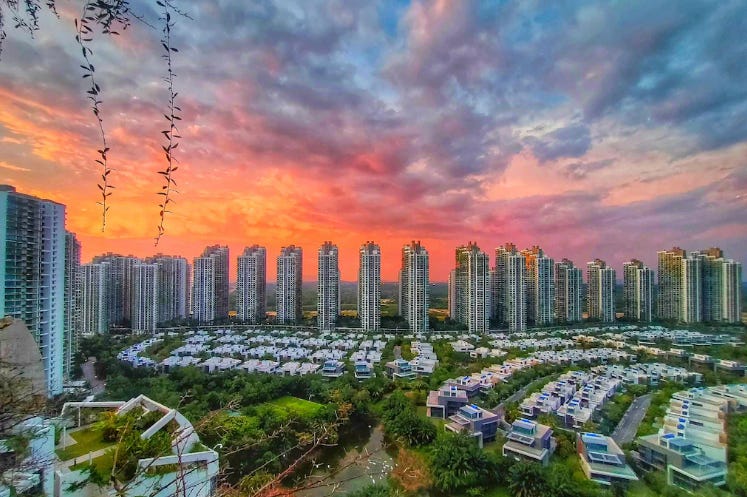
Forest City, the glittering Malaysian mega-project once hailed as a futuristic Shenzhen-on-the-Strait, is making headlines again for all the wrong reasons. Just a week after the controversial shutdown of the Network School, an international entrepreneurship incubator accused of various ideological transgressions, Johor police busted a major scam operation running from converted apartments and bungalows within the development.
On July 15, 2026, authorities arrested 335 suspects predominantly Chinese nationals operating fake cryptocurrency investment and love scam syndicates targeting victims in China and Indonesia.
Police seized hundreds of computers, over 1,500 mobile phones, and equipment worth millions. Two syndicates were dismantled: one acting as customer acquisition agents on Telegram, WhatsApp, and TikTok, the other impersonating law firms. Masterminds remain at large, with Interpol now involved. This comes against Forest City’s backdrop as a low-occupancy “ghost city,” plagued by smuggling, drug trafficking, and human movement via its duty-free status and coastal vulnerabilities.
The parallels with Sihanoukville, Cambodia, are striking and ominous. Both were grand visions of transformation through Chinese capital and connectivity. Both have morphed into cautionary tales of speculative bubbles, regulatory voids, and criminal repurposing of empty real estate.
Sihanoukville’s Descent
Sihanoukville, once a sleepy backpacker beach town, exploded in the mid-2010s under China’s Belt and Road Initiative (BRI) influence and a flood of private Chinese investment. Casinos proliferated, many catering to online gambling aimed at evading China’s mainland bans. By 2019, the city had become a “new Macau,” with Chinese-owned businesses dominating over 90% of the economy at peak. Billions poured into high-rises, hotels, and resorts. Land prices skyrocketed, construction boomed, and the Chinese population swelled.
The bubble dramatically burst. Cambodia’s 2019 online gambling ban, prompted by Chinese pressure over crime and capital flight, emptied casinos overnight. COVID-19 lockdowns finished the job. Investors and workers fled, leaving hundreds of unfinished “ghost buildings” where estimates run to 400-500 stalled projects, some skeletons dominating the skyline. Infrastructure strained, local communities displaced or marginalized, and crime filled the vacuum.
Empty towers and hotels proved perfect for scam compounds. Transnational syndicates, often Chinese-led, trafficked workers from across Asia and beyond, forcing them into “pig butchering” romance scams, crypto fraud, and more under brutal conditions with beatings, electric shocks, passport confiscation.
Sihanoukville earned the nickname “Scambodia.” Raids freed thousands, but operations persist or relocate, with UN reports highlighting links to drug trafficking and money laundering. Grand projects like certain eco-cities remain speculative amid environmental and financial doubts. What began as legitimate (if chaotic) development became a haven for predatory capitalism exploiting weak governance.
Some of these scamming syndicates moved and opened up in other places including Forest City.
Forest City’s Parallel Path
Forest City shares the DNA. Developed by Country Garden as part of Iskandar Malaysia’s ambitions, it aimed for high-end residences, hi-tech startups, and a thriving delta economy linking to Singapore. Duty-free incentives and special visas were meant to lure talent.
Instead, low occupancy turned it into a speculative asset with vast underused spaces ideal for illicit activity. Smuggling (alcohol, drugs like syabu), human movement, and now overt scam centers have stained its reputation.
The recent busts, involving mostly foreign operators in luxury units, echo Sihanoukville’s pivot from gambling/construction to cybercrime. The forced closure of Network School, framed by authorities around sovereignty and licensing, has raised investor confidence questions and sends a signal: “good” tenants promoting entrepreneurship and ideas may face hurdles, while shadowy operations exploit the emptiness. Police noted no direct link to prior “foreigner training” allegations, but the optics reinforce perceptions of selective enforcement.
This isn’t mere coincidence. Mega-projects in weak regulatory environments attract short-term speculative capital, often from networks blending legitimate business with gray economies. Low density and special zones lower barriers. When legitimate demand falters, due to issues like geopolitics, pandemics, or policy shifts, criminal enterprises fill voids. Empty apartments become call centers; construction sites hide compounds. Local benefits remain minimal while reputational damage and enforcement costs mount.
Broader Lessons
Sihanoukville’s experience warns of “compound capitalism”, enclosed ecosystems where syndicates control space, labor, and flows beyond state reach. Forest City risks similar entrenchment if occupancy stays low. Malaysia’s ambitions for Johor as a high-tech, high-value hub clash with realities of elite-driven projects detached from organic demand. Good ideas and clean tenants, like the Network School, reportedly find resistance, while scams thrive in the shadows.
The irony is sharp. Visions of Shenzhen-style dynamism yield Kawthaung or Sihanoukville-style notoriety with smuggling hubs, trafficking routes, and scam factories. Billions in potential value evaporate into ghost infrastructure and criminal rents. Masterminds evade capture while foot soldiers face charges.
For Malaysia, this demands honest reflection. Strengthening enforcement, genuine investor due diligence, better integration with local economies, and transparent governance over special zones are essential. Without them, Forest City risks becoming another abandoned monument to misplaced ambition where towers stand as memorials to what could have been, repurposed by those the state fails to deter. Southeast Asia’s development dreams too often collide with its governance nightmares. Forest City is the latest chapter in that recurring story.


There are good hotel rooms and short-mediun term rentals available in Forest City for very reasonable prices.
ReplyDeleteI stayed in one for 5 days recently , having some errands to conduct in Iskandar Puteri - the State Government offices -its within sjort driving distance , together with sight seeing and touring.
The 20th floor hotel room had breathtaking views of Singapore.
Toonsie Was Right All Along. He Said Nothing Good Will Come of It. Only Monkeys and Baboons Will Live In It.
ReplyDeletehttps://www.freemalaysiatoday.com/category/nation/2017/12/30/mahathir-launches-bitter-attack-on-forest-city-project
Satu Lagi BullyXi's Belt You Down My Road Project.
ReplyDeleteOur ECRL will be the next Gajah Putih, like the $6 billion China-Laos High Speed Rail.
Even after Guanee's repackaging of the massive loans that were disguised to plug Jibby's 1MDB hole, we can expect Massive operational losses.
Stay Tuned.