
OPINION | Why Fadhlina Will Never Become a Better Education Minister — No Matter How Many Chances She Gets
19 Dec 2025 • 6:00 PM MYT

TheRealNehruism
An award-winning Newswav creator, Bebas News columnist & ex-FMT columnist
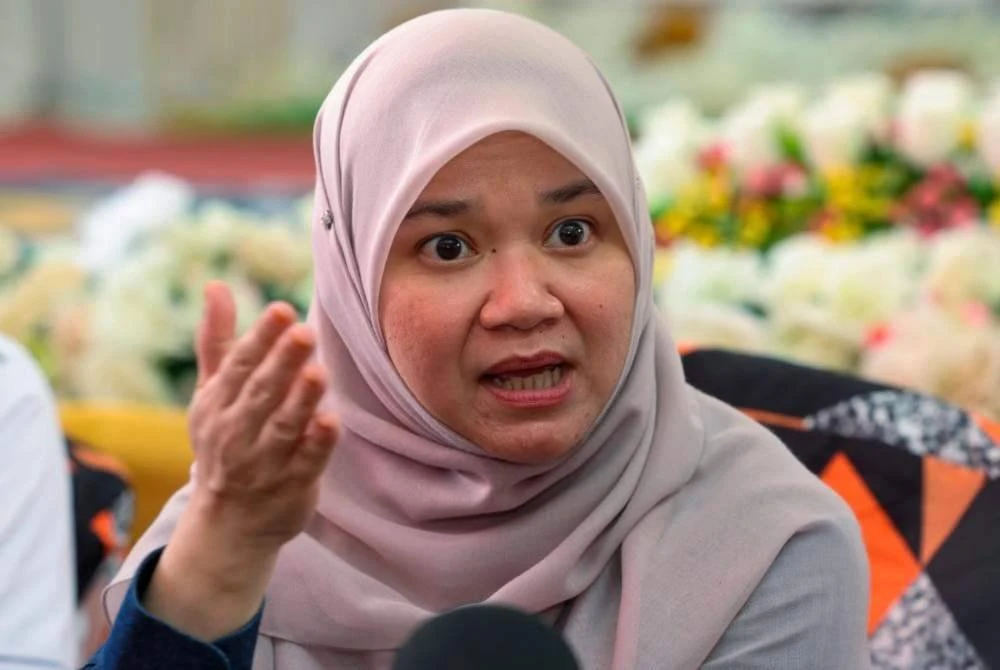
Image credit: Sinar Harian
Education minister Fadhlina Sidek has said she is grateful to be retained in Anwar Ibrahim’s Cabinet despite numerous calls for her to resign . In a familiar display of political diplomacy, she acknowledged the criticisms levelled against her, described fact-based and constructive criticism as an essential part of a healthy democracy, and promised that she would strive to do better for the education system and for Malaysia’s children.
“I would like to record my gratitude and appreciation for the trust placed in me to continue serving the ministry,” Fadhlina said during an engagement with media representatives here.
“God willing, we will strive to do better, and most certainly do what is best for our education system and for our children.”
It is all very gracious. It is also, unfortunately, almost certainly untrue.
Why?
Because I am willing to bet one ringgit and thirty cents that Fadhlina will not get better as education minister. I don't think she will, mot because she is lazy, malicious, or ill-intentioned—but because she is already as good as she can possibly be. And that level, quite simply, is not good enough.
Why she will not get better
The reason I am quite that Fadhlina will not get any better is brutally simple: if she could have been better, she would already have been better.
Three years is more than enough time to assess how a person fares in a job of this magnitude.
Fadhlina is not a 12 years old, that you need more than 3 years to see how she will fare in something. At the level that Fadhlina is in - the pro level - 3 years is more than enough to see whether one has a got what it takes, or one simply doesn't, and Fadhlina clearly doesn't have it.
In almost every human endeavour that does not end in failure, the same pattern holds true. At the beginning, you are bad. Over time, if you have a natural aptitude—or what we might call a knack—you improve. Slowly at first, then faster. Progress itself becomes motivating. Improvement feeds confidence; confidence feeds further improvement.
If, after years of doing something, you are still floundering, still reactive, still overwhelmed, it usually means one thing: this thing is not meant for you.
This is not an insult. It is simply reality.
Talent, knack, and uncomfortable truths
In life, there is such a thing as talent or knack. Some people have it for certain things; others do not. No amount of motivational slogans can change that.
I would never have been good at sports. With effort, discipline, and persistence, I might have become middling—perhaps even above average in some areas. But excellence was never on the table. I do not have the physical aptitude for demanding athletic performance, and I accept that.
Everybody must learn to accept not only their potential, but also their limitations. This, in fact, is one of the clearest marks of maturity. Only children can afford to believe that they can become anything they wish, that their abilities have no limits. As we grow older and our potential gradually reveals itself, we begin to see more clearly where we can truly excel—and, just as importantly, where we cannot.
If you have a knack for something, even if you start badly, you will get better and better the more you do it. If you do not, you can still improve with grit and hard work—but you will always hit a ceiling. And that ceiling will be far below those who possess both talent and a willingness to work.
Anyone who has ever seriously tried to excel at anything knows this to be true. No one is excellent at everything.
Ironically, this is precisely what schools are meant to help us discover: where our strengths lie, and where they do not. That our education minister appears unable to grasp such a basic truth about human potential—one that should be self-evident to anyone in the education sector—is deeply troubling.
Fadhlina as education minister: a fish out of water
When I look at Fadhlina Sidek, I do not see someone with a knack for education policy, system design, or pedagogical reform. And I am fairly certain I am not alone. Across the country, parents, teachers, and even students sense it instinctively.
This does not mean she is incompetent across the board. On the contrary, she might do reasonably well as the minister for women, family, and community development. She appears to understand social vulnerability, advocacy, and community-level concerns. There, she might even excel.
But as education minister, she is a fish out of water.
Because she lacks a natural grasp of the education ecosystem, I am quite sure that she will struggle to understand why problems occur or what she has to do to move things forward. And if you cannot understand why something is happening, you cannot prioritise correctly. You cannot know where to focus your energy, resources, or political capital. You cannot distinguish between surface-level symptoms and structural rot.
In such a situation, the minister becomes dependent on advisers who do have the knack. Explanations must be simplified, repeated, diluted. Even then, comprehension comes slowly—often too slowly for decisive action.
The worst possible time to be mediocre
If the education sector were in a calm, stable phase—if classrooms, curricula, and student psychology were largely unchanged—perhaps a hardworking but untalented minister could muddle through.
But that is not the world we are living in.
Today, teachers and parents are struggling to understand children whose minds are shaped more by TikTok, YouTube, and algorithmic feeds than by family, school, or community. Attention spans are collapsing. Authority structures are eroding. Moral frameworks are being outsourced to influencers.
At the same time, artificial intelligence is poised to upend education itself. Classrooms, textbooks, assessments, and even the role of teachers may look radically different in a decade—perhaps even sooner.
To navigate this, Malaysia does not need a minister who is merely willing to “learn on the job.” It needs someone with deep intuition, intellectual clarity, and strategic foresight.
Expecting Fadhlina to thrive in this environment is like expecting a non-swimmer to survive a raging current that even strong swimmers fear.
So why was she retained?
Given the murder, rape, and bullying cases in schools that have occurred under her watch, and the widespread calls for her resignation, why was she retained?
I can think of only two answers.
First, there is the comforting illusion that people inevitably improve if you just give them time. This belief often stems from a poor understanding of how competence and excellence actually develops. It assumes that with enough patience, you can make a monkey swim like a fish or a fish climb a tree like a monkey—provided you motivate them hard enough.
This is an oddly egoistical idea that many Malaysians cling to: the belief that sheer willpower, encouragement, or political backing can override nature, aptitude, or God-given disposition.
Second, and more troubling, is the possibility that improving the country is not the government’s primary objective. Instead, decisions may be driven by internal political calculations, factional balance, or personal loyalty—rather than by what best serves students, teachers, and parents.
This is one of the defining differences between first-world and third-world governance. In first-world countries, decisions are generally made to improve systems and outcomes. In third-world countries, decisions are often made to satisfy the preferences and survival needs of those in power.
By retaining Fadhlina as education minister, Malaysia sends an uncomfortable signal: for all our rhetoric about reform and progress, in substance, we still behave like a third-world country.
And our children will pay the price for that illusion.
Given the murder, rape, and bullying cases in schools that have occurred under her watch, and the widespread calls for her resignation, why was she retained?
I can think of only two answers.
First, there is the comforting illusion that people inevitably improve if you just give them time. This belief often stems from a poor understanding of how competence and excellence actually develops. It assumes that with enough patience, you can make a monkey swim like a fish or a fish climb a tree like a monkey—provided you motivate them hard enough.
This is an oddly egoistical idea that many Malaysians cling to: the belief that sheer willpower, encouragement, or political backing can override nature, aptitude, or God-given disposition.
Second, and more troubling, is the possibility that improving the country is not the government’s primary objective. Instead, decisions may be driven by internal political calculations, factional balance, or personal loyalty—rather than by what best serves students, teachers, and parents.
This is one of the defining differences between first-world and third-world governance. In first-world countries, decisions are generally made to improve systems and outcomes. In third-world countries, decisions are often made to satisfy the preferences and survival needs of those in power.
By retaining Fadhlina as education minister, Malaysia sends an uncomfortable signal: for all our rhetoric about reform and progress, in substance, we still behave like a third-world country.
And our children will pay the price for that illusion.
***
But I luv her hot pouty juicy lips, wakakaka


No comments:
Post a Comment