
OPINION | Anthony Loke Might Not Know the Meaning of the Words He Uses
14 Dec 2025 • 7:30 AM MYT
TheRealNehruism
An award-winning Newswav creator, Bebas News columnist & ex-FMT columnist
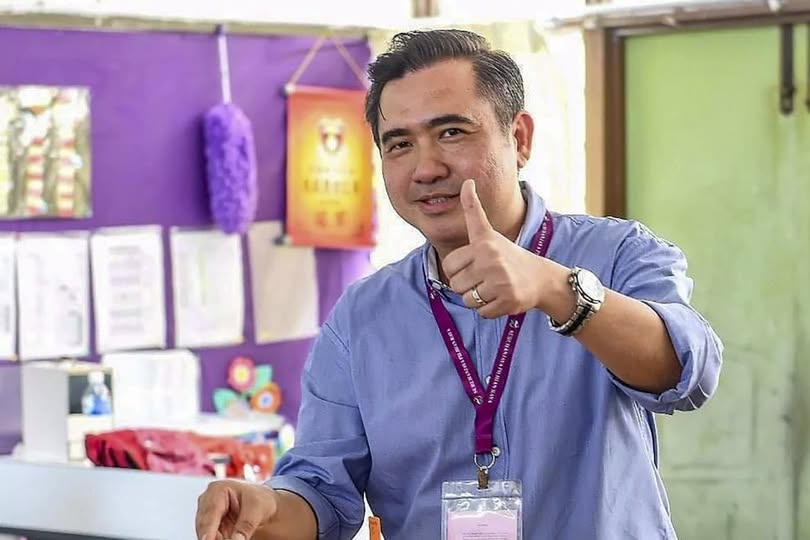
Image credit: SCMP
Right after DAP’s abysmal performance in the Sabah election, its secretary-general Anthony Loke stepped forward and solemnly declared that he would take “full responsibility” for the party’s wipeout.
“As the Secretary-General of the party, I take full responsibility for the shortcomings and the failure of DAP to win any seats in the 17th Sabah State Election,” Loke said in a statement on Facebook.
Now, in the normal universe — the same universe that dictionaries exist in — when a leader says he is taking full responsibility, the bare minimum that follows is a resignation.
I say bare minimum because in more honourable political cultures like Japan and Korea, taking full responsibility can sometimes mean even more than stepping down… it can cost you your life, if you know what I mean.
But in Anthony Loke’s case?
Nothing happened.
Not only did he not resign — nobody else in DAP resigned either.
In other words, in Anthony’s special interpretation, taking full responsibility actually means no one is responsible.
That is what “full responsibility” means in DAP’s vocabulary.
The problem isn’t just the phrase “full responsibility”
If you think this is the only instance where DAP doesn’t understand the meaning of the words it uses, think again.
Right after making his “I take full responsibility” speech, Anthony Loke made another grand announcement:
DAP, he said, is now committed to pushing rapid reforms within six months.
Just days later, DAP unveiled its first item under this new “rapid reform” agenda.
And what was it?
Recognising the UEC.
Now, we can debate whether the UEC should be recognised — many will say yes, it’s overdue, it benefits many in the country, and it might brings fairness to the system.
But let’s be clear about one thing:
Recognising the UEC is not reform.
What “reform” actually means
Reform, by definition, deals with corruption and institutional decay.
Corruption is when institutions created to serve a higher purpose — the nation, the public interest, the rule of law — get hijacked for personal or factional gain.
A civil servant who takes a bribe is corrupt because he betrays a higher duty for a lower reward.
MACC or the police become corrupt when their internal culture drifts so far from their founding mission that they serve individuals or political masters instead of the public.
So when DAP promised “reform,” the public understandably assumed it meant confronting this kind of institutional rot.
For instance:
- Removing Azam Baki, as Rafizi Ramli and even MCA have pushed for, can be considered a genuine reform effort — whether you agree with the accusations or not, the demand is rooted in restoring integrity.
- Separating the Prime Minister’s office from the Finance Ministry — also reform.
- Splitting the Attorney General’s office from that of the Public Prosecutor — also reform.
- Repealing SOSMA, as some DAP backbenchers have urged — definitely reform.
Recognising the UEC is none of the above.
It does not clean up an institution, fix governance, restore a broken system, or address any form of abuse of power.
It may be good policy.
It may be necessary.
But it is not reform.
So when DAP places “UEC recognition” under its “rapid reform” programme, it is simply misusing the word.
And now Anthony says DAP will quit the government if the UEC isn’t recognised…
Anthony Loke has since added that if UEC is not recognised within six months:DAP will leave the unity government, and
He himself will resign from all positions.
At this point, I genuinely don’t know what that means.
“I can lose my position at any time; no problem. But will losing my position really solve all problems? If Anthony Loke stops being a minister today, will UEC be recognised tomorrow? If yes, I’ll resign immediately. But that’s not the reality,” Anthony said, while speaking on his podcast, 关键陆点 (Critical Point with Loke).
Listening to him however, I must that I am not at all sure as to what in the world will Anthony Loke and DAP do in the 6 months, if it does come to pass that the “reform” that they are promising - which is the UEC recongnition - doesn't come to pass.
I am not sure, because I know what you mean when you say you will resign.
I know what I mean when I say I will leave something.
But given how Anthony Loke and DAP have used words like “full responsibility” and “reform,” I can no longer be certain as to what Anthony Loke and DAP means when they say that they are going to resign or leave.
For all we know, in Anthony’s Dictionary:“Leave the government” might mean “stay exactly where we are.”
“Resign” might mean “hold a press conference and continue as usual.”
So I suppose we must wait and see what he actually does — only then can we decipher what his words really mean.
Because the dictionary Anthony Loke uses is clearly not the one used in the rest of the English-speaking world.
And that is why, whenever he speaks — especially when it matters — we can hear the words, but we cannot always be sure what he means.


Brilliant article, always enjoy reading his writings.
ReplyDeleteLet me tell you what he means. He is saying no matter what happens, he and the rest of the DAP ministers will want to stay put in their respective positions for all the perks and power and glory. He also say people like you and me are all fools, voting for them so that he can now make as many U-turns as he wants and also supporting Anwar for doing the same thing. Lastly he says that after 6 months, he will throw some crumbs for us to excite us so come GE16, we will be fools again and vote for them. I hope you and me are using the same dictionary so that you understand what I am saying.