
North Korea’s Primary Tactical Missile Demonstrates Improved Precision Strike Capability in the Ukrainian Theatre
Asia-Pacific , Missile and Space
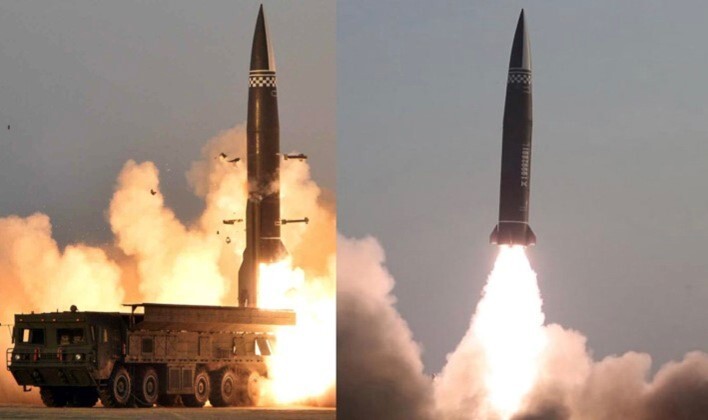
Multiple Ukrainian sources have reported that the North Korean KN-23 tactical ballistic missile, otherwise known as the Hwasong-11A, has achieved a new improved level of accuracy with a Circular Error Probable of 1–5 meters. The missile has been used extensively in the Russian-Ukrainian War, as first confirmed in January 2024, supplementing Russia’s domestically developed Iskander-M ballistic missile system. Improvements to precision strike capabilities may be the result of both feedback from combat testing and technological advances in North Korea, with funding from exports to Russia having provided a considerable boost to the country’s defence sector.
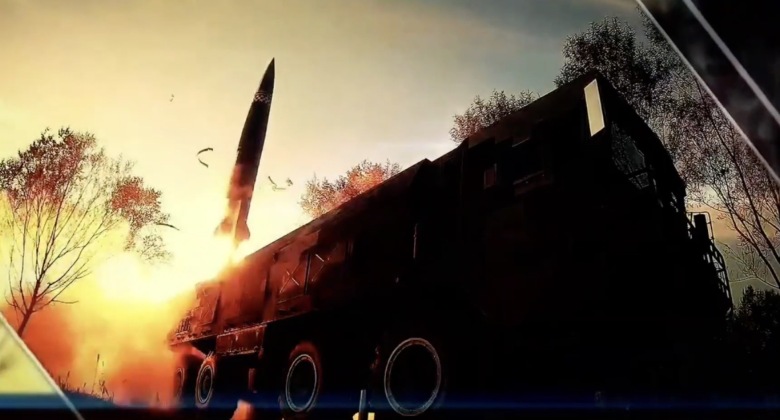
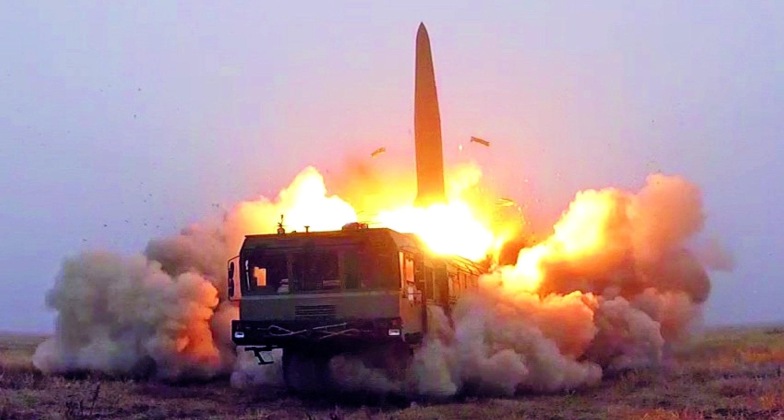
The KN-23 has many significant similarities to the Iskander-M, raising the possibility that its development may have benefitted from technology transfers or other forms of Russian support. The North Korean program is considered more successful than its Russian counterpart, having produced a much wider range of variants, and having seen the missiles deployed from a much more diverse range of launch vehicles. Commenting on the KN-23’s capabilities, a U.S. Congressional Research Service report highlighted shortly after the system’s entry into service that it “exemplifies the most notable advance” for North Korea in the field of tactical weapons, with the missile observed conducting a complex “pull-up” manoeuvres intended to confuse enemy air defence systems. Regarding the missile’s lighter counterpart, the KN-24, the report noted that the lighter missile “demonstrates the guidance system and in-flight manoeuvrability to achieve precision strikes.”
In October 2025 North Korea’s defence sector unveiled a successor to the KN-23, which uses a lift-generating hypersonic glide body and small control surfaces, and appears to be the system of its kind ever to integrate a hypersonic glide vehicle. Designated the Hwasong-11Ma, the new system appears to use the same transporter-erector-launcher as the KN-23 and same lower section, while the upper section with a glide vehicle appears intended to separate near the top of the boost phase. Russia has yet to unveil a comparably complex tactical missile type. While the KN-23’s ability to evade detection by South Korea’s U.S.-supplied AEGIS missile defence systems have been highlighted as cause for serious concern in Seoul and in the wider Western world, the capabilities of variants with hypersonic glide vehicles are expected to be considerably more formidable still in this regard.
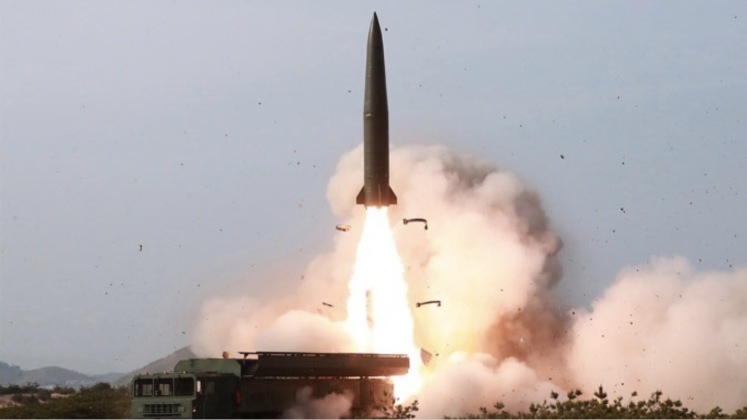
Among the variants of the KN-23 developed, the KN-23B represents a larger variant with an extended range a much enlarged 2,500 kilogram warhead. It was first test fired on March 25, 2021, and due to its larger size used a ten-wheel transporter erector launcher where the original KN-23 used an eight-wheel launcher. The missile’s longer range and larger warhead are thought to have made it highly prized in the Ukrainian theatre. In part as a result of the sharp contraction both of Russia’s defence sector and of its ground forces in the aftermath of the Soviet Union’s disintegration, Russian forces have become heavily reliant on procuring defence equipment from North Korea. The results of an investigation by Reuters published in April 2025, for example, highlighted that many Russian artillery units had come to rely almost entirely on ammunition supplied by North Korea, with at least six Russian artillery units sourcing between 50 and 100 percent of their munitions from the country.


Alternative Narrative to Military Watch….
ReplyDeleteUrgent Report
Gerasimov has reportedly prepared an urgent report due to the blockade of Crimea, a shortage of air-defense missiles, and an unprecedented lack of fuel at the front. The Chief of the General Staff reportedly intends to brief the political leadership on several failures that can no longer be concealed.
According to these claims, Crimea is effectively slipping out of control, border regions are relying primarily on electronic warfare systems rather than full-fledged air defense, and the diversion of fuel from the front to Moscow following strikes on oil refineries has begun to affect Russian offensive operations.
Sources claim that the General Staff believes the Kremlin is trying simultaneously to protect the capital, hold Crimea, and continue offensive operations, but no longer has sufficient resources to do all three. If diesel and gasoline are redirected to address Moscow's fuel crisis, armored vehicles and ammunition deliveries begin to suffer, giving Ukrainian forces an advantage. Several senior General Staff officials have reportedly told Gerasimov directly that without fuel, offensive operations cannot continue.
Gerasimov is also reportedly preparing a separate report on the Bryansk, Belgorod, and Kursk regions. According to these claims, there are very few reserve air-defense missiles left there, as available stocks are being redirected to Moscow, Crimea, oil refineries in other regions, and the front lines.
Electronic warfare systems may disrupt some attacks, but they cannot replace missiles and cannot fully protect the population.
https://x.com/olenarohoza/status/2069383560218210787?s=46&t=8K6fzabO3g6uaj4KxwSSjg
wakakakaka… yr mfering diversion from those zionist rampages in the land of Levant.
DeleteA notable story...but pretty wild if the heat really the equipment, which by right, ought to be techspec in to be able to withstand such temperature range.
ReplyDeletehttps://x.com/i/status/2069543853875482886
Germany rail network comes to complete halt due to IT malfunction
https://x.com/i/status/2069559911919272295
The nationwide GSM-R outage has been resolved since shortly after midnight — trains are running again.
#DeutscheBahn
[Via Google Translate]
While in the earlier comment, I jump to the conclusion it maybe heat related, although nothing of such nature was in the news report, such notable massive disruption to any kind of social services in such heightened geopolitical environment and couple with suspected deep state or elitist actor fast losing their control apparatus, do trigger a tinfoil hat consideration. In reality, ordinary people will never fully know such intrigues, only as speculation, too much Mission:Impossible type of speculation. Otherwise, it really boggles the mind to think of such massive failure coming from the thoroughly logical and engineer mind of the Germans.
ReplyDeletehttps://x.com/i/status/2069549963491873242
‼️🚨 A nationwide failure of the German train radio system just brought Deutsche Bahn's entire network to a standstill, halting long-distance, regional, and S-Bahn services across Germany, including every Berlin S-Bahn line.
The cause is not yet known. DB CEO Evelyn Palla told Bild the company doesn't know what happened. Trains were held at or sent to the nearest station because, without working radio, drivers and dispatchers can't reliably exchange emergency stop signals, making running unsafe.
It's a decades-old radio system, which also carries train-control signaling data, taking down a whole country's rail traffic. A similar GSM-R outage halted northern Germany in October 2022 after fiber cables were cut. No attack has been confirmed this time.
Zuckerberg has been outed as an intel asset/face on the tech-surveilance industry disguise as feelgood social media sharing corporation.
ReplyDeleteHaven't really check if whatsapp ok or not, but when several big fail occur close to each other, naturally the alert level gets triggered.
This directly imply or suggest comm network being broken down for any coordinated action purpose.
https://x.com/i/status/2069540679118688389
Zuckerberg’s entire empire CRASHES
Instagram DOWN
Facebook DOWN
WhatsApp DOWN
GLOBAL outage
https://t.me/WeTheMedia/142844
ReplyDelete🚨 Multiple countries hit with strong earthquakes today
- M5.6 California, USA 🇺🇸
- M7.1 Venezuela 🇻🇪
- M7.5 Venezuela 🇻🇪
- M6.9 Japan 🇯🇵
@insiderpaper
Opposite ends of the earth?
ReplyDeletehttps://x.com/i/status/2069916530461028731
Duel Massive Earthquakes Rock Opposite Sides of The World:
M 7.1 - 28 km NW of Montalbán, Venezuela
M 6.9 - 35 km ENE of Kuji, Japan
https://x.com/i/status/2070004787983118751
DeleteToday's back to back M7.5/M7.2 and then a M7.0 (M6.9) in Japan 25 minutes later.
We HAVE seen this back and forth before on different parts of the planet.. these are called "antipode earthquakes".
They only occur when serious seismic unrest is taking place due to multiple deep earthquakes across a vast area of the planet. The deep earthquakes are usually followed by shallower larger earthquakes up towards the surface, spanning out thousands of miles while doing so.
This happened several times in the past, a few random examples I can grab from my youtube channel for instance from 2016, 2018, and 2021 , plus today.
Usually happens within 3 days or less, a new large earthquake of similar (or greater) size strikes the antipode of the previous large quake on the opposite side of the plate (or planet in some cases).
Usually happens with M6.5+ earthquakes, and there are studies which confirm this antipode earthquake phenomenon linked here: news.oregonstate.edu/news/research-…
THE MOST IMPORTANT THING ABOUT THIS ...
The M7.5 and M7.2 earthquakes in Venezuela.. the location is the antipode for the huge M8.2 (M7.8) earthquake which struck South Philippines just two weeks ago.
Thus, the Venezuela earthquakes are themselves an antipode earthquake of the massive quake from the opposite side of the world two weeks back.