

Inside the UEC Facebook debate: Who shapes the controversy?
Azreen Madzlan
Published: Jun 17, 2026 10:00 AM
Updated: 2:17 PM
On Dec 9, 2025, Housing and Local Government Minister Nga Kor Ming announced that DAP would meet Prime Minister Anwar Ibrahim to push for federal recognition of the Unified Examination Certificate (UEC).
The announcement quickly reignited a familiar national debate.
Yet this was far from the first time the issue had returned to the political spotlight.
In January 2020, with Pakatan Harapan in the federal government, Nga said DAP would not hesitate to leave the government if the UEC was not recognised, describing the issue as one of the party’s core principles.
Five years later, the certificate once again became the centre of public debate.
This time, the issue resurfaced less than two weeks after DAP suffered a major setback in the Sabah state election. Nga’s remarks at a Chinese independent school fundraising dinner reignited debate over the UEC’s political significance.
Published: Jun 17, 2026 10:00 AM
Updated: 2:17 PM
On Dec 9, 2025, Housing and Local Government Minister Nga Kor Ming announced that DAP would meet Prime Minister Anwar Ibrahim to push for federal recognition of the Unified Examination Certificate (UEC).
The announcement quickly reignited a familiar national debate.
Yet this was far from the first time the issue had returned to the political spotlight.
In January 2020, with Pakatan Harapan in the federal government, Nga said DAP would not hesitate to leave the government if the UEC was not recognised, describing the issue as one of the party’s core principles.
Five years later, the certificate once again became the centre of public debate.
This time, the issue resurfaced less than two weeks after DAP suffered a major setback in the Sabah state election. Nga’s remarks at a Chinese independent school fundraising dinner reignited debate over the UEC’s political significance.

Housing and Local Government Minister Nga Kor Ming
A Malaysiakini analysis of 430 public Facebook posts published between December 2025 and mid-June 2026 found that discussion within Malaysia’s BM and English political sphere was driven by a relatively stable group of recurring actors, many of whom appeared across multiple controversies months apart.
While it does not capture the full range of discussion taking place in Chinese-language online spaces, it provides insight into how the UEC becomes a recurring subject of national political debate.
Different triggers, same patterns
To understand why the UEC repeatedly returns to public debate, Malaysiakini analysed 430 public Facebook posts from two major discussion waves between December 2025 and mid-June 2026.
Facebook was chosen because it remains a key platform for political discussion, making it useful for tracking how narratives emerge and spread.
The analysis focused mainly on public posts in BM and English.
A Malaysiakini analysis of 430 public Facebook posts published between December 2025 and mid-June 2026 found that discussion within Malaysia’s BM and English political sphere was driven by a relatively stable group of recurring actors, many of whom appeared across multiple controversies months apart.
While it does not capture the full range of discussion taking place in Chinese-language online spaces, it provides insight into how the UEC becomes a recurring subject of national political debate.
Different triggers, same patterns
To understand why the UEC repeatedly returns to public debate, Malaysiakini analysed 430 public Facebook posts from two major discussion waves between December 2025 and mid-June 2026.
Facebook was chosen because it remains a key platform for political discussion, making it useful for tracking how narratives emerge and spread.
The analysis focused mainly on public posts in BM and English.

While some Mandarin-language posts appeared in the dataset, Chinese-language Facebook discourse was not systematically sampled due to language limitations in the data collection and coding process.
The findings, therefore, reflect how the UEC is discussed within BM- and English-language political networks, rather than a full account of all online discourse on the issue.
Within these networks, the UEC more frequently becomes a subject of national political contestation involving major political parties, advocacy groups, commentators, and media organisations.
This analysis should therefore be understood as an examination of political mobilisation and narrative framing in the BM- and English-language sphere, rather than a measure of overall public opinion on the UEC.
ADS
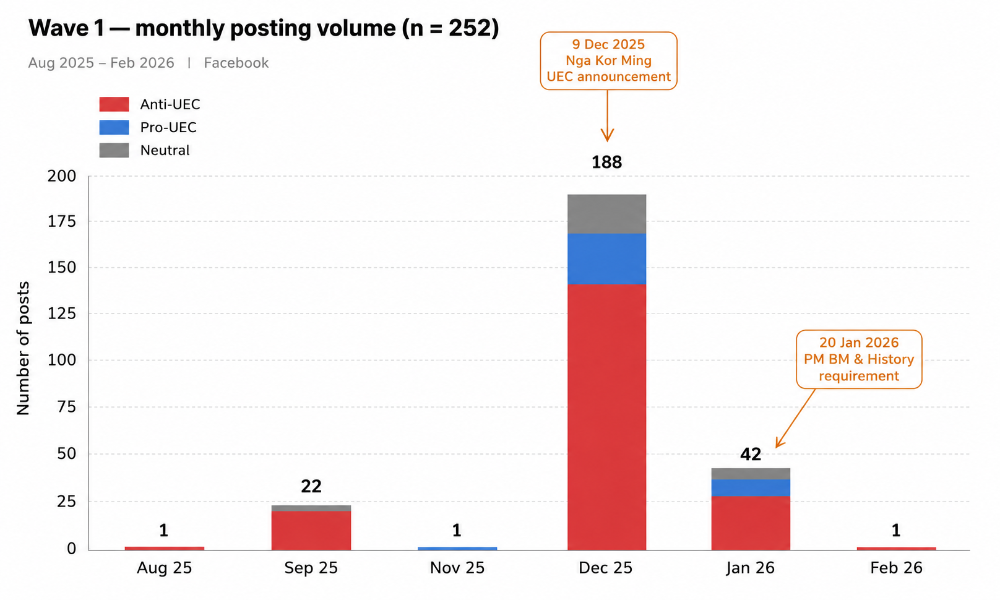
The first wave followed Nga’s renewed push for UEC recognition in December 2025 and generated 252 posts.
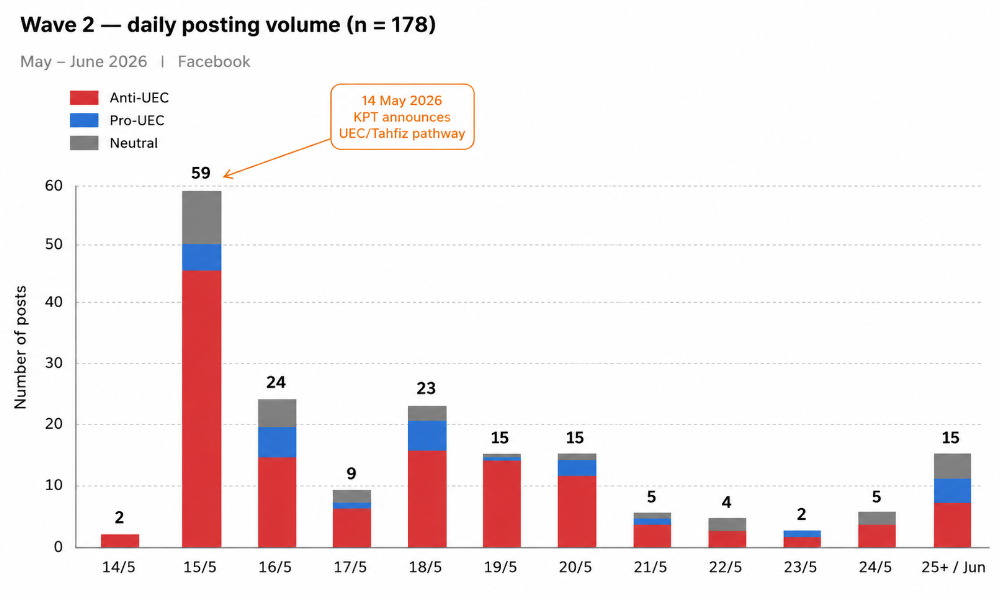
The second followed the Higher Education Ministry’s announcement in May 2026 that UEC and tahfiz graduates could apply to public universities through a pathway requiring credits in SPM BM and History, generating a further 178 posts.
Posts were identified using keywords such as “UEC”, “Dong Zong”, and “tolak UEC” to capture discussion from both supporters and opponents. Each post was manually coded as anti-UEC, pro-UEC, or neutral before undergoing AI-assisted narrative analysis to identify recurring themes and arguments.
Although triggered by different events and separated by several months, both waves produced broadly similar distributions of opinion.
In the first wave, 75.4 percent of posts opposed UEC recognition, while 14.3 percent supported it. In the second wave, anti-UEC content accounted for 71.3 percent, compared with 12.9 percent supporting recognition.

The same voices keep returning
One of the analysis’ most striking findings was how often the same actors reappeared.
Twenty-four individuals, organisations, and media platforms were active in both waves despite the controversies being separated by several months and triggered by different events.
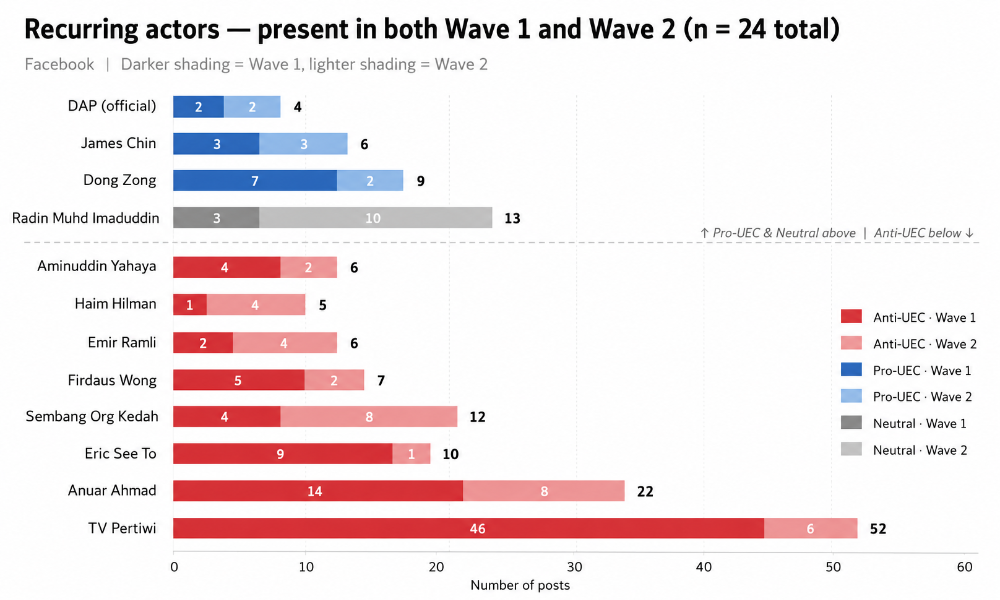
Among them, TV Pertiwi emerged as the single most prolific actor in the dataset. The platform published 46 posts during the first wave and another six during the second, making it one of the few voices to maintain a sustained presence across both periods.
TV Pertiwi is led by chief executive Firdaus Salleh Huddin, a commentator associated with the Muslim advocacy movement Ikatan Muslimin Malaysia (Isma).
Responding to Malaysiakini’s findings, Firdaus argued that the recurring controversy reflects the government’s reluctance to take a definitive position on the issue.
“So long as the government does not dare make a final decision on this issue, it will never be resolved,” he said, adding that public pressure often drives official responses.

Beyond TV Pertiwi, the anti-UEC ecosystem brought together a mix of activists, academics, commentators, and political actors.
Recurring figures included Aminuddin Yahaya, Ridhuan Tee Abdullah, Anuar Ahmad, and Eric See-To, alongside a network of political and community-based Facebook pages.
PAS and Perikatan Nasional-linked voices were particularly prominent throughout both waves, suggesting that opposition to the UEC is not sustained by a single organisation but by a broader network that repeatedly activates around the issue.
The pro-UEC coalition is noticeably smaller and more concentrated. Its most visible participants include DAP leaders such as Teo Nie Ching, political analyst James Chin, and Dong Zong - the umbrella body for Chinese independent schools and administrator of the UEC examination.
Unlike the anti-UEC camp, which draws on a wide network of commentators and advocacy-linked actors, pro-UEC mobilisation is more concentrated among political figures and Chinese education organisations.
This concentration reflects the scope of the dataset, which is limited to BM- and English-language Facebook posts and does not systematically sample Chinese-language discourse.
Not really about education
At first glance, the UEC appears to be a debate about educational qualifications.
Issued by Chinese independent secondary schools, the certificate is recognised by universities in countries including Singapore, Australia, the United Kingdom, Taiwan, and China.
Yet education policy occupied only part of the discussion.
Among anti-UEC actors, the most common themes revolved around race and ethnicity, the BM language, electoral politics, constitutional concerns, and national unity.
Pro-UEC actors focused more heavily on education rights, mother-tongue education, institutional recognition, equality, and government commitments, often framed through promises of policy consistency and equal access.
Pro-UEC actors focused more heavily on education rights, mother-tongue education, institutional recognition, equality, and government commitments, often framed through promises of policy consistency and equal access.
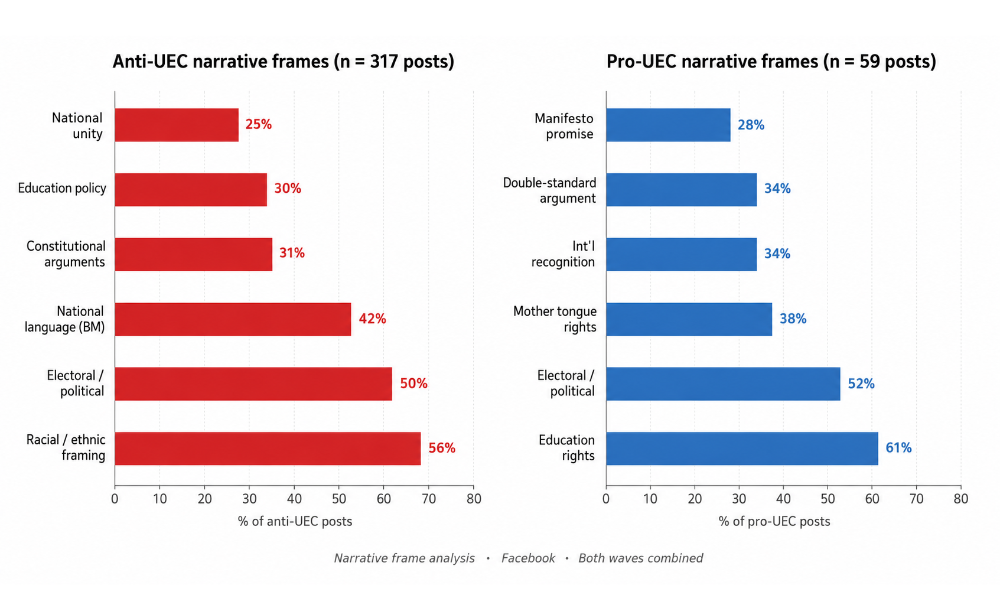
Opponents tend to frame UEC as an issue of national identity and integration, while supporters frame it as a question of fairness, recognition, and minority rights.
Electoral framing appears frequently across both camps, suggesting that political considerations cut across the debate rather than belonging to one side alone.
Anti-UEC actors often portray the qualification as part of DAP’s political agenda or an appeal to Chinese voters, while supporters frame recognition as a matter of honouring manifesto commitments and government promises.
Taken together, these patterns suggest that the UEC functions less as a technical education issue than as a proxy for broader debates about identity, representation, and nationhood.
Why do these debates keep returning?
If the UEC has become more symbolic than practical, why does it continue to resurface?
Chin argued that the certificate occupies a symbolic position in the Chinese Malaysian community, closely tied to the preservation of Chinese-language education.
Although only a relatively small proportion of students sit for the examination, its significance extends beyond those directly affected.
For many supporters, recognition is no longer primarily about educational access but about cultural and political identity within Malaysia’s multicultural framework.
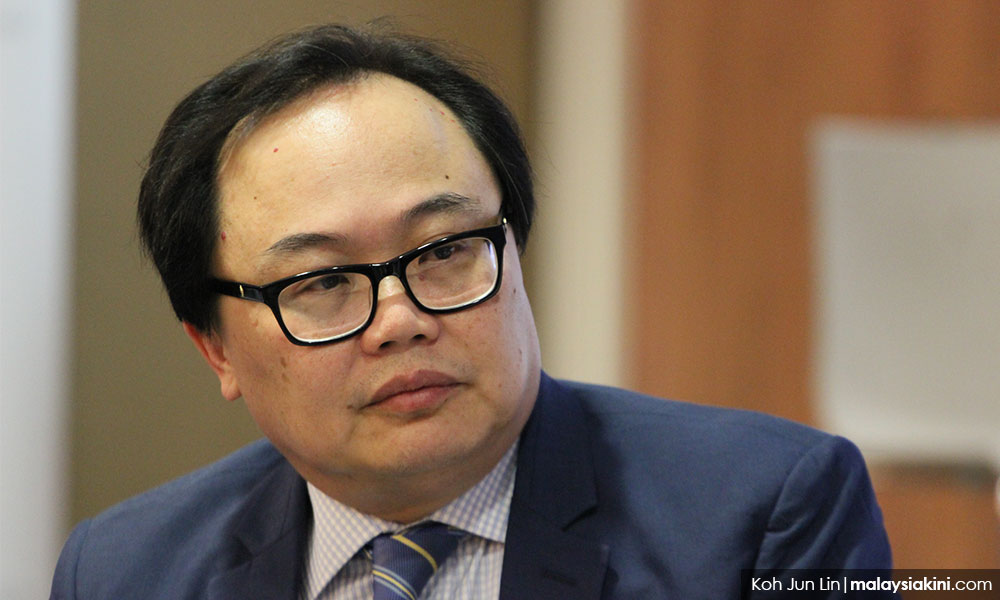
Political analyst James Chin
“This is really an issue of Chinese Malaysian identity and political recognition of minorities,” Chin said.
Political analyst Mazlan Ali offered a complementary explanation, pointing to the gap between policy arrangements and political perception.
From a policy perspective, he noted that successive governments have created pathways for UEC graduates to access public universities, teacher training institutes, and parts of the civil service through requirements such as SPM BM and History.
“The solution has actually been there for some time,” he said.
However, Mazlan argued that these arrangements have not reduced controversy because the issue is frequently interpreted through the lens of identity, integration, and nation-building.
“When people hear UEC, many automatically view it negatively. They see it as something separate from the national system,” he said.
He added that the controversy endures because the issue has become politically useful to competing actors.
“This is really an issue of Chinese Malaysian identity and political recognition of minorities,” Chin said.
Political analyst Mazlan Ali offered a complementary explanation, pointing to the gap between policy arrangements and political perception.
From a policy perspective, he noted that successive governments have created pathways for UEC graduates to access public universities, teacher training institutes, and parts of the civil service through requirements such as SPM BM and History.
“The solution has actually been there for some time,” he said.
However, Mazlan argued that these arrangements have not reduced controversy because the issue is frequently interpreted through the lens of identity, integration, and nation-building.
“When people hear UEC, many automatically view it negatively. They see it as something separate from the national system,” he said.
He added that the controversy endures because the issue has become politically useful to competing actors.
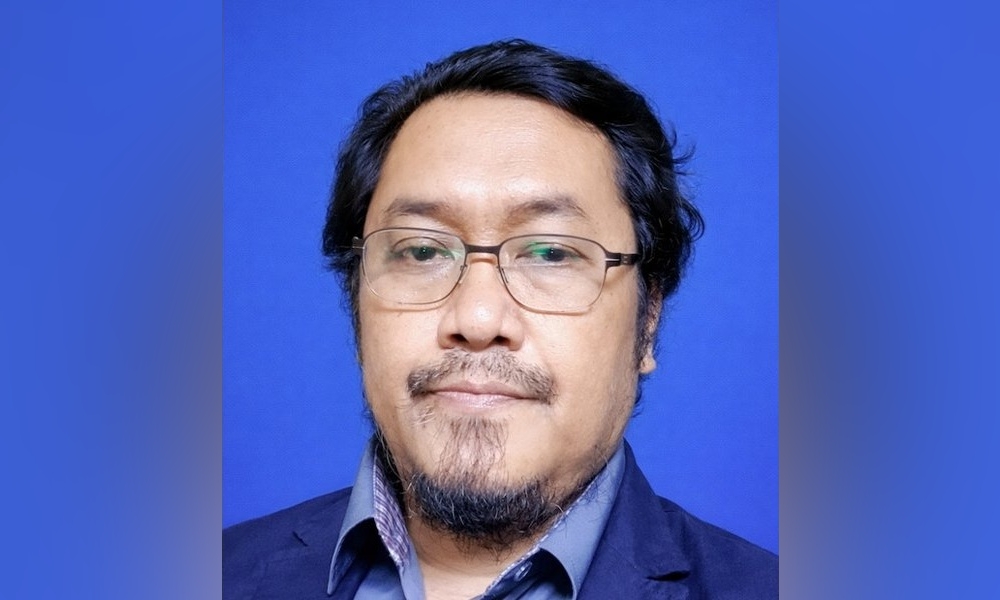
Political analyst Mazlan Ali
“The UEC has become a label that can be used to mobilise nationalism, identity, and ideas about nation-building,” Mazlan said.
“So long as political actors continue to use the UEC for political purposes, the issue will continue to resurface.”
At the centre of identity politics
Across BM and English Facebook discourse, the same actors reappear, familiar narratives resurface, and similar political framings are repeatedly mobilised across different moments of debate.
Within these networks, the UEC functions less as a technical education issue than as a recurring site of political and identity contestation.
While framing in other linguistic communities may place different emphasis on education policy or institutional recognition, the findings show how the issue is articulated within Malaysia’s BM- and English-language political networks, where it most consistently intersects with debates over identity, representation, and nationhood.
As long as these broader questions remain politically salient, the UEC is likely to remain a recurring source of controversy despite changes in policy.
“The UEC has become a label that can be used to mobilise nationalism, identity, and ideas about nation-building,” Mazlan said.
“So long as political actors continue to use the UEC for political purposes, the issue will continue to resurface.”
At the centre of identity politics
Across BM and English Facebook discourse, the same actors reappear, familiar narratives resurface, and similar political framings are repeatedly mobilised across different moments of debate.
Within these networks, the UEC functions less as a technical education issue than as a recurring site of political and identity contestation.
While framing in other linguistic communities may place different emphasis on education policy or institutional recognition, the findings show how the issue is articulated within Malaysia’s BM- and English-language political networks, where it most consistently intersects with debates over identity, representation, and nationhood.
As long as these broader questions remain politically salient, the UEC is likely to remain a recurring source of controversy despite changes in policy.


No comments:
Post a Comment