
2 hours ago
Ian Aikman
Ian Aikman
Reuters
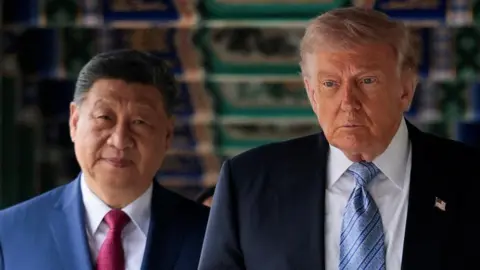
China's President Xi Jinping and Donald Trump discussed Taiwan during bilateral talks in Beijing
US President Donald Trump has said he has "made no commitment either way" on Taiwan during talks with China's President Xi Jinping.
On the flight back to Washington after the two-day summit in Beijing, Trump told reporters the pair had "talked a lot" about Taiwan - a self-governing island, which China claims as part of its territory and has not ruled out taking by force.
Trump said Xi had asked directly if the US would defend Taiwan, and he had responded: "I don't talk about that."
The US president also said he would "make a determination over a fairly short period" on whether to go ahead with previously US announced arms sales to Taiwan which China has condemned.
Taiwan is a long-standing US ally and Washington is bound by law to provide the island with the means to defend itself.
Successive US administrations have walked a diplomatic tightrope by maintaining that relationship alongside building ties with Beijing.
But that balance has been increasingly tested in recent years as China has ramped up military drills around the island, raising tensions in the region, and rattling Washington.
Late last year, the Trump administration announced an $11bn ($8bn) package of weapons to be sold to Taiwan, including advanced rocket launchers and a variety of missiles.
However on Friday, Trump said he would be "making decisions" on the sale, adding that he would speak to Taiwan's President Lai Ching-te first.
"We discussed the Taiwan, you know, the whole thing with the arm sales in great detail," he said, referring to talks with his Chinese host in Beijing.
Xi "feels very strongly" about the island and "doesn't want to see a movement for independence", Trump said.
"I made no commitment either way," Trump added, without elaborating.
"The Taiwan question is the most important issue in China-US relations," Xi warned during the talks, according to Chinese state media.
"If mishandled, the two nations could collide or even come into conflict," he said.
Asked if he foresaw a conflict with China over Taiwan, Trump said: "No, I don't think so. I think we'll be fine. [Xi] doesn't want to see a war."
He added: "On Taiwan, [Xi] does not want to see a fight for independence because that would be a very strong confrontation, and I heard him out.
"I didn't make a comment on it. I heard him out. I had a lot of respect for him."
Reporters also asked Trump if the US would defend Taiwan should it come under attack.
"I don't want to say that. I'm not going to say that," Trump said. "There's only one person that knows that. You know who it is? Me."
He continued: "That question was asked to me today by President Xi... He asked me if I'd defend them. I said, 'I don't talk about that'."
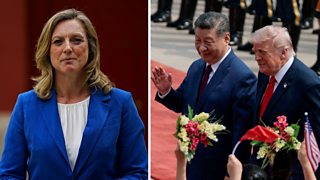
Taiwan's Foreign Minister Lin Chia-lung said his team had been monitoring the US-China summit, and had maintained good communication with the US and other countries "to ensure the stable deepening of Taiwan-US relations and safeguard Taiwan's interests".
He said Taiwan had always been a "guardian of peace and stability" in the region and accused China of escalating risk with its "aggressive military actions and authoritarian oppression".
China's President Xi Jinping and Donald Trump discussed Taiwan during bilateral talks in Beijing
US President Donald Trump has said he has "made no commitment either way" on Taiwan during talks with China's President Xi Jinping.
On the flight back to Washington after the two-day summit in Beijing, Trump told reporters the pair had "talked a lot" about Taiwan - a self-governing island, which China claims as part of its territory and has not ruled out taking by force.
Trump said Xi had asked directly if the US would defend Taiwan, and he had responded: "I don't talk about that."
The US president also said he would "make a determination over a fairly short period" on whether to go ahead with previously US announced arms sales to Taiwan which China has condemned.
Taiwan is a long-standing US ally and Washington is bound by law to provide the island with the means to defend itself.
Successive US administrations have walked a diplomatic tightrope by maintaining that relationship alongside building ties with Beijing.
But that balance has been increasingly tested in recent years as China has ramped up military drills around the island, raising tensions in the region, and rattling Washington.
Late last year, the Trump administration announced an $11bn ($8bn) package of weapons to be sold to Taiwan, including advanced rocket launchers and a variety of missiles.
However on Friday, Trump said he would be "making decisions" on the sale, adding that he would speak to Taiwan's President Lai Ching-te first.
"We discussed the Taiwan, you know, the whole thing with the arm sales in great detail," he said, referring to talks with his Chinese host in Beijing.
Xi "feels very strongly" about the island and "doesn't want to see a movement for independence", Trump said.
"I made no commitment either way," Trump added, without elaborating.
"The Taiwan question is the most important issue in China-US relations," Xi warned during the talks, according to Chinese state media.
"If mishandled, the two nations could collide or even come into conflict," he said.
Asked if he foresaw a conflict with China over Taiwan, Trump said: "No, I don't think so. I think we'll be fine. [Xi] doesn't want to see a war."
He added: "On Taiwan, [Xi] does not want to see a fight for independence because that would be a very strong confrontation, and I heard him out.
"I didn't make a comment on it. I heard him out. I had a lot of respect for him."
Reporters also asked Trump if the US would defend Taiwan should it come under attack.
"I don't want to say that. I'm not going to say that," Trump said. "There's only one person that knows that. You know who it is? Me."
He continued: "That question was asked to me today by President Xi... He asked me if I'd defend them. I said, 'I don't talk about that'."
Taiwan's Foreign Minister Lin Chia-lung said his team had been monitoring the US-China summit, and had maintained good communication with the US and other countries "to ensure the stable deepening of Taiwan-US relations and safeguard Taiwan's interests".
He said Taiwan had always been a "guardian of peace and stability" in the region and accused China of escalating risk with its "aggressive military actions and authoritarian oppression".


Smart Move.
ReplyDeleteThe final image of the 2026 Beijing summit isn’t a handshake; it’s a trash bin. As the U.S. delegation prepared to board Air Force One, American staff systematically collected every item handed out by Chinese officials—including credentials, pins, and burner phones—and discarded them in a bin at the bottom of the stairs. The message was unmistakable: nothing from China was allowed to cross the threshold of the President's plane.
This "digital purge" is the direct result of a total lack of trust. The U.S. delegation operated under a strict digital lockdown for the entire trip, treating every hotel Wi-Fi connection and provided device as a potential Trojan horse for CCP surveillance. By trashing the equipment before takeoff, the White House signaled that while trade deals can be signed, the security threat posed by Beijing’s cyber-espionage remains as active as ever.
In the high-stakes world of 2026 geopolitics, diplomacy and paranoia are now inseparable. The CCP wants to be treated as a global partner, but the U.S. response shows they are still viewed as a primary intelligence threat. While the cameras caught the smiles in the Great Hall, the real relationship was defined by the security teams ensuring that not a single piece of Chinese hardware made it back to Washington.
https://x.com/unveiled_chinax/status/2055274128912052695?s=46&t=8K6fzabO3g6uaj4KxwSSjg
wakakakaka… wounded pride darts about syiok-sendiri egoistic theme of oneupmanship!
Delete